
GAZ-Sadko
Specs, engines and history
Updated Published Sources (2) Report an error
By Felix Hartmann, Automotive Technology & EV Contributor

- Built
- 1997
- Top power
- 99 kW (135 PS)
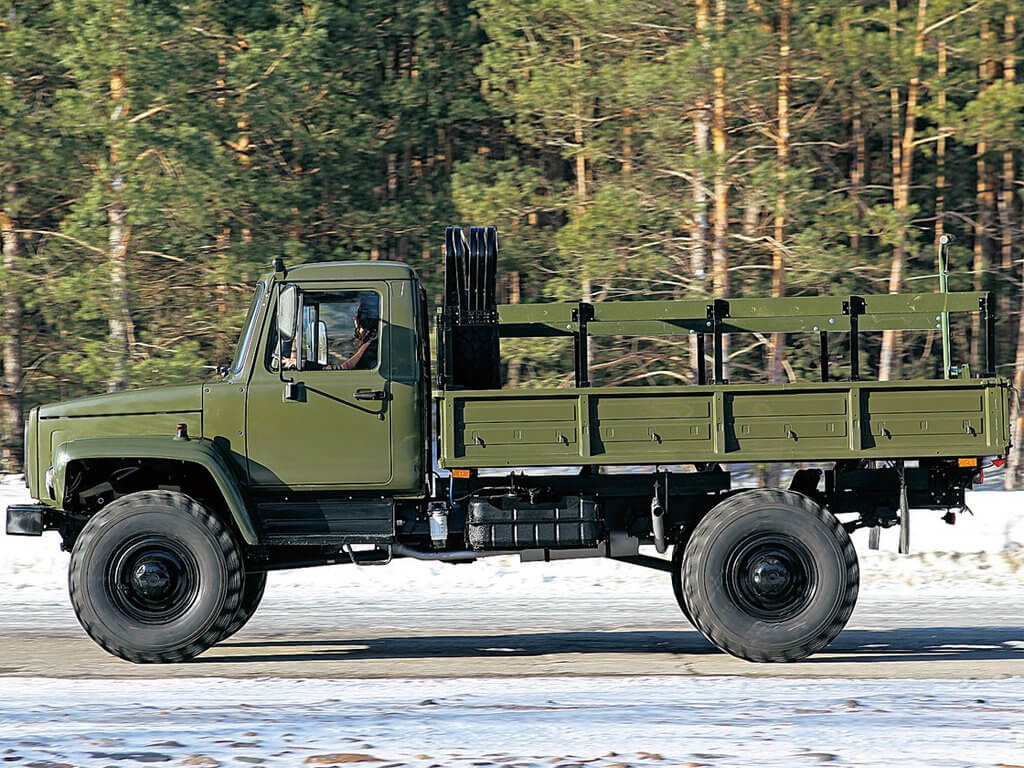
The GAZ-3308 Sadko is a 2.5-tonne four-wheel-drive truck built by GAZ since December 1997 as the successor to the GAZ-66. It combines the cab of the GAZ-3309 with an all-wheel-drive chassis derived from the GAZ-66, about 315 mm of ground clearance and petrol or diesel engines. The Sadko NEXT, presented in 2014, is its modern successor.
In short
- Development began in the late 1980s; the first GAZ-33097 prototype ran in 1995 and series production started in December 1997.
- Engines: ZMZ-5231 V8 petrol with 91 kW (124 PS), MMZ D-245.7 diesel with 86–88 kW (117–119 PS) and YaMZ-53442 diesel with 99 kW (134.5 PS).
- Running gear: 4x4 with a two-speed transfer case and limited-slip differentials from the GAZ-66, leaf springs on both axles.
- Variants include the 4-tonne Zemlyak, crew buses, the Vepr off-roader and military versions.

Specs by version
Performance
Show all 1 versions
| Version | Top speed | Fuel consumption |
|---|---|---|
| 4.4 99 kW (135 PS) Truck | 93 km/h58 mph | 16.8 l/100 km14.0 mpg US · 16.8 mpg UK |
Verified Manufacturer and type-approval data from our catalog · Sources and methodology
GAZ-3308 Sadko at a glance: maker, years and purpose
The Sadko is a medium four-wheel-drive truck for rough-terrain transport: utilities, forestry, geology, agriculture, rescue services and armed forces. It is named after Sadko, a merchant hero of medieval epic songs (bylinas). Unlike its cab-over predecessor, the GAZ-66, the Sadko has a bonneted layout with the cab of the road-going GAZ-3307/3309 family, which made it easier to service and more comfortable for the crew.

The road-going sister models are the GAZ-3307 and GAZ-3309, and the wider story of the maker is told in the history of GAZ.
From the GAZ-66 to the Sadko NEXT
GAZ began work on a successor to the GAZ-66 in the late 1980s. The GAZ-66, built for about 35 years from 1964 to 1999, was the standard light military truck of its era. The new design took the GAZ-66-40's drive axles and transmission, added the bonneted cab of the GAZ-3309 with enlarged wheel arches, and raised the payload by 500 kg to 2.5 tonnes.

The first prototype, the GAZ-33097, appeared in 1995, and series production of the GAZ-3308 began in December 1997. From 2003 most trucks used the MMZ D-245.7 diesel, which met Euro 2 from 2005 and was replaced by the Euro 4 D-245.7E4 in 2013. The GAZ-66 left production in 1999, and in June 2014 GAZ presented the Sadko NEXT with a modern cab and a 3-tonne payload.
| Year | Event |
|---|---|
| Late 1980s | Work begins on a GAZ-66 successor |
| 1995 | First prototype, GAZ-33097 |
| December 1997 | Series production of the GAZ-3308 Sadko |
| 1999 | GAZ-66 production ends |
| 2001–2006 | SemAR-3257 and KAvZ-39766 all-terrain buses on the Sadko chassis |
| 2003 | MMZ D-245.7 diesel becomes the main engine |
| 2013 | Euro 4 D-245.7E4 diesel |
| 2014 | Sadko NEXT presented |
How the Sadko is built: chassis, cab and body
The Sadko uses a two-axle ladder frame with rigid axles on longitudinal semi-elliptic leaf springs and double-acting hydraulic shock absorbers on all wheels. Drive goes through a single-plate dry clutch, a five-speed manual gearbox (four-speed on early petrol trucks) and a two-speed transfer case to both axles, which have limited-slip differentials inherited from the GAZ-66. Sources differ on whether central tyre inflation was standard: it is listed as standard on many versions but was missing from some civilian trucks.

Ground clearance is about 315 mm (12.4 in) for the civilian Sadko and 335 mm (13.2 in) for military versions, and the truck can climb gradients of up to 31 degrees. Steering is a recirculating-ball unit with hydraulic power assistance. The brakes are hydraulic drums with two circuits, hydro-vacuum boosters and a vacuum receiver on each circuit, ABS on later trucks and a transmission parking brake.
The two-seat cab is shared with the GAZ-3307/3309 family. It is simple but roomy, with a utilitarian dashboard whose gauges no longer hide behind the steering wheel and an optional adjustable driver's seat. Getting in is awkward, because the cab sits high and the factory fitted no proper grab handles. The diesel GAZ-33081 was also offered with a double cab with two or four doors; in the two-door version the rear bench can be replaced by two berths for repair crews working in remote areas. The standard body is a steel dropside platform with optional hoops and canvas, and the chassis carries vans, workshops, tankers, crew buses and fire engines.
Engines and drivetrain by period
- ZMZ-5231 petrol V8, 4.67 L (285 cu in): about 91 kW (124 PS) and 298 Nm (220 lb-ft); base GAZ-3308.
- GAZ-562 turbo-diesel, built under licence from Steyr: early GAZ-33082.
- MMZ D-245.7 turbo-diesel, 4.75 L (290 cu in): 86 kW (117 PS) and 382 Nm (282 lb-ft) in the GAZ-33081; the D-245.7E3 gives 88 kW (119 PS) and 420 Nm (310 lb-ft).
- YaMZ-53442 turbo-diesel, 4.43 L (270 cu in): 99 kW (134.5 PS) and 417 Nm (308 lb-ft), Euro 4, in the GAZ-33088.
The D-245.7 diesel with the five-speed gearbox gives a top speed of about 93 km/h (58 mph) and uses around 16.8 L/100 km (14.0 mpg US).

GAZ-3308 Sadko specifications
The table combines Wikipedia data with earlier factory figures; individual versions differ.

| Parameter | Metric | Imperial |
|---|---|---|
| Drive | 4x4, two-speed transfer case | – |
| Payload | 2,500 kg | 5,512 lb |
| Engines | 4.67 L V8 petrol; 4.43–4.75 L turbo-diesels | 270–290 cu in |
| Power | 86–99 kW (117–134.5 PS) | – |
| Gearbox | 4- or 5-speed manual | – |
| Ground clearance | 315 mm (335 mm military) | 12.4 (13.2) in |
| Maximum gradient | 31° | – |
| Top speed (D-245.7) | about 93 km/h | 58 mph |
| Fuel use (D-245.7) | about 16.8 L/100 km | 14.0 mpg US |
| Vepr (330811-10): length / width / height | 6,347 / 2,340 / 2,595 mm | 249.9 / 92.1 / 102.2 in |
| Vepr kerb / gross weight | 4,150 / 6,450 kg | 9,149 / 14,220 lb |
GAZ-3308 variants and derivatives
| Variant | Years | Body / purpose | Engine | Notes |
|---|---|---|---|---|
| GAZ-3308 | 1997– | 4x4 cargo truck | ZMZ-5231 V8 petrol | Base model |
| GAZ-33081 | – | 4x4 cargo truck | MMZ D-245.7 diesel | Main diesel version |
| GAZ-33082 | – | 4x4 cargo truck | GAZ-562 diesel | Steyr-licensed engine |
| GAZ-33085 / 33086 Zemlyak | – | 4-tonne truck | diesel | Twin rear wheels, lower off-road ability |
| GAZ-33088 | 2013– | 4x4 cargo truck | YaMZ-53442 diesel | Euro 4 |
| GAZ-330811-10 Vepr | – | Short-chassis off-roader | diesel | 3- or 5-door body |
| KAvZ-39766 | 2003–2005 | 19-seat all-terrain bus | ZMZ-513 or D-245.7 | Built by KAvZ |
| SemAR-3257 | 2001–2006 | 12-seat all-terrain bus | ZMZ-513 | Small series |
The Sadko was adopted as a military truck by several armed forces; export users include the Philippines, Bolivia, Cambodia, Laos and Lebanon.

Sadko strengths and weaknesses
The Sadko's strengths are off-road ability and simplicity: high ground clearance, limited-slip differentials, low gearing and a robust frame let it go where road trucks cannot, and its engines and cab share parts with the GAZ-3307/3309. The diesel versions are far more economical than the V8 petrol.

Its weaknesses are a basic cab, high noise levels, a modest 2.5-tonne payload and drum brakes. Owners also note that the truck is frequently overloaded, which shortens the life of springs and axles.
Buying and preserving a GAZ-3308 Sadko today
Many Sadkos come from state, utility and military fleets. When inspecting one, check:
- Frame, cab mounts and floor for corrosion.
- Leaf springs and shackles, often worn by overloading.
- Transfer case operation and noises from the axles under load.
- Diesel condition: starting from cold, smoke and oil leaks.
- Tyre inflation system, if fitted.

Other GAZ vehicles, including the GAZ Sobol 4x4 van, are listed in the GAZ catalogue.
Rivals
Compare with…
Compare GAZ-Sadko with
- KamAZ-4326 quick spec comparison
-
In production
- Years
- 1995–present
- Body
- Truck
- Fuel
- Diesel
- Power
- 177 kW (241 PS)

GAZ-Sadko in our rankings
Faster than 76% of ranked trucks in the 1CARS catalog (No. 5 of 21).
GAZ-Sadko photos 16




GAZ-Sadko videos 4

GAZ-Sadko video 1

GAZ-Sadko video 2

GAZ-Sadko video 3

GAZ-Sadko video 4
FAQ
When was the GAZ-3308 Sadko produced?
Series production started in December 1997, after a first prototype in 1995. The Sadko replaced the GAZ-66 and was followed by the Sadko NEXT, presented by GAZ in June 2014.
What engine does the GAZ Sadko have?
The base truck uses a 4.67-litre ZMZ-5231 V8 petrol engine with about 91 kW (124 PS). Most trucks since 2003 use the 4.75-litre MMZ D-245.7 diesel with 86–88 kW, and the GAZ-33088 a YaMZ-53442 diesel with 99 kW.
What is the payload of the GAZ-3308 Sadko?
The Sadko carries 2.5 tonnes, 500 kg more than the GAZ-66. The related Zemlyak versions with twin rear wheels carry 4 tonnes, and the Sadko NEXT carries 3 tonnes.
What is the ground clearance of the GAZ Sadko?
Ground clearance is about 315 mm for civilian trucks and 335 mm for military versions. Together with four-wheel drive and limited-slip differentials, this lets the Sadko climb gradients of up to 31 degrees.
What variants of the GAZ-3308 were made?
Variants include the diesel GAZ-33081 and GAZ-33088, the 4-tonne Zemlyak, the short Vepr off-roader and all-terrain buses such as the KAvZ-39766 and SemAR-3257, plus many special bodies.
Data sources
Data checked by an editor against the sources below.
- The text of this article (1cars archive)
- Wikipedia - GAZ 3308


