
 GAZ GAZon Next
Specs, engines and history
Updated Published Sources (2) Report an error
By Felix Hartmann, Automotive Technology & EV Contributor

- Built
- 2014–present
- Top power
- 112 kW (152 PS)
The GAZon Next is a two-axle 4x2 medium-duty truck built by GAZ in Russia, with series production starting on 19 September 2014. It replaced the long-running GAZ-3307, uses a 4.43-litre YaMZ-534 turbo diesel rated at 109.5 kW (149 PS) and carries a payload of about 5 tonnes on a gross vehicle weight of 8.7 tonnes.
In short
- A two-axle 4x2 truck with front engine and rear-wheel drive, in series production since 19 September 2014.
- Powered by the YaMZ-534 four-cylinder turbo diesel, 4,430 cc (270.3 cu in), 109.5 kW (149 PS) and 490 N·m (361 lb-ft).
- Payload of about 5 t on a gross vehicle weight of 8,700 kg (19,180 lb), with a three-seat or seven-seat cab.
- Successor to the GAZ-3307 and GAZ-3309; the four-wheel-drive member of the family is the separate Sadko Next.

Specs by version
| Version | Engine | Power | Drive |
|---|---|---|---|
| 4.4 YaMZ-534 110 kW (150 PS) Truck | 4.4 l · Diesel YaMZ-534 | 110 kW 150 PS148 hp | Rear-wheel drive |
| 3.8 112 kW (152 PS) Truck | 3.8 l 3,760 cc | 112 kW 152 PS150 hp | - |
Verified Manufacturer and type-approval data from our catalog · Sources and methodology
GAZon Next at a glance
The GAZon Next is GAZ's medium truck for regional distribution, municipal work and general haulage, positioned above the light vans and below heavy trucks. GAZ Group launched it as the replacement for the GAZ-3307 family, which had been in production since 1989, and as the heavier partner to the GAZelle Next light commercial range unveiled earlier in 2014.

The basic truck has two axles and a 4x2 drivetrain: the engine sits at the front, under a conventional cab, and drives the rear axle. That point matters because catalogue listings sometimes describe the GAZon Next as four-wheel drive. Only the Sadko Next, a separate member of the family, has a driven front axle.
The truck is sold as a chassis or with a flatbed, and a long list of factory and converter bodies has been built on it. GAZ itself speaks of more than 300 model variants, a figure that counts combinations of cab, wheelbase, body and equipment rather than different trucks.
From GAZ-3307 to GAZon Next
The GAZon Next was developed to replace a design whose roots went back several decades. The GAZ-3307 entered series production in 1989, and its chassis and engine layout were derived from the earlier GAZ-53. The diesel GAZ-3309 followed in late 1994. Encyclopaedic sources put GAZ-3307 output at more than 1.5 million trucks over 31 years.

GAZ Group announced the new truck in 2014, after the GAZelle Next van, and series production of the GAZon Next began on 19 September 2014, according to a launch report published the same day. GAZ named Eastern Europe, Asia and Africa as export targets. The first export market was Georgia: on 15 December 2014 GAZ Group announced the start of sales there, with the GAZon Next and its YaMZ-534 diesel in the line-up.
The family was meant to grow quickly. A trade report on the launch said the off-road Sadko Next would follow in 2015 as the four-wheel-drive version. For several years the old and new trucks were built side by side, until GAZ-3307 and GAZ-3309 production ended in January 2020.
| Year | Event |
|---|---|
| 1989 | GAZ-3307 enters series production |
| Late 1994 | GAZ-3309 diesel version enters production |
| 2014 | GAZ Group announces the GAZon Next, after the GAZelle Next van |
| 19 September 2014 | Series production of the GAZon Next begins |
| December 2014 | First export sales announced, in Georgia |
| 2015 | Four-wheel-drive Sadko Next scheduled to join the family |
| January 2020 | GAZ-3307 and GAZ-3309 production ends |
Cab, frame and suppliers
The GAZon Next is a frame-type truck with the engine at the front, offered as a chassis cab for a wide range of bodies. Two cab sizes are offered. The single-row cab seats three in a 2+1 arrangement, and the double-row crew cab seats seven, which suits municipal crews and utility companies.
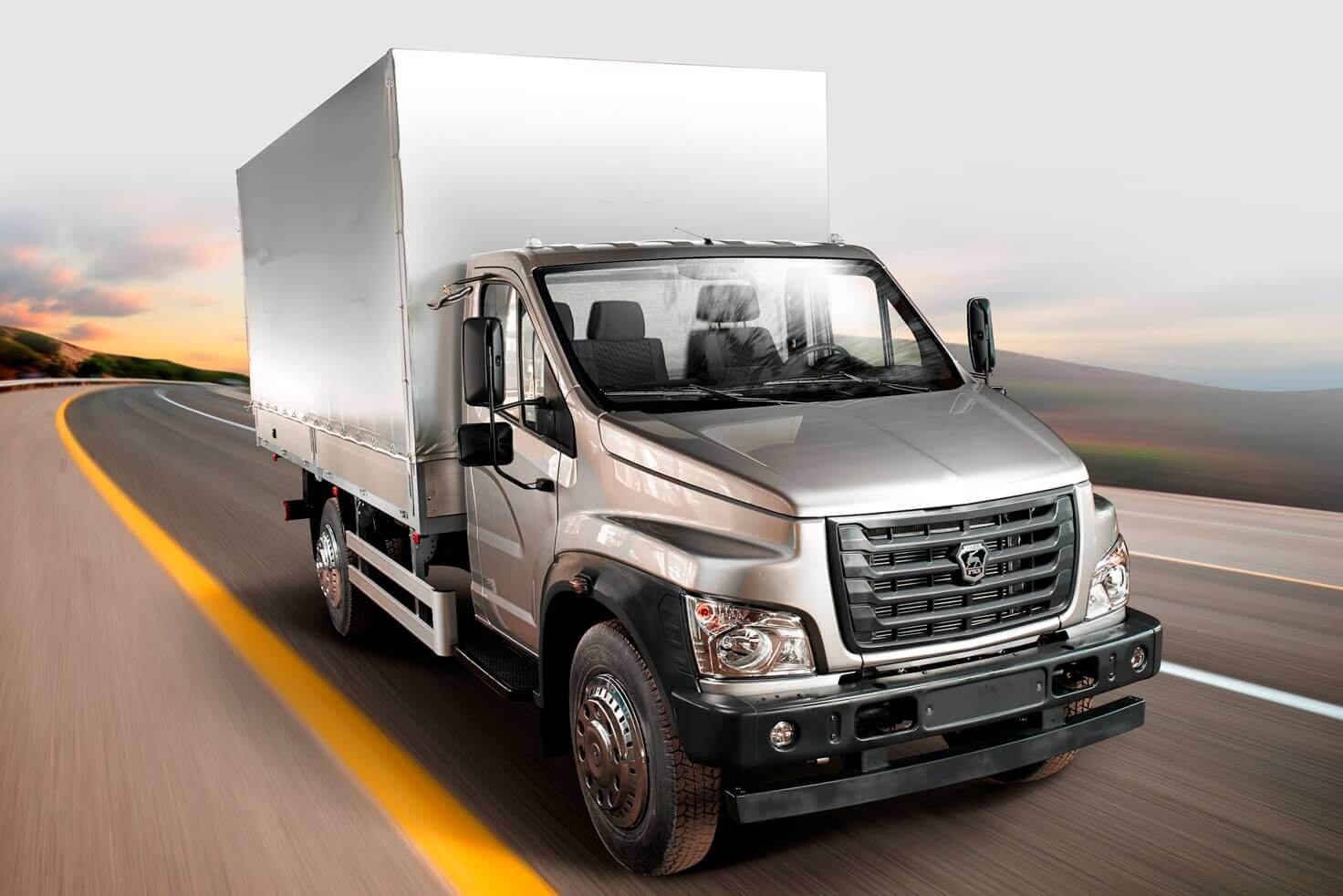
Load space was one of the main targets. GAZ quoted a 20% larger loading area and 42% more volume under the canopy than its previous medium trucks, together with about 500 kg more payload. These are manufacturer comparisons rather than independent measurements.
Much of the hardware came from international suppliers. The launch report lists ZF for the steering and clutch, Tenneco for the shock absorbers, Wabco for braking components, CSA of Castellón for the steering column, Takata for the seat belts and Delphi for the heating and air-conditioning system. Older descriptions that credit the brakes to a different supplier do not match these sources.
Wheelbases, height and the City version
Two wheelbases are listed: 3,770 mm (148.4 in) for the standard truck and 4,515 mm (177.8 in) for the long version, giving overall lengths of 6,450 mm (253.9 in) and 7,195 mm (283.3 in). Height varies between 2,335 and 2,400 mm (91.9 and 94.5 in) with wheel size. The GAZon Next City uses a lower overall height and a lower loading edge, which makes kerbside loading easier in delivery work. It is available on both wheelbases.
The YaMZ-534 diesel and five-speed gearbox
The GAZon Next is powered by the YaMZ-534, a four-cylinder turbocharged diesel from the YaMZ engine plant, listed in German sources as the JaMZ-53441. It displaces 4,430 cc (270.3 cu in) from a bore and stroke of 105 x 128 mm (4.13 x 5.04 in) and has a compression ratio of 17.5:1.

Output is 109.5 kW (149 PS), or about 147 hp, with a maximum torque of 490 N·m (361 lb-ft). The launch report described this as a rise from 136 to 149 PS compared with GAZ's previous models. The engine meets the Euro IV emissions standard.
Power goes to the rear axle through a five-speed manual gearbox. German sources note that first gear is not synchronised, a common arrangement in trucks where first is used mainly for starting off fully loaded or on a gradient. Top speed is quoted as 110 km/h (68.4 mph), and fuel consumption as 18.0 L/100 km (13.1 mpg US / 15.7 mpg imp) at a steady 80 km/h (50 mph). Both figures come from a single source family, so they are best treated as reference values rather than certified test results.
Some catalogues also list a 3.8-litre Cummins diesel for this truck. That engine is documented for the earlier GAZ-3307 family, but no source used here confirms it for the GAZon Next, so it is not included.
GAZon Next specifications
The table covers the standard short-wheelbase GAZon Next with the YaMZ-534 engine. The dimensions and weights come mainly from one encyclopaedic source family; engine type, power and payload are confirmed independently by the 2014 launch report.

| Parameter | Metric | Imperial |
|---|---|---|
| Production | From 19 September 2014 | From 19 September 2014 |
| Layout | 4x2, front engine, rear-wheel drive | 4x2, front engine, rear-wheel drive |
| Engine | YaMZ-534 (JaMZ-53441) I4 turbo diesel, 4,430 cc | YaMZ-534 (JaMZ-53441) I4 turbo diesel, 270.3 cu in |
| Bore x stroke | 105 x 128 mm | 4.13 x 5.04 in |
| Compression ratio | 17.5:1 | 17.5:1 |
| Maximum power | 109.5 kW (149 PS) | 109.5 kW (147 hp) |
| Maximum torque | 490 N·m | 361 lb-ft |
| Emissions standard | Euro IV | Euro IV |
| Gearbox | 5-speed manual | 5-speed manual |
| Wheelbase | 3,770 mm (long: 4,515 mm) | 148.4 in (long: 177.8 in) |
| Length | 6,450 mm (long: 7,195 mm) | 253.9 in (long: 283.3 in) |
| Width over mirrors | 2,755 mm | 108.5 in |
| Height | 2,335–2,400 mm | 91.9–94.5 in |
| Track | 1,740 mm | 68.5 in |
| Kerb weight | 3,930 kg | 8,664 lb |
| Gross vehicle weight | 8,700 kg | 19,180 lb |
| Payload | 4,870 kg (about 5 t claimed by GAZ) | 10,736 lb |
| Turning circle | 16.4 m | 53.8 ft |
| Top speed | 110 km/h | 68.4 mph |
| Fuel consumption at 80 km/h | 18.0 L/100 km | 13.1 mpg US / 15.7 mpg imp |
| Cab | 3 seats (crew cab: 7 seats) | 3 seats (crew cab: 7 seats) |
Payload figures vary with body and market. The data sheet gives 4,870 kg, GAZ spoke of about 5 tonnes at launch, and some export listings show lower values, so the exact figure for a given truck depends on its body and equipment. Ground-clearance figures also differ between sources and are not quoted here.
GAZon Next variants and the Sadko Next
The GAZon Next family is built around one cab design, two wheelbases and two cab sizes, with the City and the four-wheel-drive Sadko Next as distinct branches. Factory codes such as C41R13 and C42R33 identify the configurations, although the codes are not used consistently across sources.

| Variant | Years | Body / purpose | Engine | Notes |
|---|---|---|---|---|
| GAZon Next (C41R13) | From 2014 | Single cab, short wheelbase, flatbed or chassis | YaMZ-534, 109.5 kW (149 PS) | Base model, 3,770 mm wheelbase |
| GAZon Next long (C41R33) | From 2014 | Single cab, long wheelbase | YaMZ-534, 109.5 kW (149 PS) | 4,515 mm wheelbase |
| GAZon Next crew cab (C42R33) | From 2014 | Double cab, seven seats, long wheelbase | YaMZ-534, 109.5 kW (149 PS) | For work crews |
| GAZon Next City | From 2014 | Lower height and loading edge, both wheelbases | YaMZ-534, 109.5 kW (149 PS) | Urban delivery |
| Special bodies | From 2014 | Refrigerated, tarpaulin, refuse, municipal and winter-service bodies | YaMZ-534, 109.5 kW (149 PS) | Built on the chassis |
| Sadko Next | Scheduled for 2015 | Four-wheel-drive version | Not stated in sources | Successor to the GAZ-3308 |
| GAZ-3307 / GAZ-3309 | 1989–2020 / 1994–2020 | Predecessors | Petrol V8 / diesel | Built alongside the Next until 2020 |
Sadko Next: the four-wheel-drive branch
The Sadko Next is the all-wheel-drive member of the family and the successor to the GAZ-3308, which belongs to the GAZ-Sadko line. It carries the Next name with a driven front axle and deserves a separate page. Specifications for it are not given here, because the sources consulted describe it only in outline.
In service: operation, warranty and legacy
The GAZon Next was designed for the everyday work its predecessors did: deliveries, municipal services, utilities and small-business haulage. At launch GAZ offered a warranty of three years or 150,000 km (93,206 miles) and quoted service intervals of up to 20,000 km (12,427 miles), both company figures.

Independent reliability data is not available. No published owner surveys, fleet statistics or recall records were found for the GAZon Next in the English and German sources used for this page, so it makes no claims about durability. What the record does show is a production run from 2014 and a broad range of bodies built on the chassis.
The truck also carries on a name. GAZ's medium trucks have been nicknamed "GAZon" for generations, a line that includes the GAZ-52, the GAZ-53 and the 3307 family. Readers interested in the wider story of the company can turn to GAZ company history, and the GAZ-Valday is another GAZ medium truck covered on this site. The truck is also listed among other trucks and all GAZ models.
Rivals
Compare with…
Compare GAZ GAZon Next with
- KamAZ-4308 quick spec comparison
- ZIL-5301 quick spec comparison
-
Ended 2003
- Years
- 2003
- Body
- Truck
- Fuel
- Diesel
- Power
- 103–180 kW (140–245 PS)


GAZ GAZon Next in our rankings
More powerful than 21% of ranked trucks in the 1CARS catalog (No. 43 of 56).
GAZ GAZon Next photos 25


GAZ GAZon Next videos 6

GAZ GAZon Next video 1

GAZ GAZon Next video 2
GAZ GAZon Next video 3

GAZ GAZon Next video 4

GAZ GAZon Next video 5

GAZ GAZon Next video 6
FAQ
What is the GAZon Next?
The GAZon Next is a two-axle 4x2 medium-duty truck made by GAZ, in series production since 19 September 2014. It has a gross vehicle weight of 8.7 tonnes, a payload of about 5 tonnes and replaced the GAZ-3307 and GAZ-3309.
What engine does the GAZon Next have?
It uses the YaMZ-534, a 4.43-litre (270.3 cu in) four-cylinder turbo diesel rated at 109.5 kW (149 PS) and 490 N·m (361 lb-ft), meeting Euro IV. Power goes to the rear wheels through a five-speed manual gearbox.
How much can the GAZon Next carry?
GAZ quoted a payload of about 5 tonnes at launch. The German data sheet lists 4,870 kg (10,736 lb) for the standard truck, with a kerb weight of 3,930 kg and a gross vehicle weight of 8,700 kg (19,180 lb).
Is the GAZon Next four-wheel drive?
No. The GAZon Next is a 4x2 with rear-wheel drive. The four-wheel-drive member of the family is the Sadko Next, which succeeds the GAZ-3308. No hybrid or electric GAZon Next is documented in the sources used here.
What is the fuel consumption of the GAZon Next?
The figure usually quoted is 18.0 L/100 km (13.1 mpg US / 15.7 mpg imp) at a steady 80 km/h. Real consumption depends on load, body and route, and no independent test figures were found.
What replaced the GAZ-3307?
The GAZon Next, introduced in 2014, is the successor to the GAZ-3307. The two were built in parallel until the GAZ-3307 and GAZ-3309 went out of production in January 2020.
Data sources
Data checked by an editor against the sources below.
- The text of this article (1cars archive)
- Wikipedia - GAZon NEXT


Comments 8
He eats from 20 and more. 4 pots in total. There would have got a number on the six, so much for the thrust and economy. Another would be disc brakes on the front, but it is sad to look at the last century. This is overweight, and difficulties in replacing the pads, and fuel consumption ... well, and an extra load on the suspension. Because of the short 1st gear, it is very problematic to switch to a mountain on the 2nd. Transmissions are included very tightly, the strength to go right. Speed cruiser edge 80, although allowed by the standard 90 km per hour. It seems the difference is 10 km, but when you go a thousand km, the difference is palpable. If you drive more than 80, then the consumption is more than 20 liters. At 60km an hour, as the manufacturer says, the flow will be 13 liters. Many trucks with a lifting capacity of 10 or more tons consume less. (less than 20 liters per 100 km at a speed of 90 km per hour). So for a million, it's better to take something good than to look at 2 checks every day, which get out all the time. In general, there are 3 checks. You can go, you can go, but you don’t need to, you can’t go. Always working cruise and a lot of old sores in new packaging.
Machine beast appearance I like it for this and not ashamed to work plus a comfortable lounge everything is conveniently located. He normally eats no more than other cars of a similar class and is inexpensive in maintenance. In general, it seems to me that the machine turned out very good.
For a new Shumkov special thanks. The old models of the lawn, by and large, are not bad, but Shumka had to be installed by itself, it was expensive, so besides the main advantages of the neksta, Shumka personally bribes me.
Not very similar to the truth, I have not noticed such an expense with him a maximum of 12-14. And the transfer of his normal switch, I can not even imagine what it means to you tight. For such a price, you will not find a better car, but this one is reliable and comfortable.
I agree with you, the new Shumka is really cool, and I was also pleased with the replacement of the lever with the transmission joystick, it became much more convenient to switch. GAZ generally well done on the spot do not stand developing.
Yes, and a new Nexte compared to the old lawn is just a beast, thanks here not only for Shumka, but in general for a comfortable cabin in which you can relax in comfort and spend 10 hours behind the wheel quietly.
Regarding the expense of a lie of clean water. Same as everyone. But it costs less, and it is cheaper to maintain it. Suspension will last for decades. So the superiority over the more expensive cars is quite noticeable even
I go to distant, so for me the space in the cabin - not an empty phrase. And the lawn has a bed, and I like to rest on the road for an hour, because sometimes it is just necessary. The seats are soft, there is an audio system and a warm stove, Shumka normal.