
GAZ-Valday
Specs, engines and history
Updated Published Sources (2) Report an error
By Oleksandr Hnatiuk, Automotive Editor & Used Car Specialist Reviewed by Felix Hartmann

- Built
- 2004–2015
- Top power
- 112 kW (152 PS)
Who the Valdai suits: verdict
Our verdict · Oleksandr Hnatiuk
The Valdai suits a small carrier who needs more payload than a light van but wants a low, easy-to-load truck for town deliveries. The Cummins-engined GAZ-33106 is the best choice: lighter, more economical and quicker than the MMZ version. Weak points listed by owners in the old 1cars text include occasional electrical faults, a noisy gearbox, a speedometer that can misread and a plain, GAZelle-based cab. Check the brake system, the rear axle and the frame inserts before buying, and use the cost of ownership calculator to compare running costs with a newer truck. More trucks of the brand are in the GAZ catalogue and in the history of GAZ.
The GAZ-3310 Valdai is a medium-duty truck with a low frame, built by GAZ from late 2004 until December 2015. It combines a cab derived from the GAZelle van with the chassis and axles of the GAZ-3307, carries about 4 tonnes at a gross weight of 7,400 kg, and was offered with MMZ and Cummins turbodiesels from about 87 to 112 kW.
In short
- Shown as a prototype in 1999; series production from late 2004 to December 2015, with a 2020 successor called Valdai NEXT.
- Engines: MMZ D-245.7 4.75-litre turbodiesel (about 87 kW / 119 hp, 420 Nm) and Cummins ISF 3.8 (112 kW / 152 hp, 491 Nm); a 3.9-litre Cummins for export.
- Payload about 4 t, gross weight 7,400 kg, wheelbase 3,310 mm or 4,000 mm, low loading height from about 985 mm.
- Main versions: GAZ-33104 (MMZ) and GAZ-33106 (Cummins), plus long-wheelbase, crew-cab, tractor and tipper variants.

Specs by version
Verified Manufacturer and type-approval data from our catalog · Sources and methodology
GAZ Valdai at a glance
The Valdai was GAZ's answer to a gap in its range. The GAZelle van and pick-up, at about 1.5 tonnes, was too small for many small carriers, while the GAZ-3307 was a heavy, high-framed truck from the 1980s. The Valdai filled the space between them with a low-frame distribution truck for town and regional delivery work, easy to load and drivable by anyone with a category C licence.

| Fact | Value |
|---|---|
| Maker | GAZ (Gorkovsky Avtomobilny Zavod) |
| Model code | GAZ-3310 family (33104, 33106 and others) |
| Prototype | 1999 |
| Production | Late 2004 – December 2015 |
| Also assembled | Rokiškis, Lithuania, 2003–2008 |
| Type | Low-frame medium-duty truck, 4x2 |
| Payload | About 4,000 kg |
| Gross weight | 7,400 kg |
| Successor | GAZon NEXT City (2015), Valdai NEXT (2020) |
How the Valdai was developed
According to the old 1cars text, the first prototypes were designed with cabs from the Minsk Automobile Plant, but the supply arrangement ended. GAZ then developed its own cab on the basis of the mass-produced GAZelle cab, with plastic wing extensions, a new grille, a three-piece bumper with a steel centre section and an extra boarding step. A 4-tonne prototype under the Valdai name was shown at a motor show in 1999, and series production began at the end of 2004.

The chassis, suspension and axles come from the GAZ-3307. The rear axle has its roots in the GAZ-53 but uses a much lower final-drive ratio to suit the slow-revving diesel and the smaller wheels. The old 1cars text gives about 2.42 instead of the original 6.83. The frame uses side members whose height varies from 100 mm at the ends to 210 mm in the middle; inserts riveted to the members provide the different wheelbases without separate frames.
Engines: GAZ, MMZ and Cummins
GAZ originally planned to use its own GAZ-562, a licensed Steyr diesel, but this engine was costly and was never produced commercially. According to the old 1cars text, an Iveco 3.9-litre engine was also considered. The production trucks used two main engines.

| Engine | Displacement | Power | Torque | Fitted to |
|---|---|---|---|---|
| GAZ-562 turbodiesel | 3.13 l | about 110 kW (150 hp) | 420 Nm | Planned, not produced commercially |
| MMZ D-245.7E2 / E3 | 4.75 l, inline-four | about 87 kW (119 hp) at 2,400 rpm | 420 Nm at 1,400 rpm | GAZ-33104 (Euro 2 to 2008, then Euro 3) |
| Cummins ISF 3.8 | 3.76 l, inline-four | 112 kW (152 hp) at 2,600 rpm | 491 Nm | GAZ-33106, series from November 2010 |
| Cummins 3.9 "140 CIV" | 3.9 l | about 104 kW (141 hp) | 446 Nm | Export versions, Euro 4 |
The Cummins ISF has four valves per cylinder, a turbocharger and a timing chain on the flywheel side. Cummins claims a chain life of 500,000 km without adjustment. For cold climates the engine has an intake-air heating element and a heated fuel filter, and 220-volt heaters can be fitted for the coolant and sump.
Performance and fuel consumption
| Parameter | MMZ D-245.7 | Cummins ISF 3.8 |
|---|---|---|
| Top speed | 95 km/h | 105 km/h |
| 0–80 km/h | 45 s | 40 s |
| Fuel at 60 km/h | 13 l/100 km | 12 l/100 km |
| Fuel at 80 km/h | 18 l/100 km | 15 l/100 km |
| Kerb weight | 3,545 kg | 3,350 kg |
The Cummins engine made the truck lighter, faster and more economical, which explains why it became the main choice from 2010. By our calculation it carries about 30 kg of kerb weight per kW, against about 41 kg per kW for the MMZ version. In everyday work the old 1cars text puts consumption at 14–17 l/100 km. The fuel cost calculator turns those figures into a cost per delivery round.

Gearbox, brakes and steering
All Valdai trucks use a five-speed manual gearbox in an aluminium casing, with a first-gear ratio of 6.55 and a power take-off for special bodies. The clutch is a single-plate Sachs unit with a diaphragm spring.

The old 1cars text describes disc brakes on all wheels with pneumatic actuation and ABS, which allowed the truck to tow a trailer with air brakes. Steering is of the recirculating-ball type with hydraulic power assistance, and the front wheels turn up to 45 degrees, giving a turning radius of about 6.4 m. The front springs have rolled eyes and rubber bushes, and anti-roll bars on both axles improve stability.
Dimensions and weights

| Parameter | Metric | Imperial |
|---|---|---|
| Wheelbase | 3,310 mm (standard); 4,000 mm (long) | 130.3 / 157.5 in |
| Payload | About 4,000 kg (MMZ) | 8,818 lb |
| Gross vehicle weight | 7,400 kg | 16,314 lb |
| Kerb weight | 3,350–3,545 kg | 7,385–7,815 lb |
| Loading height | From about 985 mm | 38.8 in |
| Turning radius | About 6.4 m | 21 ft |
Valdai versions
| Version | Description |
|---|---|
| GAZ-33104 | MMZ D-245.7 turbodiesel; Euro 2 until 2008, then Euro 3 |
| GAZ-33106 | Cummins ISF 3.8, Euro 3, series from November 2010 |
| GAZ-331041 / 331042 | Long wheelbase |
| GAZ-331043 | Long wheelbase, double cab |
| GAZ-331061 / 331063 | Cummins-engined variants |
| GAZ-33104V | Tractor unit |
| SAZ-2505 | Tipper on the Valdai chassis |
Many trucks were fitted with box vans, including insulated and refrigerated bodies built from sandwich panels with polyurethane foam between metal sheets.

Valdai compared with the GAZelle and the GAZ-3307
| Model | Payload | Gross weight | Wheelbase | Frame |
|---|---|---|---|---|
| GAZelle (light commercial) | about 1.5 t | – | – | Light, van-based |
| GAZ-3310 Valdai | about 4 t | 7,400 kg | 3,310 / 4,000 mm | Low frame |
| GAZ-3307 | 4.5 t | 7,850 kg | 3,770 mm | High frame, bonneted |
The Valdai carries nearly three times as much as a GAZelle, yet it is much lower and easier to load than the GAZ-3307. Its smaller relative is the GAZ Sobol, and its successor in the range is the GAZon NEXT.

Successors and the Valdai NEXT
In mid-2015 GAZ began production of the GAZon NEXT City, a five-tonne delivery truck with low-profile wheels and a low loading height, and the original Valdai ended in December 2015. In 2020 the name returned as the Valdai NEXT, which keeps part of the chassis and axles of the first generation but uses the cab and interior of the Foton Ollin and a 2.8-litre Cummins ISF engine.

GAZ-Valday in our rankings
More powerful than 21% of ranked trucks in the 1CARS catalog (No. 44 of 56).
GAZ-Valday photos 23


GAZ-Valday videos 3

GAZ-Valday video 1

Test drive
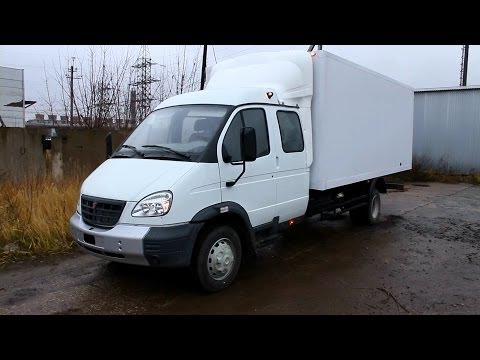
Video overview
FAQ
What is the GAZ Valdai?
The GAZ-3310 Valdai is a low-frame, two-axle medium truck built by GAZ from late 2004 to December 2015. It uses a GAZelle-derived cab on a chassis with axles from the GAZ-3307 and carries about 4 tonnes.
What engines does the GAZ Valdai have?
The main engines are the MMZ D-245.7, a 4.75-litre turbodiesel with about 87 kW (119 hp) and 420 Nm, and the Cummins ISF 3.8 with 112 kW (152 hp) and 491 Nm. Export trucks used a 3.9-litre Cummins.
What is the payload of the GAZ Valdai?
The rated payload is about 4 tonnes for the MMZ-engined truck, with a gross vehicle weight of 7,400 kg. The kerb weight is 3,350 to 3,545 kg depending on engine.
How much fuel does the GAZ Valdai use?
Official figures are 12–13 l/100 km at a steady 60 km/h and 15–18 l/100 km at 80 km/h, with the Cummins engine the more economical. Real consumption in delivery work is around 14–17 l/100 km.
What replaced the GAZ Valdai?
The GAZon NEXT City, a five-tonne low-frame truck, took over in 2015. In 2020 GAZ revived the name as the Valdai NEXT, with a cab from the Foton Ollin and a 2.8-litre Cummins diesel.
Data sources
Data checked by an editor against the sources below.
- The text of this article (1cars archive)
- Wikipedia - GAZ Valdai


