
ZIL-157 vs Ural-375: the 6x6 trucks of the 1960s army
Updated Report an error By Oleksandr Hnatiuk

Ural · 1964–1991
Ural-375D / 375DM
- Power
- 132 kW179 PS
- Top speed
- 75 km/h

ZIL · 1958–1992
ZIL-157
No versions in our catalog yet
- Power
- 76–80 kW103–109 PS
- Top speed
- —
Verdict Opinion
The Ural-375 is the more capable truck by a wide margin: a far stronger V8, almost twice the off-road payload, more ground clearance and bigger tyres. The ZIL-157 is the lighter, simpler and more compact machine, built in almost 800,000 examples and known for its long-bonnet Krokodil looks.
Both are thirsty petrol trucks, so for a collector the decision is mainly about size, period and the work the truck will do.
— Oleksandr Hnatiuk
The ZIL-157 and the Ural-375 belong to consecutive chapters of the same story. The ZIL-157 entered series production in 1958 as the successor to the ZIS-151. The Ural-375, in series production from November 1960, replaced it in service, and by the late 1970s the ZIL-131 and the Ural-375D had taken over the role completely.
Yet both stayed in production into the early 1990s, so collectors can find them side by side today. Both are bonneted 6x6 trucks with petrol engines, two-speed transfer cases and central tyre inflation, but the Ural is a much bigger and more powerful machine.
Engineering, design and everyday use
Engineering
The ZIL-157 uses a 5.55-litre petrol inline-six with 76 kW (104 PS) in its first form and 80 kW (109 PS) in the 157K, with 338 Nm. The Ural-375 has the ZIL-375Ya, a 7.0-litre carburettor V8 with about 130 to 132 kW (180 PS). Both have a five-speed manual gearbox and a two-speed transfer case with low range.
Tyres differ: the ZIL-157 runs on 12.00-18 tyres with single rear wheels, and the Ural on 14.00-20 tyres with pressure adjustable between about 0.5 and 3.1 bar while driving. The first Ural-375 had a canvas-roof cab; the all-steel cab came with the 375D from 1964.
Size and capability
The ZIL-157K is 6,922 mm (272.5 in) long with winch and weighs 5,540 kg (12,214 lb) without one; it carries 2,500 kg (5,512 lb) off road and 4,500 kg (9,921 lb) on roads, with 310 mm (12.2 in) of ground clearance. The Ural-375D is 7,350 mm (289.4 in) long, weighs 8,400 kg (18,519 lb) with winch, carries 4,800 kg (10,582 lb) and has 400 mm (15.7 in) of ground clearance. Top speed rises from about 65 km/h (40 mph) to 75 km/h (47 mph).
Fuel and running
Neither is economical. The ZIL-157 uses about 42 L/100 km from a 150 L main tank plus 65 L, for a range of roughly 460 to 510 km. The Ural-375D uses about 45 to 50 L/100 km on the road and roughly double off road, with 300 L plus an optional 60 L and a range of about 500 to 550 km.
Full specifications
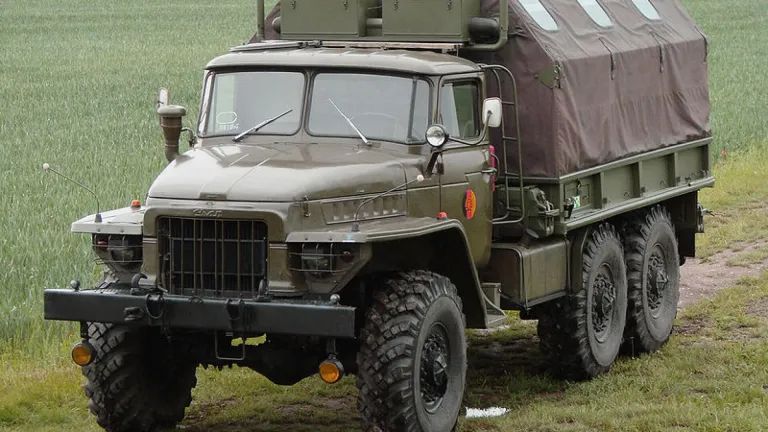
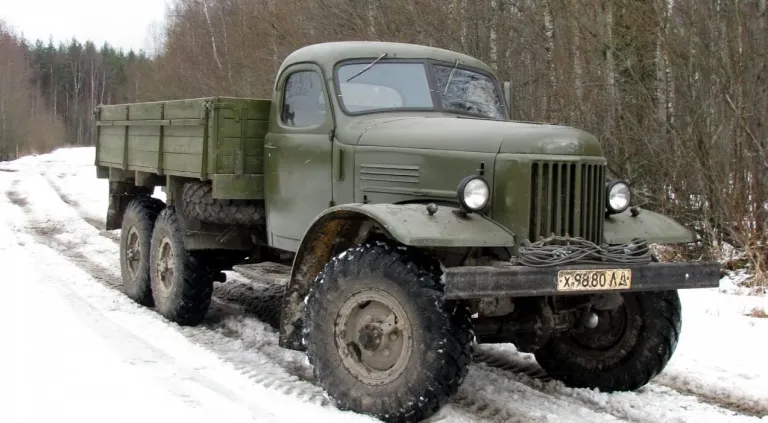
| Ural-375 | ZIL-157 | |
|---|---|---|
| General | ||
| Version | Ural-375D / 375DM · Ural-375D · petrol · 132 kW (179 PS) | No data |
| Production years | 1964–1991 | 1958–1992 |
| Body | Truck | Flatbed truck |
| Class | Heavy truck | Heavy truck |
| Country | Soviet Union (USSR) | Soviet Union (USSR) |
| Performance | ||
| Power Why it matters: More power means stronger acceleration and easier overtaking, especially with a full load. | 132 kW (179 PS) 177 hp Better | 76–80 kW (103–109 PS) 102–107 hp |
| Top speed Why it matters: Top speed hints at how relaxed the car is at motorway speeds, even if you never reach it. | 75 km/h 47 mph | No data |
| Engine and transmission | ||
| Fuel | Petrol | Petrol |
| Engine | 7,000 cc · 8 cyl 7.0 l | No data |
| Engine code | ZIL-375Ya 7.0 L petrol V8 | No data |
| Gearbox | 5-speed manual | No data |
| Drive | Multi-axle drive (6×6, 8×8…) | Multi-axle drive (6×6, 8×8…) |
| Economy and running costs | ||
| Fuel consumption Why it matters: Lower consumption cuts running costs and CO₂ emissions on every trip. | 50.0 l/100 km 4.7 mpg US | No data |
| Fuel cost per year | €13,130/year estimated | No data |
These cars do not differ in the data we have.
Equal rows hidden (4): Class, Country, Fuel, Drive.
Better marks the stronger figure — only for measurable specs (power, torque, 0–100 km/h, consumption, boot, weight).
Estimated at 15,000 km a year with fuel at €1.75/l petrol.
In plain words
ZIL-157 is the older design (from 1958); Ural-375 arrived in 1960.
Which one to choose
Choose the ZIL-157 if you want the 1950s Krokodil, a more manageable size and simpler inline-six mechanics. Later 157K and Ural-built 157KD trucks share parts with the ZIL-130/131 family.
Choose the Ural-375 if you need a much higher payload and better off-road clearance, and can live with the fuel consumption of a 7.0-litre V8. The all-steel-cab 375D is the most common version.
Frequently asked questions
Did the Ural-375 replace the ZIL-157?
Yes, in Soviet Army service, together with the ZIL-131 by the late 1970s. Both the ZIL-157 and the Ural-375 nevertheless remained in production into the early 1990s.
Which carries more?
The Ural-375D, rated at 4,800 kg. The ZIL-157K carries 2,500 kg off road and 4,500 kg on roads; the later 157KD raised that to 3,000 kg and 5,000 kg.
Do both have central tyre inflation?
Yes. Both have central tyre inflation, so the driver can change tyre pressure without leaving the cab.