
ZIL-157 vs ZIL-131: two generations of the ZIL 6x6 truck
Updated Report an error By Oleksandr Hnatiuk

ZIL · 1967–1990
ZIL-131
- Power
- 110 kW150 PS
- Kerb mass
- 6,700 kg

ZIL · 1958–1992
ZIL-157
No versions in our catalog yet
- Power
- 76–80 kW103–109 PS
- Kerb mass
- -
Verdict Opinion
The ZIL-131 is the more capable and more modern truck, with a stronger V8, a higher off-road payload and better road speed. The ZIL-157 is the simpler and lighter machine, with the period character of a 1950s design and a production run of almost 800,000 over 36 years.
Their appeal is different: the 131 is a usable working truck built in very large numbers, while the 157 is the heritage choice for those who value its looks and history.
- Oleksandr Hnatiuk
The ZIL-157 and the ZIL-131 are predecessor and successor, but for many years they were built side by side. The ZIL-157 entered series production on 18 September 1958 as a revision of the ZIS-151 and earned the nickname Krokodil for its long bonnet. The ZIL-131 was being designed while the 157 was still in development, was introduced in 1966 and reached series production in 1967.
By the late 1970s the ZIL-131 and the heavier Ural-375D had replaced the 157 as standard army trucks, yet production of the older design moved to the Ural plant and continued into the early 1990s. That overlap makes this an unusual comparison: two generations of one maker that buyers can still find side by side.
Engineering, design and everyday use
Engineering
The ZIL-157 uses a 5.55-litre petrol inline-six. The first trucks had 76 kW (104 PS); the improved 157K from 1961/62 offered 80 kW (109 PS) at 2,800 rpm and 338 Nm. The ZIL-131 moved to a V8 from the ZIL-130 family of about 6.0 litres with 110 kW (150 PS) and 402 Nm. Both have five-speed manual gearboxes and two-speed transfer cases, and both can adjust tyre pressure from the cab.
Design and size
The 157 runs on 12.00-18 tyres with single rear wheels, a change from the dual rear wheels of the ZIS-151. It measures 6,922 mm (272.5 in) with winch and weighs 5,540 kg (12,214 lb) without one. The ZIL-131 is 7,040 mm (277.2 in) long with winch, weighs 6,700 kg (14,771 lb) and shares its cab and many parts with the ZIL-130.
Use
The 157K carries 2,500 kg (5,512 lb) off road and 4,500 kg (9,921 lb) on roads; the Ural-built 157KD from 1978 raised that to 3,000 kg off road and 5,000 kg on roads. The ZIL-131 is rated at 3,500 kg (7,716 lb) off road and 5,000 kg (11,023 lb) on roads. Top speed rises from about 65 km/h (40 mph) to 80 km/h (50 mph). Road fuel use is similar: about 42 L/100 km for the 157 and about 40 L/100 km for the 131.
Full specifications
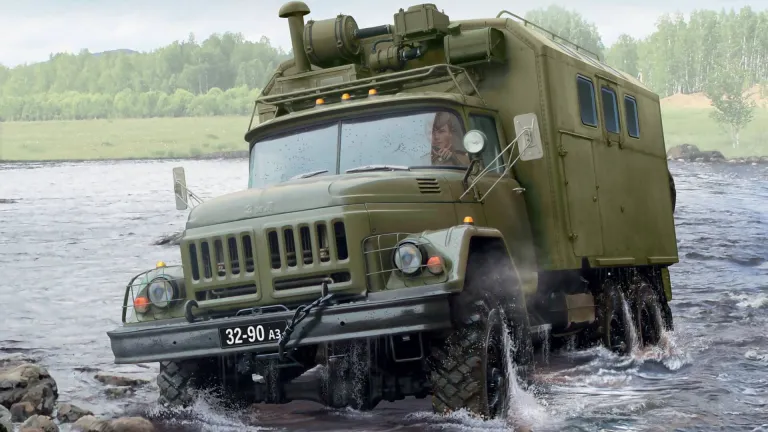
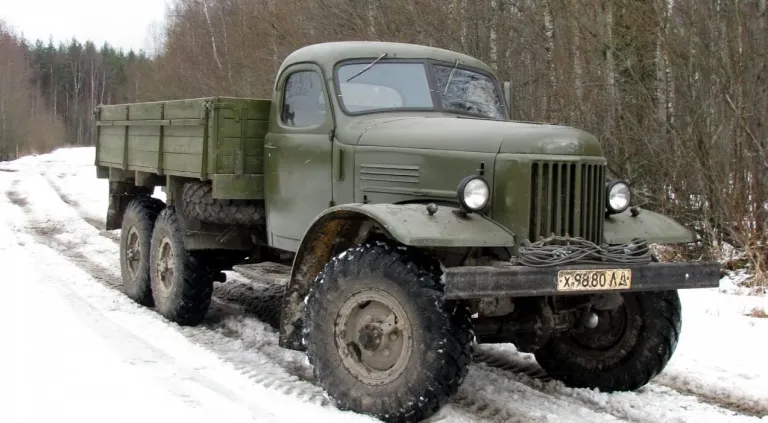
| ZIL-131 | ZIL-157 | |
|---|---|---|
| General | ||
| Version | petrol · 110 kW (150 PS) | No data |
| Production years | 1967–1990 | 1958–1992 |
| Body | Truck | Flatbed truck |
| Class | Heavy truck | Heavy truck |
| Country | Soviet Union (USSR) | Soviet Union (USSR) |
| Performance | ||
| Power Why it matters: More power means stronger acceleration and easier overtaking, especially with a full load. | 110 kW (150 PS) 148 hp Better | 76–80 kW (103–109 PS) 102–107 hp |
| Power, all versions | 77–110 kW (105–150 PS) 103–148 hp | 76–80 kW (103–109 PS) 102–107 hp |
| Power per tonne | 16 kW/t 20 hp/ton calculated | No data |
| Engine and transmission | ||
| Fuel | Petrol | Petrol |
| Engine | 8 cyl | No data |
| Drive | No data | Multi-axle drive (6×6, 8×8…) |
| Dimensions and weight | ||
| Length | 7,040 mm 277.2 in | No data |
| Width | 2,500 mm 98.4 in | No data |
| Height | 2,480 mm 97.6 in | No data |
| Wheelbase | 3,975 mm 156.5 in | No data |
| Kerb weight Why it matters: A lighter car is usually more agile and uses less energy. | 6,700 kg 14,771 lb | No data |
These cars do not differ in the data we have.
Equal rows hidden (3): Class, Country, Fuel.
Better marks the stronger figure - only for measurable specs (power, torque, 0–100 km/h, consumption, boot, weight).
In plain words
ZIL-157 is the older design (from 1958); ZIL-131 arrived in 1967. Our catalog has no kerb mass for the ZIL-157 yet, so some checks above leave it out.
Which one to choose
Choose the ZIL-157 if you want the classic 1950s Krokodil with its inline-six and are happy with lower speeds and payloads. Later 157K and Ural-built 157KD trucks share parts with the ZIL-130/131 family.
Choose the ZIL-131 if you want more power, a higher payload and an easier life on modern roads, with close to one million built and parts commonality with the ZIL-130.
Frequently asked questions
Did the ZIL-131 replace the ZIL-157?
Yes, as the standard army truck, together with the heavier Ural-375D, by the late 1970s. The 157 itself stayed in production at the Ural plant until 1992, with final assembly in 1994.
Why is the ZIL-157 called Krokodil?
The nickname, meaning crocodile, refers to its long bonnet and grille.
Which ZIL uses a V8?
The ZIL-131. It has a ZIL-130-family petrol V8 of about 6.0 litres and 110 kW (150 PS). The ZIL-157 uses a 5.55-litre petrol inline-six.