
Ural-4320 vs ZIL-131: diesel and petrol 6x6 trucks
Updated Report an error By Oleksandr Hnatiuk

Ural · 1977–present
Ural-4320
- Power
- 132 kW179 PS
- Kerb mass
- -

ZIL · 1967–1990
ZIL-131
- Power
- 110 kW150 PS
- Kerb mass
- 6,700 kg
At a glance
Who suits what, worked out from the catalog figures of the versions above.
- City ZIL-131 Length: 7,040 mm vs 7,366 mm
Verdict Opinion
The Ural-4320 is the more capable truck, with a bigger payload, larger tyres and a far more economical diesel engine. The ZIL-131 is lighter, simpler and more widely produced, and its petrol V8 and ZIL-130 parts commonality make it easier to understand and maintain for many owners.
They were designed for different jobs, and that still decides which one makes sense.
- Oleksandr Hnatiuk
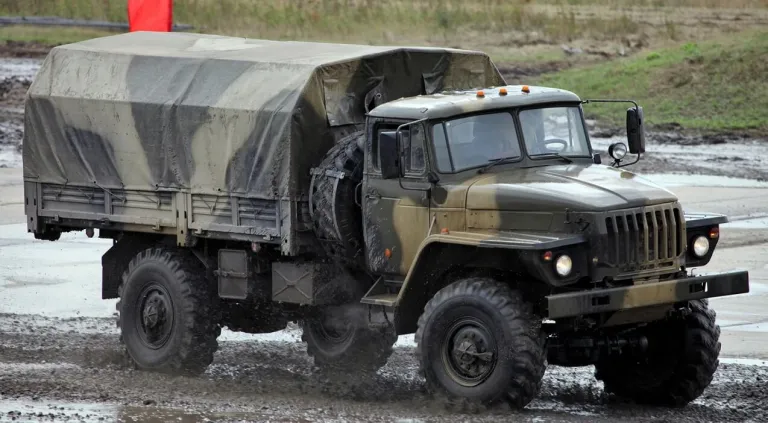
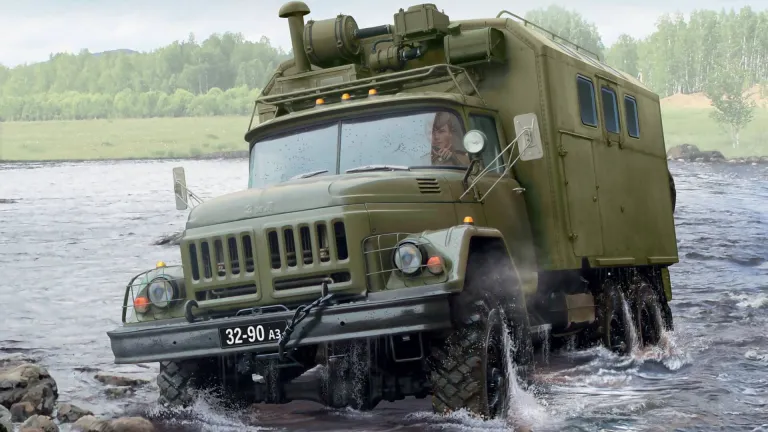
From the late 1970s to 1990 the Ural-4320 and the ZIL-131 served side by side as Soviet three-axle trucks in different weight classes. Both are bonneted 6x6 trucks with leaf-sprung solid axles, a rear bogie and a two-speed transfer case.
The ZIL-131 came first: introduced in 1966, in series production from 1967 and built in close to one million examples. The Ural-4320 followed in 1977 as the diesel successor to the Ural-375D. Ex-Soviet trucks like these now attract military-vehicle collectors, and the choice between them comes down to size, fuel and purpose.
Engineering, design and everyday use
Engineering
The ZIL-131 uses a ZIL-130-family petrol V8 of about 6.0 litres with 110 kW (150 PS) and 402 Nm. The Ural-4320 started with the KamAZ-740 V8 diesel of 10.85 litres and about 155 kW (210 PS), later replaced by YaMZ diesels. Both have a five-speed manual gearbox and a two-speed transfer case, and both offer central tyre inflation. The ZIL runs on 12.00-20 tyres, the Ural on larger 14.00-20 tyres.
Size and capability
The Ural is the heavier truck: 7,366 mm (290.0 in) long and at least 8,425 kg (18,573 lb) at kerb, with payloads quoted at 5,000 to 6,000 kg (11,023 to 13,228 lb) depending on version. The ZIL-131 is 7,040 mm (277.2 in) long with winch and weighs 6,700 kg (14,771 lb); it is rated at 3,500 kg (7,716 lb) off road and 5,000 kg (11,023 lb) on roads. Both reach about 80 km/h (50 mph), the Ural slightly more.
Fuel and running
Fuel is where the diesel pays off. The ZIL-131 uses about 40 L/100 km on the road and far more off road, from two 170 L tanks. The Ural-4320 is quoted at 27 to 38 L/100 km on the road, with a 300 L tank plus an optional 60 L and a range of 700 to 1,100 km. The ZIL shares its cab and many parts with the civilian ZIL-130, which helps parts supply.
Size and weight
Side view to scale, all cars from the front bumper.
| Ural-4320 | ZIL-131 | |
|---|---|---|
| Length | 7,366 mm290.0 in | 7,040 mm277.2 in −326 mm −12.8 in −4.4% |
| Width | 2,500 mm98.4 in | 2,500 mm98.4 in |
| Height | 2,715 mm106.9 in | 2,480 mm97.6 in −235 mm −9.3 in −8.7% |
| Fits a standard garage? | Too long and too wide | Too long and too wide |
Difference vs Ural-4320 (±). Garage check: a standard single garage takes a car up to about 5.0 m (16 ft 5 in) long and 1.9 m (6 ft 3 in) wide (width as listed in the catalog; some makers include the mirrors). Leave about 0.6 m (2 ft) to open the doors.
Full specifications
| Ural-4320 | ZIL-131 | |
|---|---|---|
| General | ||
| Version | 11.2 YaMZ-236M2 · diesel · 132 kW (179 PS) | petrol · 110 kW (150 PS) |
| Production years | 1977–present | 1967–1990 |
| Body | Truck | Truck |
| Class | Heavy truck | Heavy truck |
| Country | Soviet Union (USSR) | Soviet Union (USSR) |
| Performance | ||
| Power Why it matters: More power means stronger acceleration and easier overtaking, especially with a full load. | 132 kW (179 PS) 177 hp Better | 110 kW (150 PS) 148 hp |
| Power, all versions | 132–229 kW (179–311 PS) 177–307 hp | 77–110 kW (105–150 PS) 103–148 hp |
| Power per tonne | No data | 16 kW/t 20 hp/ton calculated |
| Engine and transmission | ||
| Fuel | Diesel | Petrol |
| Engine | 11,150 cc · 6 cyl 11.2 l | 8 cyl |
| Engine code | YaMZ-236M2 | No data |
| Drive | Multi-axle drive (6×6, 8×8…) | No data |
| Dimensions and weight | ||
| Length | 7,366 mm 290.0 in | 7,040 mm 277.2 in |
| Width | 2,500 mm 98.4 in | 2,500 mm 98.4 in |
| Height | 2,715 mm 106.9 in | 2,480 mm 97.6 in |
| Wheelbase | No data | 3,975 mm 156.5 in |
| Kerb weight Why it matters: A lighter car is usually more agile and uses less energy. | No data | 6,700 kg 14,771 lb |
These cars do not differ in the data we have.
Equal rows hidden (4): Body, Class, Country, Width.
Better marks the stronger figure - only for measurable specs (power, torque, 0–100 km/h, consumption, boot, weight).
In plain words
Ural-4320 has more power: 132 kW (179 PS) against 110 kW (150 PS) for ZIL-131. Ural-4320 is 326 mm longer than ZIL-131 (7,366 mm vs 7,040 mm). ZIL-131 is the older design (from 1967); Ural-4320 arrived in 1977. Ural-4320 is still in production; ZIL-131 is not. On the catalog figures, the ZIL-131 is the pick for city. Our catalog has no kerb mass for the Ural-4320 yet, so some checks above leave it out.
Which one to choose
Choose the Ural-4320 if you need maximum payload and range, or plan to cover long distances where diesel economy matters.
Choose the ZIL-131 if you want a lighter 6x6 that is easier to store and handle, with a huge production run behind it and parts shared with the ZIL-130. Later ZIL-131N1 and N2 versions offered diesel engines.
Frequently asked questions
Which carries more, the Ural-4320 or the ZIL-131?
The Ural-4320: 5,000 to 6,000 kg depending on version. The ZIL-131 carries 3,500 kg off road and 5,000 kg on roads.
Are both trucks petrol-powered?
No. The ZIL-131 has a petrol V8 of about 6.0 litres. The Ural-4320 is a diesel, originally with the 10.85-litre KamAZ-740 V8.
Which one was built in larger numbers?
The ZIL-131, with close to one million built. No reliable total is published for the Ural-4320.