
KamAZ-4310 vs Ural-4320: Soviet 6x6 diesel trucks compared
Updated Report an error By Oleksandr Hnatiuk

KamAZ · 1981–1995
KamAZ-4310
No versions in our catalog yet
- Power
- 154–162 kW209–220 PS

Ural · 1977–present
Ural-4320
- Power
- 132 kW179 PS
Verdict Opinion
These are two answers to the same brief, built around one engine. The Ural-4320 is the longer-lived design: it evolved into a very large family of versions with several engine families and stayed in production in updated form long after the KamAZ-4310 was replaced by the KamAZ-43114 in 1995. The KamAZ-4310 is the more compact cab-over package with the higher rated payload on paper,.
Neither is objectively better. The deciding factors today are the layout you prefer and, for collectors, which engine and version a particular truck actually carries.
— Oleksandr Hnatiuk
The KamAZ-4310 and the Ural-4320 are the two best-known Soviet three-axle diesel trucks of the late Cold War, and they are closer relatives than most people assume. Both were built around the same KamAZ-740 V8 diesel, both drive all six wheels permanently, and both carried troops, cargo and special bodies for armies across the Warsaw Pact.
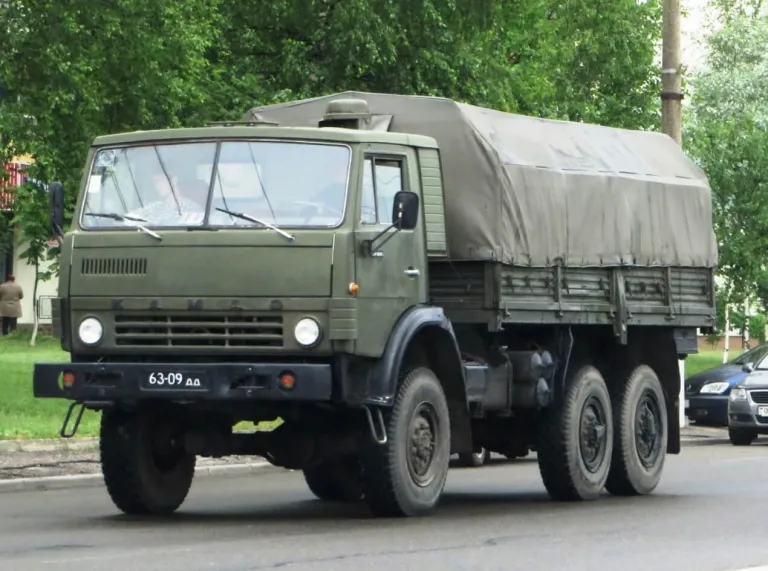
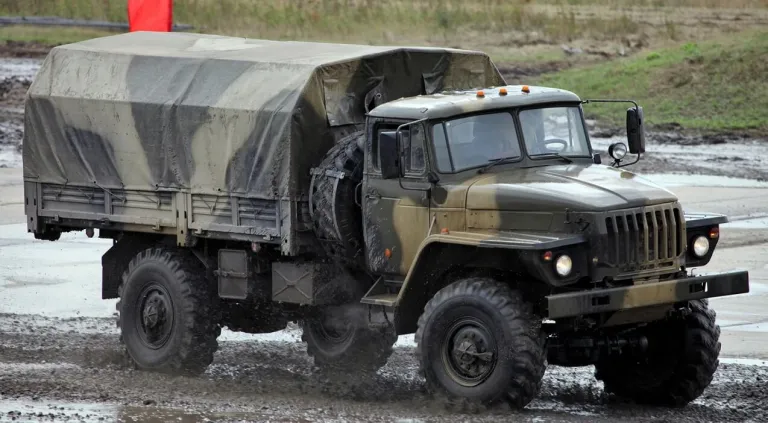
They were not designed as twins, though. The Ural-4320 is the diesel successor to the petrol Ural-375D and keeps a bonneted layout; series production began in 1977. The KamAZ-4310 is a cab-over truck closely related to the road-going KamAZ-5320 and only reached series production in 1981, ten years after its first prototype was shown.
Engineering, design and everyday use
Engineering
In their original form the two trucks share an engine: the KamAZ-740 four-stroke V8 diesel of 10.85 litres, rated at about 155 kW (210 PS). KamAZ raised the output of its own truck to 162 kW (220 PS) in 1989. Both use a five-speed manual gearbox with a two-speed transfer case, which gives the driver a low range for heavy going.
The Ural later had to diversify. A fire at the KamAZ engine plant in 1993 caused engine shortages, so Ural-4320 versions were also built with YaMZ diesels: the YaMZ-236 V6 with 132 kW (180 PS) and the YaMZ-238 V8 with 177 kW (240 PS). After KamAZ stopped supplying engines in 2013, newer YaMZ six-cylinder units took over. The KamAZ-4310 kept its own V8 until production ended in 1995.
Design and size
The KamAZ puts its crew in a tilting cab above the engine and measures 7,895 mm (310.8 in) in length. The Ural is a bonneted truck of 7,366 mm (290.0 in), with a riveted ladder frame, leaf-sprung solid axles and a rear bogie. Kerb weights are similar: 8,230 kg (18,144 lb) for the KamAZ and at least 8,425 kg (18,573 lb) for the Ural.
Use
The basic KamAZ-4310 is rated for 6,000 kg (13,228 lb), the 43105 and 43106 versions for 7,000 kg (15,432 lb). Published Ural-4320 payloads range from 5,000 to 6,000 kg (11,023 to 13,228 lb) depending on version and period. Both trucks reach about 85 km/h (53 mph). The Ural cargo body seats 27 troops, and the Ural chassis carried the BM-21 Grad launcher from 1976.
Full specifications
| KamAZ-4310 | Ural-4320 | |
|---|---|---|
| General | ||
| Version | No data | 11.2 YaMZ-236M2 · diesel · 132 kW (179 PS) |
| Production years | 1981–1995 | 1977–present |
| Body | Truck | Truck |
| Class | Heavy truck | Heavy truck |
| Country | Soviet Union (USSR) | Soviet Union (USSR) |
| Performance | ||
| Power Why it matters: More power means stronger acceleration and easier overtaking, especially with a full load. | 154–162 kW (209–220 PS) 207–217 hp Better | 132 kW (179 PS) 177 hp |
| Power, all versions | 154–162 kW (209–220 PS) 207–217 hp | 132–229 kW (179–311 PS) 177–307 hp |
| Engine and transmission | ||
| Fuel | Diesel | Diesel |
| Engine | No data | 11,150 cc · 6 cyl 11.2 l |
| Engine code | No data | YaMZ-236M2 |
| Drive | Multi-axle drive (6×6, 8×8…) | Multi-axle drive (6×6, 8×8…) |
| Dimensions and weight | ||
| Length | No data | 7,366 mm 290.0 in |
| Width | No data | 2,500 mm 98.4 in |
| Height | No data | 2,715 mm 106.9 in |
These cars do not differ in the data we have.
Equal rows hidden (5): Body, Class, Country, Fuel, Drive.
Better marks the stronger figure — only for measurable specs (power, torque, 0–100 km/h, consumption, boot, weight).
In plain words
Ural-4320 is the older design (from 1977); KamAZ-4310 arrived in 1981. Ural-4320 is still in production; KamAZ-4310 is not.
Which one to choose
Choose the Ural-4320 if you want the classic bonneted Soviet 6x6, a wide range of versions and bodies, and a design with a long service history behind it. Check which engine is fitted, because YaMZ-powered trucks differ from the original KamAZ-engined ones.
Choose the KamAZ-4310 if you prefer a cab-over truck with a 6 t to 7 t rating and a close mechanical link to the civilian KamAZ-5320 family. It was built only from 1981 to 1995, so originality and documentation matter.
Frequently asked questions
Do the KamAZ-4310 and Ural-4320 use the same engine?
In their original form, yes: both used the KamAZ-740 V8 diesel of 10.85 litres with about 155 kW (210 PS). Later Ural-4320 versions switched to YaMZ engines after KamAZ supply problems from 1993.
Which truck carries more?
On paper the KamAZ-4310: 6,000 kg for the basic truck and 7,000 kg for the 43105 and 43106. Ural-4320 payloads are quoted at 5,000 to 6,000 kg depending on version and period.
Which one was built for longer?
The Ural-4320. Series production started in 1977 and continued in updated form for decades, while the KamAZ-4310 was built from 1981 to 1995 and then replaced by the KamAZ-43114.