
KamAZ-4310
Specs, engines and history
Updated Published Sources (3) Report an error
By Felix Hartmann, Automotive Technology & EV Contributor

- Built
- 1981–1995
- Top power
- 162 kW (220 PS)
The KamAZ-4310 is a three-axle 6×6 truck with permanent all-wheel drive, built by KamAZ in the Soviet Union (USSR) in series from 1981 to 1995. It used the 10.85-litre KamAZ-740 V8 diesel, rated at 154 kW (210 PS) and from 1989 at 162 kW (220 PS), and carried 6,000 kg (13,228 lb) as standard.
In short
- A heavy off-road truck with a tilting cab over the engine, single tyres on all three axles and permanent drive to all six wheels.
- First prototype shown in 1971, four pre-series types from 1972 to 1978, series production from 1981 to 1995.
- Payload of 6,000 kg (13,228 lb), or 7,000 kg (15,432 lb) for the KamAZ-43105 and KamAZ-43106.
- Replaced in 1995 by the KamAZ-43114; the related KamAZ-5320 is the 6×4 road truck from the same design family.
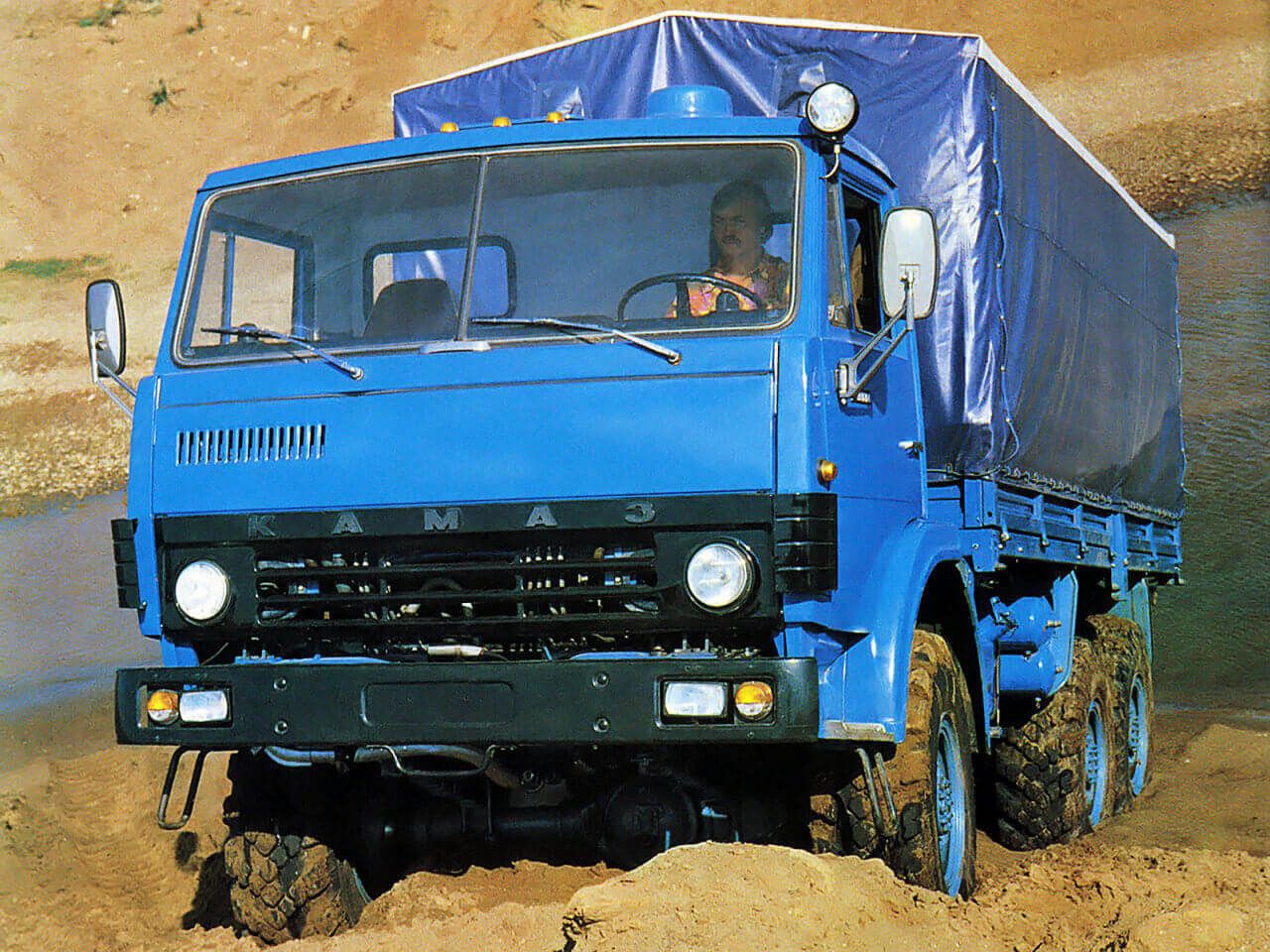
KamAZ-4310 at a glance
The KamAZ-4310 is the all-wheel-drive member of the first KamAZ truck generation: a cab-over 6×6 for heavy loads on poor roads and off-road tracks. KamAZ itself was founded in 1969, so the 4310 belongs to the company's first model range rather than to a later expansion.

Three things set it apart from the road-going models. Drive goes permanently to all three axles, every wheel runs a single tyre instead of twin rear tyres, and the axles, cab and engine were arranged for ground clearance rather than load-floor height. The army was its main user, and the chassis also carried tanks, cranes and other special equipment. For the wider picture of the plant and its products, see KamAZ: cars of the era.
Development and production history
The KamAZ-4310 spent ten years between its first public prototype and full series production. The prototype was presented in 1971 and already had the features of the later truck: a tilting cab, single tyres all round, permanent all-wheel drive and the KamAZ-740 engine.

From 1972 to 1978 KamAZ built the truck as a pre-series in four types, the 4310, 43101, 43102 and 43103, which differed mainly in cab and body layout. Series production started in 1981. The main change against the 1971 prototype was a payload raised by one tonne, to 6,000 kg (13,228 lb). In 1989 the truck received a more powerful version of its engine, and the modernised KamAZ-43101 and KamAZ-43106 were built until 1995, when the KamAZ-43114 took over.
The 4310 was not developed in isolation. Its series design is very close to that of the non-all-wheel-drive KamAZ-5320, so the off-road truck and the road truck share much of their basic engineering.
| Year | Event |
|---|---|
| 1969 | KamAZ founded |
| 1971 | First KamAZ-4310 prototype presented |
| 1972–1978 | Pre-series production in four types (4310, 43101, 43102, 43103) |
| 1981 | Series production begins; payload 6,000 kg |
| 1987 | First deliveries to the East German army (NVA) |
| 1989 | Uprated engine, 162 kW (220 PS); modernised 43101 and 43106 |
| 1995 | Production ends; the KamAZ-43114 replaces it |
Design and engineering
The KamAZ-4310 is a cab-over-engine truck on three axles, with the cab tilting forward for access to the V8 below it. That layout gives a longer load area for a given overall length than a bonneted truck would have.

The drivetrain is the heart of the design. Drive goes to all six wheels all the time, not only when the driver selects it, so the truck has no separate two-wheel-drive mode for road use. A five-speed manual gearbox feeds a two-stage transfer case, which gives a road range and a low range for steep or soft ground. The single tyres on all axles let the front, middle and rear wheels run in the same tracks, which matters in mud and snow, where twin rear tyres would have to cut their own ruts.
Ground clearance is reported as 365 mm (14.4 in), and the track is 2,100 mm (82.7 in) at both front and rear. The rear axles form a tandem 1,320 mm (52.0 in) apart, behind a 3,340 mm (131.5 in) main wheelbase.
Shared design with the KamAZ-5320
The KamAZ-4310 and the KamAZ-5320 are close relatives, and their series designs are very similar. The 5320 is a 6×4 road truck with drive to the two rear axles only, while the 4310 adds a driven front axle, single tyres and the transfer case.
Engine and drivetrain
The KamAZ-4310 is powered by the KamAZ-740, a four-stroke V8 diesel with a displacement of 10,850 cc (662 cu in). Bore and stroke are both 120 mm (4.72 in), and the compression ratio is reported as 17:1.
Before 1989 the engine was rated at 154 kW (210 PS); from 1989 it delivered 162 kW (220 PS). Published torque figures for the KamAZ-740 in this truck disagree, so none is quoted here. The same engine family was not exclusive to KamAZ trucks: the KamAZ-740.10 had been fitted to the Ural-4320 from 1977, four years before the 4310 itself reached series production.
The five-speed manual gearbox and the two-stage transfer case are described above. Reported performance figures are modest, as befits a heavy 6×6 of the period: a top speed of 85 km/h (53 mph), and a 0–60 km/h (0–37 mph) time of 35 seconds. Fuel consumption is given as 31 L/100 km (7.6 mpg US) at a steady 60 km/h, rising to 40 L/100 km (5.9 mpg US) with a trailer. The fuel tank holds 250 L (66.0 US gal).
KamAZ-4310 specifications
The table covers the series KamAZ-4310 with the standard cargo body. Most figures come from a single family of reference works, so treat them as reported values rather than factory certificates.

| Parameter | Metric | Imperial |
|---|---|---|
| Series production | 1981–1995 | 1981–1995 |
| Layout | 6×6, permanent all-wheel drive | 6×6, permanent all-wheel drive |
| Engine | KamAZ-740 V8 diesel, 10,850 cc | KamAZ-740 V8 diesel, 662 cu in |
| Bore × stroke | 120 × 120 mm | 4.72 × 4.72 in |
| Maximum power (to 1989) | 154 kW (210 PS) | 154 kW (207 hp) |
| Maximum power (from 1989) | 162 kW (220 PS) | 162 kW (217 hp) |
| Gearbox | 5-speed manual + 2-stage transfer case | 5-speed manual + 2-stage transfer case |
| Payload | 6,000 kg (7,000 kg for 43105 and 43106) | 13,228 lb (15,432 lb) |
| Kerb weight | 8,230 kg | 18,144 lb |
| Gross vehicle weight | 15,635 kg | 34,469 lb |
| Trailer load, road / off-road | 11,500 / 7,000 kg | 25,353 / 15,432 lb |
| Length × width × height | 7,895 × 2,500 × 3,200 mm | 310.8 × 98.4 × 126.0 in |
| Wheelbase | 3,340 + 1,320 mm | 131.5 + 52.0 in |
| Track, front and rear | 2,100 mm | 82.7 in |
| Ground clearance | 365 mm | 14.4 in |
| Top speed | 85 km/h | 53 mph |
| Fuel consumption at 60 km/h | 31 L/100 km | 7.6 mpg US |
| Fuel tank | 250 L | 66.0 US gal |
Two numbers in older descriptions of the truck need care. A kerb weight of 8,410 kg and a gross weight of 15,000 kg also circulate, and some texts give smaller dimensions; the values above follow the German and English reference works. Claims that 316 kW (430 hp) engines were fitted later have no support in any source checked.
Variants and derivatives
The KamAZ-4310 family splits into pre-series types, two series models and two modernised models, plus bodies built on the chassis by other makers.

| Variant | Years | Body / purpose | Engine | Notes |
|---|---|---|---|---|
| KamAZ-4310 prototype | 1971 | Development prototype | KamAZ-740 | Tilting cab, single tyres, permanent AWD |
| KamAZ-4310 (pre-series) | 1972–1978 | Cargo body, only the tailgate folds down | KamAZ-740 | One of four pre-series types |
| KamAZ-43101 (pre-series) | 1972–1978 | Cargo body, all sides fold down | KamAZ-740 | Name reused in 1989 |
| KamAZ-43102 (pre-series) | 1972–1978 | Extended cab with sleeping berth | KamAZ-740 | |
| KamAZ-43103 (pre-series) | 1972–1978 | Long cab, open cargo bed | KamAZ-740 | |
| KamAZ-4310 | 1981–1989 | Basic cargo truck, 6,000 kg | 154 kW (210 PS) | Main series model |
| KamAZ-43105 | 1981–1989 | Winch and longer cargo bed, 7,000 kg | 154 kW (210 PS) | Also used as a crane chassis |
| KamAZ-43101 (modernised) | 1989–1995 | Cargo truck, 6,000 kg | 162 kW (220 PS) | Successor to the basic 4310 |
| KamAZ-43106 (modernised) | 1989–1995 | Cargo truck, 7,000 kg | 162 kW (220 PS) | Successor to the 43105 |
The repeated name causes most of the confusion. "KamAZ-43101" means a pre-series truck with drop sides when it refers to the 1970s, and the modernised 220 PS successor of the basic 4310 when it refers to 1989–1995. The 43105 and 43106 form the heavier line, rated for 7,000 kg (15,432 lb).
Shelter bodies and special equipment
The chassis was also fitted with closed shelter bodies of the KUNG type, such as the K4320D, which armies used for specialist equipment. In East Germany the 4310 family carried tank and box bodies, described in the next section. These conversions explain why surviving trucks often look very different from the flatbed in the factory specification.
In service: operation, reliability and legacy
The KamAZ-4310 was a standard heavy 6×6 transport chassis of the Soviet Army from the mid-1980s and is often described as its most common six-wheel all-wheel-drive truck of that decade. Its service history outside the USSR is best documented for East Germany.

The East German army, the NVA, received the type from 1987, and only with box-type special bodies and as tank trucks, not as flatbeds. The main version was the AC-7-4310 TO tank truck: the "7" stands for a nominal 7,000 L (1,849 US gal) tank and "4310" for the chassis. About 240 were imported until 1990, and after the NVA was dissolved the Bundeswehr kept them for a short time. In 1989–1990, VEB Maschinenbau Karl Marx Babelsberg also built 17 truck cranes, the Autodrehkran 100 with a 10-tonne lifting capacity, on the KamAZ-43105 chassis.
Reliability is harder to pin down. No reliable service statistics or verified owner surveys were found, so this page makes no claims about durability. What the record does show is a series production life of almost 15 years, followed by a direct successor, the KamAZ-43114.
KamAZ-4310 against the Ural-4320
The two Soviet 6×6 trucks are close in purpose and payload but differ in layout. The Ural-4320 from the Ural plant entered series production in 1977 with the KamAZ-740.10 V8, the same engine family as the 4310, and carries 5,000–6,000 kg (11,023–13,228 lb) depending on version. It keeps a bonneted layout with the engine ahead of the cab and runs on 14.00-20 tyres with central tyre inflation. The KamAZ-4310 has its cab above the engine, is longer overall at 7,895 mm (310.8 in) against 7,366 mm (290.0 in), and arrived four years later.
Motorsport
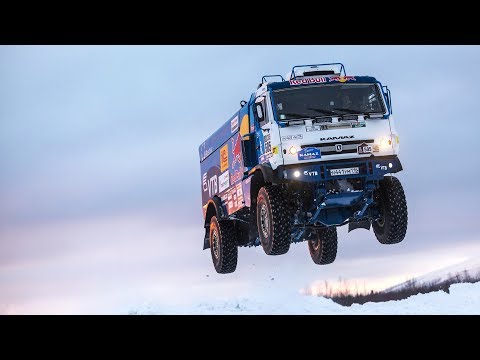
KamAZ's motorsport name comes from the same period. The KamAZ-Master team was founded in 1988 and first started the Rally Paris–Tripoli–Dakar in 1990. Early rally trucks are sometimes linked to the 4310 family, but the evidence for that link is thin, and the competition trucks were heavily modified vehicles rather than series 4310s.
Preservation and collecting today
Identifying the exact version is the first job for anyone restoring a KamAZ-4310, because model indices were reused and many chassis were rebodied. The production record gives a few useful checks:
- The model index: 4310 and 43105 point to 1981–1989, while 43101 and 43106 can mean the 1989–1995 modernised trucks.
- A 43101 needs a second look, because the same index was used for a 1972–1978 pre-series type.
- The engine rating: 162 kW (220 PS) indicates a truck from 1989 or later.
- The payload plate: 7,000 kg points to the 43105 or 43106 line.

Many trucks carry shelter bodies or tanks rather than the original cargo bed, so the body may be younger or older than the chassis. The 4310 also has a following among scale modellers, with 1:35 kits from ICM and Trumpeter, and browsing other Soviet classic vehicles or classic cars of the 1980s shows where it sits among its contemporaries. Related heavy-duty models appear in the trucks section, other all-wheel-drive vehicles are grouped separately, and the full range is listed under all KamAZ models.
Rivals
-
In production
- Years
- 1977–present
- Body
- Truck
- Fuel
- Diesel
- Power
- 132–229 kW (179–311 PS)


Popular comparisons
KamAZ-4310 in our rankings
More powerful than 37% of ranked trucks in the 1CARS catalog (No. 35 of 56).
KamAZ-4310 photos 18


KamAZ-4310 videos 5

KamAZ-4310 video 1

KamAZ-4310 video 2

KamAZ-4310 video 3
KamAZ-4310 video 4

KamAZ-4310 video 5
FAQ
What is the KamAZ-4310?
The KamAZ-4310 is a three-axle 6×6 cab-over truck with permanent all-wheel drive, built by KamAZ in the USSR. The prototype appeared in 1971, pre-series trucks followed from 1972 to 1978, and series production ran from 1981 to 1995. It carried 6,000 kg (13,228 lb) as standard.
What engine does the KamAZ-4310 have?
It uses the KamAZ-740, a 10,850 cc (662 cu in) V8 diesel with a bore and stroke of 120 × 120 mm. Trucks built before 1989 have 154 kW (210 PS); from 1989 the engine produced 162 kW (220 PS). Drive goes through a five-speed manual gearbox and a two-stage transfer case.
What is the payload and weight of the KamAZ-4310?
The basic KamAZ-4310 is rated for 6,000 kg (13,228 lb), while the 43105 and 43106 carry 7,000 kg (15,432 lb). Kerb weight is reported as 8,230 kg (18,144 lb) and gross vehicle weight as 15,635 kg (34,469 lb), though older sources give slightly different figures.
What is the difference between the KamAZ-4310, 43101 and 43105?
The 4310 is the basic 6,000 kg truck of 1981–1989, and the 43105 is its heavier 7,000 kg sister with a winch and longer cargo bed. The 43101 name was used twice: for a 1972–1978 pre-series type with drop sides and for the modernised 220 PS truck of 1989–1995.
How does the KamAZ-4310 compare with the Ural-4320?
Both are Soviet 6×6 trucks with KamAZ-740 V8 diesels and payloads of about 6,000 kg. The Ural-4320, in series from 1977, has a bonneted layout with the engine ahead of the cab, while the KamAZ-4310, in series from 1981, places the cab over the engine.
What replaced the KamAZ-4310?
The KamAZ-43114 replaced the KamAZ-4310 family when production ended in 1995. The last versions of the original design were the modernised 43101 and 43106, built from 1989 with the 162 kW (220 PS) engine.
Data sources
Data checked by an editor against the sources below.
- The text of this article (1cars archive)
- Wikipedia - KamAZ 4310
- Wikipedia - KAMAZ


Comments 1
Great layout of the truck "KAMAZ 4310". Great design, bright colors. Large load capacity, cabin with 3 places. The power of 210 horses. Many advantages, disadvantages are not observed.