
KamAZ-4326
Specs, engines and history
Updated Published Sources (2) Report an error
By Felix Hartmann, Automotive Technology & EV Contributor

- Built
- 1995–present
- Top power
- 177 kW (241 PS)
The KamAZ-4326 is a two-axle, permanent all-wheel-drive cargo truck built by KAMAZ since 1995. Prototypes derived from the six-wheel KamAZ-4310 were ready in the 1980s, but series production had to wait until the mid-1990s. It carries 3.3–4 tonnes off-road, wades through 1.5 m of water and uses a 10.85-litre V8 diesel with 176 kW (240 PS).
In short
- Development: prototypes in the 1980s, series production from 1995; the KamAZ-4350 followed in 2003.
- Engine: KamAZ-740 family turbo-diesel V8, 10.85 L, 176 kW (240 PS) and 912 Nm, Euro 2.
- Running gear: permanent 4x4, two-speed transfer case, 10-speed gearbox, 425/85 R21 tyres.
- Derivatives include the short KamAZ-43261, fire engines, crew buses and the KamAZ-4326-9 rally truck.
Specs by version
Performance
Show all 1 versions
| Version | Fuel consumption |
|---|---|
| 10.8 177 kW (241 PS) Truck | 30.0 l/100 km7.8 mpg US · 9.4 mpg UK |
Dimensions and weight
Verified Manufacturer and type-approval data from our catalog · Sources and methodology
KamAZ-4326 at a glance: maker, years and purpose
The KamAZ-4326 is the two-axle member of the KAMAZ all-wheel-drive family. It shares its cab, engine and many driveline parts with the three-axle KamAZ-4310 and KamAZ-43114, but it is shorter, lighter and more agile, which suits it to rough-terrain transport, special bodies and rescue work. KAMAZ built it mainly for military and state users; according to Wikipedia it has not been offered to private buyers since at least 2015.

The six-wheel KamAZ-4310 is the closer relative for heavy loads, while the plant's wider story is covered in the history of KAMAZ.
Why the KamAZ-4326 took ten years to reach production
KAMAZ engineers built two-axle prototypes based on the KamAZ-4310 in the 1980s. At that time the plant was producing more than 110,000 trucks a year, and there was no free capacity for another model, so the 4x4 was shelved. Series production only began in 1995, with the design largely unchanged from the prototypes.

The first production trucks already used a turbocharged version of the KamAZ-740 V8 with about 176 kW (240 PS). From the early 2000s KAMAZ added the KamAZ-43261, a short version with a wheelbase about 50 cm shorter. In 2003 the modernised KamAZ-4350 arrived as the successor, but the 4326 stayed in the range for special and military orders.
| Year | Event |
|---|---|
| 1980s | Two-axle prototypes derived from the KamAZ-4310 |
| 1995 | Series production of the KamAZ-4326 begins |
| Early 2000s | Short-wheelbase KamAZ-43261 added |
| 2003 | KamAZ-4350 introduced as the modernised successor |
| 2013 | KamAZ-4326-9 rally trucks start the Dakar Rally |
| By 2015 | No longer offered to private customers |
How the KamAZ-4326 is built: chassis, cab and body
The KamAZ-4326 uses a ladder frame with rigid axles on leaf springs at both ends. Both axles are driven all the time; a lockable centre differential and a pneumatically controlled two-speed transfer case let the driver choose between road and off-road gearing. The large single 425/85 R21 tyres are connected to a central tyre inflation system, so pressure can be lowered from the cab on sand or snow.

The three-seat forward-control cab tilts hydraulically for engine access. In civilian versions it is basic: the driver's seat is adjustable but has no air suspension, the passenger seats are fixed to the floor, and a sleeping berth sits behind the seats. Steps and grab handles make the high cab easy to climb into. Owners of older trucks criticise the dated dashboard and the floor-mounted engine-brake switch.
The standard cargo body is an all-steel dropside platform measuring 4,800 x 2,320 x 500 mm (189.0 x 91.3 x 19.7 in), with optional hoops, canvas cover and benches for troops or crews.
Engine and drivetrain
The KamAZ-4326 is powered by a KamAZ-740 family V8 turbo-diesel with charge-air cooling: a 90-degree, overhead-valve, liquid-cooled engine with a bore and stroke of 120 x 120 mm. In the Euro 2 version (740.31-240, also listed as 740.11-240) it develops 176 kW (240 PS) at 2,200 rpm and 912 Nm (673 lb-ft) at 1,100–1,500 rpm, with a governed top speed.

Its mechanical fuel injection has no electronic control, which makes it tolerant of fuel quality and easier to start in severe cold. The gearbox is a 10-speed manual (five speeds with a front range splitter) behind a twin-plate dry clutch with hydraulic release. The transfer case has ratios of 1.692:1 and 0.917:1, and the double-reduction axles use a final drive of 6.53:1. Brakes are air-operated drums of 400 mm diameter.
KamAZ-4326 specifications
The table shows the standard dropside KamAZ-4326 with the Euro 2 engine, as given in factory data and Wikipedia.

| Parameter | Metric | Imperial |
|---|---|---|
| Engine | 10.85 L V8 turbo-diesel (KamAZ-740.31-240) | 662 cu in |
| Maximum power | 176 kW (240 PS) at 2,200 rpm | – |
| Maximum torque | 912 Nm at 1,100–1,500 rpm | 673 lb-ft |
| Gearbox | 10-speed manual, 2-speed transfer case | – |
| Drive | Permanent 4x4 | – |
| Length / width / height | 7,935 / 2,500 / 2,945 mm | 312.4 / 98.4 / 115.9 in |
| Wheelbase | 4,200 mm | 165.4 in |
| Track | 2,010 mm | 79.1 in |
| Ground clearance | 385 mm | 15.2 in |
| Kerb weight | 8,025 kg | 17,692 lb |
| Payload | 3,275–4,000 kg (by source and version) | 7,220–8,818 lb |
| Gross vehicle weight | 11,600 kg | 25,574 lb |
| Trailer load, road / terrain | 7,000 / 5,000 kg | 15,432 / 11,023 lb |
| Top speed | 90 km/h | 56 mph |
| Fuel use | 25 L/100 km | 9.4 mpg US |
| Fuel tanks | 170 L + 125 L | 77.9 US gal total |
| Range | 1,180 km | 733 mi |
| Wading depth | 1,500 mm | 59.1 in |
| Maximum gradient | 31° (60%) | – |
| Turning circle | 22.6 m | 74.1 ft |
| Tyres | 425/85 R21 | – |
KamAZ-4326 variants: from fire engines to Dakar
The two-axle chassis became the base for a wide range of special vehicles:
| Variant | Years | Body / purpose | Engine | Notes |
|---|---|---|---|---|
| KamAZ-4326 | 1995– | Dropside cargo truck | KamAZ-740 V8, 176 kW | Base model |
| KamAZ-43261 | 2000s– | Short-wheelbase truck | KamAZ-740 V8 | About 50 cm shorter wheelbase |
| AZ-4-2,5 (4326) | – | Fire engine | KamAZ-740 V8 | Built on the standard chassis |
| AZ-40/4 (43261) | – | Fire engine | KamAZ-740 V8 | Short chassis |
| NefAZ-42111 | – | Crew bus or combined bus with a short cargo area | KamAZ-740 V8 | Closed body with windows and seats |
| KamAZ-43269 | – | Armoured vehicle (BPM-97) | KamAZ-740 V8 | Military derivative |
| KamAZ-4326-9 | – (Dakar 2013) | Rally raid truck | Tuned V8 | Raced in the Dakar Rally |

Bodies for winter road maintenance, cranes, refrigerated boxes and motorhomes have also been mounted on the 4326 and 43261.
KamAZ-4326 strengths and weaknesses
The KamAZ-4326 earned its reputation off the road. Permanent all-wheel drive, 385 mm of ground clearance, central tyre inflation and a 1.5 m wading depth let it reach places where conventional trucks stop, and the mechanical V8 is simple to repair in the field. Parts are widely shared with the KamAZ-4310 and 5320 families.

The price for that toughness is fuel and comfort. Consumption of around 25 L/100 km is high for a truck with a payload of about 4 tonnes and the cab design is shared with the KamAZ trucks of the 1970s. The modernised KamAZ-6520 shows how far later KAMAZ cabs moved on.
Buying and preserving a KamAZ-4326 today
Many surviving 4326s come from state fleets, and some have been converted into expedition campers or rescue vehicles. When inspecting one, check:
- Frame and cab corrosion, especially around the cab mounts and steps.
- The central tyre inflation lines and valves, which leak with age.
- Transfer case and centre differential lock operation under load.
- Engine blow-by and smoke, and the history of the turbocharger.
- Paperwork for any body conversion or change of use.

Other KAMAZ models are listed in the KAMAZ catalogue, and similar off-roaders appear among 4x4 vehicles.
Rivals


KamAZ-4326 in our rankings
More powerful than 42% of ranked trucks in the 1CARS catalog (No. 26 of 56).
KamAZ-4326 photos 15


KamAZ-4326 videos 2

KamAZ-4326 video 1
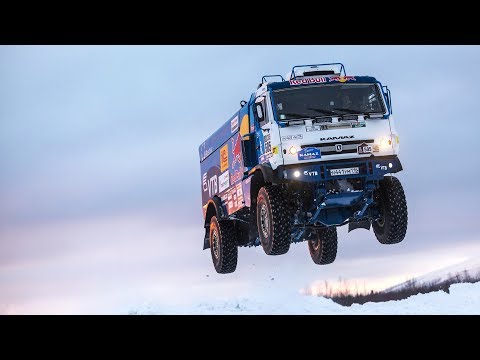
KamAZ-4326 video 2
FAQ
When was the KamAZ-4326 produced?
Series production began in 1995, although prototypes based on the KamAZ-4310 existed in the 1980s. The KamAZ-4350 replaced it as the main two-axle model from 2003, while the 4326 stayed available for special orders.
What engine does the KamAZ-4326 have?
It uses a 10.85-litre KamAZ-740 V8 turbo-diesel with charge-air cooling. The Euro 2 version produces 176 kW (240 PS) at 2,200 rpm and 912 Nm, driving all four wheels permanently through a 10-speed gearbox.
How much can a KamAZ-4326 carry?
The standard dropside version carries about 3.3 to 4 tonnes, depending on source and version, and can pull a 7-tonne trailer on roads or 5 tonnes off-road. Its gross vehicle weight is 11,600 kg.
How deep can a KamAZ-4326 wade?
It can ford water up to 1.5 m deep. It combines this with 385 mm of ground clearance, permanent all-wheel drive and a central tyre inflation system controlled from the cab.
Did the KamAZ-4326 race in the Dakar Rally?
Yes. A dedicated rally version, the KamAZ-4326-9, was built for rally raids and started the Dakar Rally, including the 2013 event. It kept the two-axle layout of the series truck, which is why the 4326 name is familiar to rally fans.
Data sources
Data checked by an editor against the sources below.
- The text of this article (1cars archive)
- Wikipedia - KAMAZ


