
KamAZ-5511
Specs, engines and history
Updated Published Sources (2) Report an error
By Oleksandr Hnatiuk, Automotive Editor & Used Car Specialist Reviewed by Felix Hartmann

- Built
- 1977–1990
- Top power
- 154 kW (209 PS)
The KamAZ-5511 is a three-axle 6×4 dump truck built by KamAZ in series from 1977 to 1990. One of the first models of the KamAZ family, it shares its cab, frame and 10.85-litre KamAZ-740 V8 diesel with the KamAZ-5320 flatbed. It carries 10 tonnes in a steel body of 6.6 to 7.2 cubic metres that can be heated by exhaust gas, and it was succeeded by the KamAZ-55111.
In short
- Production: prototype KamAZ-5510 in 1972, series production 1977–1990.
- Engine: KamAZ-740 V8 diesel, 10,850 cc, 154 kW (210 PS), 639 Nm.
- Payload 10,000 kg, gross vehicle weight 19,150 kg, ground clearance 280 mm.
- Successor: KamAZ-55111, built in parallel from 1988 until 2012.

KamAZ-5511 at a glance
The 5511 was developed for construction sites and bulk transport, where a robust truck had to work for long periods under heavy loads. Most of its main components are shared with other trucks of the KamAZ family, which kept production and maintenance simple. According to the old 1cars text, early trucks stood out with their bright yellow paint and had headlights with an asymmetric beam to reduce glare for oncoming drivers. It is closely related to the KamAZ-5320 flatbed and the KamAZ-5410 tractor unit. The company's story is in the history of KamAZ, and its trucks are in the KamAZ catalogue.

| Fact | Value |
|---|---|
| Maker | KamAZ |
| Prototype | KamAZ-5510 (1972) |
| Series production | 1977–1990 |
| Layout | 6×4 |
| Body | Rear-tipping steel dump body, 6.6–7.2 m³ |
| Engine | KamAZ-740 V8 diesel |
| Payload | 10,000 kg |
| Successor | KamAZ-55111 (1988–2012) |
From the 5510 prototype to the 55111
The KamAZ-5511 was planned alongside the 5320 flatbed as part of the original KamAZ range. A prototype, the KamAZ-5510, was built in 1972, and series production started in 1977. From 1980 the agricultural KamAZ-55102 tipper was added. Some trucks were exported to East Germany. In 1988 the improved KamAZ-55111 went into production alongside the 5511, which was phased out in 1990; the 55111 itself remained in production until 2012.

| Year | Event |
|---|---|
| 1972 | Prototype KamAZ-5510 built |
| 1977 | Series production of the KamAZ-5511 begins |
| 1980 | Agricultural KamAZ-55102 tipper introduced |
| 1988 | Successor KamAZ-55111 enters production in parallel |
| 1990 | End of KamAZ-5511 production |
| 2012 | End of KamAZ-55111 production |
Body, frame and cab
The dump body
The welded all-steel body has a protective canopy over the cab and, according to the old 1cars text, slightly widened sides that make bulk loads easier to unload. Its volume was originally 7.2 m³; later the body was shortened by about half a metre, reducing the volume by about 0.6 m³ to 6.6 m³. Exhaust gas can be routed through the body to heat it, so that wet loads such as sand or gravel do not freeze to the floor in winter.

The hydraulic tipping system uses a power take-off from the gearbox, an oil pump, a control valve, a hydraulic cylinder and an oil tank with pneumatic and electro-pneumatic controls. According to the old 1cars text, raising or lowering the body takes no more than 20 seconds. Locking pins and a safety cable hold the raised body securely during maintenance.
Frame
The old 1cars text describes a reinforced frame for the dump truck, with a subframe made of transverse beams and pressed-steel longitudinal members, joined to the main frame by tie rods and brackets.
Cab
The cab is spring-mounted on the frame, seats two and tilts forward on a torsion-bar mechanism for access to the engine. The old 1cars text describes laminated glass, wind-down windows, swivelling quarter lights, noise and heat insulation on the floor and walls, and heating and ventilation. Later trucks received an adjustable driver's seat and a higher roof. There is no sleeping berth, because the truck was intended for regional work.
KamAZ-740 V8 and gearbox
The 5511 uses the KamAZ-740, a naturally aspirated four-stroke V8 diesel mounted longitudinally under the cab. It has a sealed liquid-cooling system with two thermostats and a fan driven through an automatic hydraulic coupling. The gearbox is a five-speed manual with a two-stage range unit, and the clutch is a dry twin-plate design. Only the two rear axles are driven.

| Parameter | Value |
|---|---|
| Engine | KamAZ-740, V8 diesel |
| Displacement | 10,850 cc |
| Bore × stroke | 120 × 120 mm |
| Power | 154 kW (210 PS) |
| Torque | 639 Nm |
| Gearbox | 5-speed manual + 2-stage range unit |
| Drive | 6×4 |
| Fuel tank | 170 L |
KamAZ-5511 specifications

| Parameter | Metric | Imperial |
|---|---|---|
| Length | 7,130 mm | 280.7 in |
| Width | 2,500 mm | 98.4 in |
| Height | 2,700 mm | 106.3 in |
| Wheelbase | 2,840 + 1,320 mm | 111.8 + 52.0 in |
| Track (front/rear) | 2,026 / 1,850 mm | 79.8 / 72.8 in |
| Ground clearance | 280 mm | 11.0 in |
| Kerb weight | 8,900 kg | 19,621 lb |
| Payload | 10,000 kg | 22,046 lb |
| Gross vehicle weight | 19,150 kg | 42,219 lb |
| Body volume | 6.6–7.2 m³ | 8.6–9.4 cu yd |
| Top speed | 90 km/h | 56 mph |
| Fuel use | about 35 l/100 km | 6.7 mpg US |
Fuel use and range
The German reference data give a typical consumption of about 35 litres per 100 km, while the old 1cars text quotes the official figure of about 27 litres per 100 km at a steady 60 km/h. With the 170-litre tank, that means a working range of roughly 490 to 630 km between refuelling stops, depending on load and conditions. Many operators also used the 5511 with a trailer, which the old 1cars text notes the truck's drivetrain can handle, to move larger loads per trip.

Suspension, steering and brakes
According to the old 1cars text, the front axle is suspended on longitudinal leaf springs with sliding rear ends and dampers, and the rear bogie uses a balancing suspension. The rear twin wheels are of the disc-less, three-piece type. The steering has a hydraulic power booster driven from the engine.

The braking system has four independent parts: a dual-circuit pneumatic service brake, an emergency brake acting on the rear wheels, a parking brake and an auxiliary exhaust brake that also cuts the fuel supply to slow the truck smoothly on long descents. There is no ABS.
5511 variants and successors

| Variant | Years | Body / purpose | Engine | Notes |
|---|---|---|---|---|
| KamAZ-5510 | 1972 | Prototype dump truck | KamAZ-740 V8 | Development vehicle |
| KamAZ-5511 | 1977–1990 | Construction dump truck | KamAZ-740 V8 | 10 t payload |
| KamAZ-55102 | from 1980 | Agricultural tipper | KamAZ-740 V8 | 7 t payload, larger flat-floored body |
| Cold- and tropical-climate versions | – | Dump truck | KamAZ-740 V8 | For extreme climates |
| KamAZ-55111 | 1988–2012 | Dump truck | KamAZ-740 family | Successor |
In service: operation and legacy
Its strengths, according to the old 1cars text, are its simple design, easy repairs, a strong frame and the ability to work with a trailer for even larger loads. Its weaknesses are high fuel consumption and basic comfort. Its layout, with a forward-control tilting cab, a V8 diesel and a rear-tipping steel body, was carried over to the KamAZ-55111 and to later KamAZ dump trucks such as the KamAZ-6520.

Buying and preserving a 5511
Because production ended in 1990, every 5511 is now more than 35 years old, and condition varies widely. When inspecting one, check the frame and body for cracks and corrosion, the tipping hydraulics, the engine and the condition of the rear bogie. Parts for the KamAZ-740 engine and the gearbox remain widely available.

What operators liked and disliked
The old 1cars text lists what operators valued and criticised:

Strengths:
- Good cross-country ability and ground clearance for construction sites.
- Easy maintenance and wide availability of parts.
- Fast tipping and the option of heating the body with exhaust gas.
- Copes with heavy loads and works in a wide range of temperatures.
- Hydraulic power steering and compact dimensions for its payload.
Weaknesses:
- An outdated cab with uncomfortable seats and limited space.
- Basic interior materials and build quality.
- High fuel consumption and modest power by later standards.
- No all-wheel drive.
Rivals: how the 5511 compared
Its main competitors were other heavy dump trucks of the period, such as the MAZ-5516 and the KrAZ-6510. The 5511 offered a powerful V8, a heated body and shared parts with a large family of trucks.

Rivals
-
Classic
- Years
- 1966–1994
- Body
- Truck
- Fuel
- Diesel
- Power
- 177–202 kW (241–275 PS)


KamAZ-5511 in our rankings
More powerful than 30% of ranked trucks in the 1CARS catalog (No. 38 of 56).
KamAZ-5511 photos 15


KamAZ-5511 videos 2

KamAZ-5511 video 1
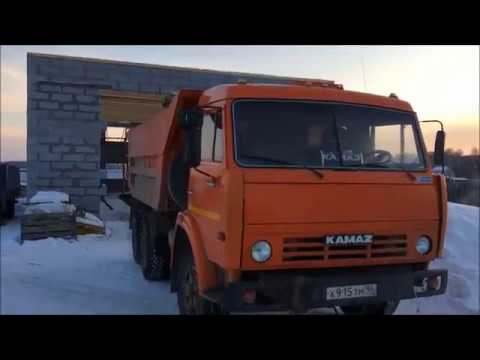
KamAZ-5511 video 2
FAQ
What is the payload of the KamAZ-5511?
The KamAZ-5511 carries 10,000 kg in its steel dump body, with a gross vehicle weight of 19,150 kg. The agricultural 55102 version carries 7 tonnes in a larger body.
What engine does the KamAZ-5511 have?
It uses the KamAZ-740, a 10.85-litre naturally aspirated V8 diesel with 154 kW (210 PS) and 639 Nm, combined with a five-speed gearbox and a two-stage range unit.
How big is the KamAZ-5511 body?
The steel body originally held 7.2 m³. It was later shortened by about half a metre, reducing the volume to about 6.6 m³. It can be heated by exhaust gas to stop loads freezing.
When was the KamAZ-5511 made?
Series production ran from 1977 to 1990, after a 1972 prototype called the KamAZ-5510. The successor, the KamAZ-55111, was built in parallel from 1988 until 2012.
What replaced the KamAZ-5511?
The KamAZ-55111 replaced it. It entered production in 1988, alongside the 5511, and remained in production until 2012, keeping the same basic layout with updated components.
Data sources
Data checked by an editor against the sources below.
- The text of this article (1cars archive)
- Wikipedia - KAMAZ


