
Ural-375 vs Ural-4320: from petrol V8 to diesel
Updated Report an error By Oleksandr Hnatiuk

Ural · 1964–1991
Ural-375D / 375DM
- Power
- 132 kW179 PS
- Top speed
- 75 km/h

Ural · 1977–present
Ural-4320
- Power
- 132 kW179 PS
- Top speed
- —
Verdict Opinion
The Ural-4320 is the better truck in almost every practical respect: more power, more payload, better road speed and far lower fuel consumption, with a production life that ran into the 2010s and beyond. The Ural-375 is the original, simpler petrol design, and the one that defined the bonneted Ural 6x6 shape.
For daily work the diesel is the logical choice; for heritage value and simplicity the petrol 375D still has its followers, as long as the owner can live with its fuel bills.
— Oleksandr Hnatiuk
The Ural-4320 is the diesel successor to the Ural-375, and from the outside the two trucks are close relatives. Both are bonneted three-axle trucks with permanent six-wheel drive, a 3,500 + 1,400 mm wheelbase, 14.00-20 tyres with central tyre inflation and the same optional rear winch. The 4320 even used the 375 load bodies until about 1986.
Underneath, the change was fundamental. The Ural-375 went into series production in 1960 with a thirsty petrol V8. Its replacement needed a diesel, and after an in-house diesel was dropped and prototype diesel engines were tested in a Ural-375D from 1970, the Ural-4320 was approved at the end of 1975. Series production began in 1977, and for many years the two trucks were built in parallel.
Engineering, design and everyday use
Engineering
The Ural-375D uses the ZIL-375Ya, a 7.0-litre carburettor petrol V8 rated at about 130 to 132 kW (180 PS). The Ural-4320 started with the KamAZ-740 V8 diesel of 10.85 litres and about 155 kW (210 PS); later versions used YaMZ V6 and V8 diesels. Both keep a five-speed manual gearbox and a two-speed lockable transfer case. The 4320 switched from 12-volt to 24-volt electrics.
Fuel and range
Fuel was the main reason for the change. The Ural-375D uses about 45 to 50 L/100 km on the road and roughly double that off road, which gives a range of only about 500 to 550 km from 300 litres plus an optional 60. With a similar tank, the diesel Ural-4320 is quoted at 27 to 38 L/100 km on the road and a range of 700 to 1,100 km.
Use
The Ural-375D is rated at 4,800 kg (10,582 lb). Published Ural-4320 payloads range from 5,000 to 6,000 kg (11,023 to 13,228 lb), depending on version. Top speed rises from 75 km/h (47 mph) to about 80 to 85 km/h (50 to 53 mph). Both trucks served as the base for the BM-21 Grad launcher: the 375D from 1963 and the 4320 from 1976.
Full specifications
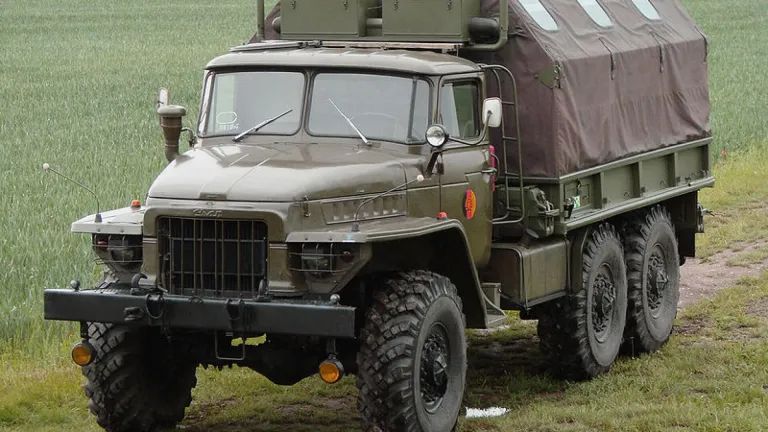
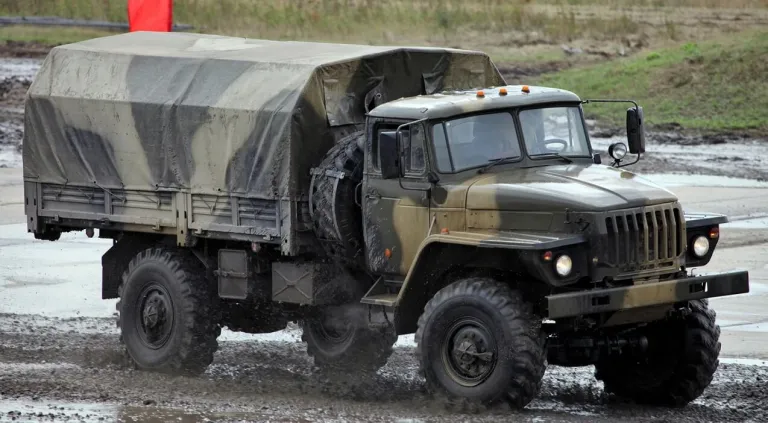
| Ural-375 | Ural-4320 | |
|---|---|---|
| General | ||
| Version | Ural-375D / 375DM · Ural-375D · petrol · 132 kW (179 PS) | 11.2 YaMZ-236M2 · diesel · 132 kW (179 PS) |
| Production years | 1964–1991 | 1977–present |
| Body | Truck | Truck |
| Class | Heavy truck | Heavy truck |
| Country | Soviet Union (USSR) | Soviet Union (USSR) |
| Performance | ||
| Power Why it matters: More power means stronger acceleration and easier overtaking, especially with a full load. | 132 kW (179 PS) 177 hp | 132 kW (179 PS) 177 hp |
| Power, all versions | 132 kW (179 PS) 177 hp | 132–229 kW (179–311 PS) 177–307 hp |
| Top speed Why it matters: Top speed hints at how relaxed the car is at motorway speeds, even if you never reach it. | 75 km/h 47 mph | No data |
| Engine and transmission | ||
| Fuel | Petrol | Diesel |
| Engine | 7,000 cc · 8 cyl 7.0 l | 11,150 cc · 6 cyl 11.2 l |
| Engine code | ZIL-375Ya 7.0 L petrol V8 | YaMZ-236M2 |
| Gearbox | 5-speed manual | No data |
| Drive | Multi-axle drive (6×6, 8×8…) | Multi-axle drive (6×6, 8×8…) |
| Dimensions and weight | ||
| Length | No data | 7,366 mm 290.0 in |
| Width | No data | 2,500 mm 98.4 in |
| Height | No data | 2,715 mm 106.9 in |
| Economy and running costs | ||
| Fuel consumption Why it matters: Lower consumption cuts running costs and CO₂ emissions on every trip. | 50.0 l/100 km 4.7 mpg US | No data |
| Fuel cost per year | €13,130/year estimated | No data |
These cars do not differ in the data we have.
Equal rows hidden (5): Body, Class, Country, Power, Drive.
Estimated at 15,000 km a year with fuel at €1.75/l petrol.
In plain words
Ural-375 is the older design (from 1960); Ural-4320 arrived in 1977. Ural-4320 is still in production; Ural-375 is not.
Which one to choose
Choose the Ural-375 if you want the original 1960s Ural with a petrol V8 and simple 12-volt electrics, and your mileage is low enough for its consumption not to matter.
Choose the Ural-4320 if you plan to drive the truck regularly: the diesel gives a far longer range and a higher payload. Check which engine is fitted, as KamAZ- and YaMZ-engined versions differ.
Frequently asked questions
Is the Ural-4320 just a diesel Ural-375?
Largely, in concept. It keeps the bonneted 6x6 layout, wheelbase, tyres and central tyre inflation, but has a diesel engine, 24-volt electrics and a higher payload, and it evolved into many more versions.
How much fuel does a Ural-375 use?
About 45 to 50 L/100 km on the road and roughly double that off road. The diesel Ural-4320 is quoted at 27 to 38 L/100 km on the road.
When did the Ural-4320 replace the Ural-375?
The Ural-4320 entered series production in 1977, but the Ural-375D and the modernised 375DM stayed in production alongside it until the early 1990s.