
Ural-375 vs ZIL-131: petrol V8 army trucks of the 1960s
Updated Report an error By Oleksandr Hnatiuk

Ural · 1964–1991
Ural-375D / 375DM
- Power
- 132 kW179 PS
- Top speed
- 75 km/h
- Kerb mass
- —

ZIL · 1967–1990
ZIL-131
- Power
- 110 kW150 PS
- Top speed
- —
- Kerb mass
- 6,700 kg
Verdict Opinion
The Ural-375 is the heavy hauler of the pair, with the bigger engine, the higher payload and more ground clearance. The ZIL-131 is the lighter, more numerous workhorse: almost one million were built, and its parts commonality with the ZIL-130 made it easier to keep running. Both were eventually followed by diesels: the Ural by the Ural-4320, the ZIL by its diesel N1 and N2 variants.
For anyone choosing between them today, size, fuel bills and parts supply matter more than outright capability.
— Oleksandr Hnatiuk
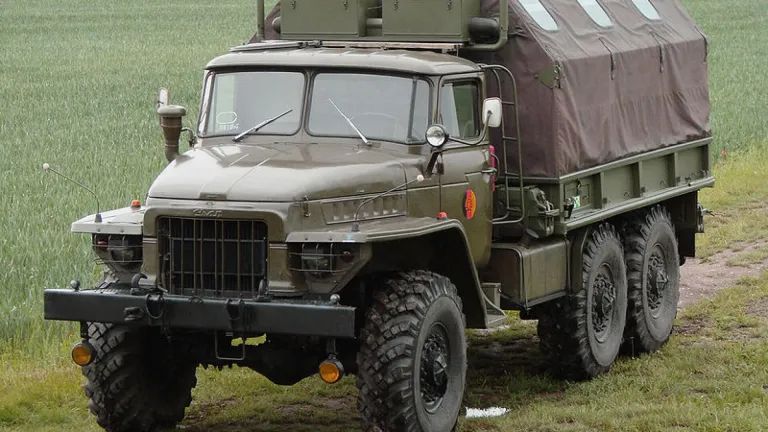
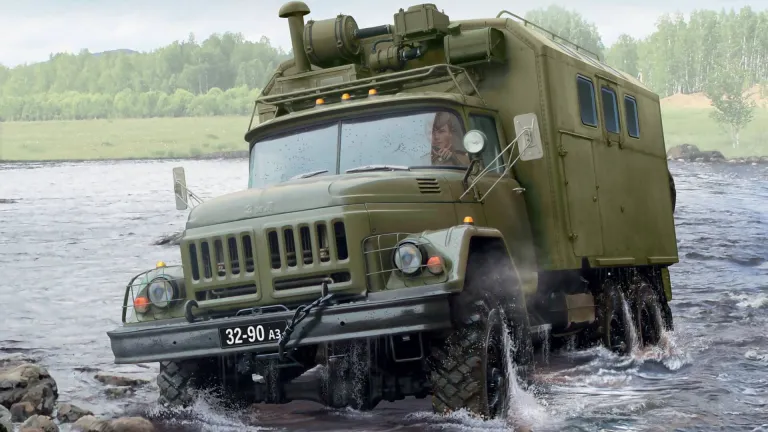
The Ural-375 and the ZIL-131 are the two petrol-engined three-axle trucks that replaced the ZIL-157 in Soviet Army service. Both are bonneted 6x6 designs with a ladder frame, leaf-sprung solid axles, a rear bogie and a two-speed transfer case, and both remained in production for roughly three decades.
They sit in different weight classes, though. The Ural-375 is the heavier truck, rated at 4,800 kg (10,582 lb), and went into series production from November 1960. The ZIL-131 is a lighter 3.5 t off-road / 5 t on-road truck, introduced in 1966 with series production from 1967, and it shares its cab and many parts with the civilian ZIL-130.
Engineering, design and everyday use
Engineering
Both trucks use a carburettor petrol V8, and the engines are related. The Ural-375 has the ZIL-375Ya, a 7.0-litre V8 described as a bored-out ZIL-130 unit, rated at about 130 to 132 kW (180 PS). The ZIL-131 uses a ZIL-130-family V8 of about 6.0 litres with 110 kW (150 PS) at 3,200 rpm and 402 Nm. Both have a five-speed manual gearbox and a two-speed transfer case, and both offer central tyre inflation.
Design and size
The Ural is the bigger machine: 7,350 mm (289.4 in) long, 8,400 kg (18,519 lb) at kerb with winch and 400 mm (15.7 in) of ground clearance on 14.00-20 tyres. The ZIL-131 is 7,040 mm (277.2 in) long with winch, weighs 6,700 kg (14,771 lb) and has 330 mm (13.0 in) of clearance. The first Ural-375 had a canvas-roof cab; the all-steel cab arrived with the 375D from 1964.
Use and running costs
The ZIL is quicker on the road, with a top speed of 80 km/h (50 mph) against 75 km/h (47 mph) for the loaded Ural. Fuel is the weak point of both: about 45 to 50 L/100 km on the road for the Ural-375D and about 40 L/100 km for the ZIL-131, with far higher figures off road. The Ural tows up to 10,000 kg (22,046 lb); the ZIL is rated at 6,500 kg (14,330 lb) on the road.
Full specifications
| Ural-375 | ZIL-131 | |
|---|---|---|
| General | ||
| Version | Ural-375D / 375DM · Ural-375D · petrol · 132 kW (179 PS) | petrol · 110 kW (150 PS) |
| Production years | 1964–1991 | 1967–1990 |
| Body | Truck | Truck |
| Class | Heavy truck | Heavy truck |
| Country | Soviet Union (USSR) | Soviet Union (USSR) |
| Performance | ||
| Power Why it matters: More power means stronger acceleration and easier overtaking, especially with a full load. | 132 kW (179 PS) 177 hp Better | 110 kW (150 PS) 148 hp |
| Power, all versions | 132 kW (179 PS) 177 hp | 77–110 kW (105–150 PS) 103–148 hp |
| Top speed Why it matters: Top speed hints at how relaxed the car is at motorway speeds, even if you never reach it. | 75 km/h 47 mph | No data |
| Power per tonne | No data | 16 kW/t 20 hp/ton calculated |
| Engine and transmission | ||
| Fuel | Petrol | Petrol |
| Engine | 7,000 cc · 8 cyl 7.0 l | 8 cyl |
| Engine code | ZIL-375Ya 7.0 L petrol V8 | No data |
| Gearbox | 5-speed manual | No data |
| Drive | Multi-axle drive (6×6, 8×8…) | No data |
| Dimensions and weight | ||
| Length | No data | 7,040 mm 277.2 in |
| Width | No data | 2,500 mm 98.4 in |
| Height | No data | 2,480 mm 97.6 in |
| Wheelbase | No data | 3,975 mm 156.5 in |
| Kerb weight Why it matters: A lighter car is usually more agile and uses less energy. | No data | 6,700 kg 14,771 lb |
| Economy and running costs | ||
| Fuel consumption Why it matters: Lower consumption cuts running costs and CO₂ emissions on every trip. | 50.0 l/100 km 4.7 mpg US | No data |
| Fuel cost per year | €13,130/year estimated | No data |
These cars do not differ in the data we have.
Equal rows hidden (4): Body, Class, Country, Fuel.
Better marks the stronger figure — only for measurable specs (power, torque, 0–100 km/h, consumption, boot, weight).
Estimated at 15,000 km a year with fuel at €1.75/l petrol.
In plain words
Ural-375 has more power: 132 kW (179 PS) against 110 kW (150 PS) for ZIL-131. Ural-375 is the older design (from 1960); ZIL-131 arrived in 1967. Our catalog has no kerb mass for the Ural-375 yet, so some checks above leave it out.
Which one to choose
Choose the Ural-375 if you need the heavier payload, the larger tyres and the greater clearance, and you accept very high petrol consumption. The 375D with the all-steel cab is the most common version.
Choose the ZIL-131 if you want a more manageable truck with a large production run behind it and wide parts sharing with the ZIL-130. Civilian conversions, including campers, exist as well.
Frequently asked questions
Are the Ural-375 and ZIL-131 engines related?
Yes. The Ural-375 engine is described as a bored-out ZIL-130 V8 of 7.0 litres, while the ZIL-131 uses a ZIL-130-family V8 of about 6.0 litres. Both run on petrol.
Which truck carries more?
The Ural-375D is rated at 4,800 kg. The ZIL-131 carries 3,500 kg off road and 5,000 kg on roads.
How many ZIL-131 trucks were built?
Close to one million; one published figure is 998,429. No reliable total is published for the Ural-375.