Legendary Soviet trucks: eight models that moved a country
Soviet trucks were designed for enormous distances, unpaved roads and harsh winters, and many of them stayed in production for decades. Their engineering answers – central tyre inflation controlled from the cab, permanent six-wheel drive, simple petrol V8s and later large diesel V8s – are still admired by off-road enthusiasts and collectors.
For this list we looked for trucks that were built in large numbers, introduced an important technical idea, or defined a whole class of transport, from the ZIL-157 of 1958 to the KamAZ-4310 of 1981. We only included models with a published model page on 1cars whose production years and engines could be confirmed by a verified catalogue entry, our researched fact sheets or independent reference sources.
The eight trucks appear in chronological order of series production. For each one we explain why it earns its place, who might want one today – as a collector's piece, an expedition base or a working vehicle – and the honest drawback you should weigh before buying.
-
1. ZIL-157
The pioneer of tyre inflation
- Production years
- 1958–1992
- Body type
- Flatbed truck
- Fuel
- Petrol
- Power output
- 76–80 kW (103–109 PS)
Nicknamed 'Krokodil' for its long bonnet, the ZIL-157 entered series production in September 1958 and won a prize at that year's Brussels World Expo. Compared with the ZIS-151 it gained single rear tyres and a central tyre-pressure system controlled from the cab. The first version's petrol six gave about 76 kW (104 PS), and almost 800,000 were built over 36 years; many served forestry firms as log trucks. It suits collectors and off-road enthusiasts who want a simple, robust six-wheel-drive truck. The drawback: top speed is only about 65 km/h, so long road journeys are slow.
Full review: ZIL-157Pros
- Central tyre inflation from the cab
- Simple petrol six-cylinder engine
- Almost 800,000 built
Cons
- About 65 km/h top speed
-
2. Ural-375
The heavy all-rounder
- Production years
- 1960–1991
- Body type
- Truck, Tractor unit
- Fuel
- Petrol
- Power output
- 132 kW (179 PS)
Developed from a 1953 requirement, the Ural-375 went into series production in November 1960 and replaced the ZIL-157 as the standard heavy army truck. Its 7.0-litre petrol V8 gives about 132 kW (180 PS), all three axles are permanently driven, and tyre pressure can be adjusted while driving. The payload is 4,800 kg, and it can tow up to 10,000 kg. The all-steel-cab 375D followed in 1964 and stayed in production for decades. It suits buyers who want a capable heavy six-wheel-drive truck with simple mechanics. The drawback: road fuel use of about 45–50 L/100 km.
Full review: Ural-375Pros
- Permanent six-wheel drive with central tyre inflation
- 4,800 kg payload, 10,000 kg towing
- Simple petrol V8
Cons
- Thirsty: about 45–50 L/100 km on the road
-
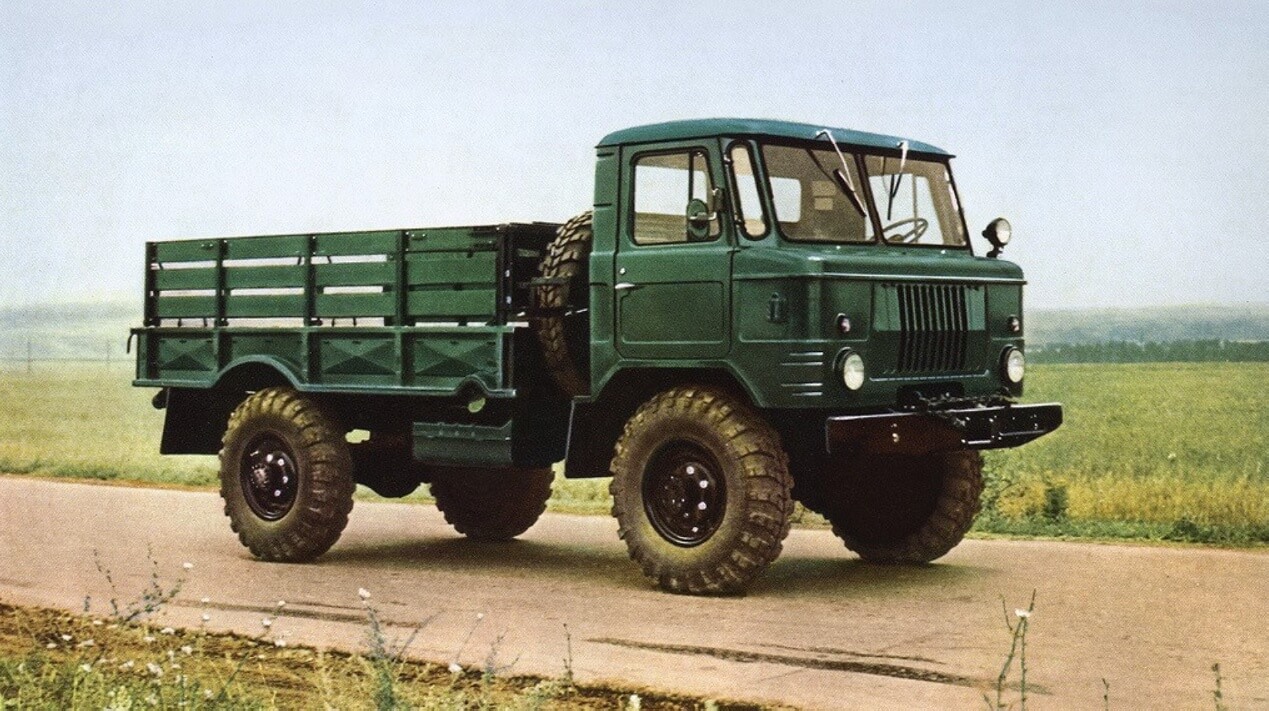
3. GAZ-66
Most agile off-roader
- Production years
- 1964–1999
- Body type
- Truck
- Fuel
- Petrol, Diesel
- Power output
- 85–88 kW (116–120 PS)
Series production of the GAZ-66 began on 1 July 1964 and ended in 1999 after 965,941 trucks. It placed the cab over the engine of a compact four-wheel-drive truck with a 2,000 kg payload; the 4,254 cc petrol V8 gave 85 kW (115 PS), raised to 88 kW (120 PS) in 1985, and diesel versions followed in 1993. Nicknamed 'shishiga', it carried infantry and also served as a van, ambulance and mobile clinic. It suits anyone who needs a small, highly mobile off-roader or an expedition base. The drawback: the 2,000 kg payload makes it a light truck by Soviet standards.
Full review: GAZ-66Pros
- Compact cab-over four-wheel drive
- 965,941 built over 35 years
- Diesel versions from 1993
Cons
- Light payload: 2,000 kg
-
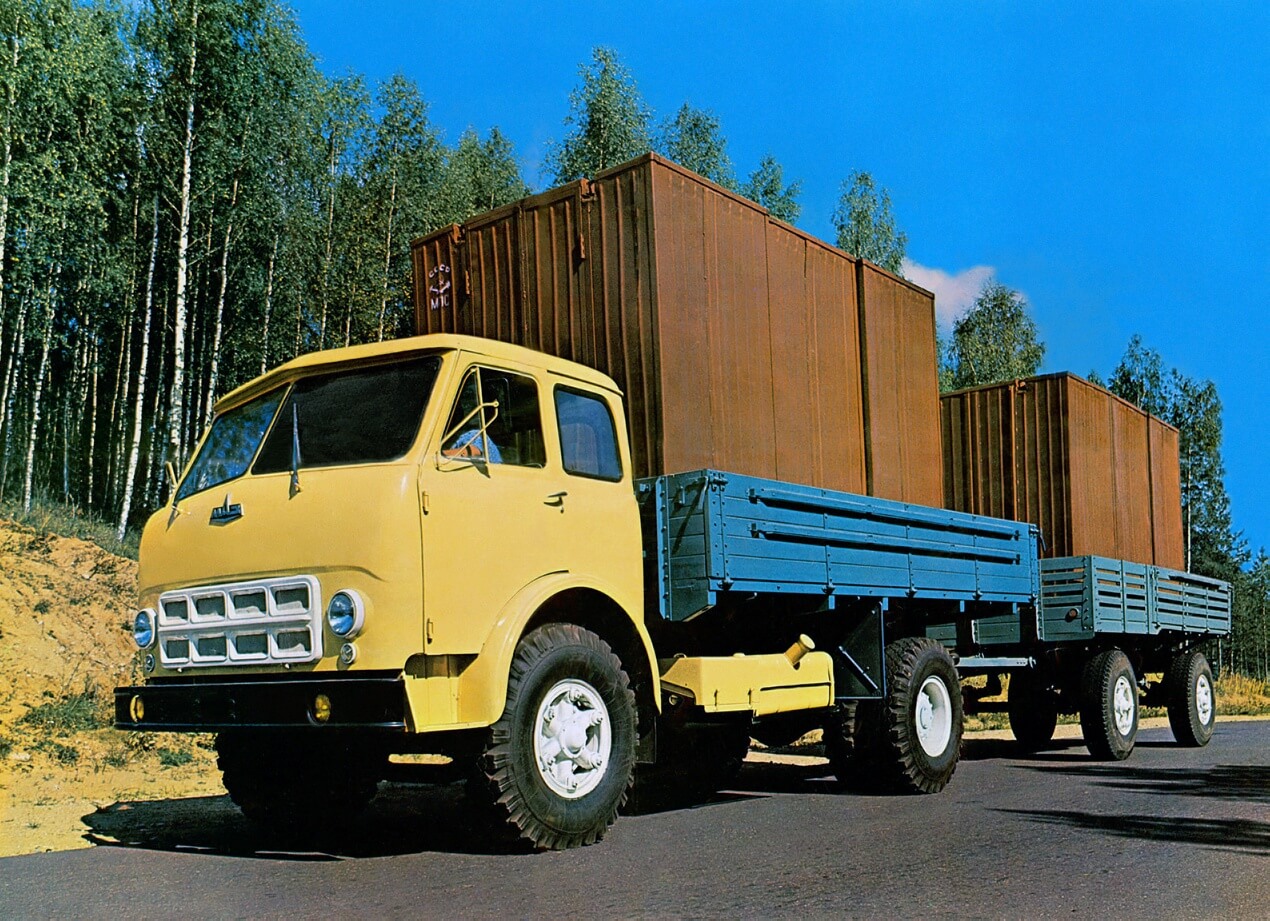
4. MAZ-500
The road-haulage classic
- Production years
- 1965–1977
- Body type
- Truck
- Fuel
- Diesel
- Power output
- 132–177 kW (179–241 PS)
The MAZ-500 replaced the bonneted MAZ-200 with a cab-over design to save weight, raise payload and lower fuel use, and its tilting cab was unusual for its time. After a 1955 prototype and limited production from 1963, full series production ran from 1965 to 1977. The standard YaMZ-236 V6 diesel gave 132 kW (180 PS), heavier models used the YaMZ-238 V8 with 177 kW (240 PS), and the family included the 503 dump truck and 504 tractor unit. It suits fans of classic road haulage. The drawback: it was designed for roads, not for off-road work.
Full review: MAZ-500Pros
- Tilting cab-over design
- Diesel V6 or V8 engines
- Flatbed, dump-truck and tractor variants
Cons
- A road truck with limited off-road ability
-
5. ZIL-131
The million-seller
- Production years
- 1967–1990
- Body type
- Truck
- Fuel
- Petrol, Diesel
- Power output
- 77–110 kW (105–150 PS)
The ZIL-131 replaced the ZIL-157 and shares its cab and many parts with the ZIL-130 road truck. Built at ZIL from 1967 to 1990 and from 1987 also at a second plant in the Urals, it reached 998,429 units and received the Soviet State Quality Mark in 1974. The six-wheel-drive truck carries 5,000 kg on roads or 3,500 kg off road, with a two-speed transfer case, a central tyre-pressure system and a petrol V8 from the ZIL-130 family. It suits off-road buyers who want parts commonality with one of the most widely built Soviet truck families. The drawback: top speed is about 80 km/h.
Full review: ZIL-131Pros
- 998,429 built
- 5,000 kg road payload
- Central tyre-pressure system
Cons
- About 80 km/h top speed
-
6. KamAZ-5320
The long-distance workhorse
- Production years
- 1976–2000
- Body type
- Truck
- Fuel
- Diesel
- Power output
- 132–154 kW (179–209 PS)
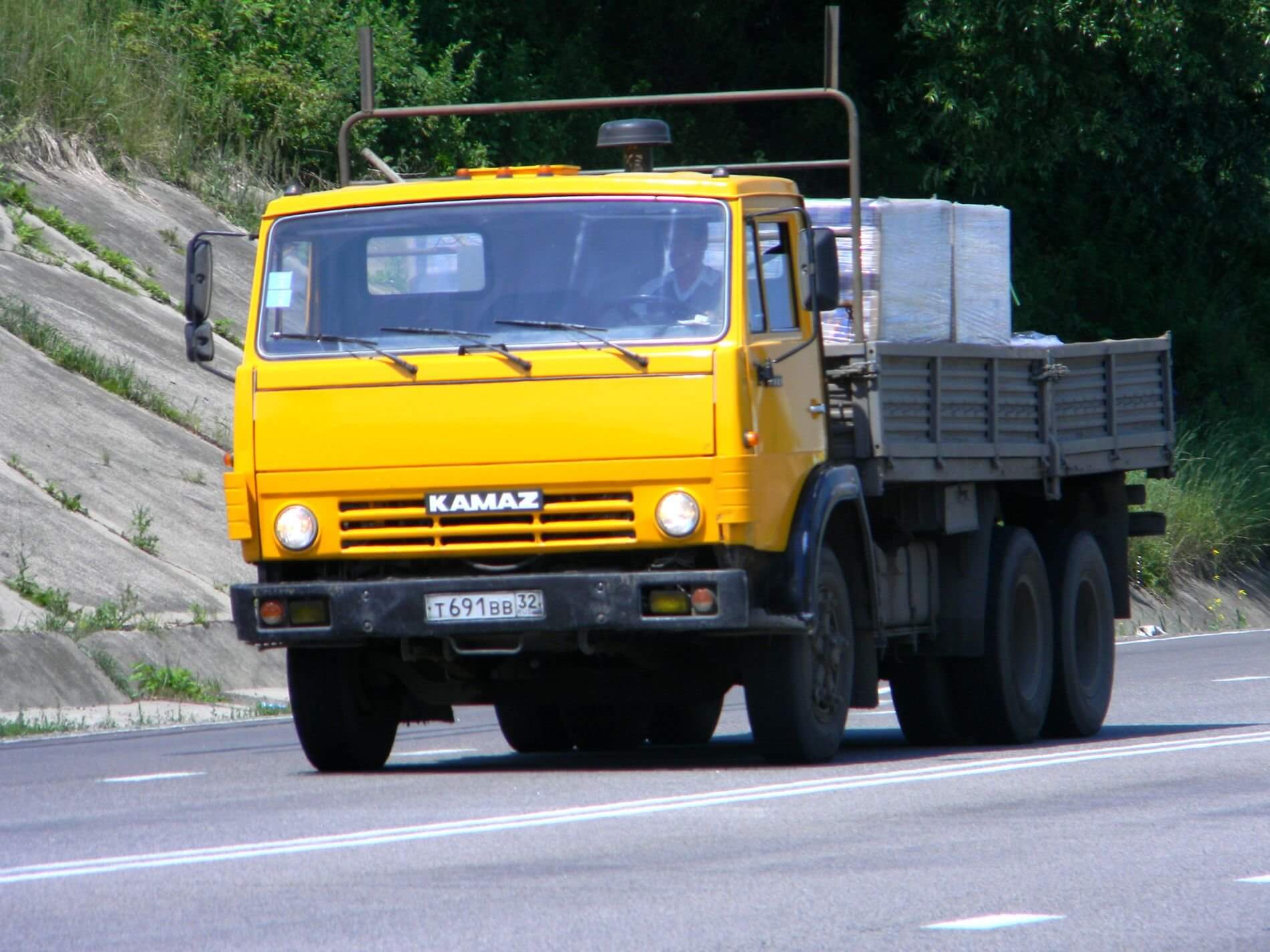
KamAZ was founded in 1969, and the 5320 was one of its first trucks: small numbers were built from 1976 and series production started in 1978, continuing until 2000. The 6x4 flatbed uses the 10,850 cc KamAZ-740 V8 diesel with 154 kW (210 PS), a five-speed gearbox with a range group that gives ten ratios, and an 8,000 kg payload. Every cab tilts forward for engine access. It suits buyers interested in the typical road freight truck of the late Soviet period. The drawback: it was not intended for heavy off-road use.
Full review: KamAZ-5320Pros
- 10.85-litre V8 diesel, 154 kW (210 PS)
- 8,000 kg payload
- Tilting cab
Cons
- Not intended for heavy off-road use
-
7. Ural-4320
The diesel successor
- Production years
- 1977–present
- Body type
- Truck
- Fuel
- Diesel
- Power output
- 132–229 kW (179–311 PS)
The diesel successor to the Ural-375 was approved for series production at the end of 1975, but engine shortages meant the first five trucks were only finished in December 1977. Its KamAZ-740.10 V8 diesel gives about 154–156 kW (210 PS) from 10.85 litres, and the permanent six-wheel drive keeps the 375's go-anywhere ability in the 5–6 t payload class. Crew cabs and sleeper cabs were offered, and after KamAZ stopped supplying engines in 2013 the truck switched to YaMZ diesels and stayed in production. It suits buyers who want a heavy off-roader that is still current. The drawback: it is a large, heavy specialist vehicle.
Full review: Ural-4320Pros
- Diesel instead of the 375's petrol V8
- Still in production in updated form
- Crew-cab and sleeper versions
Cons
- Large and heavy for civilian use
-
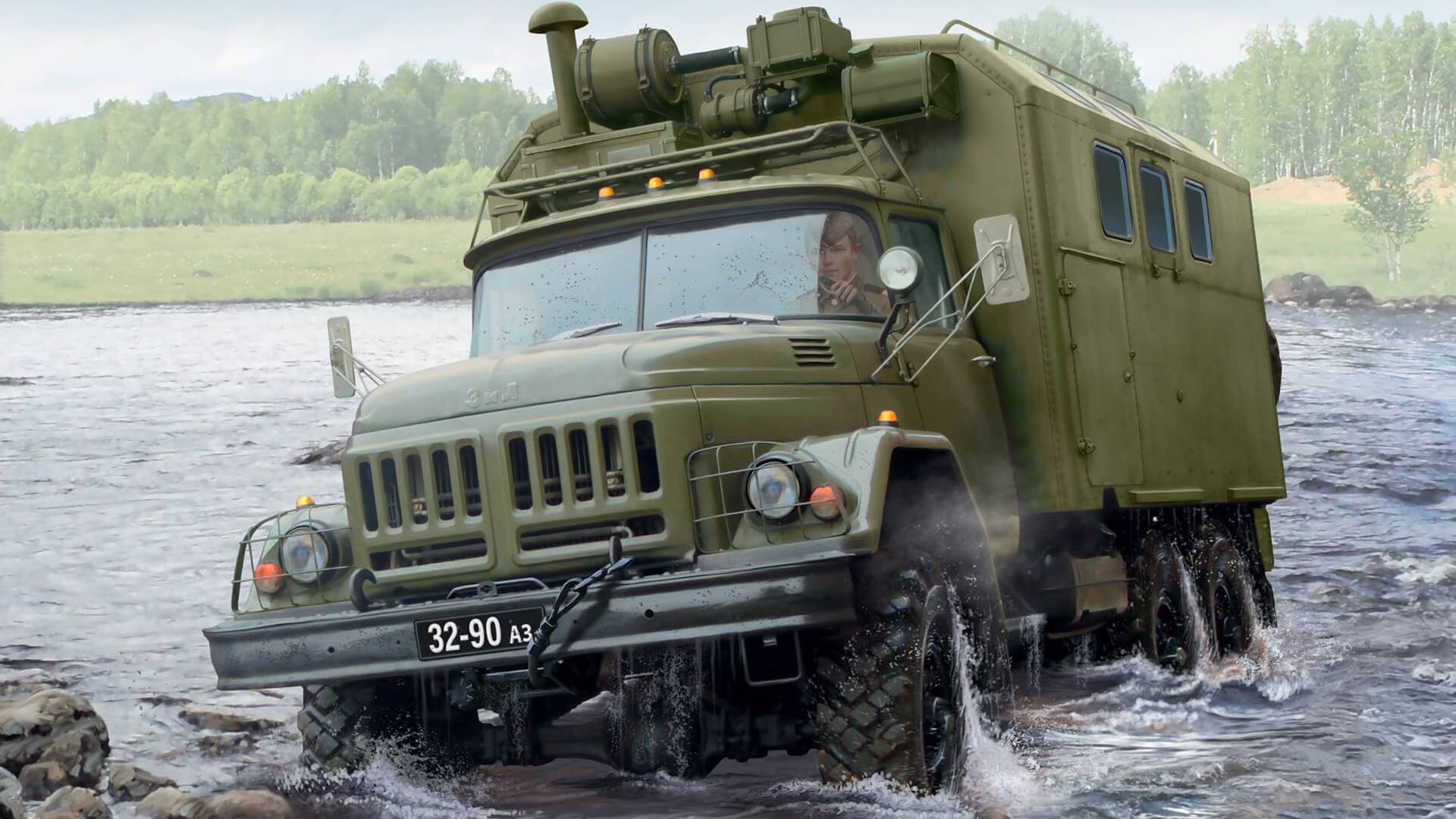
8. KamAZ-4310
The six-wheel-drive KamAZ
- Production years
- 1981–1995
- Body type
- Truck
- Fuel
- Diesel
- Power output
- 154–162 kW (209–220 PS)
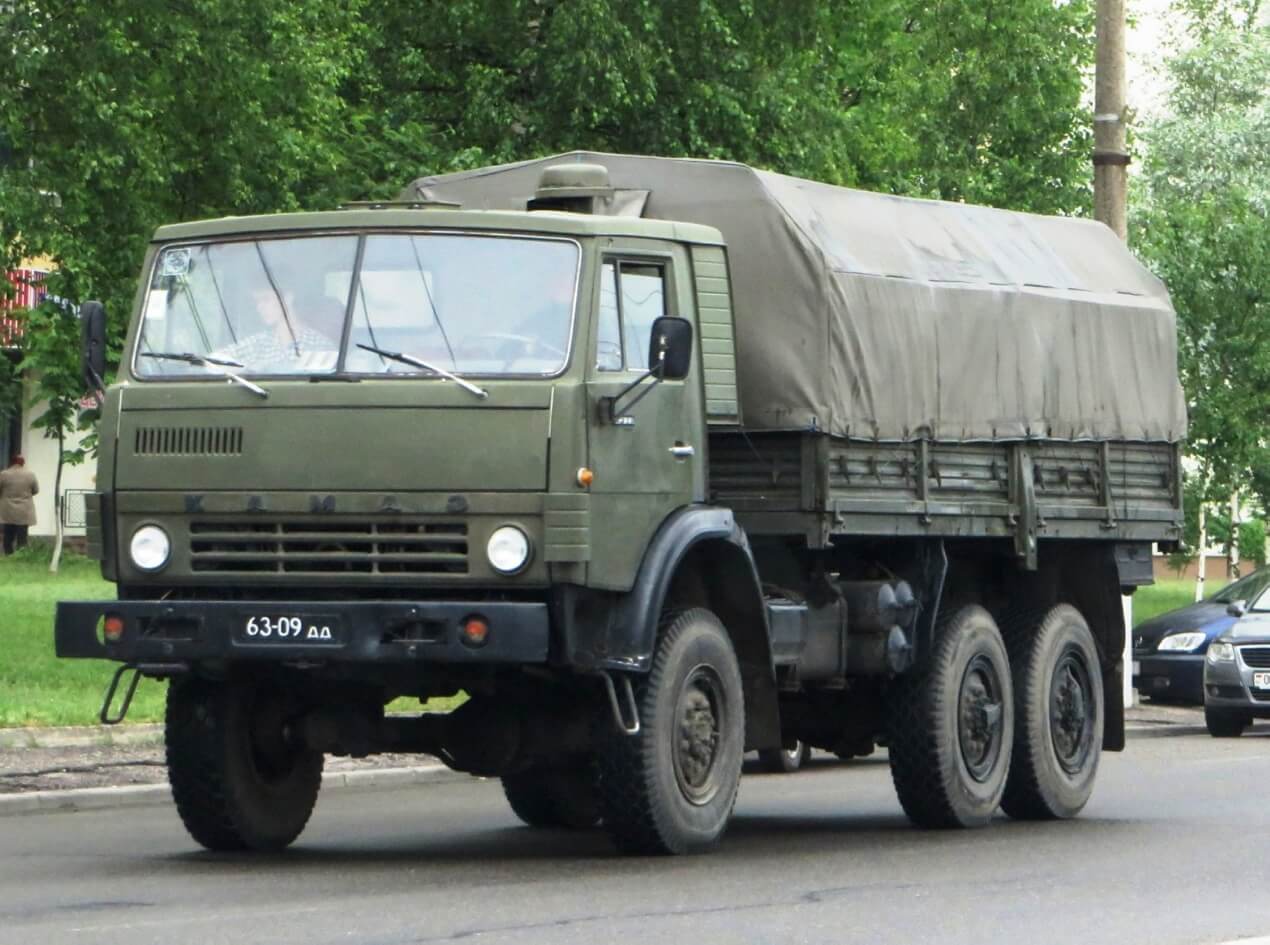
The KamAZ-4310 was shown as a prototype in 1971 but entered series production only in 1981; it was built until 1995, when the 43114 replaced it. Permanent six-wheel drive, single tyres on all axles and a tilting cab carry a 6,000 kg payload, and the 10.85-litre KamAZ-740 V8 gave 154 kW (210 PS), raised to 162 kW (220 PS) in 1989. Reference sources describe it as the most common six-wheel-drive truck in the Soviet Army of the 1980s. It suits buyers who want KamAZ parts commonality with full off-road ability. The drawback: fuel use of about 31 L/100 km at 60 km/h.
Full review: KamAZ-4310Pros
- 6,000 kg payload with off-road ability
- Permanent six-wheel drive
- Shares its engine family with the KamAZ-5320
Cons
- About 31 L/100 km at 60 km/h



Catalog: All Soviet-era models in the catalog — every model with specs, not only our picks.
How we chose
Selection. We considered Soviet trucks with long production runs and included only those whose years and engines we could confirm. We left out the KamAZ-5410 (the tractor-unit version of the 5320), the ZIL-133 (its start year could not be confirmed), the KrAZ-250 (too little verifiable data), the GAZ-3307 (built from 1989 to 2020, mostly after the Soviet period) and the MAZ-503 (a dump-truck variant covered by the MAZ-500). We added the ZIL-157, KamAZ-4310 and Ural-4320, which have researched data. Every truck listed has a published model page on 1cars.
Data sources. Card facts come from the 1cars catalogue; for the GAZ-66 (years, power), MAZ-500 (power) and Ural-4320 (years) we corrected the values from Wikipedia before publication, and the ZIL-131, ZIL-157, Ural-375 and KamAZ-4310 entries were already verified. Text facts come from our researched fact sheets (English and German Wikipedia, technical encyclopaedias and model-kit references) and from English and German Wikipedia for the GAZ-66, MAZ-500 and KamAZ-5320. Power is given in kW first, then PS as in the source.
Ranking. The order is chronological by start of series production; the selection is editorial. Prices are deliberately not given.
Frequently asked questions
Which Soviet truck is best for off-road use?
The six-wheel-drive ZIL-131, Ural-375, Ural-4320 and KamAZ-4310 were all designed for off-road work, and the compact four-wheel-drive GAZ-66 is the most agile. The KamAZ-5320 and MAZ-500 are road trucks.
What is central tyre inflation?
A system that lets the driver lower or raise tyre pressure from the cab while driving. Lower pressure gives a larger footprint in sand, mud or snow. The ZIL-157 was one of the first Soviet trucks to offer it, and the ZIL-131 and Ural-375 kept it.
Are petrol or diesel Soviet trucks better?
Petrol V8 trucks such as the ZIL-131 and Ural-375 are mechanically simple but thirsty: the Ural-375 uses about 45–50 L/100 km on the road. The diesel Ural-4320 and KamAZ trucks are far more economical.
Why are there no prices in this list?
Prices depend on the country, age, mileage and condition of each car and change quickly. We only publish facts that can be checked, so compare current local listings and a full service history before you buy.