Volkswagen Tiguan — Three Generations of VW's Compact SUV
The Volkswagen Tiguan is VW's compact SUV and, for most of its life, one of the most successful cars of the Volkswagen Group. The first generation appeared in 2007, the second in 2016 and the third in 2024. By spring 2020 more than six million had been sold worldwide, and in 2019 alone Volkswagen built 910,926 of them. The name combines the German words Tiger and Leguan (iguana); it was chosen in a naming contest run by the magazine Auto Bild.
Key takeaways
- Three generations: Tiguan I (2007–2016 in Europe), Tiguan II (2016–2024) and Tiguan III (since 2024).
- Outputs range from 81 kW (110 PS) in the first 2.0 TDI to 235 kW (320 PS) in the Tiguan R of 2020–2024.
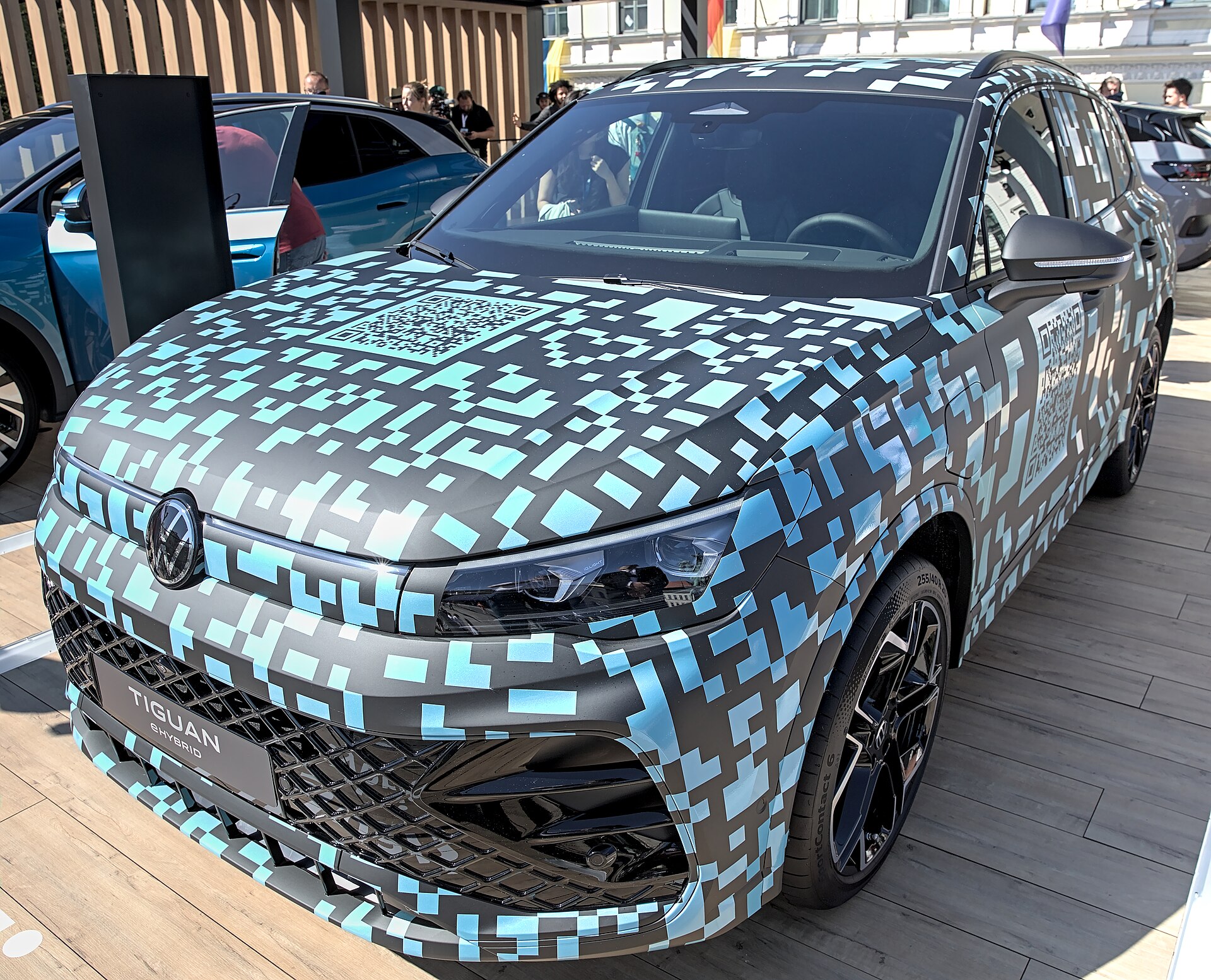
- The 2024 Tiguan eHybrid has a 19.7 kWh battery and up to about 120 km of electric range (WLTP).
- In Germany the Tiguan III started at €36,600 with the 96 kW eTSI (February 2024).
Volkswagen Tiguan at a glance
| Specification | Volkswagen Tiguan |
|---|---|
| Production | since 2007; Wolfsburg, also Osnabrück and Puebla (Mexico) |
| Generations | Tiguan I (5N), Tiguan II (AD1, Allspace BW2), Tiguan III |
| Platform | PQ46 (I), MQB (II), MQB evo (III) |
| Body | five-door SUV; seven-seat long-wheelbase Allspace (II) |
| Drive | front-wheel drive or 4MOTION all-wheel drive |
| Fuel | petrol, diesel, plug-in hybrid (eHybrid since 2020); 48-volt mild hybrid (eTSI) in the III |
| Most powerful | Tiguan R (2020–2024): 235 kW (320 PS), 420 Nm |
| Length (III) | 4,551 mm; wheelbase 2,681 mm |
| Euro NCAP | five stars for the II (2016) and the III (2024) |
The Tiguan sits between the Volkswagen Golf, whose technology it shares, and the larger Volkswagen Touareg. The full VW range is in the Volkswagen catalogue.
Size at a glance
Volkswagen Tiguan AD1
The Volkswagen Tiguan III is 65 mm longer and 8 mm taller than the Volkswagen Tiguan AD1.
| Dimensions | Volkswagen Tiguan III | Volkswagen Tiguan AD1 | Difference |
|---|---|---|---|
| Length | 4,551 mm179.2 in | 4,486 mm176.6 in | +65 mm+2.6 in |
| Width | 1,842 mm72.5 in | 1,839 mm72.4 in | +3 mm+0.1 in |
| Height | 1,640 mm64.6 in | 1,632 mm64.3 in | +8 mm+0.3 in |
| Wheelbase | 2,681 mm105.6 in | 2,677 mm105.4 in | +4 mm+0.2 in |
| Boot | 652 L23.0 cu ft | 615 L21.7 cu ft | +37 L+1.3 cu ft |
First generation (2007–2016): the Golf-based SUV
Volkswagen previewed the Tiguan with a concept car in Los Angeles in November 2006 and showed the production model at the Frankfurt show ten months later. Production began in 2007 in Wolfsburg; European sales started in early 2008. The Tiguan used modules from the Golf and the Passat, including 4MOTION all-wheel drive with a Haldex coupling, and its interior dimensions were based on the Golf Plus. Wikipedia names the platform PQ46. The boot held 470 litres, or about 360 litres with the false floor and a spare wheel, and up to 1,510 litres with the rear seats folded.
At launch the petrol range started with a 1.4 TSI of 90 kW (122 PS). The 2.0 TSI produced 147 kW (200 PS) and was raised to 155 kW (210 PS) at the facelift of July 2011. Diesel buyers began with a 2.0 TDI of 81 kW (110 PS), and versions of 100 to 125 kW followed. A long-wheelbase version for China, 4.54 m long, was added in 2010. European production ended in January 2016, while North America kept selling the old car as the Tiguan Limited until 2018.

Second generation (2016–2024): MQB, Allspace and Tiguan R
The second Tiguan was unveiled at Frankfurt in September 2015 and went on sale in January 2016. It moved to the MQB platform and was 50 kg lighter than its predecessor; the standard car is about 4.49 m long on a 2.68 m wheelbase. In 2017 Volkswagen added the long-wheelbase Tiguan Allspace, 4.70 m long and available with seven seats; in Europe it was later replaced by the Volkswagen Tayron. Puebla built it for most markets, and European sales began in September 2017. China received its own Tiguan L.
The facelift of July 2020 brought new LED headlights in the style of the Golf VIII, the MIB3 infotainment system and the optional Travel Assist. Two new versions followed in November 2020. The Tiguan R has a 2.0 TSI with 235 kW (320 PS), 420 Nm and a seven-speed DSG. The eHybrid plug-in delivers 180 kW (245 PS) of system output. Across the generation, petrol and diesel engines of 1.4 to 2.0 litres covered 92 to 235 kW; the 2.0 TDI alone ranged from 85 to 176 kW (115 to 240 PS).

Third generation (since 2024): eTSI and long-range eHybrid
The third Tiguan was presented in September 2023, orders opened in November and deliveries began in February 2024. It stays on an updated MQB platform (MQB evo) and is built in Wolfsburg. The body is 4,551 mm long, 1,842 mm wide and 1,640 mm tall, on a 2,681 mm wheelbase.
| Version (Tiguan III) | Power | Notes | German price (Feb 2024) |
|---|---|---|---|
| 1.5 eTSI | 96 kW (130 PS) | 48-volt mild hybrid, cylinder deactivation | from €36,600 |
| 1.5 eTSI | 110 kW (150 PS) | 48-volt mild hybrid | — |
| 2.0 TDI | 110 kW (150 PS) | diesel, available from launch | — |
| 2.0 TDI 4MOTION | 142 kW (193 PS) | all-wheel drive | from €49,055 (Life) |
| eHybrid | 150 kW (204 PS) | 19.7 kWh, about 120 km WLTP | from €48,655 |
| eHybrid | 200 kW (272 PS) | 19.7 kWh | — |
Petrol 2.0 TSI versions with up to 195 kW complete the range. The plug-in hybrids use the new 1.5-litre TSI engine with 110 or 130 kW plus an electric motor. Their battery has 19.7 kWh net and charges at up to 11 kW on alternating current (previously 3.6 kW) and up to 50 kW at fast chargers. The fuel cost comparison shows what that saves against a petrol or diesel version.


Engines by generation
| Generation | Years | Typical engines | Power range |
|---|---|---|---|
| Tiguan I (5N) | 2007–2016 | 1.4 TSI, 2.0 TSI, 2.0 TDI | 81–155 kW (110–210 PS) |
| Tiguan II (AD1) | 2016–2024 | 1.5 TSI, 2.0 TSI, 2.0 TDI, eHybrid, R | 85–235 kW (115–320 PS) |
| Tiguan III | since 2024 | 1.5 eTSI, 2.0 TSI, 2.0 TDI, eHybrid | 96–200 kW (130–272 PS) |
Versions of all three generations can be compared with the Tiguan's rivals, such as the Škoda Kodiaq, in the car comparison tool.
Safety
Euro NCAP judged the first Tiguan under its old scoring system: five stars for adult occupant protection, four for child protection and two of a possible four for pedestrians. The second generation received the full five stars in 2016, and the third generation five stars in its May 2024 test. In the 2024 test, Wikipedia gives 83 percent for adult and 88 percent for child occupant protection.
Reliability and known problems
In the ADAC breakdown statistics, Tiguans first registered in 2023 show 3.1 breakdowns per thousand cars and the 2022 cars 5.0. For the 2017–2019 registrations the figure rises to between 10.7 and 14.0. Older cars therefore need a careful check.
A CarGurus buying guide from November 2025 names the North American model years 2008 to 2010 as the weakest. On the first-generation 2.0 TSI it reports turbocharger and intake manifold failures and slipping timing chains. Cooling and electrical faults were common too. It rates the second generation better, but mentions engine, electrical and infotainment glitches. The third generation is too new for long-term data, which CarGurus expects around 2028.
Which Tiguan to buy
For drivers who can charge at home, the Tiguan III eHybrid with 150 kW makes the most sense. Its 120 km of electric range covers daily trips. In the German list of February 2024 it cost only about €400 less than the TDI 4MOTION. Drivers with long motorway distances or a caravan should take the 2.0 TDI 4MOTION. The 96 kW eTSI is the economical entry point for town use.
On the used market a late facelifted Tiguan II is the safest choice. It has the newer MIB3 infotainment. ADAC figures also improve clearly for cars registered in 2022: 5.0 breakdowns per 1,000, against 9.3 to 14.0 for 2017–2021. First-generation 2.0 TSI cars should be bought only with proof of timing-chain checks. Close rivals are the Škoda Kodiaq, the Hyundai Tucson, the Kia Sportage and the Ford Kuga; the car finder filters them by size and drive.
Photo gallery


FAQ
What does the name Tiguan mean?
It combines the German words Tiger and Leguan (iguana). The name was picked in an Auto Bild naming contest ahead of Namib, Rockton, Samun and Nanuk.
How many generations of the Tiguan are there?
Three: Tiguan I (2007), Tiguan II (2016) and Tiguan III (2024). The long-wheelbase Allspace belongs to the second generation.
Is the Tiguan a plug-in hybrid?
It can be. The eHybrid has been offered since 2020; the 2024 version has 150 or 200 kW and up to about 120 km of electric range.
Which Tiguan years should be avoided?
CarGurus names the first-generation model years 2008–2010 in North America, mainly for engine problems of the 2.0 TSI. In Germany, ADAC records the most breakdowns for cars registered between 2017 and 2019.
Is the Volkswagen Tiguan safe?
Yes. The second generation received five Euro NCAP stars in 2016 and the third generation five stars in 2024.