 Ferrari F40
Specs, engines and history
Published Sources (3) Report an error
By Felix Hartmann, Automotive Technology & EV Contributor
- Built
- 1987–1992
- Top power
- 356 kW (484 PS)
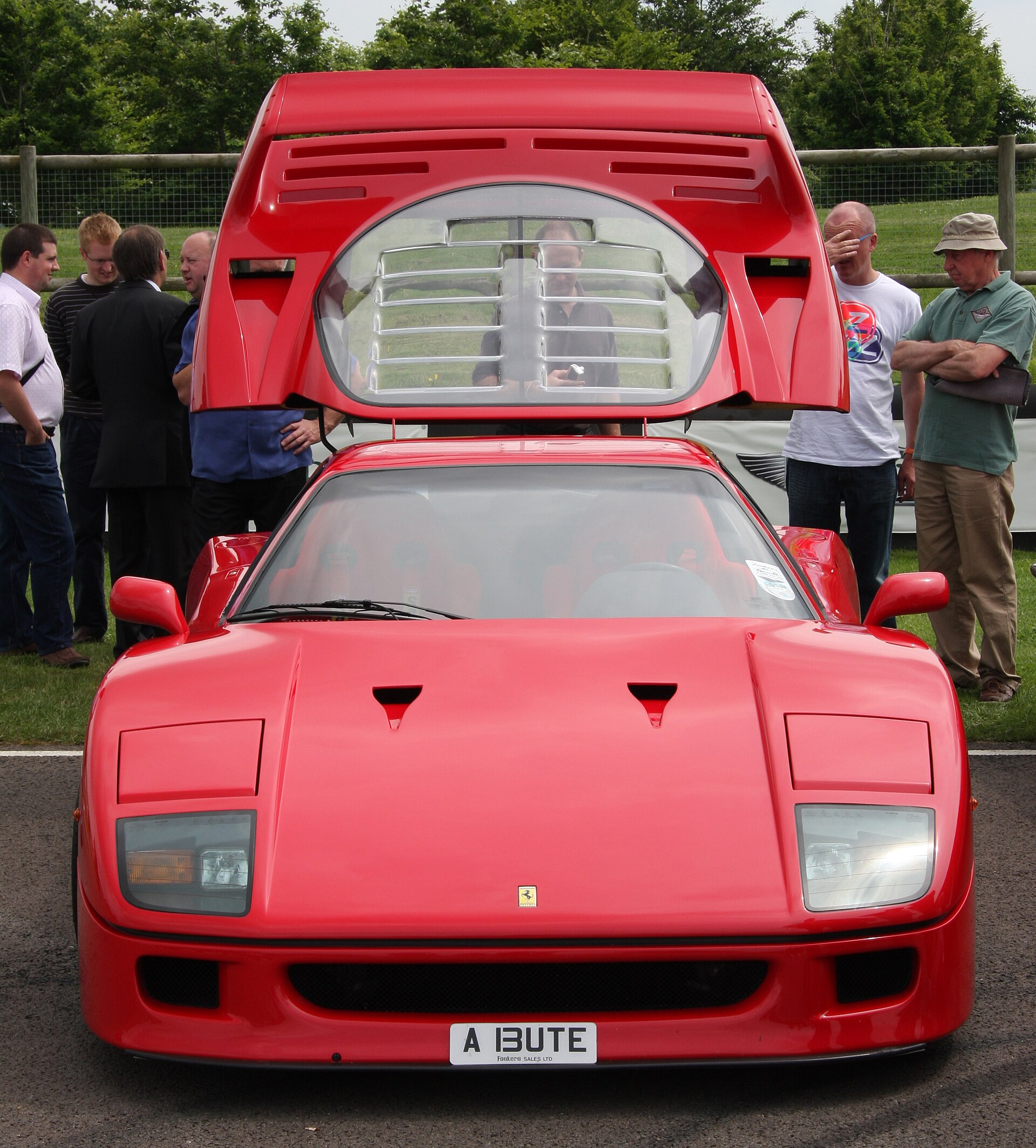
The Ferrari F40 is the mid-engined, twin-turbocharged V8 supercar that Ferrari built to mark its 40th anniversary. It was revealed on 21 July 1987 at the Civic Centre in Maranello and it was the last new Ferrari approved personally by Enzo Ferrari. Light, loud and stripped of almost every comfort, it became the fastest, most powerful and most expensive Ferrari on sale at the time, and it remains one of the reference points of the supercar world.
In short
- Built in Maranello from 1987 to 1992; 1,311 cars according to most sources (some give up to 1,315), 213 of them for the United States.
- 2,936 cc twin-turbo, intercooled 90° V8: 352 kW (478 PS) at 7,000 rpm and 577 Nm at 4,000 rpm in European form, driving the rear wheels through a five-speed manual gearbox.
- A body of Kevlar, carbon fibre and aluminium, polycarbonate windows and a kerb weight of 1,254 kg (European specification).
- 0–100 km/h in 4.7 seconds and 321 km/h in the first independent measurement.
Specs by version
Engines
| Version | Engine | Gearbox | Drive | Production years |
|---|---|---|---|---|
| 2.9 L 8 cyl Manual 5-spd · 1992 (EPA) | 2.9 l · 8 cyl 2,900 cc | 5-sp Manual | Rear-wheel drive | 1992 |
| 2.9 L 8 cyl Manual 5-spd · 1991 (EPA) | 2.9 l · 8 cyl 2,900 cc | 5-sp Manual | Rear-wheel drive | 1991 |
Performance
Show all 2 versions
| Version | Fuel consumption |
|---|---|
| 2.9 L 8 cyl Manual 5-spd · 1992 (EPA) | 18.1 l/100 km13.0 mpg US · 15.6 mpg UK |
| 2.9 L 8 cyl Manual 5-spd · 1991 (EPA) | 18.1 l/100 km13.0 mpg US · 15.6 mpg UK |
Verified Manufacturer and type-approval data from our catalog · Sources and methodology
Ferrari F40 at a glance
| Specification | Ferrari F40 |
|---|---|
| Production | 1987–1992, Maranello (Italy) |
| Cars built | 1,311 (213 for the USA) |
| Body | two-seat berlinetta, mid-engine, rear-wheel drive |
| Engine | Tipo F120A, 2,936 cc V8, two turbochargers, intercoolers |
| Power | 352 kW (478 PS) at 7,000 rpm; US version 356 kW (484 PS) |
| Torque | 577 Nm at 4,000 rpm |
| Gearbox | five-speed manual |
| Kerb weight | 1,254 kg (Europe), 1,369 kg (USA) |
| Predecessor / successor | 288 GTO / F50 |
The F40 sits between the 288 GTO and the F50 in the line of Ferrari's limited "halo" cars (all models are in the Ferrari catalogue), and the story continues with the Ferrari Enzo and the LaFerrari. The wider history of the company is told in our history of Ferrari.
How the F40 was born
The idea came from engineering rather than marketing. Ferrari's chief engineer Nicola Materazzi had proposed a lighter, more powerful car on the 288 GTO base as early as 1984, when the GTO Evoluzione was being developed for the Group B racing class. When Group B was cancelled, the hardware and the know-how were still there.
The F40 project itself started on 10 June 1986. Enzo Ferrari wanted the car ready in eleven months; it took thirteen from the first meeting to the launch. Instead of a show debut at the Frankfurt motor show, the car was presented more than two months earlier, in Maranello. The original plan was to build around 400 cars, but demand was so strong that production finally reached more than three times that number.
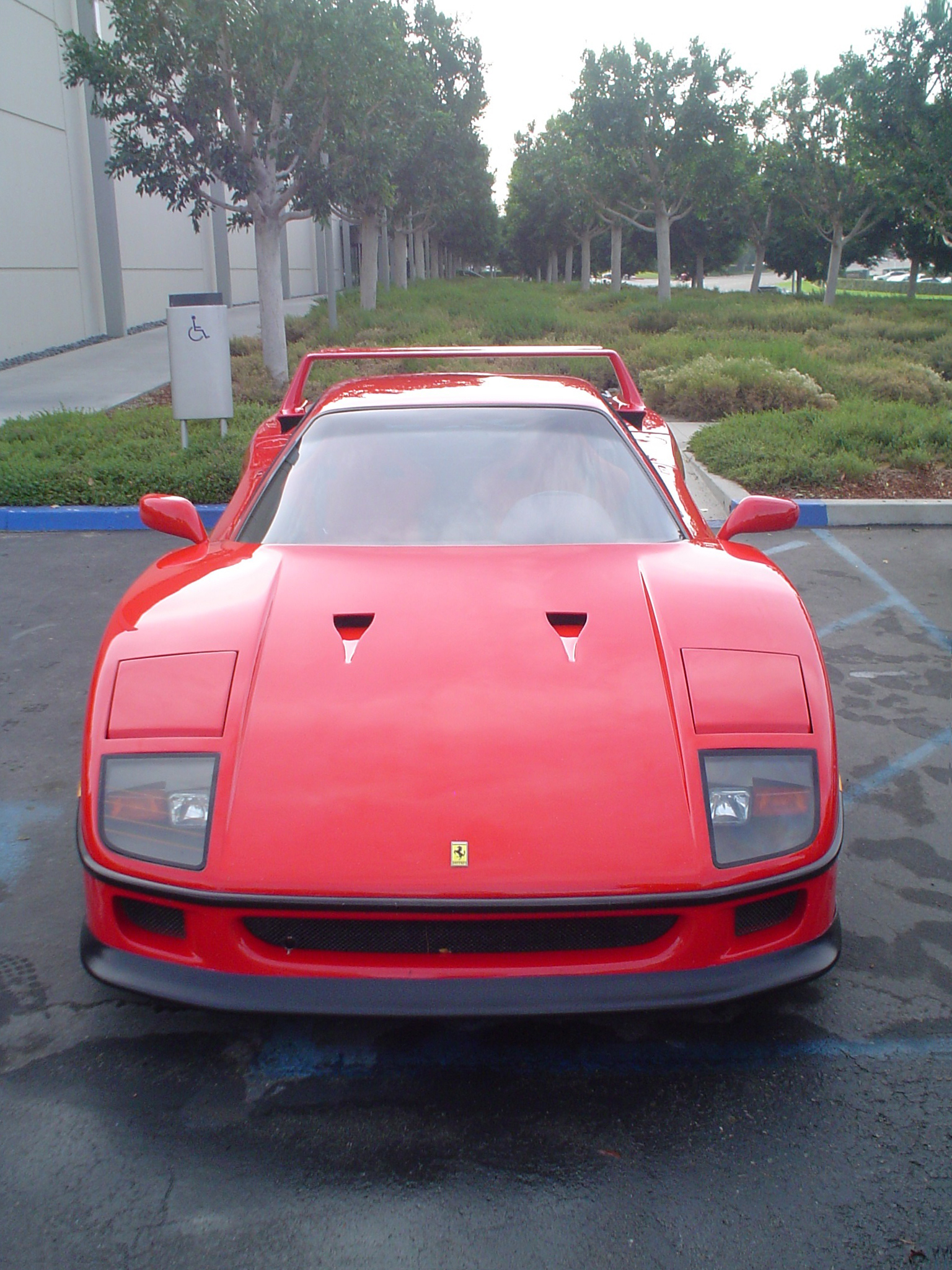
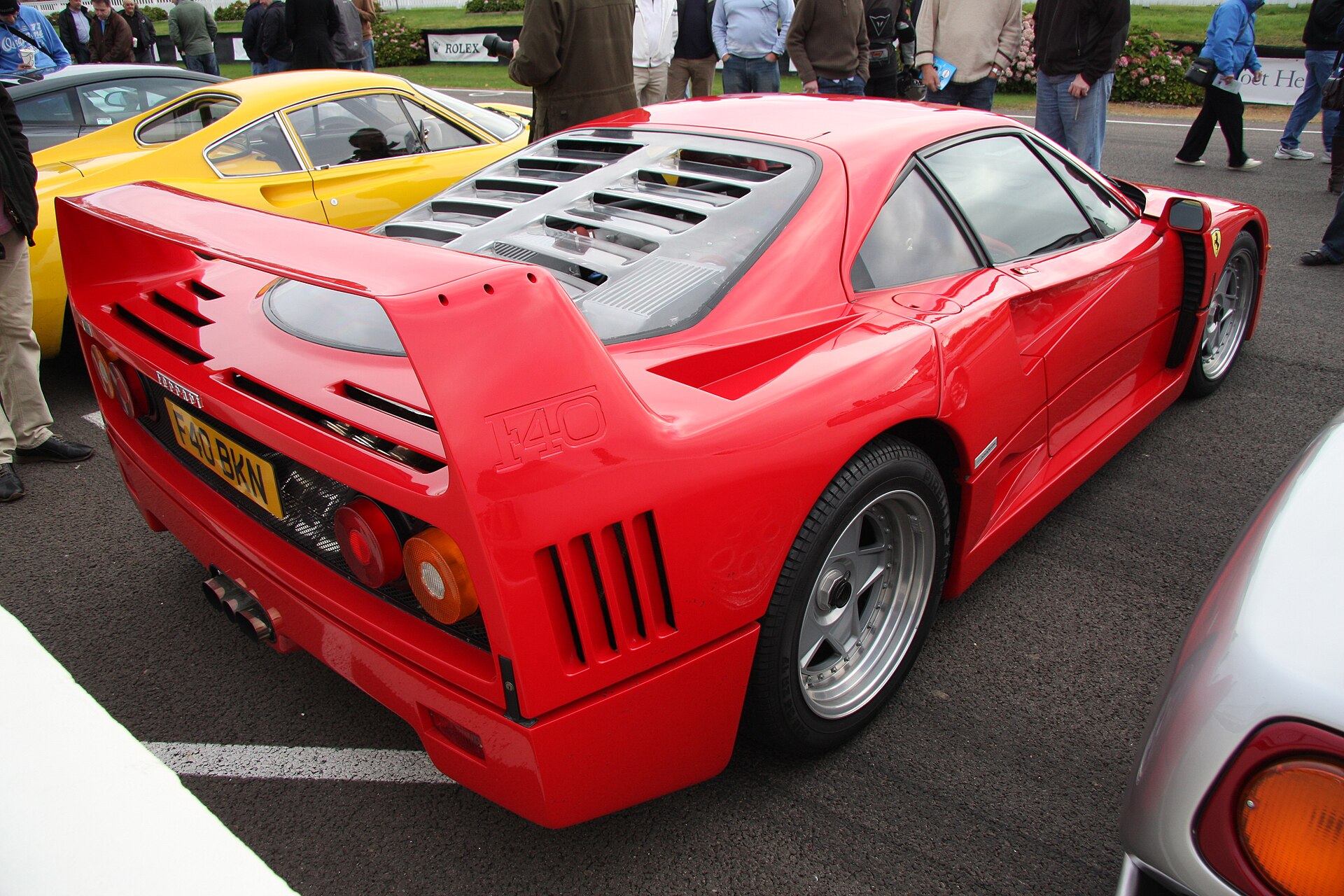
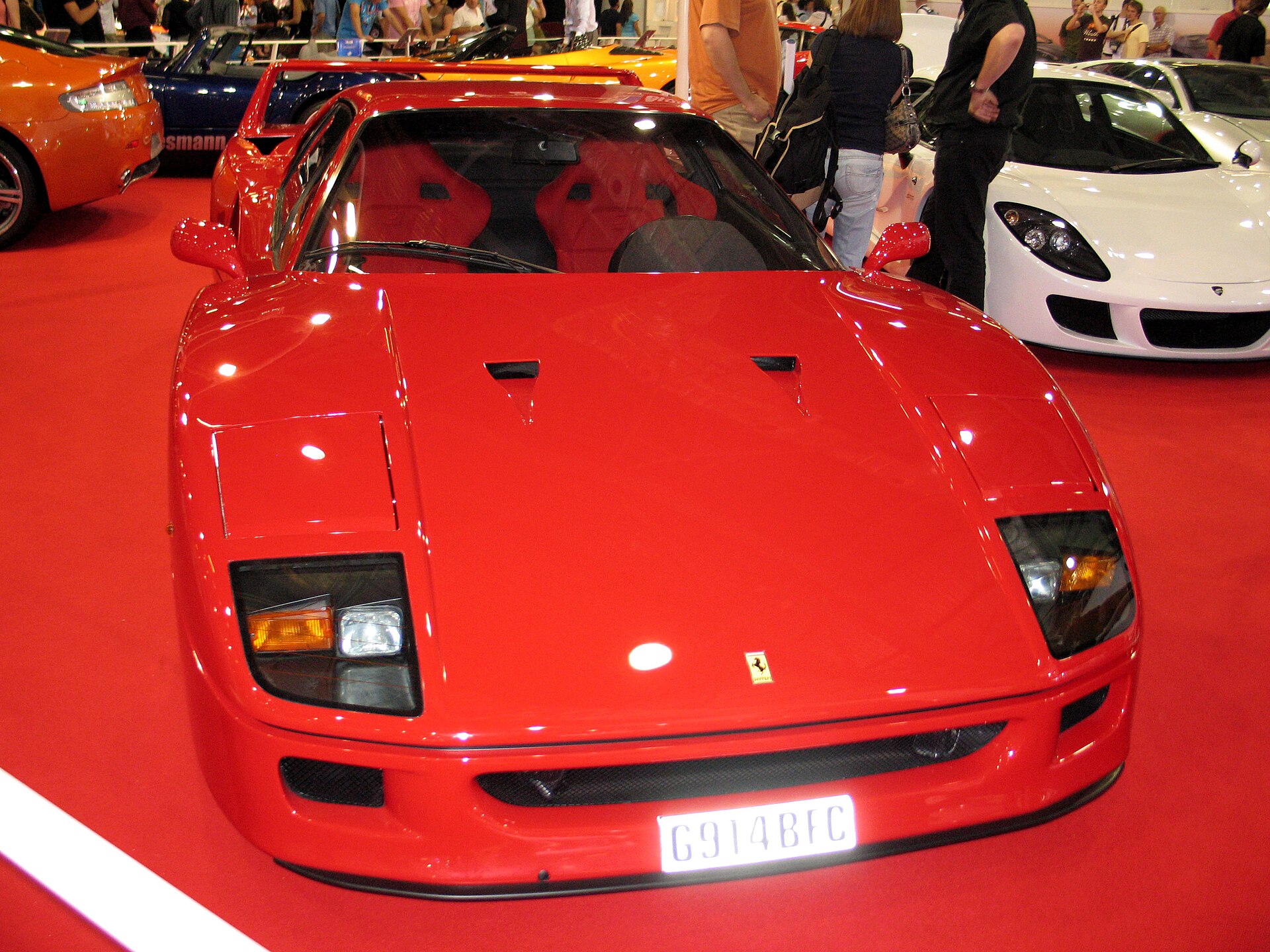
The body was designed at Pininfarina by Pietro Camardella under the supervision of Aldo Brovarone. The shape follows function: a low nose, a large rear wing that is part of the body, NACA ducts for cooling and a clear engine cover through which the V8 can be seen. The drag coefficient is a modest 0.34 - the F40 was tuned for stability and cooling at speed, not for the lowest possible drag.

Engine and performance
The engine is a 2,936 cc V8 with a 90° angle between the cylinder banks, mounted lengthwise behind the cabin. Two turbochargers with intercoolers push it to 352 kW (478 PS) at 7,000 rpm in the European version; the US cars, homologated later, were rated at 356 kW (484 PS). Peak torque is 577 Nm at 4,000 rpm. Power goes to the rear wheels through a five-speed manual gearbox, with no electronic driver aids. Until 1990 the cars had no catalytic converter; it arrived when US rules required it.
| Version | Power | Torque | Kerb weight |
|---|---|---|---|
| F40 (Europe) | 352 kW (478 PS) at 7,000 rpm | 577 Nm at 4,000 rpm | 1,254 kg |
| F40 (USA) | 356 kW (484 PS) | 577 Nm | 1,369 kg |
The first independent measurement, published by the German magazine Sport Auto in September 1988, recorded 0–100 km/h in 4.7 seconds and a top speed of 321 km/h. Other magazines measured slightly less: Road & Track recorded 315 km/h for both European and US cars, Car and Driver 317 km/h. In tests at the Nardò ring the cars did not exceed 321 km/h. The F40 was not the fastest sports car in the world, but among cars built in series of more than 500 it held the top-speed crown until the Lamborghini Diablo arrived.
The twin-turbo V8 also closed an era: it was Ferrari's last turbocharged road engine until the California T of 2014.

Lightweight construction
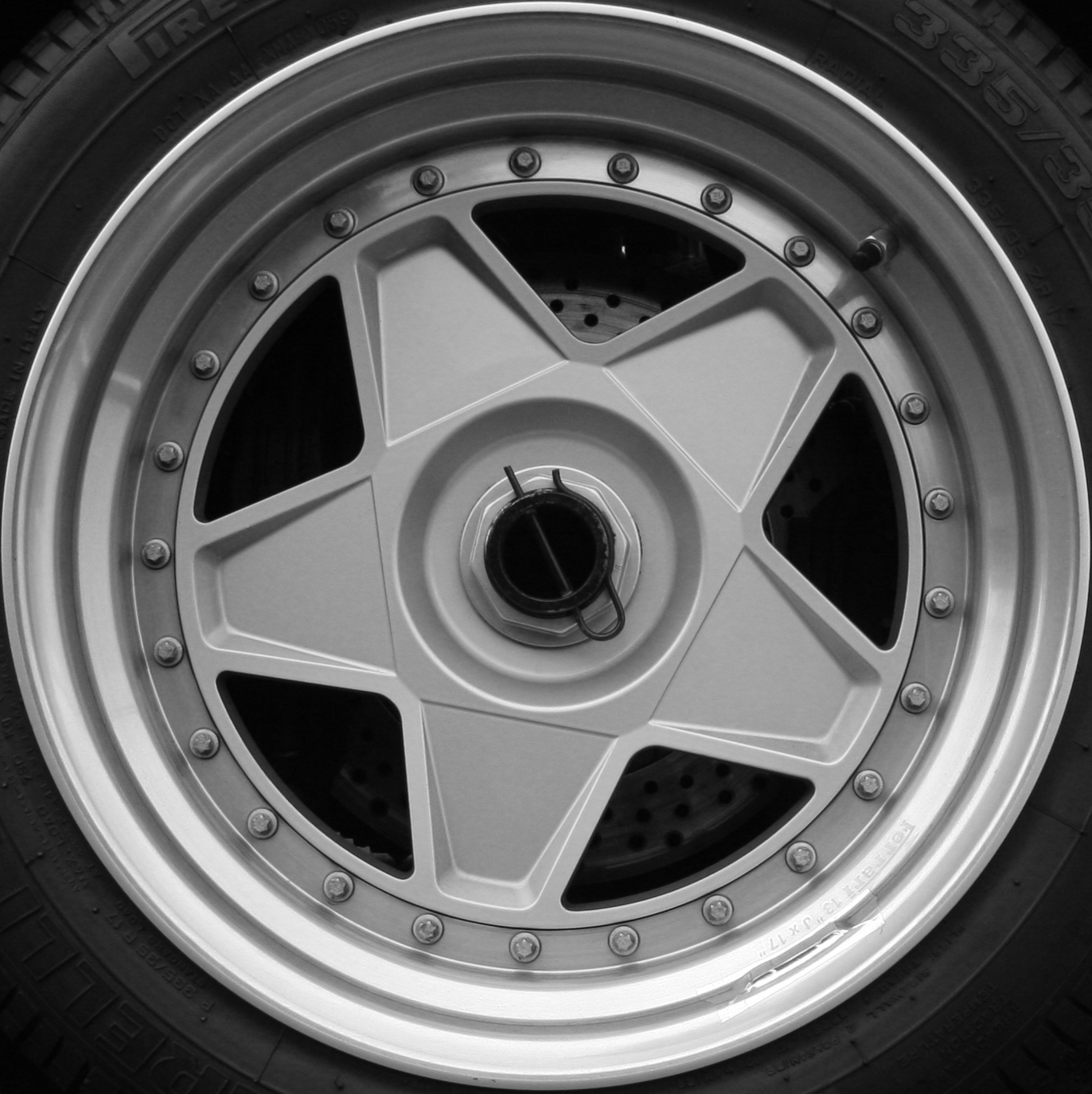
Weight was the main enemy. The body uses Kevlar, carbon fibre and aluminium, and the windscreen and windows are polycarbonate. The first 50 cars had sliding Lexan side windows. Pirelli developed the P Zero tyre specifically for the car.
Dimensions are compact for a car of this performance: 4,430 mm long, 1,970 mm wide, only 1,124 mm high, on a 2,450 mm wheelbase. With 352 kW for 1,254 kg, the European F40 has about 281 kW per tonne of kerb weight.

Inside the cabin
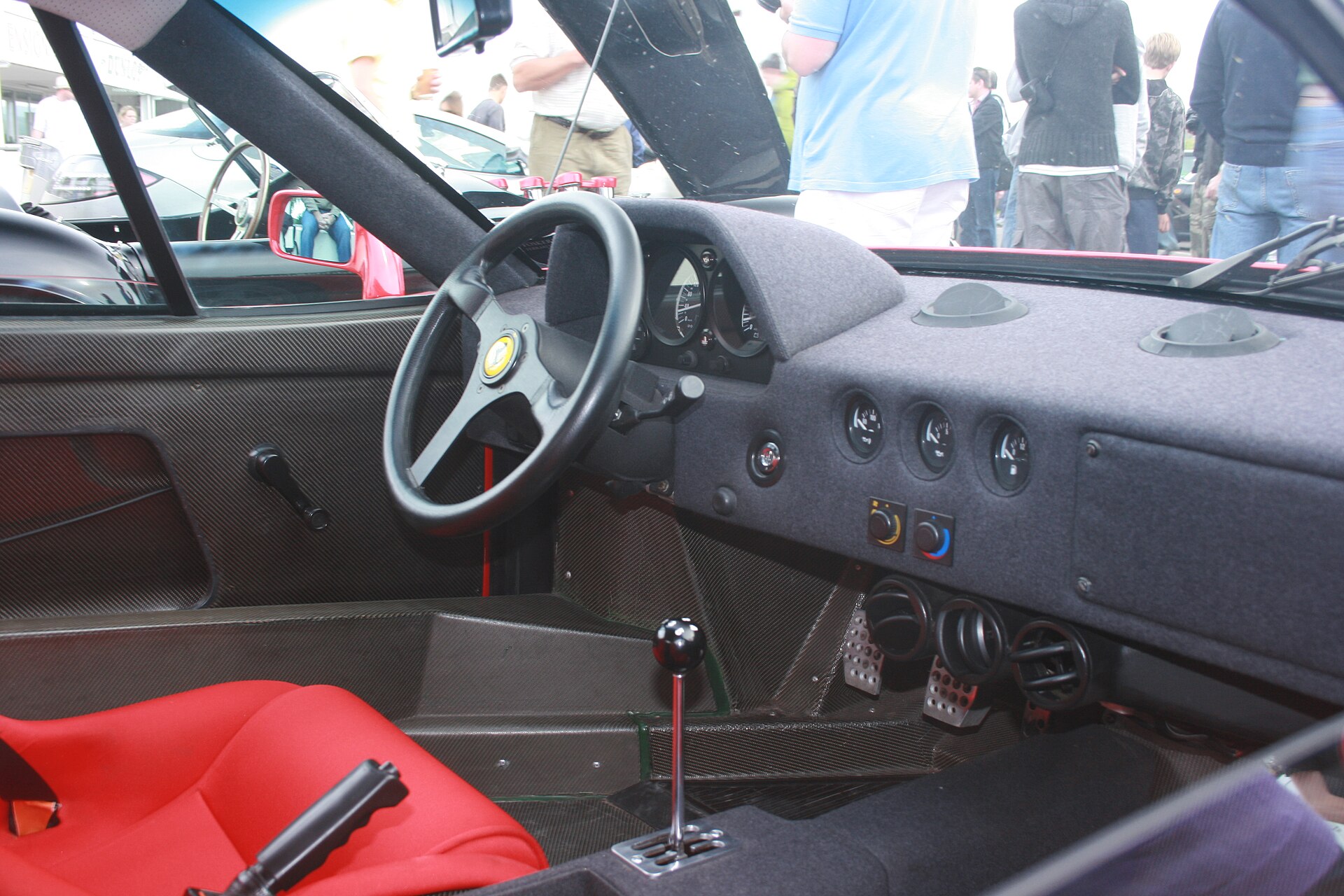
The cockpit is a working space rather than a lounge. Ferrari removed everything that did not help the car go faster: there are no door handles inside (a pull cable opens the door), no door trim panels, no carpets, no glove box and no sound system. The seats are thin racing-style shells, the composite structure stays visible and the driver faces a simple instrument binnacle. There are no electronic driver aids, so the F40 asks for effort and attention at every speed, which is a large part of its reputation.
Every F40 left the factory painted Rosso Corsa. The cars were built with left-hand drive, with the exception of at least seven right-hand-drive cars made to special order for the Sultan of Brunei.

Racing versions: LM, Competizione and GTE
Although the road car was never meant for racing, private teams soon took it to the track. The F40 LM was prepared by Michelotto, Ferrari's long-time competition partner, and a small run of cars followed under the Competizione name, rated at about 515 kW (700 PS) at 8,100 rpm. In the mid-1990s seven F40 GTE cars were converted for GT racing, with the engine enlarged to 3.5 litres in 1995 and 3.6 litres in 1996 and power of about 456 kW (620 PS). These racing cars are separate from the 1,311 road cars and are not road-legal versions.
Legacy
The F40 set the pattern for the anniversary and "halo" Ferraris that followed: a technical showcase built in limited numbers, close to a racing car in spirit. Its successor, the F50 of 1995, moved to a naturally aspirated V12 derived from Formula 1. Today the F40 is one of the most collected Ferraris, and it appears in almost every list of the greatest supercars. For comparison with more recent Ferraris, see the Ferrari F430 and the Ferrari 599, or browse all supercars on 1CARS.

Photo gallery


Ferrari F40 in our rankings
- No. 213 of 859 · Most powerful cars (356 kW · top 25%)
- No. 123 of 313 · Most powerful coupes (356 kW · top 40%)
- No. 51 of 127 · Most powerful Italian cars (356 kW · top 41%)
- No. 291 of 557 · Biggest engines: cars (2,900 cc · top 53%)
- No. 641 of 912 · Longest-running car nameplates (5 years · top 77%)
- No. 141 of 173 · Biggest engines: coupes (2,900 cc · top 83%)
More powerful than 75% of ranked cars in the 1CARS catalog (No. 213 of 859).
Ferrari F40 photos 6
FAQ
How many Ferrari F40s were built?
Most sources give 1,311 road cars built between 1987 and 1992, including 213 cars for the United States. Some sources give a slightly higher total of up to 1,315. The original plan was only about 400 cars.
How powerful is the Ferrari F40?
The European F40 has a 2,936 cc twin-turbo V8 with 352 kW (478 PS) at 7,000 rpm and 577 Nm at 4,000 rpm. The US version is rated at 356 kW (484 PS).
How fast is the Ferrari F40?
The first independent test, by Sport Auto in 1988, measured 0–100 km/h in 4.7 seconds and a top speed of 321 km/h. Road & Track measured 315 km/h and Car and Driver 317 km/h.
Why is the F40 so special?
It was built to celebrate Ferrari's 40th anniversary, it was the last new model approved by Enzo Ferrari, and it combined a light composite body with a twin-turbo V8 and no driver aids - a road car very close to a racing car in spirit.
Data sources
Data checked by an editor against the sources below.
- Wikipedia - Ferrari F40
- US EPA fueleconomy.gov - 8569.shtml
- US EPA fueleconomy.gov - 7462.shtml