
 Ferrari Enzo
Specs, engines and history
Updated Published Sources (3) Report an error
By Felix Hartmann, Automotive Technology & EV Contributor Reviewed by Oleksandr Hnatiuk

- Built
- 2002–2004
- Top power
- 485 kW (659 PS)
- New price
- from about €645,000 (2004)
Verdict: who the Enzo suits and what to check
Our verdict · Felix Hartmann
Every Enzo is the same car mechanically, so the choice comes down to history, mileage and colour. A full Ferrari service record matters as much as the odometer reading, and Ferrari Classiche certification confirms that a car matches its original specification.
Points to check:
- Gearbox and clutch: the F1 system needs specialist diagnostics; ask for the clutch wear reading.
- Carbon-ceramic brakes: discs are expensive, so check their condition.
- Accident history: carbon-fibre tub repairs are a specialist job and affect value.
The Enzo suits a collector who wants the first Ferrari hypercar of the carbon-and-paddles era. A driver who prefers a manual gearbox may enjoy the Carrera GT more, and anyone wanting hybrid technology should look at the LaFerrari. Ferrari's company history is told in our history of Ferrari.
The Ferrari Enzo is a mid-engined V12 hypercar built from 2002 to 2004 and named after the company's founder. Shown at Paris in 2002, it was offered by invitation to 399 customers, mostly F40 and F50 owners; a 400th car went to the Vatican. The 6.0-litre V12 makes 485 kW (660 PS), and the chassis, gearbox and brakes drew on Formula One.
In short
- Built: 2002–2004 in Maranello, 399 cars for customers plus one charity car, 400 in total.
- Engine: 5,999 cc F140B V12 with 657 Nm and an 8,200 rpm redline; rear-wheel drive.
- Technology: carbon-fibre tub, six-speed F1 automated gearbox with 150 ms shifts, active aerodynamics, Brembo carbon-ceramic discs.
- Legacy: the base of the track-only FXX and the Maserati MC12; succeeded by the LaFerrari in 2013.

Size at a glance
| Dimensions | Ferrari Enzo |
|---|---|
| Length | 4,702 mm185.1 in |
| Width | 2,035 mm80.1 in |
| Height | 1,147 mm45.2 in |
| Wheelbase | 2,650 mm104.3 in |
Specs by version
Engines
Dimensions and weight
Verified Manufacturer and type-approval data from our catalog · Sources and methodology
Enzo at a glance

| Item | Ferrari Enzo |
|---|---|
| Type | two-seat mid-engined coupé, butterfly doors |
| Debut | Paris Motor Show, 2002 |
| Production | 2002–2004, Maranello (Italy) |
| Built | 400 (399 for customers, 1 for the Vatican) |
| Designer | Ken Okuyama, head of design at Pininfarina |
| Engine | F140B 65° V12, 5,999 cc, naturally aspirated |
| Power / torque | 485 kW (660 PS) / 657 Nm |
| Gearbox | 6-speed automated manual (F1), Graziano |
| Weight | 1,255 kg dry; 1,365 kg kerb (German data) |
| Top speed | up to 355 km/h |
How Ferrari developed the Enzo
The Enzo continued the line of limited Ferrari flagships that began with the 288 GTO and continued with the F40 and the F50. This time the brief was explicit: put as much Formula One technology on the road as the rules and the customers would allow. Ferrari's F1 team was then winning world titles with Michael Schumacher, and the road car took its gearbox logic, its carbon structure and its ceramic-composite brakes from that programme.

Engineers tested the components in three development mules, called M1, M2 and M3, which wore bodies based on the Ferrari 348. The finished car was presented by Luca di Montezemolo in 2002 and named after Enzo Ferrari, who had died in 1988. The Enzo has active aerodynamics, something Formula One does not allow: flaps at the front and a rear spoiler adjust to keep the balance as speed rises.
Design by Ken Okuyama
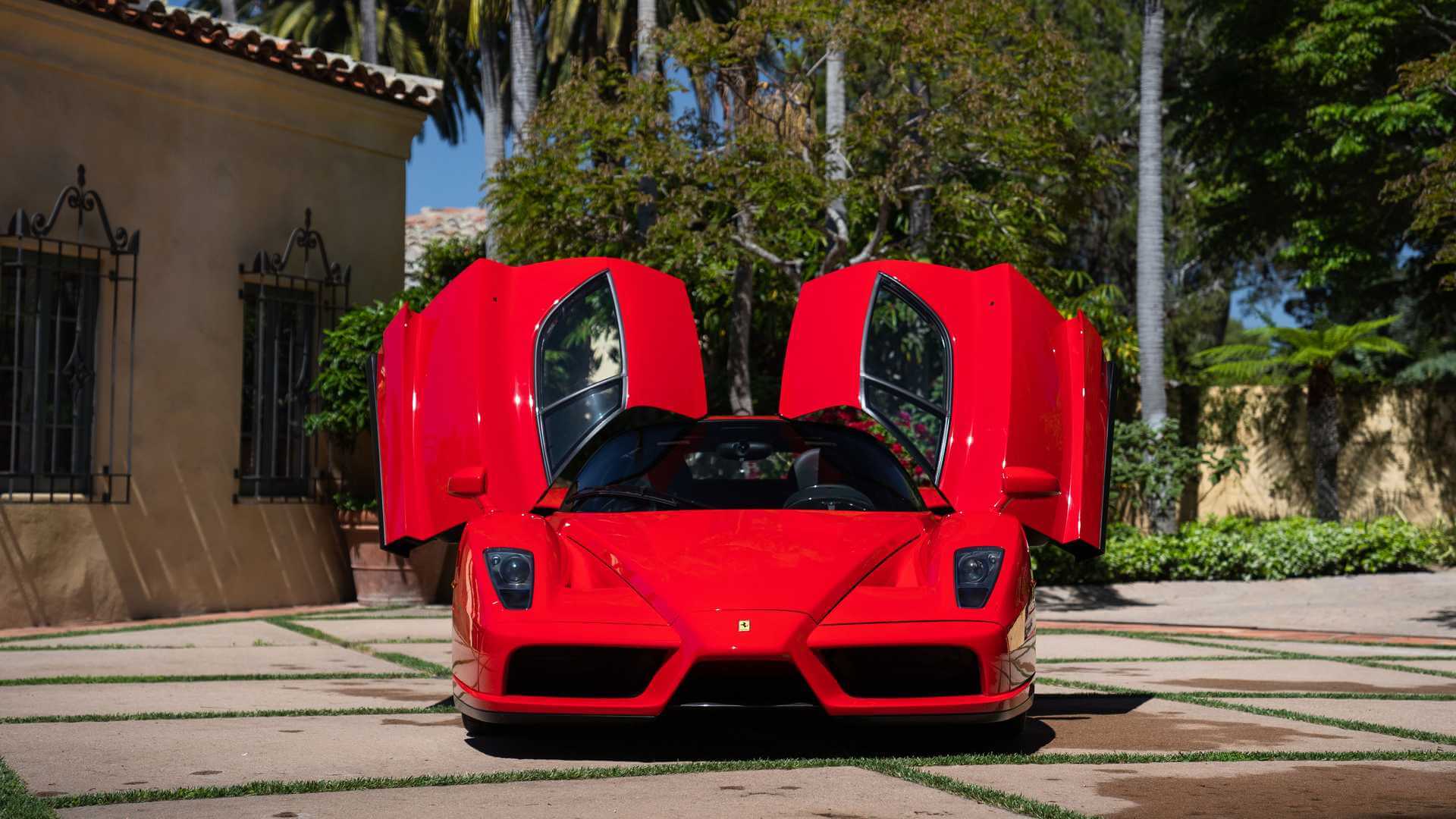
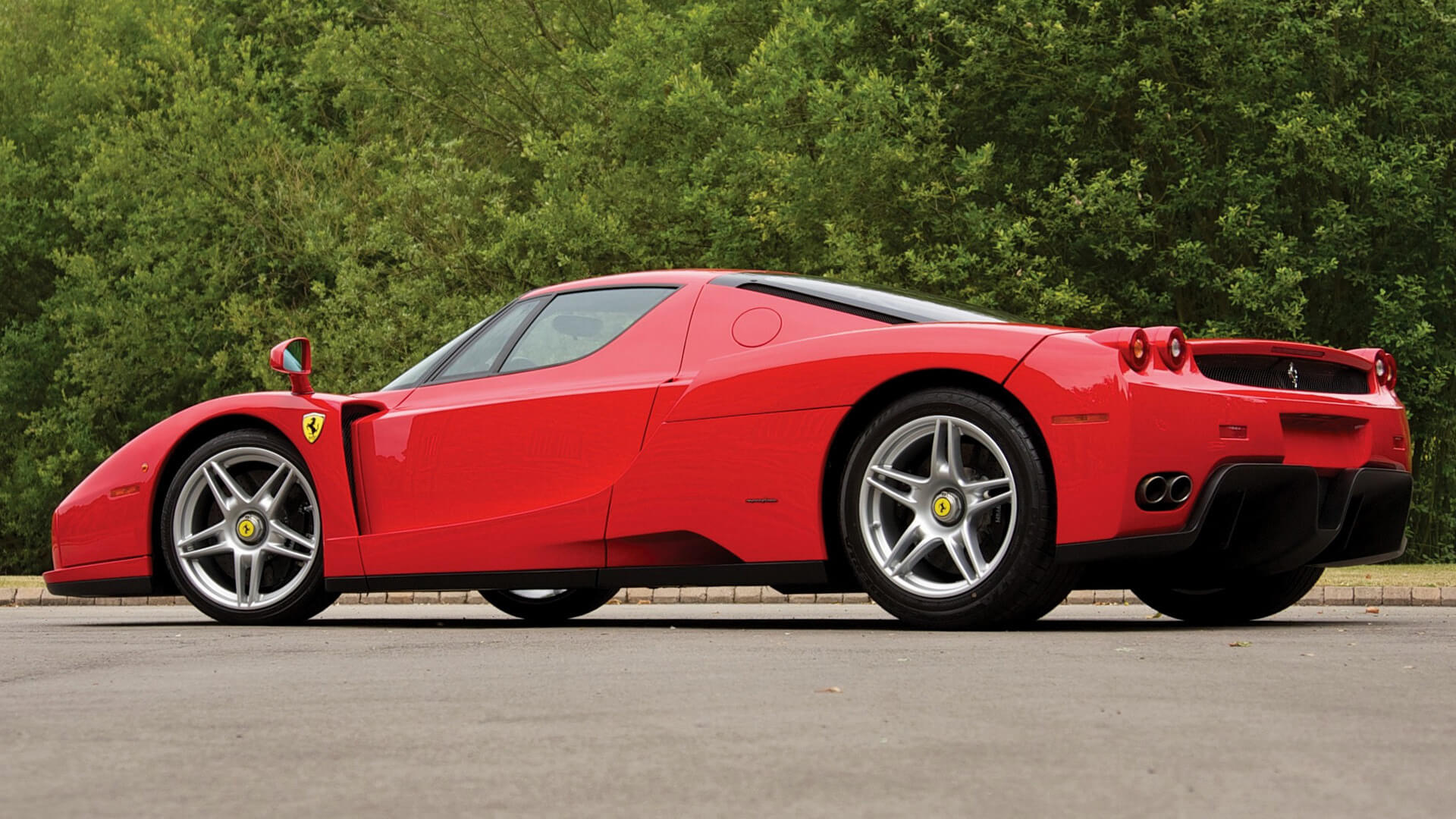
Pininfarina styled the car under Ken Okuyama, a Japanese designer who led the studio at the time. The nose is shaped like a single-seater's: a raised centre section between two large intakes, so the front looks like an F1 car's nose and front wing. The doors open upwards and forwards, and the engine sits under a glass cover in the tail.

The design divided opinion. Sports Car International ranked the Enzo third among the top sports cars of the 2000s, while Bloomberg Businessweek later put it on a list of the 50 ugliest cars of the previous half-century. Ferrari offered five standard colours (Giallo Modena, Nero, Bianco Fuji, Argento Nürburgring and Grigio Titanio) besides the classic red. According to German sources, 20 cars were painted in other, special-order colours.
F140B V12, F1 gearbox and brakes
The F140B was a new 65-degree V12 with four valves per cylinder, variable valve timing and Bosch Motronic ME7 injection. It reaches peak power at 7,800 rpm and peak torque at 5,500 rpm. By our calculation that is about 81 kW per litre from an engine without turbochargers. The F140 family later powered the 599, the F12 and the LaFerrari.
Power goes to the rear wheels through a six-speed automated manual gearbox built by Graziano. Shifts take 150 milliseconds; there is no clutch pedal, and the driver changes gear with paddles behind the wheel. Owners have described the shifts as abrupt by later standards, because this was a first-generation single-clutch system from the late 1990s.
The Enzo was one of the first road cars with carbon-ceramic (C/SiC) brake discs, made by Brembo and 15 inches in diameter. It runs on 19-inch wheels with Bridgestone Potenza RE050A Scuderia tyres developed for it.
| Gear | Ratio |
|---|---|
| 1st | 3.15 |
| 2nd | 2.18 |
| 3rd | 1.57 |
| 4th | 1.19 |
| 5th | 0.94 |
| 6th | 0.76 |
| Final drive | 4.1 |
Ferrari Enzo key specifications
| Parameter | Metric | Imperial |
|---|---|---|
| Engine | 5,999 cc V12, 48 valves | 366 cu in |
| Power | 485 kW (660 PS) at 7,800 rpm | 651 hp |
| Torque | 657 Nm at 5,500 rpm | 485 lb-ft |
| Length / width / height | 4,702 / 2,035 / 1,147 mm | 185.1 / 80.1 / 45.2 in |
| Wheelbase | 2,650 mm | 104.3 in |
| Dry weight | 1,255 kg | 2,767 lb |
| Weight distribution | 44 % front / 56 % rear | - |
| Downforce | 343 kg at 200 km/h; 775 kg at 300 km/h | 756 lb at 124 mph; 1,709 lb at 186 mph |
| 0–97 km/h (60 mph) | 3.3 s (Motor Trend test) | 3.3 s |
| Top speed | up to 355 km/h | 221 mph |
| Combined consumption | 29 l/100 km (US rating) | 8 mpg |
Downforce is highest at around 300 km/h and lower at top speed, where Ferrari's figure is 585 kg. On the Nürburgring Nordschleife, evo magazine timed an Enzo at 7:25.21 even with a faulty electronic damper. At Ferrari's Fiorano test track the Enzo lapped in 1:22.3, about five seconds quicker than the F50.

400 cars: who could buy one
Ferrari announced the run of 399 cars at the 2002 launch and offered them first to its most loyal customers, starting with owners of the F40 and F50. Demand exceeded supply, and Ferrari chose the buyers. German sources describe the run as 349 cars plus a further 50 that were added after the launch.

In 2004 Ferrari built a 400th Enzo and gave it to Pope John Paul II for charity. Sotheby's auctioned it on 28 June 2005 for €1,055,000, and the money went to survivors of the 2004 Indian Ocean tsunami. The third development mule was sold in the same auction for €195,500.
| Number | Detail |
|---|---|
| 399 | customer cars, by invitation |
| 1 | 400th car for the Vatican, auctioned in 2005 |
| 20 | cars in special-order colours (German sources) |
| 57 | new registrations in Germany, 2003–2006 |
| 3 | development mules (M1–M3) |
German price lists put the Enzo at about €662,000 before options and about €700,000 with typical extras. Since then values have risen far above that. In March 2020 a US-delivered Enzo with under 1,700 miles sold at RM Sotheby's Amelia Island auction for 2,782,500 US dollars, about €2.5 million at that time.
FXX, MC12 and the cars built on the Enzo
The Enzo's chassis and drivetrain became the base for several other cars:
| Car | Year | What it is | Key figures |
|---|---|---|---|
| Ferrari FXX | 2005 | track-only client car, 29–30 built | 6.3 l V12, about 588 kW (800 PS); price about €1.3–1.5 million |
| FXX Evoluzione | to 2009 | upgrade for FXX owners | 633 kW (860 PS) at 9,500 rpm, 60 ms shifts |
| Maserati MC12 | 2004 | road car for GT1 homologation, 50 built | Enzo chassis, engine and gearbox |
| Ferrari P4/5 by Pininfarina | 2006 | one-off for James Glickenhaus | built on an unregistered Enzo |

On the Top Gear test track, Michael Schumacher lapped an FXX in 1:10.7. The track-only client programme continued with the FXX K, built on the LaFerrari.
Rivals: Carrera GT, SLR and MC12
The Enzo's direct rival was the Porsche Carrera GT, also a naturally aspirated carbon-chassis supercar, but with a V10 and a manual gearbox. Our published comparison Ferrari Enzo vs Porsche Carrera GT goes through both cars in detail.

| Model | Engine | Power | Gearbox | Built |
|---|---|---|---|---|
| Ferrari Enzo | 6.0 l V12 | 485 kW (660 PS) | 6-speed automated | 400 |
| Porsche Carrera GT | 5.7 l V10 | 450 kW (612 PS) | 6-speed manual | 1,270 |
| Maserati MC12 | 6.0 l V12 (Enzo-based) | 463 kW (630 PS) | 6-speed automated | 50 road cars |
The Enzo was the most powerful and the rarest of the three. By our calculation it carried 2.6 kg of dry weight per kW, against 3.1 kg per kW of kerb weight for the Carrera GT; our power-to-weight calculator runs the same sum for any car.

Popular comparisons
Ferrari Enzo in our rankings
- No. 8 of 206 · Most powerful cars of the 2000s (485 kW)
- No. 10 of 102 · Widest coupes (2,035 mm)
- No. 10 of 28 · Most powerful V12 cars (485 kW)
- No. 23 of 524 · Widest cars (2,035 mm · top 5%)
- No. 21 of 409 · Power-to-weight: cars (328 kW/t · top 6%)
- No. 112 of 1066 · Most powerful cars (485 kW · top 11%)
More powerful than 96% of ranked cars of the 2000s in the 1CARS catalog (No. 8 of 206).
Ferrari Enzo photos 17



FAQ
How many Ferrari Enzos were made?
Four hundred. Ferrari announced 399 cars in 2002 and sold them by invitation, then built a 400th in 2004 for Pope John Paul II. That car was auctioned by Sotheby's in 2005 for charity.
How much power does the Ferrari Enzo have?
Its 6.0-litre V12 produces 485 kW (660 PS, 651 hp) at 7,800 rpm and 657 Nm of torque at 5,500 rpm. The engine revs to 8,200 rpm and drives only the rear wheels.
What is the fuel consumption of the Ferrari Enzo?
The US rating is about 29 l/100 km combined (8 mpg), with 20 l/100 km on the highway and 34 l/100 km in town. The Enzo has no hybrid system and no all-wheel drive.
Who designed the Ferrari Enzo?
Ken Okuyama, who was head of design at Pininfarina. The nose with its raised centre section was inspired by Ferrari's Formula One cars of the period.
What replaced the Ferrari Enzo?
The LaFerrari of 2013, Ferrari's first hybrid hypercar, built in 499 coupés. Between the two, the track-only FXX of 2005 extended the Enzo's life as a development tool for Ferrari.
Data sources
Data checked by an editor against the sources below.
- The text of this article (1cars archive)
- Wikipedia - Enzo Ferrari (automobile)
- Wikipedia - Ferrari Enzo


