 Ferrari F8
Specs, engines and history
Published Sources (1) Report an error
By Felix Hartmann, Automotive Technology & EV Contributor
- Built
- 2019–2023
- Top power
- 530 kW (721 PS)
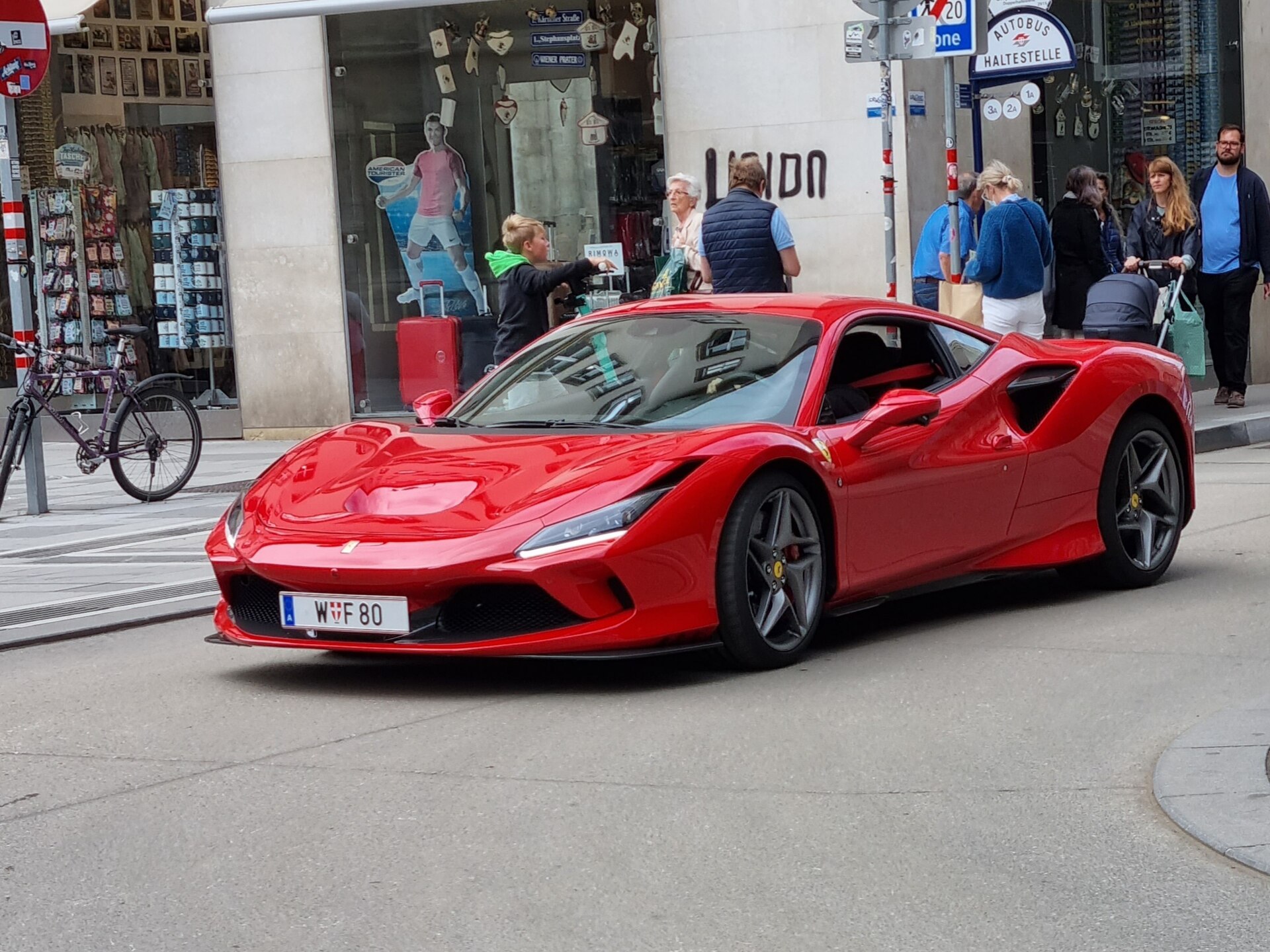
The Ferrari F8 is the mid-engined V8 sports car that Ferrari built in Maranello from 2019 to 2023, as the F8 Tributo coupé and the F8 Spider. It replaced the 488 GTB and used the twin-turbo V8 of the track-focused 488 Pista, with 530 kW (720 PS) - at the time the most powerful V8 in a series-production Ferrari. The name "Tributo" is a tribute to that engine and to more than four decades of mid-engined V8 Ferraris. It was the last purely combustion-engined car of this line: its successor, the 296, is a V6 plug-in hybrid.
In short
- Built 2019–2023 in Maranello; type F142MFL; unveiled at the Geneva motor show in March 2019, followed by the F8 Spider.
- 3,902 cc twin-turbo V8 (F154 CG): 530 kW (720 PS) at 8,000 rpm and 770 Nm at 3,250 rpm.
- Seven-speed dual-clutch gearbox, rear-wheel drive; 40 kg lighter than the 488 GTB.
- 0–100 km/h in 2.9 seconds, top speed 340 km/h for both coupé and Spider.
Ferrari F8 at a glance
| Specification | Ferrari F8 Tributo / F8 Spider |
|---|---|
| Production | 2019–2023, Maranello (Italy) |
| Body | two-seat berlinetta (Tributo); retractable hard-top spider |
| Engine | F154 CG 3,902 cc V8, twin-turbo |
| Power | 530 kW (720 PS) at 8,000 rpm |
| Torque | 770 Nm at 3,250 rpm |
| Gearbox | seven-speed dual-clutch, rear-wheel drive |
| Weight | 1,435 kg kerb (Tributo); 1,330 kg dry with lightweight options; Spider 1,400 kg dry |
| Dimensions | 4,611 × 1,979 × 1,206 mm, wheelbase 2,650 mm |
| Predecessor / successor | 488 GTB / 296 GTB |
The F8 continues the line of mid-engined V8 Ferraris that runs through the F430, the 458 Italia and the 488. The complete range is in the Ferrari catalogue.
Launch in Geneva, 2019
Ferrari released the first photographs of the new car on 28 February 2019 and unveiled it at the Geneva motor show on 5 March 2019, four years after the 488 GTB had made its debut at the same show. Ferrari presented the F8 Tributo as a tribute to its mid-engined V8s of the previous 45 years and, in particular, to the engine it used. That twin-turbo V8 had won the "Best Engine" title in the International Engine of the Year awards in 2016, 2017 and 2018.
The open F8 Spider followed later in 2019. Both versions were built until 2023. In 2021 Ferrari introduced the 296 GTB, with a hybrid V6 instead of a V8, and the 296 took over the role of the F8 when production ended.

Design and aerodynamics
The Ferrari Styling Centre under Flavio Manzoni kept the general shape of the 488 but changed most of the details, and added references to older Ferraris. The engine cover is a louvred panel of light Lexan, which recalls the F40. At the rear, the F8 returns to twin round tail lights on each side - a feature of the 308 GTB of 1975 and last seen on a V8 Ferrari with the F430.
The most visible aerodynamic change is the S-Duct, an air channel through the nose that exits on the bonnet. According to Ferrari's launch data reported by Motor1, the S-Duct alone gives 15% of the increase in downforce over the 488 GTB, and the car's overall aerodynamic efficiency is 10% better. The aerodynamic solutions came from Ferrari's experience in GT and Challenge racing.
Inside, the dashboard, instrument housing, door panels and centre tunnel were redesigned, with a new-generation steering wheel and new seats. A 220 mm touchscreen for the passenger was available as an option.

Engine and performance
The engine is the F154 CG, a 3,902 cc V8 with two turbochargers, taken from the 488 Pista. It produces 530 kW (720 PS) at 8,000 rpm - 37 kW (50 PS) more than the 488 GTB - and 770 Nm at 3,250 rpm. Its specific output is 136 kW (185 PS) per litre. The exhaust system with Inconel manifolds was redesigned, and a turbo speed sensor developed for the 488 Challenge racing car helps the engine respond to the accelerator.
Power reaches the rear wheels through a seven-speed dual-clutch gearbox with revised ratios.
| Figure | F8 Tributo | F8 Spider |
|---|---|---|
| Power | 530 kW (720 PS) at 8,000 rpm | 530 kW (720 PS) |
| Torque | 770 Nm at 3,250 rpm | 770 Nm |
| 0–100 km/h | 2.9 s | 2.9 s |
| 0–200 km/h | 7.6 s (Wikipedia) / 7.8 s (Motor1) | 8.2 s |
| Top speed | 340 km/h | 340 km/h |
| Weight | 1,435 kg kerb; 1,330 kg dry with options | 1,400 kg dry |
Compared with the 488 GTB, the F8 Tributo is 0.1 seconds quicker to 100 km/h and 10 km/h faster at the top end. Ferrari's electronic driving aids were updated as well: Side Slip Control moved to version 6.1, and the Ferrari Dynamic Enhancer drift-management system could now also be used in the Race position of the manettino. Carbon-fibre wheels from the 488 Pista were offered as an option.

F8 Tributo versus 488 GTB
Ferrari's launch figures, as reported by Motor1, show how much the F8 moved on from the car it replaced:
| Figure | 488 GTB (2015) | F8 Tributo (2019) |
|---|---|---|
| Power | 493 kW (670 PS) | 530 kW (720 PS) |
| Torque | 760 Nm | 770 Nm |
| 0–100 km/h | 3.0 s | 2.9 s |
| 0–200 km/h | 8.3 s | 7.8 s |
| Top speed | 330 km/h | 340 km/h |
| Weight | reference | 40 kg lighter |
In other words, the regular F8 Tributo matched the output of the limited 488 Pista while weighing less than the 488 GTB, and its aerodynamic package produced more downforce at the same time.
F8 Spider and one-offs
F8 Spider. The open version has a retractable hard-top that folds in 14 seconds and can be operated at up to 45 km/h. It uses the same drivetrain as the coupé, reaches 100 km/h in 2.9 seconds and 200 km/h in 8.2 seconds, and has the same top speed of 340 km/h. Its luggage compartment holds 200 litres.
Ferrari's Special Projects department built several one-offs on the F8:
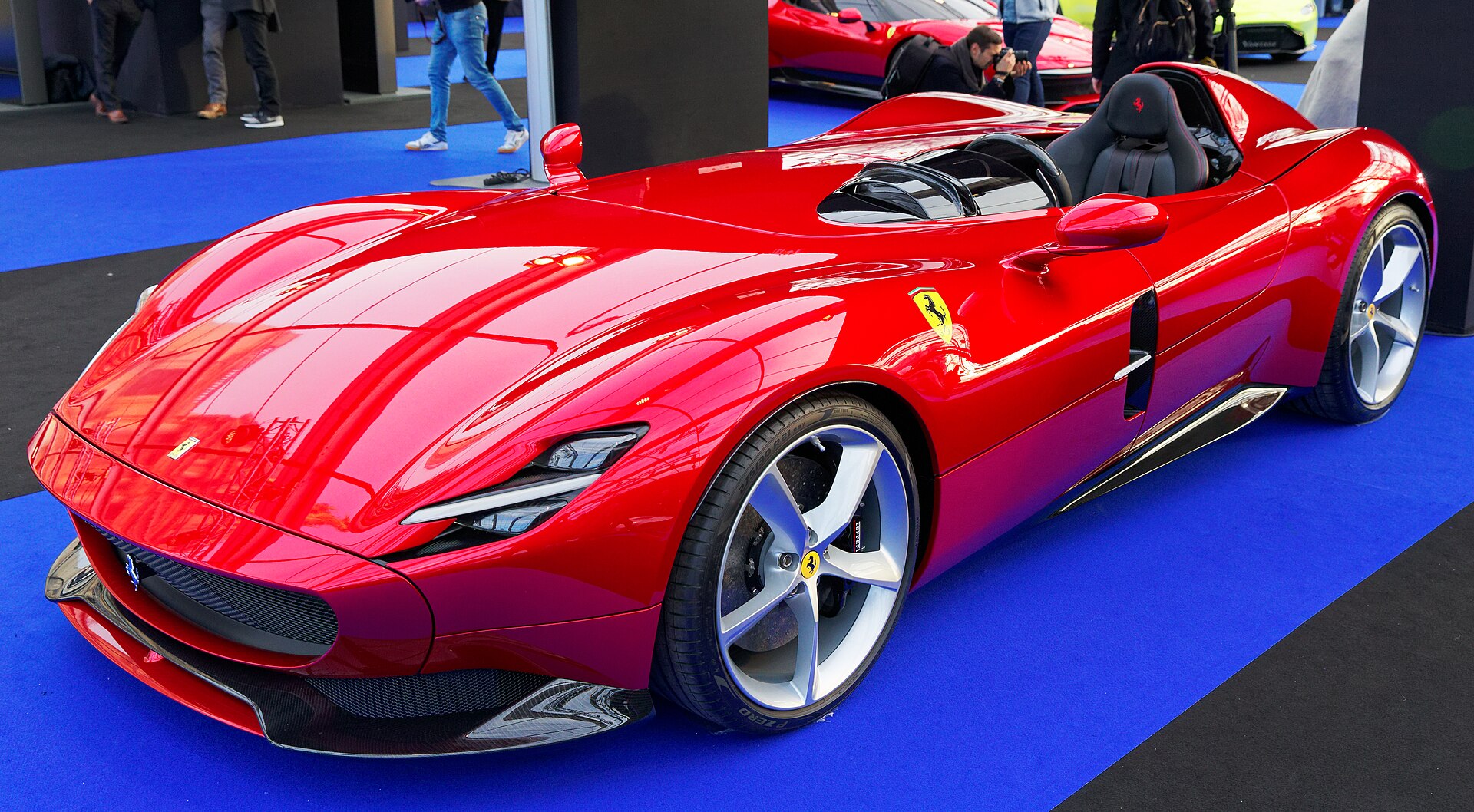
- SP48 Unica - based on the Tributo, with a new body, a rear section without windows, rectangular headlights and tail lights, and a hexagon motif inside and out.
- SP-8 - a roofless car based on the Spider for a customer in Taiwan, with a two-tone body, five-spoke wheels inspired by the F40 and rear lights derived from the Roma.
- HC25 - based on the Spider and shown in 2026 at the Ferrari Racing Days in Austin. It has a black band across the body, slimmer headlights and new rear lights; the drivetrain is unchanged.

Legacy
The F8 marks the end of an era: it was the last mid-engined Ferrari of its line to rely on a V8 alone, without electric help. It also brought the power of the limited 488 Pista to the regular model. In the range that followed, the hybrid SF90 Stradale and the 296 took over. Testing a US-specification F8 Tributo, Road & Track recorded a quarter-mile time of 10.3 seconds.
Photo gallery


Ferrari F8 in our rankings
- No. 84 of 859 · Most powerful cars (530 kW · top 10%)
- No. 60 of 313 · Most powerful coupes (530 kW · top 20%)
- No. 28 of 127 · Most powerful Italian cars (530 kW · top 23%)
- No. 734 of 912 · Longest-running car nameplates (4 years · top 83%)
More powerful than 90% of ranked cars in the 1CARS catalog (No. 84 of 859).
FAQ
Why is the car called F8 Tributo?
Ferrari named it as a tribute to its V8 engine - the most powerful V8 in a series-production Ferrari at the time - and to the brand's mid-engined V8 cars of the previous 45 years.
How powerful is the Ferrari F8?
Both the F8 Tributo and the F8 Spider have a 3.9-litre twin-turbo V8 with 530 kW (720 PS) at 8,000 rpm and 770 Nm.
How fast is the F8 Tributo?
Ferrari quotes 0–100 km/h in 2.9 seconds and a top speed of 340 km/h. Published 0–200 km/h times are 7.6 or 7.8 seconds, depending on the source.
How does the F8 differ from the 488 GTB?
It has 37 kW (50 PS) and 10 Nm more and weighs 40 kg less. It also gains the S-Duct and a Lexan engine cover, and its top speed is 10 km/h higher.
What replaced the Ferrari F8?
The 296 GTB and GTS, plug-in hybrids with a twin-turbo V6, replaced the F8 in Ferrari's range.
Data sources
Data checked by an editor against the sources below.