
 Peugeot 306
Specs, engines and history
Published Sources (1) Report an error
By Felix Hartmann, Automotive Technology & EV Contributor
Which 306 to choose
Our verdict · Felix Hartmann
- For economy: a Phase 3 car with the 2.0 HDi (66 kW / 90 PS) and side airbags.
- For driving enjoyment: the GTI-6 with 120 kW and six speeds, or the lighter UK Rallye.
- For open-air motoring: a cabriolet from 1999 onwards, when every version had the electro-hydraulic roof.
- For space: the Break estate, 4,338 mm long.
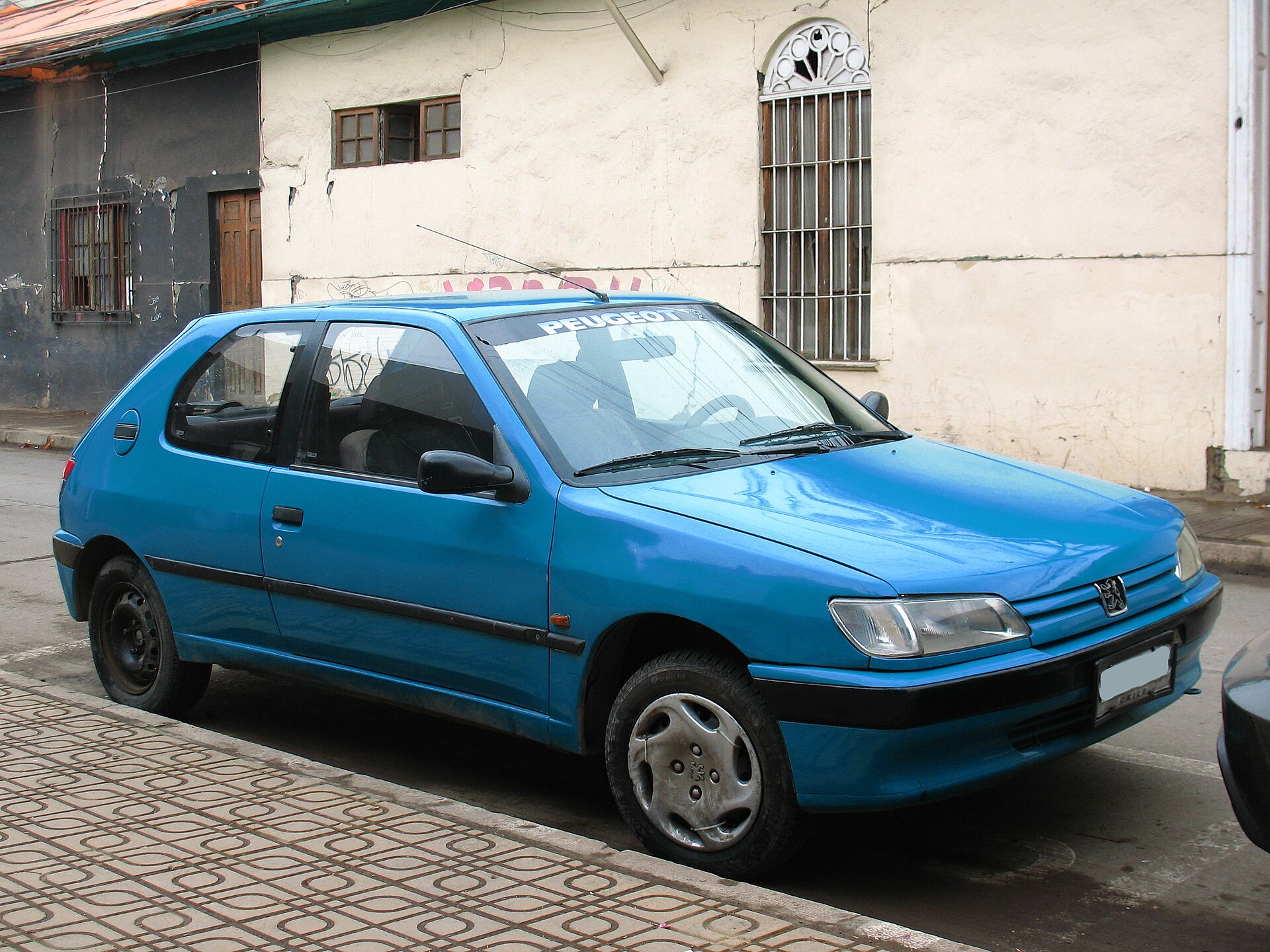
The Peugeot 306 was Peugeot's compact family car from 1993 to 2002, the successor to the 309 and the predecessor of the 307. Styled by Pininfarina and built on the floorpan of the Citroën ZX, it was offered as a hatchback, saloon, cabriolet and estate, with engines ranging from small TU petrol units to the GTI-6 and the HDi diesel. Just under three million were built, and the six-speed GTI-6 was the fastest regular version.
In short
- Launched in February 1993; hatchback replaced by the 307 in 2001, estate and cabriolet built until 2002.
- Hatchback (3/5-door), saloon and Pininfarina cabriolet from 1994, estate (Break) from 1997.
- Petrol engines from 40 kW (55 PS) to 120 kW (163 PS); diesels from 44 kW (60 PS) to the 66 kW (90 PS) HDi of 1999.
- Euro NCAP 1998: three stars for adult occupants; just under 3 million built.
Peugeot 306 at a glance
| Specification | Peugeot 306 |
|---|---|
| Production | 1993–2002 |
| Plants | Poissy and Sochaux (France), Ryton (UK), San Giorgio Canavese (Italy, cabriolet), plus Argentina, Chile, Uruguay, Indonesia, Nigeria, Ecuador |
| Designer | Pininfarina; cabriolet by Pietro Camardella at Pininfarina |
| Body styles | 3- and 5-door hatchback, 4-door saloon, 2-door cabriolet, 5-door estate (Break) |
| Layout | transverse front engine, front-wheel drive |
| Platform | shared with the Citroën ZX; later used by the Xsara, Berlingo and Partner |
| Power range | 40–120 kW (55–163 PS) |
| Gearboxes | 5- and 6-speed manual, 4-speed automatic |
| Units built | just under 3 million |
| Predecessor / successor | Peugeot 309 / Peugeot 307 |
All Peugeot models are listed in our Peugeot catalogue, and the company's long history is told in the history of Peugeot.
Development and design
Peugeot developed the 306 between 1990 and 1992 and launched it in February 1993. Mechanically it was almost identical to the Citroën ZX, which had appeared two years earlier: both cars share the floorpan and core structure. The same base later carried the Citroën Xsara and the Berlingo and Partner vans. The 306's body, however, was its own, styled by Pininfarina.
In Germany the 306 was positioned as a direct rival to the VW Golf III, which you can follow in our overview of all Golf generations, but it sold better in France than in Germany. In Britain it was among the ten best-selling cars every year from 1994 to 1998.
Body styles: from hatchback to cabriolet
The three- and five-door hatchbacks came first. A four-door saloon and the cabriolet followed in 1994, and the estate arrived with the 1997 facelift.
The cabriolet, available from April 1994, was a two-door four-seater designed by Pietro Camardella at Pininfarina and built in Italy. Its fabric roof folded into its own well under a separate cover, so boot space did not change with the roof down. The rear window was plastic on all versions. The roof was manual or electro-hydraulic depending on the model at first, and electro-hydraulic on all cars from 1999. Special editions included the Roland Garros, St. Tropez and Platinum. Cabriolet production ended in April 2002.
| Body | Length | Height |
|---|---|---|
| Hatchback | 4,030 mm | 1,380 mm |
| Saloon | 4,267 mm | 1,386 mm |
| Estate | 4,338 mm | 1,415 mm |
All bodies share a 2,580 mm wheelbase and a width of 1,680 mm. The estate is 308 mm longer than the hatchback, by our calculation.


Phase 1, 2 and 3
- Phase 1 (1993): the original car.
- Phase 2 (May 1997): new lights, grille and bumpers with round fog lamps, a revised interior and the new estate.
- Phase 3 (mid-1999): clear-lens headlamps, colour-coded trim and the common-rail HDi diesel instead of the older XUD. Side airbags were added in 1999.

Engines and performance
The smaller petrol engines came from the TU family (1.1, 1.4 and 1.6 litres; the 1.1 was dropped early). Larger XU-derived 1.8 and 2.0-litre units with eight or sixteen valves powered the XSi and S16. At launch petrol outputs ranged from 40 to 89 kW (55–121 PS) and diesel outputs from 44 to 68 kW (60–92 PS).
| Engine | Family | Power |
|---|---|---|
| 1.1, 1.4, 1.6 petrol 8V | TU | from 40 kW (55 PS) |
| 1.8 and 2.0 petrol 8V / 16V | XU | up to 89 kW (121 PS) at launch |
| 2.0 16V S16 (first version) | XU | about 114 kW (155 bhp) |
| 2.0 16V GTI-6 / S16 (from 1996) | XU10J4RS | 120 kW (163 PS) |
| 1.8 / 1.9 diesel and turbodiesel | XUD | 44–68 kW (60–92 PS) |
| 2.0 HDi (from June 1999) | DW | 66 kW (90 PS) |
The XUD diesel started at 1,769 cc and was later enlarged to 1,905 cc, both with and without a turbocharger. In Australia the XSi and XT were rated at 99 kW (132 bhp).
Gearboxes were five-speed manuals, a six-speed manual for the GTI-6 and four-speed automatics (ZF 4HP14 and later the AL4).
GTI-6, S16 and Rallye
From June 1996 the top model was upgraded: the GTI-6, still called S16 in some markets, used a new manifold and intake that raised output to 120 kW (163 PS), and its six-speed gearbox was unusual in this class at the time. Like the Citroën ZX, Xantia and Xsara, the 306 used a self-steering rear axle, which improved stability at speed but could make the car oversteer when the driver lifted off suddenly. In 1997 the French Gendarmerie's rapid-intervention brigade put 80 Phase 2 S16s into service.
The UK-market 306 Rallye of 1998 was 65 kg lighter than the GTI-6 and priced at £15,995 in 1998. Roughly 500 were built. Our power-to-weight calculator shows how such weight savings change performance.


Key specifications: 306 GTI-6
| Parameter | Metric | Imperial |
|---|---|---|
| Engine | 2.0-litre 16-valve petrol (XU10J4RS) | 2.0-litre I4 |
| Power | 120 kW (163 PS) | 120 kW (161 hp) |
| Gearbox | 6-speed manual | 6-speed manual |
| Length (hatchback) | 4,030 mm | 158.7 in |
| Wheelbase | 2,580 mm | 101.6 in |
| Width | 1,680 mm | 66.1 in |
| Height | 1,380 mm | 54.3 in |
Safety
Euro NCAP tested the 306 in 1998 and gave it three of five stars for adult occupants. In the same period the 1999 Ford Escort scored two stars, while the Ford Focus and Opel/Vauxhall Astra scored four. Australia's Used Car Safety Ratings judged its occupant protection significantly better than average, with four stars for driver protection.
Motorsport
As the 306 Maxi, the car competed in Group A in the French and World Rally Championships. The Maxi Evo 1 of 1995 had 205 kW (280 PS) at 8,700 rpm, the Evo 2 of 1997 217 kW (308 PS) at 11,000 rpm. On the circuits the 306 GTi won the Spa 24 Hours in 1999 and 2000, the Danish Touring Car Championship from 1999 to 2001 and the Asian Touring Car Series from 2000 to 2002. It raced in the British Touring Car Championship from 2000 to 2003, and in 2001 Simon Harrison won the championship with 227 points.
Successors
The 307 replaced the 306 hatchback and saloon in 2001; the estate and cabriolet stayed in production until 2002. The current generation of that line is covered in our Peugeot 308 article, and the larger sister model of the 306 era in our Peugeot 406 guide.
Photo gallery

Peugeot 306 in our rankings
In production longer than 51% of ranked nameplates in the 1CARS catalog (No. 476 of 1082).
FAQ
What years was the Peugeot 306 made?
From 1993 to 2002. The hatchback was replaced by the 307 in 2001; the estate and cabriolet continued until 2002.
Is the Peugeot 306 the same as the Citroën ZX?
Mechanically almost: both share the floorpan and core structure, but the 306 has its own Pininfarina-styled body.
How many Peugeot 306s were built?
Just under 3 million, according to German Wikipedia.
How powerful is the Peugeot 306 GTI-6?
120 kW (163 PS) from a 2.0-litre 16-valve engine, with a six-speed manual gearbox.
How safe is the Peugeot 306?
Euro NCAP gave it three stars for adult occupants in 1998.
Data sources
Data checked by an editor against the sources below.


