 Peugeot 5008
All generations, specs and history
Published Sources (1) Report an error
By Felix Hartmann, Automotive Technology & EV Contributor
- Built
- 2009–present
- Generations
- 3
Timeline
5008 generations
Click a generation for its own page


Newest first · 3 generations since 2009
All generations by year: 5008 III (2024–now) · 5008 II (2017–2024) · 5008 I (2009–2016)
Which one is mine?
Pick the year of first registration to see which generation it is.
- 5008 III 2024–present
- 5008 II 2017–2024
- 5008 I 2009–2016
Verdict
Our verdict · Felix Hartmann
Peugeot updated the 5008 at the right time, as crossovers are very popular in many markets. The facelifted car offers excellent, modern looks, a comfortable cabin, a digital instrument display and a huge boot - all from the base version - which helps it stand out from its rivals. Ground clearance is generous; what is missing is all-wheel drive, even as an option. Even so, it is a good family SUV for sensible money.
The Peugeot 5008 is a mid-size SUV with front-wheel drive and five or seven seats, built by the French manufacturer Peugeot. In Peugeot's words, it combines "the look and ability of an SUV with the practicality and comfort of a family MPV". The original 5008 of 2009 was a compact MPV; the second generation, unveiled in September 2016, became an SUV while keeping its MPV-style versatility. In September 2020 Peugeot revealed a facelift, and this article focuses on that updated second-generation car.
In short
- First generation 2009–2016, a compact MPV (facelift 2013); second generation from 2016, a seven-seat SUV on the EMP2 platform, facelifted in 2020.
- Essentially a seven-seat version of the Peugeot 3008, with a 165 mm longer wheelbase.
- Engines described here: a 1.6 turbo petrol and a 2.0 BlueHDi diesel, both with 110 kW (150 PS); front-wheel drive only.
- Three individual second-row seats, an optional third row and up to 780 litres of luggage space in five-seat form.
Peugeot 5008 at a glance
More Peugeot models are listed in our Peugeot catalogue, and the company's story is told in our history of Peugeot.
| Generation | Years | Type | Notes |
|---|---|---|---|
| First | 2009–2016 | Compact MPV | Unveiled July 2009; facelift October 2013; based on the first 3008 |
| Second | 2016–2024 | Seven-seat SUV | Unveiled 7 September 2016, shown in Paris; facelift September 2020; mild hybrid from 2023 |
| Third | 2024 onwards | SUV, including electric e-5008 | Introduced March 2024 on the STLA Medium platform |
History
The first 5008 went on sale in late 2009 as a family MPV and replaced the larger Peugeot 807 in spirit; it was updated in 2013. The big change came in 2016, when the five-door car became a mid-size SUV but kept its MPV strengths. As the SUV market grew and rivals launched new models, Peugeot presented the facelifted 5008 online in September 2020. The changes are not radical, but the SUV looks fresher, the cabin was improved and new options became available.
Exterior
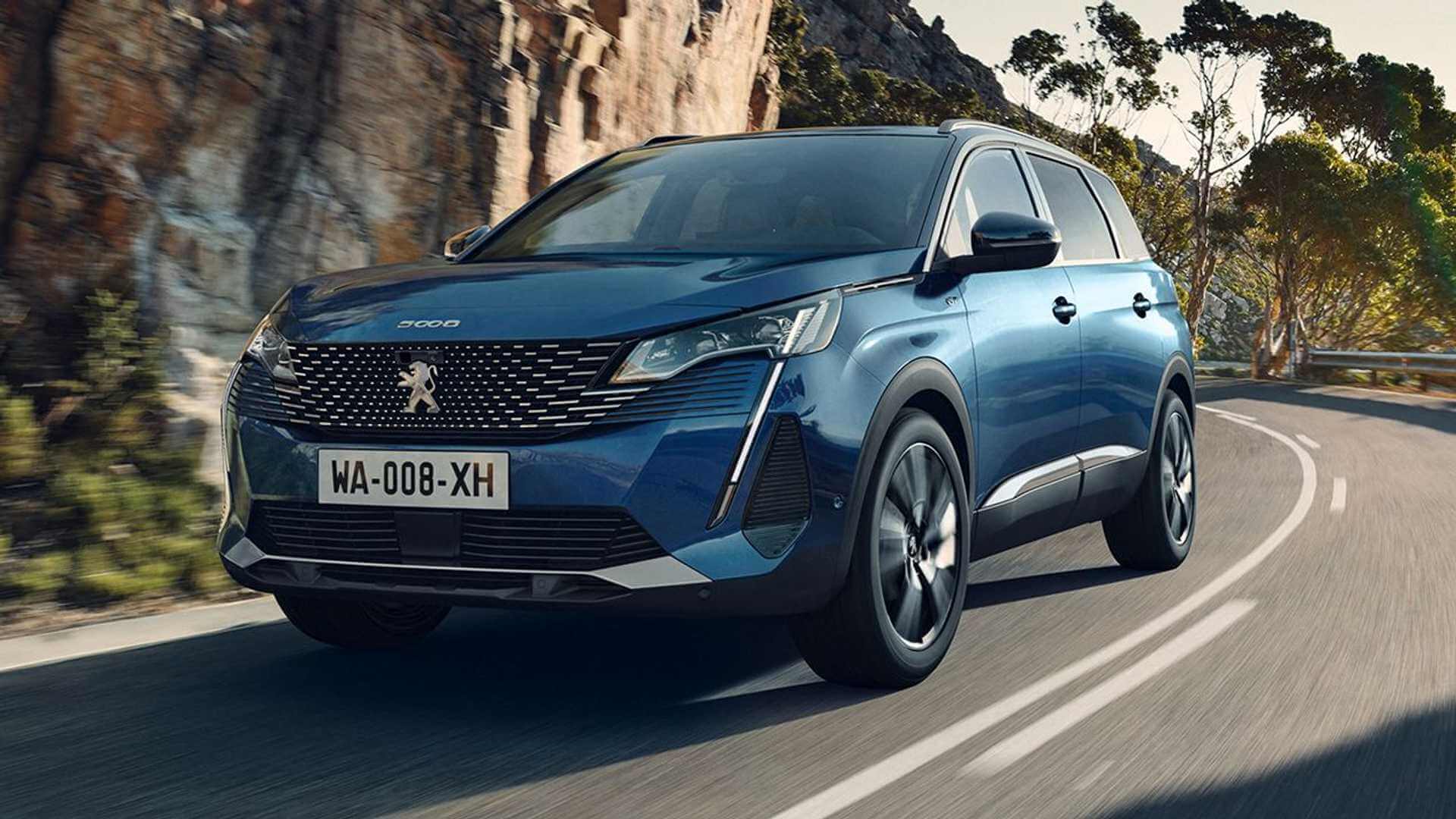
The second-generation 5008 already attracted attention with its modern look, but the facelift showed the direction of Peugeot's future design, following the updated 3008 shown shortly before. Most changes are at the front. The new frameless grille has unusual inserts that are larger at the sides and smaller towards the centre. The facelifted car still wore the old lion badge; Peugeot unveiled its new emblem in February 2021.
Black inserts below the headlights add contrast. The headlights themselves are stylish and innovative: the facelifted 5008 has LED lights with "lion's fangs", as Peugeot calls them - vertical LED daytime running lights that run down from the headlights into the bumper and also serve as indicators. At first glance they look like chrome inserts, but at night they look superb. With the fangs, the front fog lamps disappeared. Even the base version has full LED headlights - Eco LED on entry versions and Full LED on the others. The headlights also changed shape, with a curved lower edge and usually a black background inside. The model number sits above the grille, a solution used on Peugeot's larger SUVs and many hatchbacks.
The bonnet has sharp side ridges pointing towards the grille and is slightly raised in the centre without unnecessary lines. The bumper has an open grille almost the full width of the car, a chrome strip at the bottom and vertical plastic inserts at the sides.
The profile is unchanged. The lower body has the usual black plastic cladding, and the doors carry chrome mouldings. The mirrors kept their shape and colour; they have electric adjustment, heating, power folding, LED indicators and puddle lights. Black and chrome lines run from the bonnet to the tail lights. The roof is solid with roof rails and a shark-fin antenna; the GT version can be ordered with a panoramic roof with a sliding front section. Base versions ride on 17-inch alloy wheels, higher versions on 18-inch wheels and the GT Pack on black 19-inch alloys, which look sporty. Ground clearance is a generous 236 mm.
The rear, like the side, is unchanged and remains restrained. A gloss-black spoiler with an LED brake light crowns the tailgate. The tail lights, with LEDs divided into sections, sit mostly on the tailgate and partly on the body. The bumper is matt black plastic as standard, with an optional gloss-black insert between the exhaust tips, and it carries fog lamps and parking sensors at the sides. Slim pillars give a sense of lightness.
Interior
The facelifted 5008 has leather upholstery, quality fabrics, metal and even carbon-fibre trim, plus a modern infotainment system with a long list of functions. The cabin follows Peugeot's i-Cockpit concept. The driver has a small, sporty two-spoke multifunction steering wheel with a thick rim, flattened at the top and bottom, with a few physical buttons for the most important functions. Above it sits a 12.3-inch digital instrument display, placed higher than in most cars, which can show whatever information the driver needs at the moment.
The centre console has a 10-inch touchscreen on the facelifted car (8 inches on earlier versions), with two air vents and a row of piano-key switches below. These flow into the tunnel, which starts with a large recess for wired or wireless phone charging, followed by the gear selector, comfort-function buttons, cupholders and an armrest whose hinged lid gives access to a cooled storage box.
The 5008 seats five as standard. Peugeot worked hard on comfort: heating, good side support and plenty of electric adjustment are available, with ventilated seats as an option. The second row has three individual seats - unusual for an SUV - that fold flat in three equal sections. An optional third row adds two individual seats suitable for children or teenagers; they fold flat into the floor or can be removed completely. With five seats in use, the boot holds 780 litres, one of the largest in its class, and folding the rear rows increases this to 2,150 litres.
Engines and transmissions
| Engine | Fuel | Power (kW / PS) | Torque | Gearbox |
|---|---|---|---|---|
| 1.6 turbo petrol (THP), direct injection | Petrol | 110 kW / 150 PS | 240 Nm | 6-speed automatic |
| 2.0 BlueHDi, common-rail | Diesel | 110 kW / 150 PS | 370 Nm | 8-speed automatic |
These two engines were offered in some markets. In Europe the facelifted car was sold with a 1.2 PureTech petrol with 96 kW (130 PS), a 1.6 PureTech with 133 kW (180 PS), a 1.5 BlueHDi diesel with 96 kW (130 PS) and a 2.0 BlueHDi with 131 kW (180 PS); from February 2023 the range also included the 5008 Hybrid mild-hybrid version, which Peugeot says uses up to 15% less fuel than the petrol equivalent. The 1.6 THP petrol engine in the table is a 16-valve four-cylinder with double overhead camshafts and variable valve timing; the diesel has a turbocharger, common-rail injection and 16 valves. Combined consumption is about 7 l/100 km for the petrol and 5.5 l/100 km for the diesel. All versions are front-wheel drive - there is no all-wheel-drive 5008. Depending on the engine, the SUV reaches 100 km/h in 10.3–10.5 seconds and has a top speed of 186–201 km/h.
Chassis
The second-generation 5008 uses the modular EMP2 platform with extensive use of high-strength steel in the body. The front suspension is independent with MacPherson struts, the rear a semi-independent torsion beam. Rack-and-pinion steering has electric assistance with adaptive characteristics. All four wheels have disc brakes (ventilated at the front), with ABS, EBD, brake assist and other electronic aids.
Safety and equipment
The facelifted 5008 is well equipped for comfort and safety: front and side airbags, curtain airbags covering all three rows, ABS and stability control, traction control, EBD, automatic emergency braking, tyre-pressure monitoring, distance alert, lane keeping assist, driver attention monitoring, automatic high beam, traffic-sign recognition, a head-up display, blind-spot monitoring, adaptive cruise control, night vision, the digital instrument display, dual-zone climate control, keyless entry, central locking, a heated windscreen, rear parking sensors, a 360-degree camera and a power tailgate, depending on the version.
Well-equipped entry versions have six airbags, ABS and ESP, light and rain sensors, an electric parking brake, dual-zone climate control, cruise control, 17-inch alloy wheels, LED headlights, the digital instrument display, rear parking sensors, heated front seats, an 8-inch infotainment screen and a six-speaker audio system. The top GT version adds sporty design details, adaptive cruise control, blind-spot monitoring, automatic parking, a power tailgate and front seats with electric adjustment, memory and massage.
What owners say
Owners like the modern exterior and interior and the infotainment system with CarPlay, Android Auto and MirrorLink, praising its picture quality and functions, as well as the digital instruments. They also mention the Nappa leather upholstery, soft plastics where they matter, plenty of metal trim and ambient lighting. The seats are comfortable, the optional third row and big boot are welcome, and engine power and ground clearance are sufficient for confidence on rough roads as well as tarmac. On the downside, owners miss an all-wheel-drive option, the third row is really only for children, and some report build-quality issues. Overall, the 5008 is considered a very good, practical car.
Rivals
The second-generation 5008 competed with the Skoda Kodiaq, Kia Sorento, Hyundai Santa Fe, Volkswagen Tiguan Allspace, Renault Koleos, Nissan X-Trail and Mitsubishi Outlander.
Image credits · Photos from Wikimedia Commons under free licences
- Peugeot 5008 I · Photo: Vauxford / Wikimedia Commons, CC BY-SA 4.0
- Peugeot 5008 II · Photo: © M 93 / Wikimedia Commons, CC BY-SA 3.0 de
- Peugeot 5008 III · Photo: Alexander-93 / Wikimedia Commons, CC BY-SA 4.0
Peugeot 5008 in our rankings
- No. 223 of 912 · Longest-running car nameplates (17 years · top 25%)
- No. 124 of 305 · Oldest car models still on sale (17 years · top 42%)
- No. 219 of 345 · Cars with the most generations (3 generations · top 68%)
In production longer than 75% of ranked nameplates in the 1CARS catalog (No. 223 of 912).
FAQ
Is the Peugeot 5008 an SUV or an MPV?
The first generation (2009–2016) was a compact MPV; since 2016 the 5008 has been a seven-seat SUV.
Does the Peugeot 5008 have seven seats?
Yes, with the optional third row of two seats; the second row has three individual seats.
Is the Peugeot 5008 available with all-wheel drive?
No. The second-generation 5008 is front-wheel drive only.
How big is the Peugeot 5008 boot?
780 litres with five seats in use and up to 2,150 litres with the rear seats folded.
Data sources
Data checked by an editor against the sources below.