 Pontiac GTO Judge
Specs, engines and history
Published Sources (1) Report an error
By Sarah Whitmore, Senior Automotive Writer
- Built
- 1969–1971
- Top power
- 276 kW (375 PS)
Which Judge to choose
Our verdict · Sarah Whitmore
- For the original story: a 1969 Carousel Red hardtop with the Ram Air 400.
- For the strongest high-rev engine: a Ram Air IV car from 1969 or 1970.
- For torque: a late 1970 or a 1971 car with the 455 HO.
- For rarity: a 1970 or 1971 convertible.
The Judge's main rival was the Plymouth Road Runner, and its sister car at Pontiac was the Firebird Trans Am. Read more about the brand in Pontiac history, see all versions in the Pontiac catalogue, and compare the Judge with other cars of the golden age in the American muscle car guide and the car rankings.
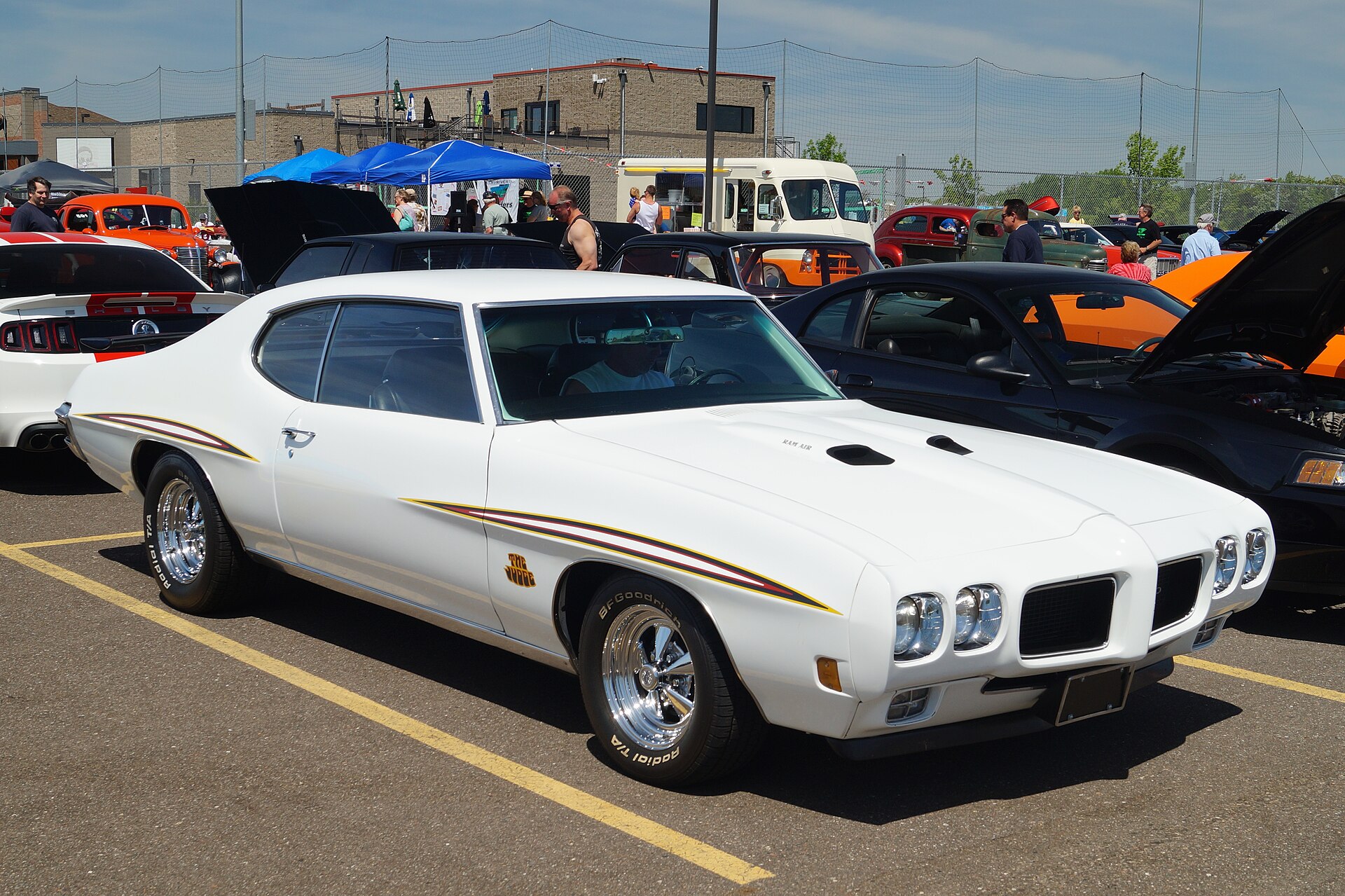
The Pontiac GTO Judge was an option package for the GTO hardtop and convertible from 1969 to early 1971. It began as an idea for a cheaper GTO to fight the Plymouth Road Runner, but it reached showrooms as a dressed-up, better-equipped GTO with the Ram Air 400 V8 as standard. Pontiac built 6,833 Judges in 1969, 3,797 in 1970 and 357 in 1971, and the name came from a running joke on American television.
In short
- Standard engine: the 400 Ram Air (known to enthusiasts as Ram Air III) with 273 kW (366 hp, SAE gross); the Ram Air IV with 276 kW (370 hp) was optional.
- 1970 added the 455 HO late in the year; in 1971 it was the standard Judge engine, rated at 250 kW (335 hp, gross).
- A rear spoiler, stripes and decals, Rally II wheels without trim rings and a Hurst T-handle shifter on four-speed cars.
- Pontiac stopped taking orders on 1 March 1971; only 17 Judge convertibles were made that year.
Specs by version
Engines
| Version | Engine | Power | Torque | Drive | Production years |
|---|---|---|---|---|---|
| 455 HO V8 (SAE gross) | 7.5 l · 8 cyl · Petrol 7,457 cc | 250 kW 340 PS335 hp | 651 Nm480 lb-ft | Rear-wheel drive | 1971 |
| 455 HO V8 (SAE gross) | 7.5 l · 8 cyl · Petrol 7,457 cc | 268 kW 364 PS359 hp | 678 Nm500 lb-ft | Rear-wheel drive | 1970 |
| 400 Ram Air V8 (SAE gross) | 6.6 l · 8 cyl · Petrol 6,555 cc | 273 kW 371 PS366 hp | 603 Nm445 lb-ft | Rear-wheel drive | 1969–1970 |
| 400 Ram Air IV V8 (SAE gross) | 6.6 l · 8 cyl · Petrol 6,555 cc | 276 kW 375 PS370 hp | 603 Nm445 lb-ft | Rear-wheel drive | 1969–1970 |
Dimensions and weight
Show all 4 versions
| Version | Wheelbase |
|---|---|
| 455 HO V8 (SAE gross) | 2,845 mm112.0 in |
| 455 HO V8 (SAE gross) | 2,845 mm112.0 in |
| 400 Ram Air V8 (SAE gross) | 2,845 mm112.0 in |
| 400 Ram Air IV V8 (SAE gross) | 2,845 mm112.0 in |
Verified Manufacturer and type-approval data from our catalog · Sources and methodology
GTO Judge at a glance
| Specification | Pontiac GTO The Judge |
|---|---|
| Model years | 1969, 1970, 1971 (orders closed 1 March 1971) |
| Bodies | two-door hardtop and convertible |
| Platform | GM A-body, 2,845 mm (112 in) wheelbase for two-door GTOs |
| Standard engine | 400 cu in (6.6 l) Ram Air V8, 273 kW (366 hp) at 5,100 rpm |
| Options | 400 Ram Air IV (1969–1970), 455 HO (late 1970) |
| 1971 engine | 455 HO, 250 kW (335 hp) gross, 231 kW (310 hp) net |
| Gearboxes | three-speed manual, three four-speed manuals, automatic |
| Built | 6,833 (1969), 3,797 (1970), 357 (1971) |
| Feature colours | Carousel Red (1969), Orbit Orange (1970) |
The Judge belongs to the second-generation Pontiac GTO, whose 1964 launch 1CARS takes as the start of the muscle car era; the catalogue lists it as a separate version.
Where the name came from
In the late 1960s the sketch "Here Come de Judge" was a catchphrase on the comedy show Rowan & Martin's Laugh-In. Flip Wilson made it famous; it was borrowed from the stage act of Dewey "Pigmeat" Markham. Pontiac turned it into a car. Its advertising used lines such as "All rise for the Judge" and "The Judge can be bought". Paul Revere & the Raiders recorded a song for the car and appeared in television publicity.
According to Wikipedia and Old Cars Weekly, the Judge was first meant to be a low-cost, stripped GTO to compete with the low-priced Plymouth Road Runner. The finished package went the other way: it cost more than a standard GTO and came with more equipment.
The 1969 Judge
The first Judge came with the 400 Ram Air V8 instead of the standard GTO's 261 kW (350 hp) 400. Pontiac never called it "Ram Air III"; the name is an enthusiasts' label. Functional bonnet scoops fed a Rochester Quadrajet four-barrel carburettor. Old Cars Weekly lists the rest of the package:
- a 60-inch rear wing on the boot lid, which needed different torsion rods for the lid;
- a blacked-out centre grille, "The Judge" decals and a "The Judge" badge on the glovebox;
- 14 × 6-inch steel Rally II wheels without trim rings and G70-14 tyres;
- a Hurst shifter with a T-shaped handle on four-speed cars;
- four-wheel drum brakes as standard, with power front discs optional.
Pontiac claimed the spoiler produced a little downforce at high speed; Wikipedia notes it was of little value at legal speeds. Early cars came only in Carousel Red, a shade that looks orange. Old Cars Weekly puts the red-only run at roughly the first couple of thousand cars, after which any GTO colour could be ordered. Hidden headlamps were optional.
Buyers could choose a three-speed manual, an automatic or one of three four-speed manuals: the wide-ratio M20 with 3.23 or 3.55 axles and the close-ratio M21 and M22 with shorter gearing. Of the 72,287 GTOs sold in 1969, 6,833 were Judges. The Ram Air IV was fitted to about 200 GTOs that year, according to Old Cars Weekly, which adds that no reliable figure exists for how many of them were Judges.


Judge engines and power
| Engine | Years | Power (SAE gross) | Torque |
|---|---|---|---|
| 400 Ram Air ("Ram Air III") | 1969–1970 | 273 kW (366 hp) at 5,100 rpm | 603 Nm (445 lb-ft) at 3,600 rpm, per Old Cars Weekly |
| 400 Ram Air IV | 1969–1970 | 276 kW (370 hp) at 5,500 rpm | 603 Nm (445 lb-ft) at 3,900 rpm |
| 455 HO (D-port) | 1970 | 268 kW (360 hp) at 4,300 rpm | 678 Nm (500 lb-ft) at 2,700 rpm |
| 455 HO | 1971 | 250 kW (335 hp) at 4,800 rpm; 231 kW (310 hp) net | 651 Nm (480 lb-ft) at 3,600 rpm |
Pontiac rated the Ram Air IV only 3 kW above the Ram Air 400, and Wikipedia cites speculation that the Ram Air IV was under-rated. The 455 HO of 1970 traded revs for torque: 678 Nm at 2,700 rpm, the highest torque of any Judge engine. For 1971 the 455 HO was rated at 250 kW (335 hp, gross), and Wikipedia also gives its net figure in the GTO, 231 kW (310 hp).
No road test of a Judge is quoted on Wikipedia, but tests of Ram Air GTOs of the same body give an idea of the pace. Car Life recorded 0–60 mph in 6.6 seconds and a quarter mile of 14.53 seconds at 99.7 mph with a 3.90 axle. Motor Trend timed a Ram Air four-speed with 4.33 gears at 14.45 seconds and 98.2 mph.

1970: Orbit Orange and the 455 HO
For 1970 the Judge changed in detail. The Ram Air 400 stayed standard and the Ram Air IV optional; the 455 HO became available on the Judge only late in the model year. Orbit Orange replaced Carousel Red as the feature colour, although any GTO colour could be chosen. The stripes moved to the creases above the wheel arches, the grille surrounds turned dark argent, the bonnet air inlets were painted black and the rear wing sat higher.
Pontiac sold 40,149 GTOs that year, 3,797 of them Judges. Only 168 Judges were convertibles: 147 with the Ram Air 400, 18 with the Ram Air IV and 3 with the 455 HO. Of the 13 GTO convertibles built with the Ram Air IV and an automatic gearbox, just six had the Judge option.
1971: the last Judges
The Judge returned for 1971 with the 455 HO as its standard engine. On 11 February 1971 Pontiac announced that it would accept no new Judge orders after 1 March 1971. Production ended at 357 cars, including 17 convertibles, out of 10,532 GTOs for the year. Motor Trend tested a 1971 GTO with the 455, a four-speed and a 3.90 axle at 6.1 seconds to 60 mph and 13.4 seconds over the quarter mile at 102 mph.
For 1972 the GTO itself became an option package on the LeMans, with net ratings of 186 kW (250 hp) for the 400 and 224 kW (300 hp) for the 455 HO. The Judge name was not used again.
How many Judges were built
| Model year | Judges built | All GTOs | Judge convertibles |
|---|---|---|---|
| 1969 | 6,833 | 72,287 | not given |
| 1970 | 3,797 | 40,149 | 168 |
| 1971 | 357 | 10,532 | 17 |
| Total | 10,987 | 122,968 | - |
By our calculation, the Judge made up about 9.5 % of GTO sales in 1969, 9.5 % in 1970 and 3.4 % in 1971.
Buying a GTO Judge: points to check
- Paperwork: a Judge was an option on a regular GTO, so the build documents matter more than badges and stripes, which are easy to add.
- Engine: 1969 and 1970 Judges should have a Ram Air 400 or Ram Air IV; a 1970 car with a 455 HO is a late-year car; 1971 cars came with the 455 HO.
- Colour: a very early 1969 car should be Carousel Red.
- Convertibles: with 168 built in 1970 and 17 in 1971, a convertible Judge needs especially careful checking.
- Shifter: four-speed Judges had the Hurst T-handle.
Photo gallery


Pontiac GTO Judge in our rankings
- No. 17 of 557 · Biggest engines: cars (7,457 cc · top 4%)
- No. 13 of 173 · Biggest engines: coupes (7,457 cc · top 8%)
- No. 23 of 94 · Most powerful cars of the 1960s (276 kW · top 25%)
- No. 90 of 368 · Most torque: cars (678 Nm · top 25%)
- No. 23 of 88 · Most powerful cars of the 1970s (268 kW · top 27%)
- No. 40 of 106 · Most torque: coupes (678 Nm · top 38%)
Bigger engine than 96% of ranked cars in the 1CARS catalog (No. 17 of 557).
FAQ
Why is it called the Judge?
After the "Here Come de Judge" routine on the TV show Rowan & Martin's Laugh-In, made famous by Flip Wilson.
How many GTO Judges were made?
6,833 in 1969, 3,797 in 1970 and 357 in 1971, according to Wikipedia: 10,987 in total.
What engine did the Judge have?
The 400 Ram Air V8 with 273 kW (366 hp, gross) as standard, the Ram Air IV and, from late 1970, the 455 HO; the 455 HO was standard in 1971.
What colour was the first Judge?
Carousel Red. Later in 1969 any GTO colour could be ordered, and in 1970 the feature colour was Orbit Orange.
When did Pontiac stop making the Judge?
Pontiac accepted no new orders after 1 March 1971.
Data sources
Data checked by an editor against the sources below.