
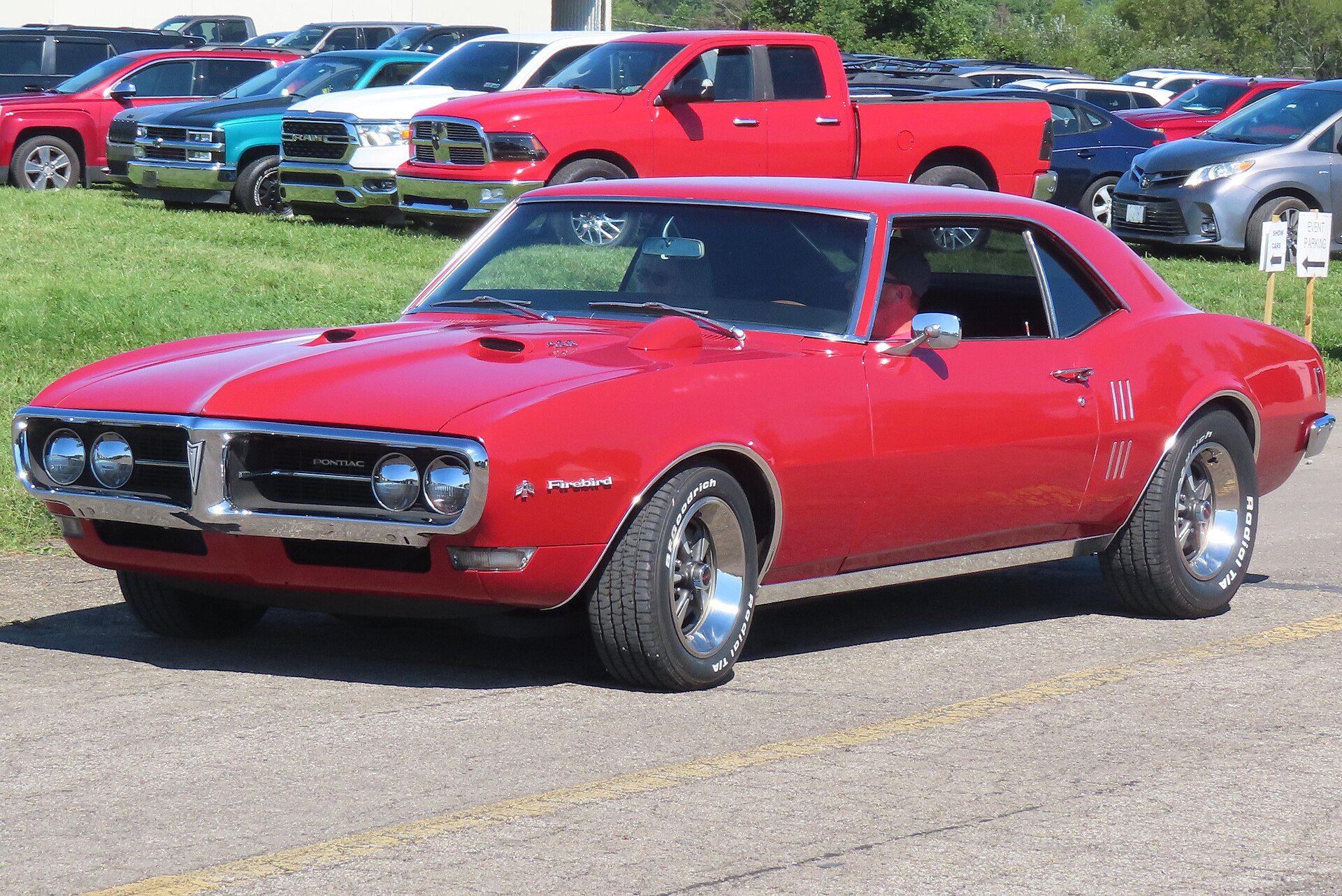
 Pontiac Firebird 400
Specs, engines and history
Published Sources (2) Report an error
By Felix Hartmann, Automotive Technology & EV Contributor
- Built
- 1967–1969
- Top power
- 257 kW (349 PS)
The Firebird 400 was the performance version of Pontiac's first Firebird, sold for the 1967, 1968 and 1969 model years. It took the 400 cu in (6.6 L) V8 of the GTO and put it in the new F-body pony car, with ratings from 242 kW (325 hp, SAE gross) in 1967 to 257 kW (345 hp) for the 1969 Ram Air IV. The Formula 400 replaced it in 1970.
In short
- Launched with the Firebird on 23 February 1967, five months after the Chevrolet Camaro; the 400 package cost US$358.09 in 1967.
- In 1967, 18,632 of the 82,560 Firebirds built had the 400 V8, and only 65 of them the Ram Air version (First Generation Firebird club figures).
- Five 400 versions in three years: the four-barrel 400, the 400 HO, Ram Air, Ram Air II (1968) and Ram Air IV (1969).
- Motor Trend (May 1967) timed a Ram Air car with an automatic at 6.4 s to 60 mph and 14.3 s at 100.3 mph over the quarter mile.
Specs by version
| Version | Engine | Power | Drive | Production years |
|---|---|---|---|---|
| 400 4-barrel V8 (SAE gross) | 6.6 l · 8 cyl · Petrol 6,555 cc | 242 kW 329 PS325 hp | Rear-wheel drive | 1967 |
| 400 HO V8 (SAE gross) | 6.6 l · 8 cyl · Petrol 6,555 cc | 250 kW 340 PS335 hp | Rear-wheel drive | 1968 |
| 400 Ram Air II V8 (SAE gross) | 6.6 l · 8 cyl · Petrol 6,555 cc | 254 kW 345 PS341 hp | Rear-wheel drive | 1968 |
| 400 Ram Air IV V8 (SAE gross) | 6.6 l · 8 cyl · Petrol 6,555 cc | 257 kW 349 PS345 hp | Rear-wheel drive | 1969 |
Verified Manufacturer and type-approval data from our catalog · Sources and methodology
Firebird 400 at a glance
| Specification | Pontiac Firebird 400 |
|---|---|
| Model years | 1967-1969 (1969 cars were built into early 1970) |
| Launch | 23 February 1967 |
| Body | two-door coupé and convertible |
| Platform | GM F-body, shared with the Chevrolet Camaro |
| Engine | 400 cu in (6.6 L) Pontiac V8, Rochester Quadrajet four-barrel |
| Power | 242 kW (325 hp) in 1967 to 257 kW (345 hp) in 1969, SAE gross |
| Torque | 583 Nm (430 lb-ft) at 3,400 rpm (1969 Ram Air IV) |
| Gearboxes | heavy-duty three-speed manual; four-speed manual or Turbo Hydra-Matic optional |
| Built with a 400 | 18,632 in 1967; about 21,000 in 1968 (club estimate) |
| 0-60 mph | 6.4-7.0 s depending on gearbox (Motor Trend, May 1967) |
| Price new | US$2,666 for the base coupé plus US$358.09 for the 400 package (1967) |
A pony car with the GTO engine
Pontiac launched the Firebird on 23 February 1967, five months after Chevrolet had introduced the Camaro on the same F-body. To keep costs down, Pontiac engineers had to use the Camaro's front wings and doors, so the Firebird's identity came from its split grille, its tail lamps and its engines. The 400 sat at the top of a range that started with an overhead-cam six; the four-barrel Sprint version of that six was rated at 215 hp.
The big V8 came straight from the GTO, Pontiac's intermediate muscle car, and the Firebird 400 was rated 242 kW (325 hp) at 4,800 rpm in 1967. Enthusiasts have long claimed that a small tab on the Quadrajet linkage stopped the secondary barrels from opening fully on 1967-1968 Firebird 400s, to keep the smaller car below the GTO under GM's rule of 10 lb of car per advertised horsepower. The First Generation Firebird club treats the story as unsettled: Firebird and GTO carburettors often share a part number, and inspections of original parts have produced mixed results.
The 400 package and the Ram Air option
Ordering the 400 brought more than the engine. On 1968 cars the package also included twin non-functional bonnet scoops, heavy-duty springs, red-line wide-oval tyres, a chrome air cleaner, dual exhausts, a declutching fan, a heavy-duty battery, starter and radiator, and chrome rocker covers. The standard gearbox was a heavy-duty three-speed manual with ratios of 2.41, 1.59 and 1.00.
The Ram Air option, US$263 in 1967 on top of the 400, made the two scoops work: they were opened and ducted straight into the air cleaner. Pontiac paired them with a camshaft of longer duration and more overlap, a valvetrain built for 6,000 rpm, exhaust manifolds of the 428 type and a recalibrated Quadrajet. The official rating stayed at 242 kW (325 hp), only reached at 5,200 rpm instead of 4,800. Ram Air cars usually had 3.90:1 or 4.33:1 axles, against the 3.36:1 standard ratio.

400 engines by year, 1967-1969
Each year brought a new top engine, and the ratings rose by small steps that hid larger changes inside.
| Year | Engine | Rating (SAE gross) | Built, club figures |
|---|---|---|---|
| 1967 | 400 four-barrel | 242 kW (325 hp) at 4,800 rpm | 18,632 including Ram Air |
| 1967 | 400 Ram Air | 242 kW (325 hp) at 5,200 rpm | 65 |
| 1968 | 400 | 246 kW (330 hp) | 7,563 manual, 11,151 automatic |
| 1968 | 400 HO | 250 kW (335 hp) at 5,000 rpm | 2,087 |
| 1968 | 400 Ram Air | 250 kW (335 hp) at 5,300 rpm | about 413 |
| 1968 | 400 Ram Air II | 254 kW (340 hp) | about 110 |
| 1969 | 400 HO with Ram Air | 250 kW (335 hp) | not published |
| 1969 | 400 Ram Air IV | 257 kW (345 hp) at 5,000 rpm | not published |
The 1968 400 HO, a US$76.88 step up from the regular 400, added premium-fuel tuning and stiffer suspension. Ram Air II replaced the first Ram Air in mid-1968 with revised round-port heads, forged pistons and crankshaft and a higher-lift camshaft. Sources give different start dates: Wikipedia cites 1 March 1968, while the club records the first Ram Air II as built on 20 May 1968.

Period road tests
Motor Trend tested four Firebird 400s for its May 1967 issue, and the results show how little the gearbox choice mattered with this much torque.
| Firebird 400 (1967) | 0-60 mph | Quarter mile |
|---|---|---|
| three-speed manual | 7.0 s | 14.8 s at 98 mph |
| four-speed manual | 6.7 s | 14.5 s at 99 mph |
| Turbo Hydra-Matic | 6.7 s | 14.7 s at 99 mph |
| Ram Air, Turbo Hydra-Matic | 6.4 s | 14.3 s at 100.3 mph |
The wide-ratio four-speed (2.52, 1.88, 1.47, 1.00) cost US$184.31 in 1967 and the Turbo Hydra-Matic US$226.44, available only with the big engine. Car Life, testing a four-speed car in August 1967, wrote that with the flexibility of Pontiac engines a three-speed was "more than adequate and costs less". For scale, Car Life's 1969 test of a Camaro SS396 with the 375 hp L78 and a four-speed gave 6.8 s to 60 mph and 14.77 s over the quarter mile.
1969, Ram Air IV and the first Trans Am
The 1969 Firebird received a new front end and a revised instrument panel, with the ignition switch moved to the steering column. The regular 400 and the 400 HO continued with little change, and the "Ram Air III" name that collectors use for the 1969 HO with Ram Air was never a Pontiac designation. In the middle of the year Pontiac added the Ram Air IV, rated 257 kW (345 hp) at 5,000 rpm and 583 Nm (430 lb-ft) at 3,400 rpm, with 1.65:1 rocker arms against 1.5:1 on the lesser engine.
In March 1969 the 400 also became the base of the Trans Am, the WS4 package priced at US$1,083, with the 400 HO as standard. Pontiac built 689 Trans Am hardtops and eight convertibles; Hagerty counts 55 of them with the Ram Air IV, 46 with a four-speed. The full story of that car sits in our Firebird Trans Am hub. Pontiac rated the same Ram Air IV at 370 hp in the GTO, and Hagerty notes that both figures were probably on the low side. Because the second-generation Firebird was late, 1969 cars were built into early 1970.

Firebird 400 today: what to check
The 400 name was a package, so the engine, its code and the paperwork carry the value. On 1968 cars, the club lists separate engine codes for each version: WZ and YT for the 400 with manual and automatic gearboxes, WQ and YW for the 400 HO, WI and XN for the first Ram Air and WU and XT for Ram Air II. Body codes 22337 (coupé) and 22367 (convertible) apply to every first-generation Firebird and say nothing about the engine.
- Ram Air cars are the rarest: 65 in 1967, roughly 413 Ram Air and 110 Ram Air II cars in 1968.
- The club says its 1968 totals are mostly estimates; firm figures need Pontiac's original billing records, which Pontiac Historic Services uses for its documentation.
- A 1967-1968 400 with non-functional scoops is a regular 400; working scoops ducted to the air cleaner should come with the Ram Air camshaft and manifolds.
- The car shares body panels with the Camaro, so rust repairs and parts supply follow the first-generation Camaro.
The whole Firebird line from 1967 to 2002 is covered in our Pontiac Firebird guide, the engine's original home in the Pontiac GTO story, and the other Pontiacs in the Pontiac catalogue and the American muscle car guide.
Pontiac Firebird 400 in our rankings
- No. 63 of 667 · Biggest engines: cars (6,555 cc · top 10%)
- No. 45 of 204 · Biggest engines: coupes (6,555 cc · top 23%)
- No. 164 of 512 · Most torque: cars (583 Nm · top 33%)
- No. 39 of 117 · Most powerful cars of the 1960s (257 kW · top 35%)
- No. 407 of 1044 · Most powerful cars (257 kW · top 40%)
- No. 72 of 137 · Most torque: coupes (583 Nm · top 54%)
Bigger engine than 90% of ranked cars in the 1CARS catalog (No. 63 of 667).
FAQ
How much horsepower did the Firebird 400 have?
242 kW (325 hp, SAE gross) in 1967, 246-254 kW (330-340 hp) in 1968 depending on version, and up to 257 kW (345 hp) with the 1969 Ram Air IV.
How many 1967 Firebird 400s were built?
First Generation Firebird club figures give 18,632 Firebirds with the 400 V8 in 1967, out of 82,560 built. Only 65 had the Ram Air option.
What is the difference between the Firebird 400 and the Trans Am?
The Firebird 400 was an engine package for any coupé or convertible from 1967. The 1969 Trans Am was a separate WS4 package built on the 400 HO, with its own stripes, spoiler and suspension; only 697 were made.
Was the Ram Air III a real Pontiac engine name?
No. Pontiac sold it as the 400 HO with Ram Air; "Ram Air III" is a later enthusiast name that distinguishes it from the Ram Air IV of 1969.
What replaced the Firebird 400?
The Formula 400 of 1970, part of the second-generation Firebird, which kept the 400 V8 and twin bonnet scoops in a new body.
Data sources
Data checked by an editor against the sources below.
- Wikipedia - Pontiac Firebird (first generation)
- Firstgenfirebird - 1968 Pontiac Firebird History


