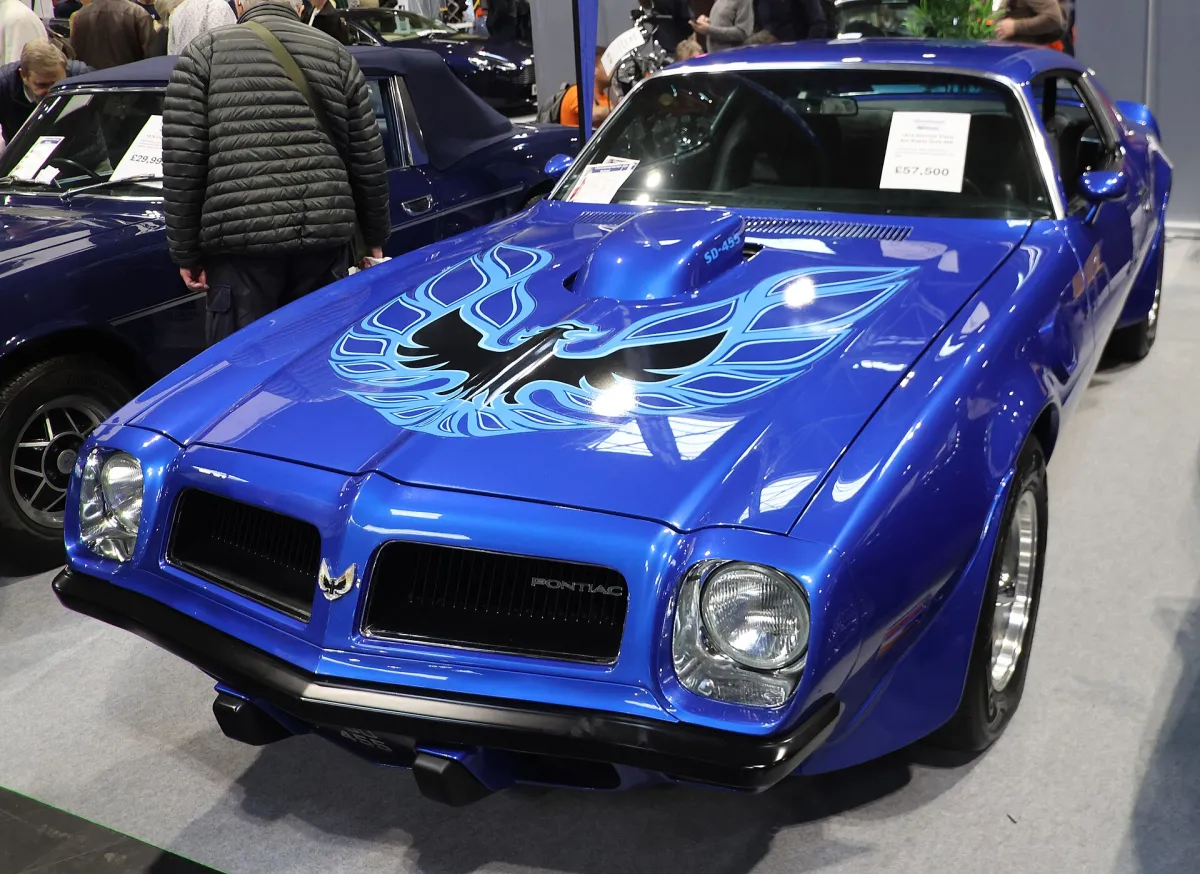
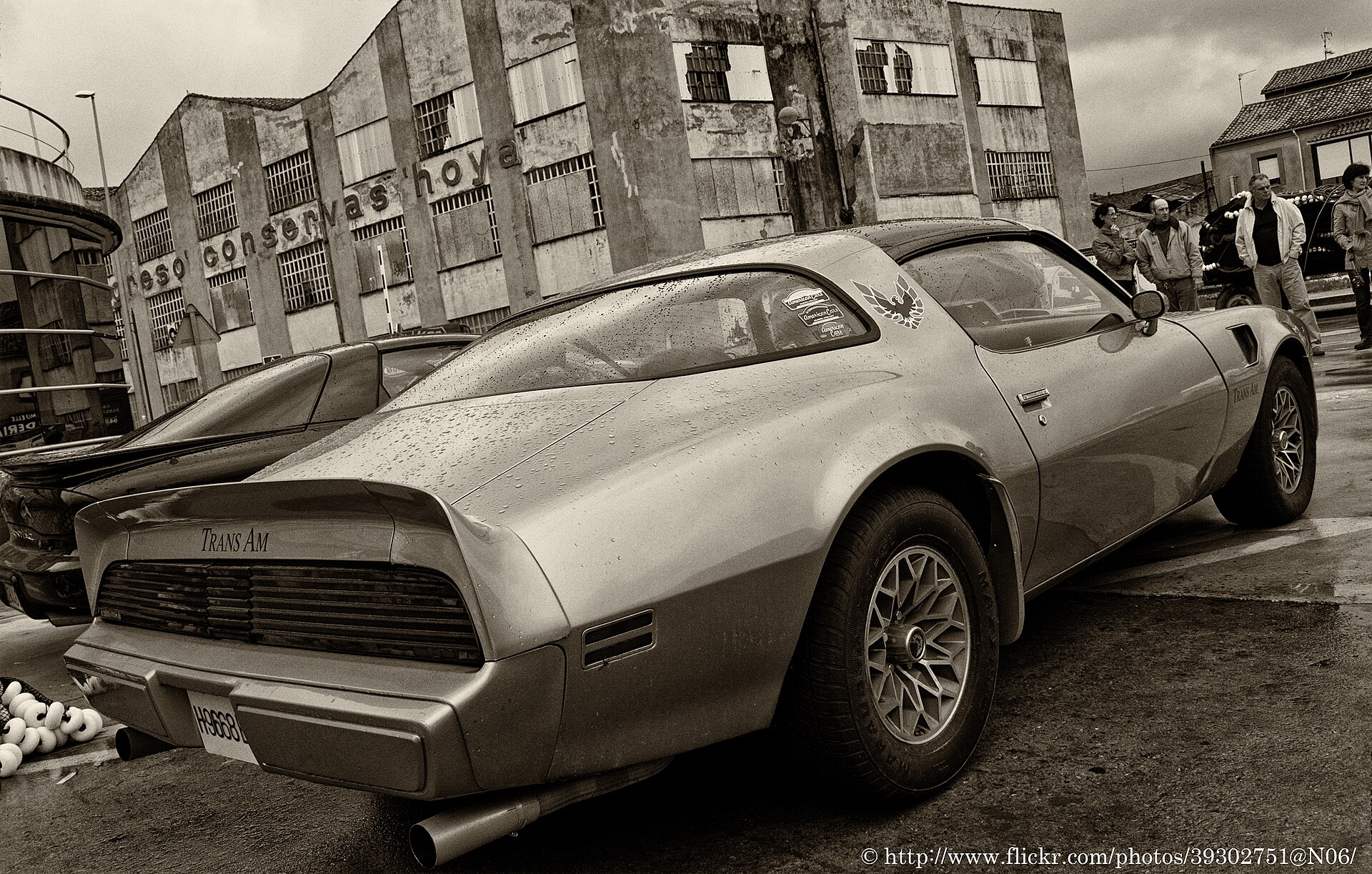
 Pontiac Firebird Trans Am Turbo
Specs, engines and history
Published Sources (3) Report an error
By Felix Hartmann, Automotive Technology & EV Contributor
- Built
- 1980–1981
- Top power
- 157 kW (213 PS)
The Pontiac Firebird Trans Am Turbo, usually called the Turbo Trans Am, was the top Trans Am of the 1980 and 1981 model years. Pontiac fitted a Garrett turbocharger to its 4.9 L (301 cu in) V8 after emissions and fuel economy rules ended the 6.6 L engines. It was rated at 157 kW (210 hp, SAE net) in 1980 and paced the 1980 Indianapolis 500.
In short
- Turbo option price in 1980: USD 350 on a Trans Am and USD 530 on a Formula, plus air conditioning at USD 566, which was required.
- 157 kW (210 hp) and 468 Nm (345 lb-ft) in 1980; 149 kW (200 hp) and 461 Nm (340 lb-ft) in 1981. Three-speed automatic only, 3.08:1 axle.
- About 22,176 Turbo Trans Ams in 1980 and 15,578 in 1981, including 5,700 Indy pace car replicas and 2,000 Daytona 500 pace car editions.
- Car and Driver measured 8.2 seconds to 60 mph and 16.7 seconds at 86 mph over the quarter mile.
Specs by version
| Version | Engine | Power | Torque | Gearbox | Drive | Production years |
|---|---|---|---|---|---|---|
| 4.9 Turbo V8 (LU8) 1981 | 4.9 l · 8 cyl · Petrol 4,932 cc | 149 kW 203 PS200 hp | 461 Nm340 lb-ft | 3-sp Automatic | Rear-wheel drive | 1981 |
| 4.9 Turbo V8 (LU8) 1980 | 4.9 l · 8 cyl · Petrol 4,932 cc | 157 kW 213 PS211 hp | 468 Nm345 lb-ft | 3-sp Automatic | Rear-wheel drive | 1980 |
Verified Manufacturer and type-approval data from our catalog · Sources and methodology
Pontiac Turbo Trans Am at a glance
| Specification | Pontiac Firebird Trans Am Turbo |
|---|---|
| Model years | 1980-1981 |
| Built | about 22,176 (1980) and 15,578 (1981) Trans Ams, per a Trans Am registry table |
| Body | two-door hatchback coupé, with or without T-top roof |
| Platform | GM F-body, second-generation Firebird |
| Engine | LU8 4.9 L (301 cu in) Pontiac V8, Garrett TBO-305 turbocharger, 800 cfm Rochester Quadrajet |
| Boost | factory limit 9 psi (0.62 bar), plus or minus 1 psi |
| Power | 157 kW (210 hp, SAE net) in 1980; 149 kW (200 hp) in 1981 |
| Torque | 468 Nm (345 lb-ft) in 1980; 461 Nm (340 lb-ft) in 1981 |
| Gearbox | three-speed TH350 automatic, 3.08:1 axle |
| 0-60 mph | 8.2 s (Car and Driver) |
| Quarter mile | 16.7 s at 86 mph (Car and Driver); 16.30 s (Hot Rod, March 1980) |
| Price new | turbo option USD 350 on a Trans Am in 1980, air conditioning USD 566 extra |
Why Pontiac turbocharged the 301
By 1980 tightening emissions and fuel economy rules had forced Pontiac to drop its large-displacement V8s. The 1979 Trans Am could still be ordered with the 6.6 L (400 cu in) W72, and its replacement had to come from a much smaller engine family. Pontiac chose the 301 and added a turbocharger.
The resulting rating was 157 kW (210 hp) and 468 Nm (345 lb-ft). On paper that was 7 kW (10 hp) short of the W72 400 of 1979, which Carscoops puts at about 164 kW (220 hp); Drivingline argues that the old 400 really made more than 194 kW (260 hp), because Pontiac had understated it. The normally aspirated 301 of 1980 gave 116 kW (155 hp), so the turbo still added more than a third.
301 Turbo engine specs and hardware
Pontiac did more than bolt a turbocharger to a standard engine. The 301 Turbo had a stronger block cast with thicker cylinder walls and more nickel, forged pistons with a D-shaped crown, a crankshaft with two counterweights instead of five, a high-pressure oil pump and a fully baffled oil pan. Fuel came through a single-plane intake from an 800 cfm Rochester Quadrajet that was unique to this engine. The turbocharger itself was an oil-cooled Garrett TBO-305.
Boost was capped at about 9 psi by the wastegate, and owners measured anywhere from 7 to 10 psi on factory cars. An Electronic Spark Controller with a knock sensor retarded the ignition when it detected detonation. Drivingline blames that system for much of the car's flat feel: on low-octane petrol the computer pulled spark, and the carburettor often could not supply enough air and fuel, which led to pinging. For 1981 Pontiac fitted a computer-controlled E4ME carburettor, and the rating dropped to 149 kW (200 hp).
Bonnet bulge, boost lights and pace cars
The turbo layout dictated the look. The turbocharger took so much room that the carburettor sat off-centre, and Pontiac covered it with an offset bonnet bulge. A dummy rear-facing intake in the bulge held lights that came on as boost rose, in effect a boost gauge on the bonnet.
The 1980 Turbo Trans Am was chosen to pace the Indianapolis 500. Five cars were prepared for the race, driven by 1950 winner Johnnie Parsons at the start, and needed little modification apart from an extra-large bird decal on the bonnet. Pontiac then built 5,700 replicas under RPO Y85, white with charcoal trim. The same pace cars led the 1980 Daytona 500, and for 1981 the Turbo Trans Am returned at Daytona with a 2,000-car Daytona 500 pace car edition, also coded Y85. Film audiences saw the car in Smokey and the Bandit II, where the 1980 Turbo Trans Am needed nitrous oxide tanks from Marvin Miller Systems to deliver the performance the scenes required.
Turbo Trans Am road tests and 0-60 times
Road testers liked the handling and disliked the straight-line speed. Car and Driver's 1980 test car, with the three-speed automatic and 3.08:1 axle, reached 60 mph in about 8.2 seconds and ran the quarter mile in 16.7 seconds at 86 mph. A 1979 W72 Trans Am with a manual gearbox had needed 6.7 seconds and 15.3 seconds at 97 mph.
| Test | Car | 0-60 mph | Quarter mile |
|---|---|---|---|
| Car and Driver, 1979 | Trans Am W72 400, manual | 6.7 s | 15.3 s at 97 mph |
| Hot Rod, March 1980 | Turbo Trans Am | 16.30 s | |
| Car and Driver, 1980 | Turbo Trans Am, automatic | 8.2 s | 16.7 s at 86 mph |
| Car and Driver, April 1980 | Camaro, 5.7 L LM1 V8, four-speed | 16.40 s |
Drivingline adds that the Formula Turbo ran a few tenths quicker than the Trans Am Turbo, and that fully equipped pace car replicas were the slowest and most expensive of the turbo cars. The Chevrolet rival in the last row is covered in the second-generation Camaro history.

How many Turbo Trans Ams were built
A production table compiled by a Trans Am registry site from Pontiac data gives the Turbo split by roof and package. Formula Turbos are not broken out, so the totals below cover Trans Ams only. The same table's own sums differ slightly from its overview, so treat the totals as close approximations.
| Version | 1980 | 1981 |
|---|---|---|
| Trans Am Turbo, hardtop | 5,753 | 3,851 |
| Trans Am Turbo, T-top | 7,176 | 6,612 |
| Y84 Special Edition Turbo | 3,547 | 3,115 |
| Y85 pace car | 5,700 | 2,000 |
| Turbo Trans Am total | about 22,176 | about 15,578 |
| All Trans Ams | 50,896 (Wikipedia) | 33,493 (Wikipedia) |
Why the Turbo Trans Am lasted two years
Sales fell fast. Drivingline notes that total Trans Am volume halved against the last big-block year and then halved again. GM was also centralising engine development, and the 301 Turbo, planned for the third-generation F-body, was cancelled before that car went into production. The redesigned 1982 Trans Am used Chevrolet V8s instead. Pontiac's next turbocharged Trans Am was the 1989 20th Anniversary car with a Buick 3.8 L V6, the engine family of the Buick Grand National.
Turbo Trans Am today: what to check when buying
Start with the VIN: its engine code is T on a 1980-1981 301 Turbo. The cowl tag shows Y84 on a Special Edition and Y85 on a pace car, and a Hagerty-auctioned Turbo shown by Carscoops in 2025 illustrates why that matters, because it wore Special Edition parts without the Y84 code. Pace car replicas should be white with charcoal trim, and Y84 cars should be black and gold, most of them with Fisher T-tops.
Mechanically, look for evidence of detonation and a tired Quadrajet, both linked to the turbo's spark control and fuel delivery. According to Wikipedia the wastegate could be raised safely to about 15 psi only with water or alcohol injection, so ask about boost changes on a car without it. The wider Trans Am story is told in the Pontiac Firebird Trans Am hub, and the model sits in the Pontiac catalogue. How the Turbo Trans Am ranks against its contemporaries is shown in the best malaise-era muscle cars.
Pontiac Firebird Trans Am Turbo in our rankings
- No. 204 of 772 · Biggest engines: cars (4,932 cc · top 27%)
- No. 40 of 99 · Most powerful cars of the 1980s (157 kW · top 42%)
- No. 281 of 640 · Most torque: cars (468 Nm · top 45%)
- No. 125 of 250 · Biggest engines: coupes (4,932 cc · top 50%)
- No. 759 of 1190 · Most powerful cars (157 kW · top 64%)
- No. 117 of 169 · Most torque: coupes (468 Nm · top 70%)
Bigger engine than 73% of ranked cars in the 1CARS catalog (No. 204 of 772).
FAQ
How much power did the Turbo Trans Am have?
Between 149 and 157 kW. The 1980 car was rated at 157 kW (210 hp, SAE net) and 468 Nm (345 lb-ft). For 1981 the rating fell to 149 kW (200 hp) and 461 Nm (340 lb-ft).
Was the Turbo Trans Am available with a manual gearbox?
No. Every Turbo Trans Am used the three-speed automatic with a 3.08:1 axle. In 1980 no manual gearbox was offered on any Formula or Trans Am.
How many 1980 Turbo Trans Am pace cars were built?
Pontiac built 5,700 Indianapolis 500 pace car replicas in 1980 under RPO Y85, white with charcoal trim. A further 2,000 Daytona 500 pace car editions followed in 1981.
How do I identify a real Turbo Trans Am?
Check the VIN: the engine code T stands for the 301 Turbo of 1980-1981. Then check the cowl tag for Y84 or Y85 if the car is sold as a Special Edition or a pace car.
Data sources
Data checked by an editor against the sources below.
- Wikipedia - Pontiac 301 Turbo
- 78ta - Production
- Wikipedia - Pontiac Firebird (second generation)