
 Pontiac Firebird Formula
All generations, specs and history
Published Sources (5) Report an error
By Felix Hartmann, Automotive Technology & EV Contributor
- Built
- 1970–2002
- Generations
- 3
- Top power
- 257 kW (349 PS)
Timeline
Firebird Formula generations
Click a generation for its own page
- Formula 1970–1981 · Coupe · 257 kW (349 PS)
- Formula 1987–1992 · Coupe · 127–175 kW (173–238 PS)
- Formula 1993–2002 · Coupe, Convertible · 205–239 kW (279–325 PS)
Newest first · 3 generations since 1970
- 1993 Formula 1993–2002 · Coupe, Convertible · 205–239 kW (279–325 PS)
- 1987 Formula 1987–1992 · Coupe · 127–175 kW (173–238 PS)
- 1970 Formula 1970–1981 · Coupe · 257 kW (349 PS)
All generations by year: Formula (1993–2002) · Formula (1987–1992) · Formula (1970–1981)
Which one is mine?
Pick the year of first registration to see which generation it is.
Check by VINThe Firebird Formula was the performance Firebird for buyers who wanted Trans Am engines in a quieter body. It arrived with the second-generation car in February 1970 as the Formula 400, added 455 V8s in 1971 and stayed in the range until 2002, with a gap from 1982 to 1986. Its strongest years were 1970-1974, when it could be ordered with every big Pontiac V8 up to the Super Duty 455.
In short
- 1970 Formula 400: 400 V8 with 246 kW (330 hp, SAE gross) and 583 Nm (430 lb-ft); 7,708 built, 689 of them with the Ram Air III.
- Twin snorkel bonnet scoops above the grille, working when Ram Air was ordered, until a shaker scoop replaced them in 1973.
- Formula 455 from 1971, with the 455 HO at 250 kW (335 hp gross); the Super Duty 455 went into 43 Formulas in 1973 and 58 in 1974.
- The name returned for 1987-1992 with fuel-injected V8s and for 1993-2002 with the LT1 and LS1, up to 239 kW (320 hp) with WS6.
Specs by version
| Version | Engine | Power | Torque | Drive | Production years |
|---|---|---|---|---|---|
| Formula · 455 Super Duty V8 (SAE net) | 7.5 l · 8 cyl · Petrol 7,457 cc | 216 kW 294 PS290 hp | 536 Nm395 lb-ft | Rear-wheel drive | 1973–1974 |
| Formula · 400 L78 V8 (SAE gross) | 6.6 l · 8 cyl · Petrol 6,555 cc | 246 kW 334 PS330 hp | 583 Nm430 lb-ft | Rear-wheel drive | 1970 |
| Formula · 455 HO V8 (SAE gross) | 7.5 l · 8 cyl · Petrol 7,457 cc | 250 kW 340 PS335 hp | - | Rear-wheel drive | 1971 |
| Formula · 5.7 LT1 V8 | 5.7 l · 8 cyl · Petrol 5,733 cc | 205 kW 279 PS275 hp | 441 Nm325 lb-ft | Rear-wheel drive | 1993–1995 |
| Formula · 5.7 LS1 V8 | 5.7 l · 8 cyl · Petrol 5,665 cc | 227 kW 309 PS304 hp | 454 Nm335 lb-ft | Rear-wheel drive | 1998–2000 |
Verified Manufacturer and type-approval data from our catalog · Sources and methodology
Firebird Formula at a glance
| Specification | Pontiac Firebird Formula |
|---|---|
| Model years | 1970-1981, 1987-1992, 1993-2002 |
| Launch | Chicago Auto Show, 26 February 1970 |
| Body | two-door coupé; convertible in the fourth generation until 1997 |
| Platform | GM F-body |
| Engines 1970-1974 | 350, 400 and 455 cu in V8 (5.7, 6.6 and 7.5 L) |
| Highest rating | 250 kW (335 hp, SAE gross), 455 HO, 1971 |
| Torque | 583 Nm (430 lb-ft) at 3,000 rpm, 1970 Formula 400 |
| Gearboxes (1970) | three-speed manual with Hurst shifter; two four-speeds and a three-speed automatic optional |
| Best year | 24,850 built in 1979 |
| Road test | 0-60 mph 6.4 s, quarter mile 14.7 s at 98.9 mph (Car and Driver, Formula 400) |
| Weight | about 45 kg (100 lb) lighter than the 1970 Trans Am, per LSX Magazine |
Formula 400: a Trans Am in plain clothes
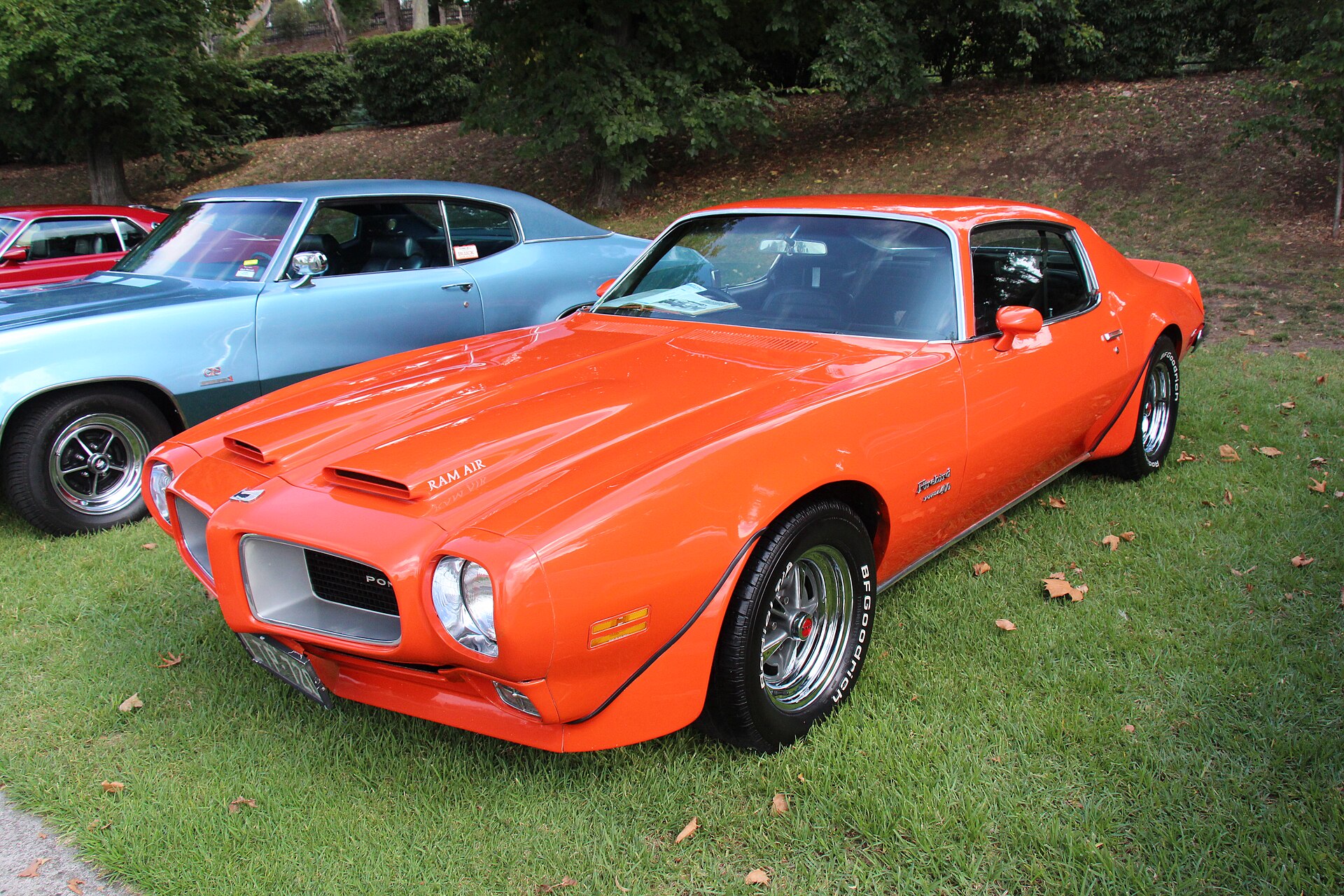
Pontiac showed the second-generation Firebird at the Chicago Auto Show on 26 February 1970, with four models: Firebird, Esprit, Formula 400 and Trans Am. The Formula took its name from open-wheel racing and replaced the 1967-1969 Firebird 400. It had no stripes, spoilers or wing flares, but it could take most Trans Am options; the exceptions were the wheel-arch flares, the shaker scoop and the wing air extractors. Inside it used a deluxe steering wheel and a woodgrain gauge panel instead of the Trans Am's engine-turned metal.
The standard engine was the L78 400 with a Rochester four-barrel, 10.25:1 compression, 246 kW (330 hp) at 4,800 rpm and 583 Nm (430 lb-ft) at 3,000 rpm. For US$168.51 in 1970, buyers could order the L74 Ram Air version with 10.75:1 compression. Old Cars Weekly quotes 250 kW (335 hp) at 5,000 rpm for it; Wikipedia lists 335 hp with the automatic and 257 kW (345 hp) with a manual gearbox. The Ram Air IV, offered in the Trans Am, did not reach a single Formula.
The Formula's long twin scoops opened just above the grille. With the Ram Air engine, two rubber-sealed ducts under the bonnet fed the carburettor with outside air, and "RAM AIR" decals appeared on the scoops. Firmer springs and dampers, anti-roll bars front and rear and power front disc brakes were standard. Car and Driver measured 6.4 s to 60 mph and 14.7 s at 98.9 mph over the quarter mile, a little slower than the Trans Am it tested, which cost US$4,663.63 in 1970 at the same time.
| 1970 Formula 400 | Manual | Automatic | Total |
|---|---|---|---|
| L78 400 | 2,381 | 4,638 | 7,019 |
| L74 400 Ram Air III | 396 | 293 | 689 |
| Total | 2,777 | 4,931 | 7,708 |
Formula 455 and the Super Duty years, 1971-1974
For 1971 the Formula became three models, each with its displacement on the lower front wings: Formula 350, Formula 400 and Formula 455. The 455 came as the L75 with D-port heads or as the LS5 455 HO, the Trans Am engine with round-port heads, rated at 250 kW (335 hp, SAE gross). Of the 7,802 Formulas built in 1971, 321 had the 455 HO (166 manual, 155 automatic) and 350 the L75. Tran-Zam counts 159 of the manual HO cars with the close-ratio M22 four-speed.
| Year | Formula engines | Strongest rating | Formulas built |
|---|---|---|---|
| 1970 | 400, 400 Ram Air | 250-257 kW (335-345 hp) gross | 7,708 |
| 1971 | 350, 400, 455, 455 HO | 250 kW (335 hp) gross | 7,802 |
| 1972 | 455 HO and smaller V8s | 224 kW (300 hp) net | 5,249 |
| 1973 | 350, 400, 455, SD-455 | 216 kW (290 hp) net | 10,166 |
| 1974 | 350, 400, 455, SD-455 | 216 kW (290 hp) net | 14,519 |
The change from gross to net ratings in 1972 makes the 455 HO look weaker on paper, at 224 kW (300 hp). For 1973 the twin-snorkel bonnet gave way to the Trans Am's shaker scoop without the bird decal, and the shaker was no longer functional. Tran-Zam lists that year's Formula 400 at 172 kW (230 hp), while the L75 455 had 186 kW (250 hp) at 4,000 rpm and 502 Nm (370 lb-ft) at 2,800 rpm. Production split into 4,771 Formula 350s, 4,622 Formula 400s, 730 Formula 455s and 43 cars with the Super Duty 455. For 1974 the Formula received the sloped nose and rubber bumper strips that met the new 5 mph bumper rules; 702 cars had the L75 455 and 58 the Super Duty.

Production 1975-1981 and the first exit
After 1974 the big engines left the Formula first. When the 455 HO returned in mid-1975 with 149 kW (200 hp), it was not offered in the Formula, and from 1976 the 455 was a Trans Am engine only. Sales grew anyway, helped from 1976 by the W50 Formula appearance package, and peaked with the second generation.
| Year | Built | Year | Built |
|---|---|---|---|
| 1975 | 13,670 | 1979 | 24,850 |
| 1976 | 20,613 | 1980 | 9,356 |
| 1977 | 21,801 | 1981 | 5,927 |
| 1978 | 24,346 |
In 1980 neither the Formula nor the Trans Am could be ordered with a manual gearbox. The third-generation Firebird of 1982 started without a Formula, and the name stayed off the price list until 1987.

Formula after 1987: TPI, LT1 and LS1
The 1987 Formula returned as a lighter, cheaper car below the GTA, with the Turbo bulge bonnet, 16-inch wheels and WS6 suspension as standard. Engines were the carburetted LG4 305, the LB9 305 with tuned-port injection and the L98 350 TPI. With the N10 dual-catalyst exhaust of 1989 the LB9 reached 168 kW (225 hp) and the L98 175 kW (235 hp), and Car and Driver (March 1990) found the Formula about 136 kg (300 lb) lighter than a GTA, with 0-60 mph under 7 seconds.
The fourth-generation Formula of 1993 used the 5.7 L LT1 with 205 kW (275 hp) and 441 Nm (325 lb-ft), and a T56 six-speed manual or 4L60 automatic. Dual catalytic converters lifted it to 213 kW (285 hp) in 1996, and the WS6 Ram Air package of 1996-1997 brought back working twin-inlet bonnet scoops with 227 kW (305 hp) and 454 Nm (335 lb-ft). The aluminium LS1 arrived in 1998 at 227 kW (305 hp), or 239 kW (320 hp) and 468 Nm (345 lb-ft) with the WS6 option, which cost US$3,150 in 1998. LSX Magazine counts 7,198 Formula coupés from 1998 to 2002, falling from 2,123 to 901 a year. GM announced on 25 September 2001 that 2002 would be the last year of the Firebird and the Camaro.

Formula or Trans Am: what to check today
The Formula's engine badge was its identity in 1971-1974, so a Formula 455 should carry the matching wing callouts and the engine to go with them. Small batches matter most:
- 689 Ram Air III cars among the 7,708 Formulas of 1970.
- 321 Formula 455 HOs in 1971, of which 159 had the M22 four-speed (Tran-Zam).
- 101 Super Duty Formulas in 1973-1974: the 43 of 1973 are split 33 manual and 10 automatic by Tran-Zam, while Street Muscle says only 10 were manual.
- About 50 N10 "sleeper" Formulas a year with the TPI engines and a five-speed in 1989, according to Car and Driver.
The Formula shared its body with the Camaro of the same years, from the second-generation Camaro and its Z28 to the fourth generation. Its louder sister is described in our Firebird Trans Am hub, the whole line in the Pontiac Firebird guide, and its place among the period's cars in the American muscle car guide.
Pontiac Firebird Formula evolution in numbers
Did you know?
- The Pontiac Firebird Formula ran for 32 years, from 1970 to 2002, over 3 generations in our catalog.
- The longest-running generation is the Formula (1970–1981): 11 years.
- The biggest jump in power came with the Formula: up to 239 kW (325 PS), 64 kW more than the Formula.
- The most powerful Pontiac Firebird Formula is not the newest: the Formula (1970–1981) offered up to 257 kW (349 PS), the Formula up to 239 kW (325 PS).
Most powerful version, kW
Figures from the 1cars catalog: power is the strongest version of each generation; generations without the figure are left out.
Pontiac Firebird Formula: first vs latest generation
| Spec | Formula | Formula | Change |
|---|---|---|---|
| Years | 1970–1981 | 1993–2002 | 23 years apart |
| Most powerful version | 257 kW (349 PS) | 239 kW (325 PS) | −18 kW (−7%) |
Oldest and newest generation in the 1cars catalog. Power is the strongest version of each; other rows are shown only when both generations have the figure.
Pontiac Firebird Formula in our rankings
- No. 18 of 670 · Biggest engines: cars (7,457 cc · top 3%)
- No. 14 of 206 · Biggest engines: coupes (7,457 cc · top 8%)
- No. 291 of 1116 · Longest-running car nameplates (15 years · top 28%)
- No. 34 of 114 · Most powerful cars of the 1990s (227 kW · top 31%)
- No. 35 of 109 · Most powerful cars of the 1970s (250 kW · top 33%)
- No. 165 of 515 · Most torque: cars (583 Nm · top 33%)
Bigger engine than 97% of ranked cars in the 1CARS catalog (No. 18 of 670).
FAQ
What was the difference between the Firebird Formula and the Trans Am?
The Formula shared the Trans Am's engines but not its stripes, spoiler, flares or shaker scoop until 1973, and LSX Magazine puts the 1970 car about 45 kg (100 lb) lighter. In 1970 it could not get the Ram Air IV.
What engine did the 1970 Formula 400 have?
The L78 400 cu in V8 with 246 kW (330 hp, SAE gross) and 583 Nm (430 lb-ft). The L74 Ram Air III was optional; 689 of the 7,708 Formulas had it.
Did the Formula get the Super Duty 455?
Yes, in 1973 and 1974. Pontiac built 43 Super Duty Formulas in 1973 and 58 in 1974, against 1,195 Super Duty Trans Ams.
Which year of Formula sold best?
1979, with 24,850 cars. Sales then dropped to 9,356 in 1980 and 5,927 in 1981, the last year of the second generation.
When did the Firebird Formula end?
With the Firebird itself in 2002. GM announced the end of the F-body Firebird and Camaro on 25 September 2001.
Data sources
Data checked by an editor against the sources below.
- Wikipedia - Pontiac Firebird
- Wikipedia - Pontiac Firebird (second generation)
- Wikipedia - Pontiac Firebird (third generation)
- Lsxmag - Formula Driven Pontiacs Final Firebird Formula 1998 2002
- Oldcarsweekly - Car Week 1970 12 Pontiac Formula Firebird


