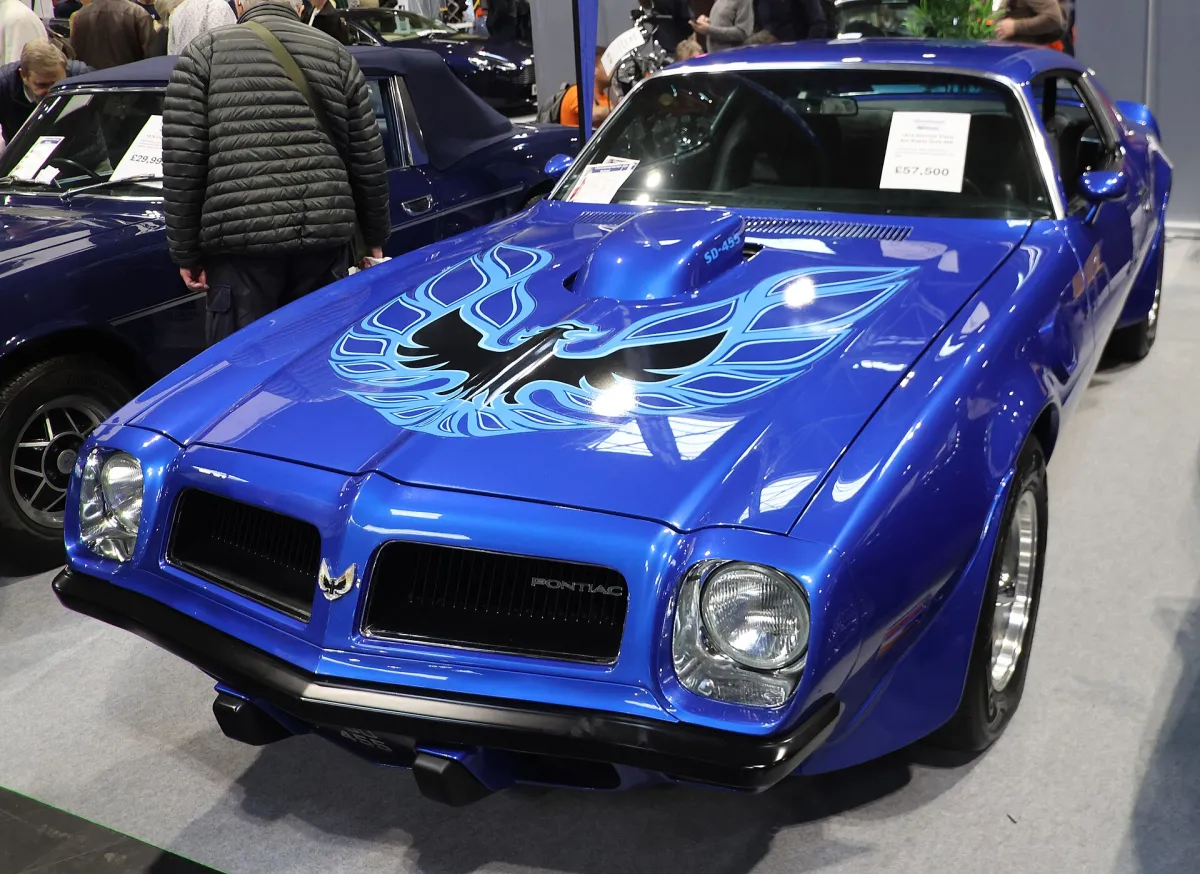
 Pontiac Firebird Trans Am GTA
Specs, engines and history
Published Sources (2) Report an error
By Felix Hartmann, Automotive Technology & EV Contributor
- Built
- 1987–1992
- Top power
- 179 kW (243 PS)
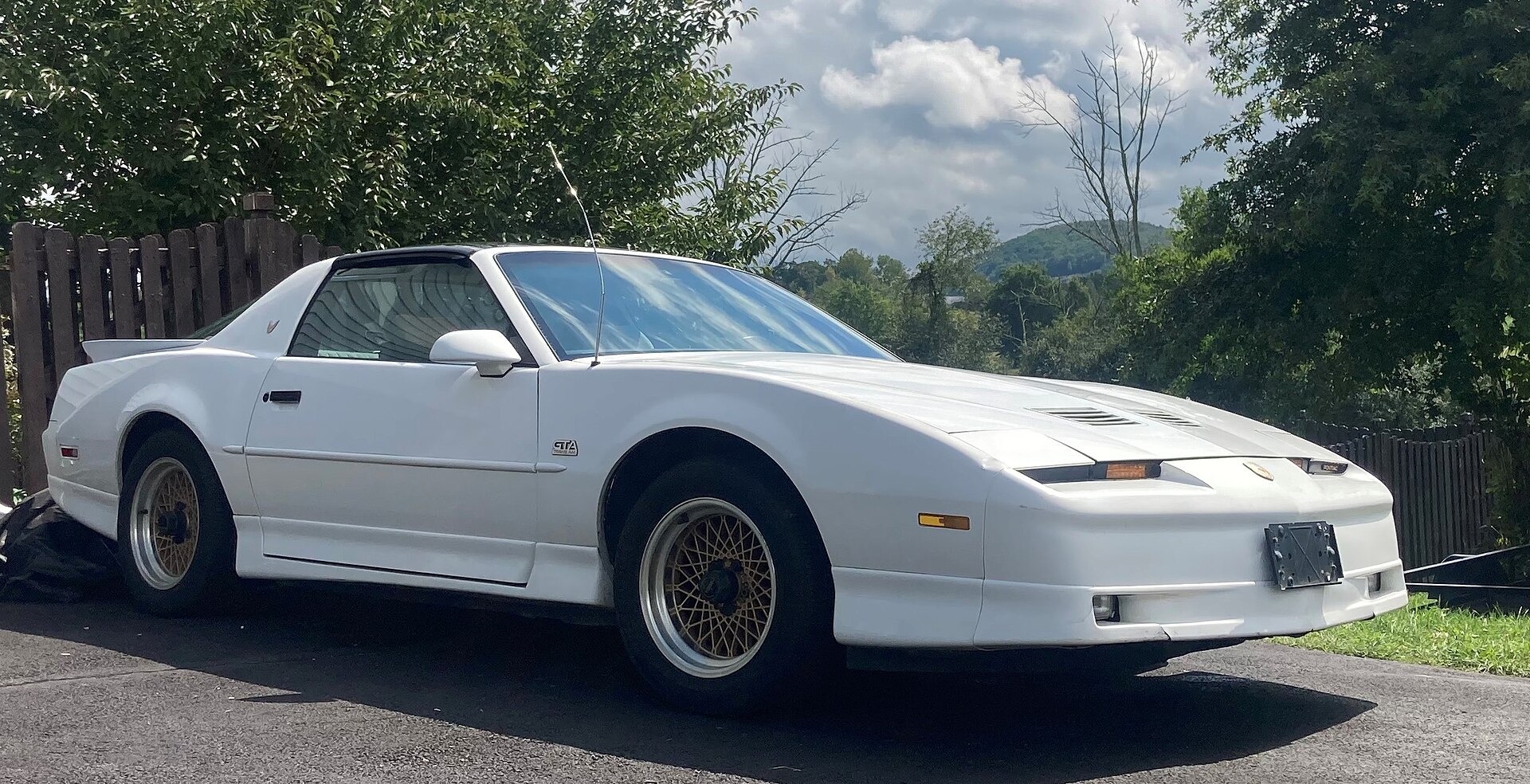
The Pontiac Firebird Trans Am GTA was the top regular Trans Am of 1987-1992, a package (RPO Y84) that bundled the 5.7 L tuned port injection V8, the WS6 suspension, gold 16-inch wheels and a long list of comfort equipment. In 1987 the 350 was rated at 157 kW (210 hp) and the GTA package cost USD 2,700 on top of a USD 13,259 Trans Am.
In short
- Third-generation F-body hatchback coupé, built mainly at Van Nuys, California; some 1987 cars came from Norwood, Ohio.
- 5.7 L (350 cu in) TPI V8 with automatic only: 157 kW (210 hp) in 1987, rising to 179 kW (240 hp) in 1991-1992. The 5.0 L (305 cu in) TPI was the only engine with a five-speed manual.
- About 11,000 GTAs a year in 1987-1988 by one count, falling to 226 US cars in 1992.
- The 1989 20th Anniversary Turbo Trans Am, with a turbocharged 3.8 L V6, was built on the GTA.
Specs by version
| Version | Engine | Power | Torque | Gearbox | Drive | Production years |
|---|---|---|---|---|---|---|
| 5.7 TPI V8 (B2L) 1987 | 5.7 l · 8 cyl · Petrol 5,735 cc | 157 kW 213 PS211 hp | 427 Nm315 lb-ft | 4-sp Automatic | Rear-wheel drive | 1987 |
| 5.7 TPI V8 (B2L) 1988-1989 | 5.7 l · 8 cyl · Petrol 5,735 cc | 168 kW 228 PS225 hp | 447 Nm330 lb-ft | 4-sp Automatic | Rear-wheel drive | 1988–1989 |
| 5.0 TPI V8 (LB9) manual 1991-1992 | 5.0 l · 8 cyl · Petrol 4,998 cc | 172 kW 234 PS231 hp | 407 Nm300 lb-ft | 5-sp Manual | Rear-wheel drive | 1991–1992 |
| 5.7 TPI V8 (B2L) 1990 | 5.7 l · 8 cyl · Petrol 5,735 cc | 175 kW 238 PS235 hp | 461 Nm340 lb-ft | 4-sp Automatic | Rear-wheel drive | 1990 |
| 5.7 TPI V8 (B2L) 1991-1992 | 5.7 l · 8 cyl · Petrol 5,735 cc | 179 kW 243 PS240 hp | 461 Nm340 lb-ft | 4-sp Automatic | Rear-wheel drive | 1991–1992 |
Verified Manufacturer and type-approval data from our catalog · Sources and methodology
Pontiac Firebird Trans Am GTA at a glance
| Specification | Pontiac Firebird Trans Am GTA |
|---|---|
| Model years | 1987-1992 |
| Built | about 11,096 (1987), 11,214 (1988), 9,631 (1989), 1,442 (1990); 226 US and 48 Canadian cars in 1992; figures vary between sources |
| Body | two-door hatchback coupé; notchback hatch option from 1988 |
| Platform | GM F-body, third-generation Firebird, 2,581 mm (101.6 in) wheelbase |
| Engines | 5.7 L (350 cu in) B2L TPI V8; 5.0 L (305 cu in) LB9 TPI V8 |
| Power | 157-179 kW (210-240 hp, SAE net), 5.7 L |
| Torque | 427-461 Nm (315-340 lb-ft), 5.7 L |
| Gearboxes | four-speed automatic (5.7 L); five-speed manual (5.0 L) |
| Wheels and tyres | 16 x 8 in gold diamond-spoke alloys; 245/50VR16 Goodyear Eagle, ZR-rated from 1989 |
| Weight | 1,522 kg (3,355 lb) in 1987 period data; 1,569-1,601 kg (3,460-3,530 lb) later |
| 0-60 mph | 6.5 s (Pontiac claim, 1987) |
| Price new | Trans Am USD 13,259 plus GTA package USD 2,700 (1987); test car USD 18,828 |
A Trans Am with everything included
Pontiac introduced the GTA for 1987, alongside the Formula, and put most of the Trans Am's option list into one package price. The Y84 package grouped the 5.7 L TPI V8, the four-speed automatic, air conditioning, articulating bucket seats with inflatable bolsters, special door panels, body-coloured ground effects, epoxy-filled emblems, a GTA horn button and the WS6 handling package.
The 350 was the Corvette's tuned port engine with different cylinder heads, and Curbside Classic notes that it gave 4 kW (5 hp) and 61 Nm (45 lb-ft) more than the 305. A Denver Post review of a 1987 car added the details buyers paid for: a 1987 Trans Am listed at USD 13,259, the GTA package added USD 2,700, and the test car with air conditioning, a graphic-equaliser cassette and power windows came to USD 18,828. Pontiac also gave a six-year or 60,000-mile powertrain warranty. Curbside Classic points out that the light gold wheels kept the car just under the weight at which a gas-guzzler tax would have applied.
Trans Am GTA engines and power by year
The 5.7 L was the standard engine, and the 5.0 L LB9 was a no-cost alternative. The bigger engine came only with the automatic, so a GTA with a manual gearbox has the 305. Ratings rose almost every year, and the N10 dual catalytic converters of 1989 accounted for part of the gain.
| Model year | 5.7 L B2L, automatic | 5.0 L LB9, five-speed manual (MM5) |
|---|---|---|
| 1987 | 157 kW (210 hp), 427 Nm (315 lb-ft) | 153 kW (205 hp), 366 Nm (270 lb-ft), gearbox not specified |
| 1988 | 168 kW (225 hp), 447 Nm (330 lb-ft) | 160 kW (215 hp), 386 Nm (285 lb-ft) |
| 1989 | 168 kW (225 hp); 175 kW (235 hp), 454 Nm (335 lb-ft) with N10 | 168 kW (225 hp), 400 Nm (295 lb-ft) |
| 1990 | 175 kW (235 hp), 461 Nm (340 lb-ft) | 168 kW (225 hp), 407 Nm (300 lb-ft) |
| 1991-1992 | 179 kW (240 hp), 461 Nm (340 lb-ft) | 172 kW (230 hp), 407 Nm (300 lb-ft) |
In 1989 the 350 was no longer available in T-top cars, and the manual 305 came with a limited-slip differential and a 3.45:1 axle. Wikipedia gives 160 kW (215 hp) for the 1987 350; the GTA specialist register and the Denver Post's 1987 test data say 157 kW (210 hp).
The WS6 chassis and the notchback
The WS6 package was standard on every GTA. It used 36 mm front and 24 mm rear anti-roll bars, gas-filled struts, a quick-ratio steering box and 245/50 tyres on 16-inch wheels, retuned for 1987 to ride more softly than earlier WS6 cars. Four-wheel disc brakes were the norm, although some cars had rear drums; rear discs grew from 267 mm (10.5 in) to 297 mm (11.7 in) for 1989. The Firebird Formula had the same suspension as standard but none of the GTA's comfort equipment.
From 1988 buyers could order a notchback hatch: a glass-fibre boot lid with a small vertical window in place of the large glass hatch. It cost USD 800 and usually meant a factory order with about six months' wait. Owners later reported blistering in the glass-fibre.
Year-by-year changes and the Turbo Trans Am
For 1988 the GTA got a steering wheel with radio controls and restyled wheels. In 1989 a driver's airbag became standard, which removed those radio controls, and the deluxe door panels were dropped. The same year Pontiac built the 20th Anniversary Turbo Trans Am on the GTA, with a turbocharged Buick 3.8 L V6 rated at 186 kW (250 hp) and 461 Nm (340 lb-ft). Only 1,555 were built, five test cars included, and Car and Driver recorded 0-60 mph in 4.6 seconds and the quarter mile in 13.4 seconds at 101 mph. Conceptcarz says it cost around USD 10,000 more than a GTA.
The 1990 model year was short, and the GTA's volume fell sharply. For 1991 the Firebird got a new nose, a flat wrap-around wing and two-piece tail lamps. The 1992 car was the last GTA and the last third-generation F-body.

Trans Am GTA vs Camaro IROC-Z and the 1987 road test
The GTA's closest rival came from inside GM: the Camaro IROC-Z used the same 5.7 L and 5.0 L TPI engines on the same F-body platform. The Denver Post's 1987 reviewer called the GTA a "real muscle car" with a firm ride, a long nose that scraped on dips and cramped rear seats. The same test recorded 13.3 mpg in town and 21 mpg on the highway, or 17.7 and 11.2 L/100 km, against EPA figures of 16 and 25 mpg (14.7 and 9.4 L/100 km). The reviewer praised the V8 sound, the cornering and the front seats.

Trans Am GTA today: how to spot a clone
The VIN cannot prove a GTA, because every Trans Am shares the W model code; it only shows the engine (F for the 5.0 L TPI, 8 for the 5.7 L) and the year. The decisive code is Y84 on the Service Parts Identification label, which sits in the console glove box on 1987-1990 cars and on the left rear storage door on 1991-1992 cars. Its VIN must match the dash VIN. The GTA register also lists AQ9 seats and PW7 gold wheels as standard GTA codes.
Clones are common, because a 1991-1992 Trans Am is easy to convert. Warning signs include fender vents (no GTA had them from the factory), a Trans Am logo in the dash pocket, black or 17-inch wheels and any 1991-1992 GTA convertible, since Pontiac never built one. Only the 1989 ASC convertibles were factory conversions. A non-TPI engine means a swap. For the bigger picture, see the Trans Am history and the Pontiac catalogue. The GTA is ranked with its rivals in the best malaise-era muscle cars.
Pontiac Firebird Trans Am GTA in our rankings
- No. 139 of 772 · Biggest engines: cars (5,735 cc · top 19%)
- No. 31 of 99 · Most powerful cars of the 1980s (168 kW · top 32%)
- No. 95 of 250 · Biggest engines: coupes (5,735 cc · top 38%)
- No. 48 of 120 · Most powerful cars of the 1990s (179 kW · top 40%)
- No. 288 of 640 · Most torque: cars (461 Nm · top 45%)
- No. 694 of 1190 · Most powerful cars (179 kW · top 59%)
Bigger engine than 81% of ranked cars in the 1CARS catalog (No. 139 of 772).
FAQ
What is the difference between a Trans Am and a Trans Am GTA?
The GTA was a Trans Am with the Y84 package: the 5.7 L TPI V8, automatic, WS6 suspension, gold 16-inch wheels, articulating seats, air conditioning and other comfort items included. It cost USD 2,700 extra in 1987.
Could you get a Trans Am GTA with a manual gearbox?
Yes, but only with the 5.0 L TPI V8. The 5.7 L engine was sold only with the four-speed automatic, so every manual GTA is a 305.
How much power did the Trans Am GTA have?
The 5.7 L TPI V8 was rated at 157 kW (210 hp) in 1987, 168 kW (225 hp) in 1988, 175 kW (235 hp) in 1989-1990 and 179 kW (240 hp) in 1991-1992, all SAE net.
How do you tell a real Trans Am GTA?
Look for the Y84 code on the Service Parts Identification label and check that its VIN matches the dash. Fender vents, non-gold wheels or a 1991-1992 convertible point to a clone.
Data sources
Data checked by an editor against the sources below.
- Wikipedia - Pontiac Firebird (third generation)
- Gtasourcepage