 Peugeot Type 3
Specs, engines and history
Published Sources (1) Report an error
By Oleksandr Hnatiuk, Automotive Editor & Used Car Specialist
- Built
- 1891–1894
- Top power
- 1 kW (1 PS)
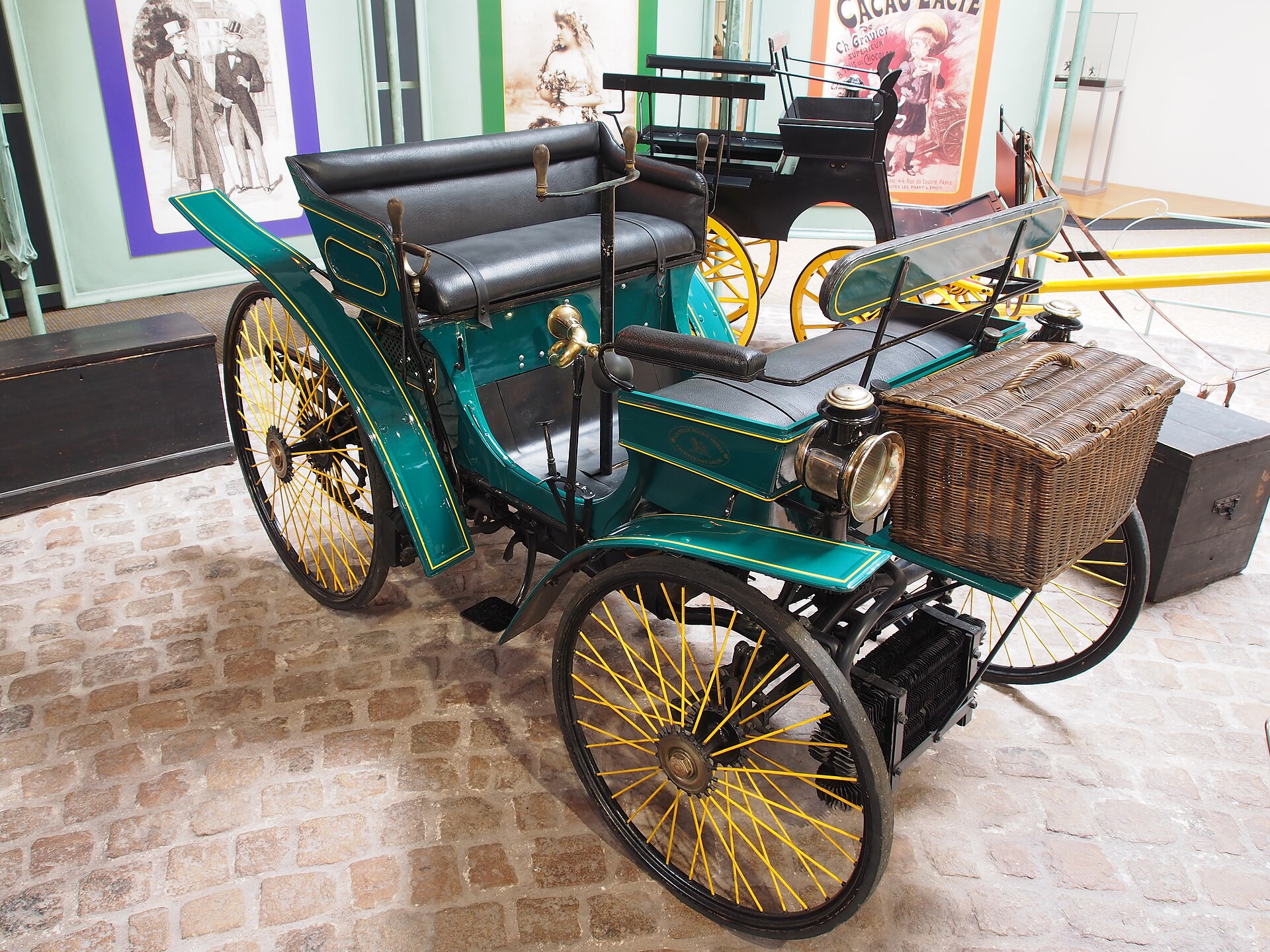
The Peugeot Type 3 is the early French car that Peugeot built from 1891 to 1894, the first Peugeot made in any significant number: 64 were sold. It was the company's second petrol car, after the Type 2, and used a 565 cc V-twin of Daimler design, built under licence by Panhard et Levassor. In September 1891 a Type 3 followed the first Paris–Brest–Paris cycle race and covered 2,045 km without serious trouble. A lightened Type 3 later finished second in the 1895 Paris–Bordeaux–Paris race.
In short
- 565 cc Daimler V-twin at the rear, 1.5 kW (2 hp) at 1,000 rpm, top speed about 18 km/h.
- 64 built at Valentigney between 1891 and 1894; for 1892 and 1893 it was the only Peugeot in the catalogue.
- Paris–Brest–Paris 1891: 2,045 km at an average of 14.7 km/h (English Wikipedia); the first Peugeot sold to the public.
- Built under licence in Italy by Costruzioni Meccaniche di Saronno from 1891.
Peugeot Type 3 at a glance
| Parameter | Metric | Imperial |
|---|---|---|
| Maker | Peugeot, Valentigney plant | — |
| Production | 1891–1894 | — |
| Built | 64 | — |
| Body | vis-à-vis, four seats | — |
| Layout | rear engine, chain drive to the rear wheels | — |
| Engine | Daimler 15° V-twin, licence-built by Panhard et Levassor, 565 cc | 34.5 cu in |
| Power | 1.5 kW (2 hp) at 1,000 rpm | — |
| Wheelbase | 1,630 mm | 64 in |
| Track | 1,150 mm (German Wikipedia) | 45.3 in |
| Length × width × height | 2,500 × 1,350 × 1,500 mm (German Wikipedia) | 98.4 × 53.1 × 59.1 in |
| Top speed | about 18 km/h | 11 mph |
| Predecessor / successor | Type 2 / Type 4 | — |
Armand Peugeot's turn to petrol
Armand Peugeot's first self-propelled vehicles, from 1889, were steam-powered tricycles. In 1890 he met Gottlieb Daimler and Émile Levassor and concluded that a practical car needed four wheels and a petrol engine. The Type 2 was the first such Peugeot, and the Type 3 followed in 1891.
The engine came by a roundabout route. Daimler had licensed his designs for France to Panhard et Levassor, and English Wikipedia's Panhard article records that in 1891 the company shared the licence with Armand Peugeot. French Wikipedia adds that the Type 3 was based on the Daimler Stahlradwagen of 1889 and used the Daimler Type P engine, the same unit as the Type 2. The Type 3 was 20 cm longer than the Type 2 and kept its width. The family business and its later cars are covered in our history of Peugeot.

Engine and design
The engine was a 565 cc V-twin with its cylinders set at 15°, mounted at the rear. It produced 1.5 kW (2 hp) at 1,000 rpm, enough for a top speed of about 18 km/h. Chains drove the rear wheels. The open vis-à-vis body seated four people, two of them facing the other two, on a wheelbase of 1,630 mm.
| Item | Type 3 figure | Source |
|---|---|---|
| Engine | 565 cc 15° V-twin, Daimler design | English Wikipedia |
| Engine type | Daimler Type P, as in the Type 2 | French Wikipedia |
| Power | 1.5 kW (2 hp) at 1,000 rpm | English Wikipedia; German Wikipedia gives 1.5 kW (2 PS) |
| Drive | rear engine, chains to the rear wheels | German Wikipedia |
| Seats | four | German Wikipedia |
| Length | 2,500 mm, 20 cm more than the Type 2 | German / French Wikipedia |
The sources give no weight, so no power-to-weight figure is quoted here. English Wikipedia rates the engine in hp and German Wikipedia in PS; for such small outputs the two are almost the same, as our power converter shows.


Paris–Brest–Paris 1891
In September 1891 Peugeot sent a Type 3 to accompany the cyclists in the first Paris–Brest–Paris race. Pierre Giffard of Le Petit Journal organised the event over about 1,200 km; 207 riders started, 99 finished, and Charles Terront won in 71 hours 22 minutes. English Wikipedia reports that the car covered 2,045 km at an average of 14.7 km/h without major faults; French Wikipedia gives 14 km/h and counts the trip from Valentigney and back. A photograph caption in French Wikipedia names the engineer Louis Rigoulot and the foreman Auguste Doriot as the crew. The demonstration car became the first Peugeot sold to the public.
The article on the race adds the human side. Armand Peugeot wanted the car's progress certified by Giffard's network of marshals. The car drove from Valentigney to Paris and then set off behind the cyclists, covering 200 km on the first day and 160 km on the second. A gear failure near Morlaix cost about 24 hours; the crew repaired it with a shoemaker's tools and reached Brest after dark, where a crowd and the local Peugeot dealer met them. By then the leading cyclists were already back in Paris, and the Peugeot finished six days after them.
Peugeot in the first motor races
The early races were reliability trials as much as contests of speed, and Peugeot cars did well in them:
| Event | Date | Peugeot result |
|---|---|---|
| Paris–Brest–Paris (cycle race, car as escort) | September 1891 | Type 3 completes about 2,045 km from Valentigney |
| Paris–Rouen, 126 km | 22 July 1894 | Albert Lemaître 2nd and fastest petrol car; Auguste Doriot 3rd; first prize shared by Peugeot and Panhard et Levassor |
| Paris–Bordeaux–Paris, 1,178 km | June 1895 | Louis Rigoulot 2nd (54 h 35 min); Paul Koechlin 3rd and official winner; Doriot 4th |
English Wikipedia's Type 3 article identifies the 1895 runner-up as a lightened Type 3, which averaged 21.7 km/h, against 14.7 km/h on the 1891 run. Émile Levassor finished first in 48 hours 48 minutes, but his car, like Rigoulot's, was a two-seater, and the rules had been written for four-seaters, so Koechlin's Peugeot received the main prize. At Paris–Rouen, Lemaître's Peugeot, rated at about 2.2 kW (3 hp), finished 3 minutes 30 seconds behind Count de Dion's steam vehicle. The steamer was not eligible for the main prize because it needed a stoker. The sources do not say which Peugeot types took part in 1894.
Peugeot Type 3 compared with other early cars
The Type 3 shared its engine size with the Daimler Stahlradwagen that inspired it and was slower than the cars of the late 1890s. The figures come from each car's Wikipedia articles:
| Car | Years | Engine | Power | Weight | Top speed |
|---|---|---|---|---|---|
| Daimler Stahlradwagen | 1889 | 565 cc V-twin | 0.97 kW (1.3 PS) | 300 kg | — |
| Peugeot Type 3 | 1891–1894 | 565 cc V-twin | 1.5 kW (2 hp) | — | about 18 km/h |
| Benz Velo | 1894–1902 | 1,045 cc single | 1.1–2.6 kW (1.5–3.5 PS) | 280–320 kg | about 19 km/h |
| De Dion-Bouton Vis-à-vis | 1898–1902 | 402–700 cc single | 2.6–4.4 kW (3.5–6 PS) | about 300 kg | 35 km/h (Type G) |
| Fiat 4 HP | 1899–1900 | 657–679 cc twin | 3.1 kW (4.2 hp) | 680 kg | about 35 km/h |
Compared with the Stahlradwagen, the Peugeot had about 0.5 kW more from the same 565 cc. Within ten years the De Dion-Bouton Vis-à-vis and the Fiat 4 HP roughly doubled the Type 3's top speed.
Italy: Saronno and the first registered car
The Type 3 had an Italian career as well. From 1891 Costruzioni Meccaniche di Saronno, near Milan, assembled Type 3 cars under a Peugeot licence; French Wikipedia calls it the first car produced entirely in Italy. Gaetano Rossi, director of the Lanerossi company in Piovene Rocchette near Vicenza, ordered a Type 3 that French Wikipedia describes as the first car registered in Italy. It was car number 25, with Daimler engine number 124. A surviving Type 3 is kept at the Museo Nazionale dell'Automobile in Turin.

Legacy
The Type 3 is the car with which Peugeot moved from experiments to selling cars. It was the only model in the Peugeot catalogue in 1892 and 1893, and the Type 4 followed it. Its engine connects three of the earliest car makers: the design was Daimler's, the licence came through Panhard et Levassor, and the car was Peugeot's.
- To see one: the Museo Nazionale dell'Automobile in Turin keeps a surviving car, and a Type 3 has been shown at Sochaux, home of the L'Aventure Peugeot museum (see the photo below).
- To understand the design: compare it with the Daimler Stahlradwagen, the 1889 car it was based on.
- For the numbers: 64 cars in four years, built by hand at Valentigney.
Current and past models are listed in the Peugeot catalogue, and more early cars are in our classic cars section.

Peugeot Type 3 in our rankings
In production longer than 11% of ranked nameplates in the 1CARS catalog (No. 755 of 912).
FAQ
How many Peugeot Type 3 were built?
64, from 1891 to 1894, at the Valentigney plant.
What engine does the Peugeot Type 3 have?
A 565 cc V-twin of Daimler design, licence-built by Panhard et Levassor, mounted at the rear and producing 1.5 kW (2 hp) at 1,000 rpm.
How fast was the Peugeot Type 3?
About 18 km/h at most. On the 2,045 km Paris–Brest–Paris run in 1891 it averaged 14.7 km/h, according to English Wikipedia.
Was the Type 3 the first Peugeot car?
No. Peugeot built steam tricycles from 1889 and the petrol Type 2 before it, but the Type 3 was the first Peugeot made in significant numbers and the first sold to the public.
Where can a Peugeot Type 3 be seen?
A surviving car is in the Museo Nazionale dell'Automobile in Turin, and a Type 3 has also been displayed at Sochaux.
Data sources
Data checked by an editor against the sources below.