 Mercedes-Benz Daimler Stahlradwagen
Specs, engines and history
Published Sources (1) Report an error
By Felix Hartmann, Automotive Technology & EV Contributor
- Built
- 1889
- Top power
- 1 kW (1 PS)
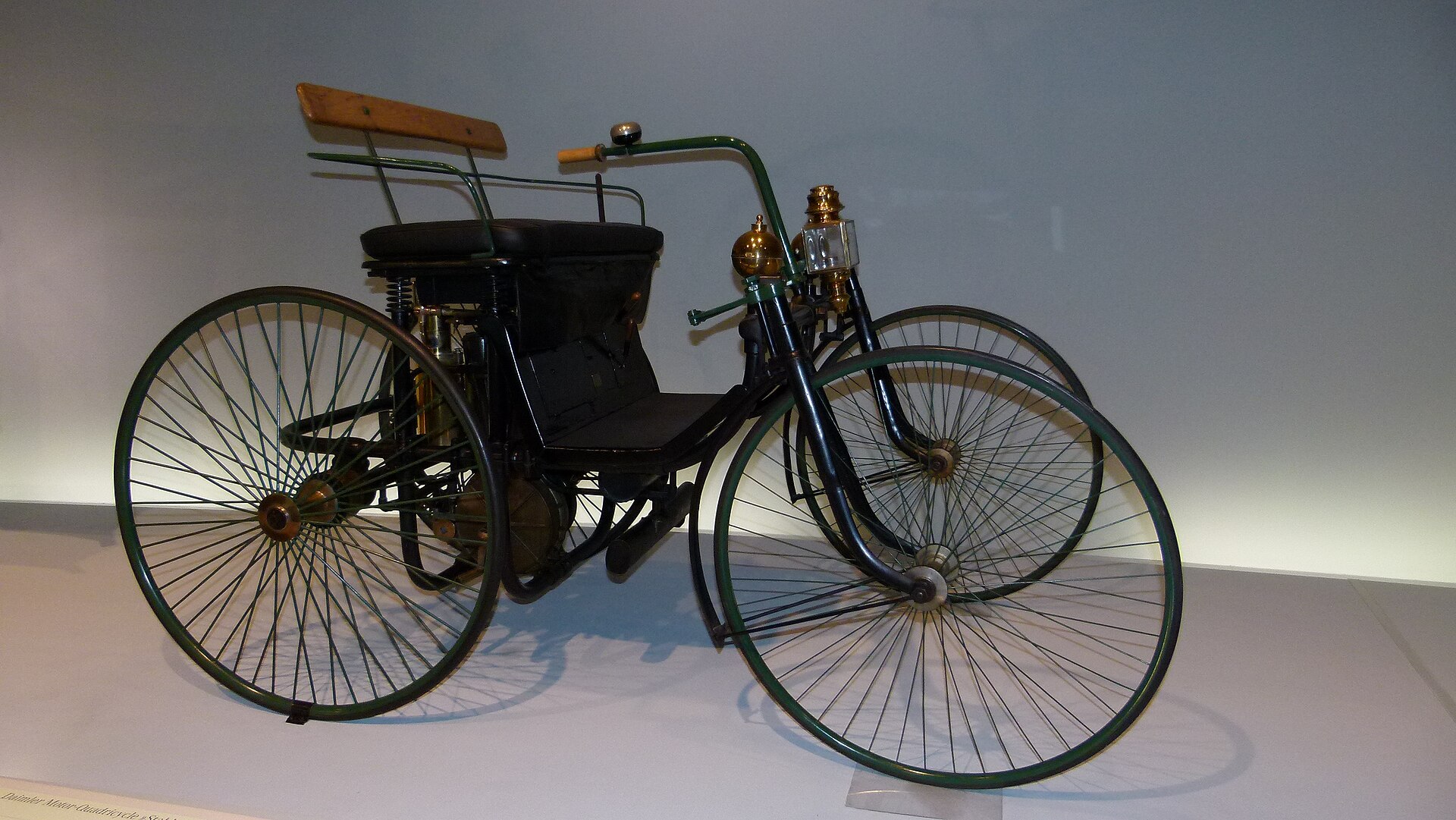
The Daimler Stahlradwagen ("steel-wheeled car") is the four-wheeled car that Gottlieb Daimler and his chief designer Wilhelm Maybach built in Cannstatt in 1889 and showed at the Paris World Exhibition that year. Unlike Daimler's motorised coach of 1886, it was designed from scratch as a motor car, with a tubular steel frame, wire wheels and a V-twin engine. It was never built in series by Daimler, but Peugeot and Panhard et Levassor built their first cars on its concept with Daimler engines, which indirectly started France's motor industry.
In short
- 565 cc inlet-over-exhaust V-twin at the rear: 0.97 kW (1.3 PS) and 2.86 Nm.
- Four-speed gearbox with toothed gears, axle-pivot steering and engine cooling water running through the frame tubes.
- About 300 kg, on a tubular frame made by Neckarsulmer Stahlfabriken, later part of NSU.
- Peugeot's Type 3 of 1891 was based on it, and Peugeot was building cars to its design by 1890.
Stahlradwagen at a glance
| Parameter | Metric | Imperial |
|---|---|---|
| Makers | Gottlieb Daimler and Wilhelm Maybach, Cannstatt | - |
| Year | 1889 | - |
| Designer | Wilhelm Maybach (main designer) | - |
| Layout | mid-rear engine, rear-wheel drive | - |
| Engine | four-stroke V-twin, inlet over exhaust, 16° (English Wikipedia), 565 cc | 34.5 cu in |
| Power | 0.97 kW (1.3 PS) | - |
| Torque | 2.86 Nm | 2.1 lb-ft |
| Gearbox | four-speed manual, toothed gears | - |
| Frame | tubular steel, carrying the cooling water | - |
| Width × height | 1,450 × 1,200 mm | 57.1 × 47.2 in |
| Wheelbase / length | 2,350 mm (English Wikipedia gives the same figure for both) | 92.5 in |
| Kerb weight | 300 kg | 660 lb |
| Predecessor / successor | Daimler Motorized Carriage (1886) / Daimler belt-driven car | - |
Daimler and Maybach in Cannstatt
Gottlieb Daimler and Wilhelm Maybach worked in a workshop in the garden of Daimler's house in Cannstatt, near Stuttgart. It was a glass-fronted summer house with a brick extension, and Daimler paid for the house with the compensation he had received from the engine maker Deutz. English Wikipedia's Maybach article recalls that neighbours suspected the two men of counterfeiting money, and the police searched the property, finding only engines.
Daimler had left the engine maker Deutz in 1880 with 112,000 gold marks in Deutz shares as compensation for his and Maybach's patents. Their first engine, fuelled by ligroin, was patented on 16 December 1883 and ran at 750 rpm. In 1885 came the vertical "Standuhr" (grandfather clock) engine of 100 cc and about 0.7 kW (1 hp) at 600 rpm. In November 1885 Maybach rode a smaller engine fitted to a wooden two-wheeler, the Reitwagen, for about 3 km at 12 km/h.
On 8 March 1886 they moved a coach from Wilhelm Wimpff & Sohn into the house, officially as a birthday present for Mrs Daimler, and fitted an engine to it. English Wikipedia's article on this Motorized Carriage gives 462 cc and 0.82 kW (1.1 PS) at 600 rpm, a single speed and 290 kg. The sources disagree on its speed, with 15, 16 and 23 km/h quoted. The same engine also powered the 4.5 m boat Neckar (1886 or 1887, depending on the source). In June 1887 Daimler bought a larger works on the Seelberg in Cannstatt for 30,200 gold marks, with 23 employees at first. Daimler used hot-tube ignition until 1897, when he adopted Bosch's electrical system. The Motorized Carriage was still an adapted horse-drawn vehicle. For their next car they started with a clean sheet. Maybach's later career, and the brand named after him, is the subject of our history of Maybach.
Design: a car rather than a carriage
The Stahlradwagen was, in German Wikipedia's words, an independent design and a true automobile rather than a motorised carriage. Maybach's article lists its main features: a high-speed four-stroke petrol engine, two cylinders in a V, mushroom-shaped valves, water cooling, a four-speed toothed gearbox and pioneering axle-pivot steering.
The frame was made of steel tubes by Neckarsulmer Stahlfabriken, a company that later became part of NSU Motorenwerke. The engine's cooling water flowed through those tubes, so the frame also worked as the radiator system. The engine sat behind the seat in a mid-rear position and drove the rear wheels. Its steel wheels gave the car its German name.
| Item | Motorized Carriage (1886) | Stahlradwagen (1889) |
|---|---|---|
| Basis | bought American coach | purpose-built frame |
| Engine | 462 cc single-cylinder | 565 cc V-twin |
| Power | 0.82 kW (1.1 PS); Maybach's biography gives 1.1 kW (1.5 hp) | 0.97 kW (1.3 PS) |
| Drive | belt, single speed | four-speed toothed gearbox |
| Weight | 290 kg | 300 kg |
| Speed | 15–23 km/h, depending on the source | not recorded in the sources |
The output was only slightly higher, and with about 300 kg the new car had roughly 3.2 kW per tonne, against about 2.8 kW per tonne for the 290 kg carriage. Our power-to-weight calculator shows how small that is next to any later car.

Paris 1889 and the link with France
In October 1889 the car was presented in Paris, where Maybach represented the company at the Exposition Universelle; English Wikipedia says it was demonstrated near the end of the exhibition. Its effect was felt mainly in France. Armand Peugeot had seen a Daimler V-twin in the exhibit of Panhard et Levassor, which held Daimler's licence for France, and he became interested in a light vehicle powered by it.
In 1890 the licences for France went to Panhard et Levassor and Peugeot. Peugeot was building cars based on the Stahlradwagen's design by 1890, and French Wikipedia states that the Peugeot Type 3 of 1891 was based on it and used the Daimler Type P engine. The Type 3 became Peugeot's first car made in significant numbers, with 64 sold; the story continues in our history of Peugeot.
DMG and the Daimler Motorwagen
Daimler-Motoren-Gesellschaft (DMG) was founded on 28 November 1890, with Maybach as chief designer. The investors included the gunpowder maker Max Duttenhofer, the banker Kilian von Steiner and the munitions maker Wilhelm Lorenz, and Daimler soon lost control to them. In February 1891 Maybach left DMG after he was refused a seat on the board and continued designing at his own house with Daimler's backing. In 1893 the directors, with DMG 400,000 gold marks in debt, forced Daimler to sell his shares and patents for 66,666 gold marks, and he resigned.
The licences kept the designs alive abroad. In France they went through Louise Sarazin to Panhard et Levassor and Peugeot from 1890. In the USA they went from 1891 to the Daimler Motor Company with Steinway & Sons, and in Britain in 1893 to Frederick Simms' Daimler Motor Syndicate.
DMG sold its first car in 1892. From 1892 to 1895 it sold a modified version of the car as the "Daimler Motorwagen". German Wikipedia notes that Daimler and Maybach were not involved in that version, that it had little success and that it nearly drove DMG into insolvency. Recovery came with the four-cylinder Phoenix engine of 1894. Simms made Daimler's return a condition of buying the licences for Britain, and in 1895, the year of DMG's 1,000th engine, Daimler and Maybach were back. Gottlieb Daimler died in Cannstatt on 6 March 1900, aged 65. The company's road to Mercedes-Benz is covered in our history of Mercedes-Benz.
Stahlradwagen compared with other early cars
The figures from each car's Wikipedia articles show where the Stahlradwagen stands among the first small cars:
| Car | Years | Engine | Power | Weight | Top speed |
|---|---|---|---|---|---|
| Daimler Stahlradwagen | 1889 | 565 cc V-twin | 0.97 kW (1.3 PS) | 300 kg | - |
| Peugeot Type 3 | 1891–1894 | 565 cc V-twin | 1.5 kW (2 hp) | - | about 18 km/h |
| Benz Velo | 1894–1902 | 1,045 cc single | 1.1–2.6 kW (1.5–3.5 PS) | 280–320 kg | about 19 km/h |
| De Dion-Bouton Vis-à-vis | 1898–1902 | 402–700 cc single | 2.6–4.4 kW (3.5–6 PS) | about 300 kg | 35 km/h (Type G) |
| Fiat 4 HP | 1899–1900 | 657–679 cc twin | 3.1 kW (4.2 hp) | 680 kg | about 35 km/h |
The Peugeot Type 3 got about 0.5 kW more from the same 565 cc V-twin, and a decade later the single-cylinder De Dion-Bouton had nearly three times the power at the same weight.
Why the Stahlradwagen matters
- First purpose-built Daimler car: the frame, wheels, gearbox and steering were designed for a motor vehicle rather than taken from a carriage.
- Engine layout: the V-twin was the engine that Panhard et Levassor licensed and Peugeot used in its first petrol cars.
- Influence: German Wikipedia credits it with indirectly starting France's motor industry.
- To see it: the Mercedes-Benz Museum in Stuttgart shows a Stahlradwagen and the 1889 two-cylinder engine, and a replica built as an apprentice project also exists (see the video).
Current and past models of the brand are listed in the Mercedes-Benz catalogue.

Photo gallery


FAQ
What is the Daimler Stahlradwagen?
The "steel-wheeled car" that Gottlieb Daimler and Wilhelm Maybach built in 1889, Daimler's first car designed from scratch as a motor vehicle. It was shown at the 1889 Paris World Exhibition.
What engine does the Stahlradwagen have?
A 565 cc four-stroke V-twin with inlet-over-exhaust valves, producing 0.97 kW (1.3 PS) and 2.86 Nm, mounted behind the seat.
Who designed the Daimler Stahlradwagen?
Wilhelm Maybach was the main designer, working with Gottlieb Daimler in Cannstatt.
Was the Stahlradwagen built in series?
Not by Daimler and Maybach. DMG sold a modified "Daimler Motorwagen" from 1892 to 1895 without them, and Peugeot built cars based on the design from 1890.
How is the Stahlradwagen linked to Peugeot?
Armand Peugeot saw the Daimler V-twin in Paris in 1889, Peugeot obtained a licence in 1890, and the Peugeot Type 3 of 1891 was based on the Stahlradwagen.
Data sources
Data checked by an editor against the sources below.