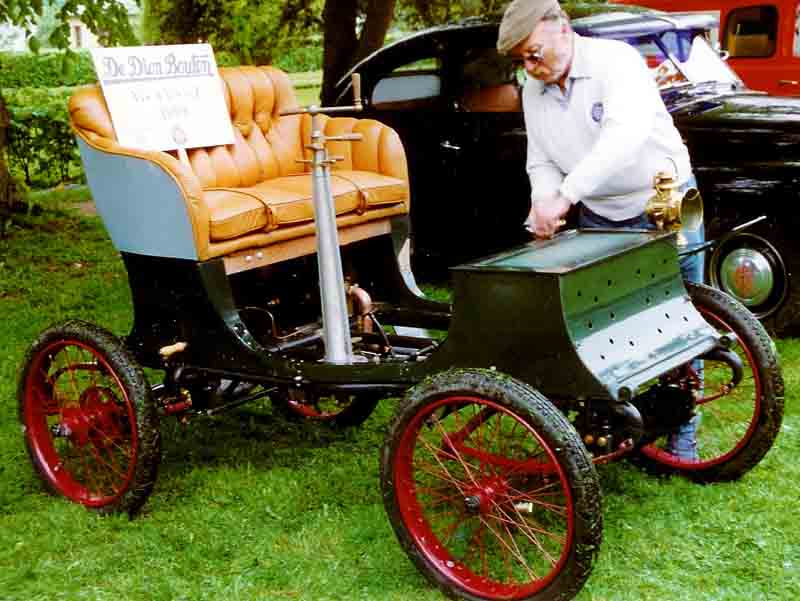
De Dion-Bouton — the Paris Pioneers of Steam and Petrol, 1883 to 1953
De Dion-Bouton was the French company that helped turn the motor car from an experiment into an industry. The Marquis Jules-Albert de Dion founded it in Paris in 1883 with the toymakers Georges Bouton and Charles Trépardoux. It built steam vehicles first and then a small, fast-running single-cylinder petrol engine that was licensed to more than 150 manufacturers. Around 1900 it was among the largest car makers in the world, and its name survives in the de Dion rear axle. Passenger car production ended in 1932 and the company in the early 1950s.
Key takeaways
- De Dion saw a toy locomotive in a Paris shop window in 1881 and paid Bouton and Trépardoux to build a full-size steam car; the firm was formed in 1883.
- On 22 July 1894 de Dion's steam tractor finished first in the Paris–Rouen contest, 126 km in 6 hours 48 minutes, but was ruled ineligible because it needed a stoker.
- The 1895 single-cylinder engine ran at about 2,000 rpm, and by 1904 about 40,000 had been supplied across Europe.
- The 1910 Type CJ had a 6,107 cc V8, described as the first successful mass-produced V8.
De Dion-Bouton at a glance
| Fact | Value |
|---|---|
| Founded | 1883, Paris (as Trépardoux et Cie) |
| Founders | Jules-Albert de Dion (1856–1946), Georges Bouton (1847–1938), Charles Trépardoux |
| Factory | Puteaux, near Paris |
| Known for | High-speed single-cylinder engine, de Dion axle, early V8 |
| Best-known models | La Marquise, Model D vis-à-vis, Model K, Type CJ V8 |
| Peak | About 1904–1908; 1,300 workers and more than 2,000 cars in 1904 |
| Car production ended | 1932 |
| Company | 1883–1953 |
A toy locomotive and three partners
Jules-Albert de Dion was born in Carquefou, Loire-Atlantique, on 9 March 1856, and was wealthy enough to finance engineering projects. In 1881 he saw a toy locomotive in a Paris shop window and asked its makers to build another. They were Georges Bouton and his brother-in-law Charles Trépardoux, engineers who earned a bare living from scientific toys. Trépardoux had long wanted to build a steam car but had no money. De Dion, fascinated by steam, became their backer, and in 1882 Bouton and de Dion were working on a self-propelled steam vehicle.
The firm was formed in Paris in 1883 as Trépardoux et Cie and soon moved to larger workshops. Its first steam car burned during trials. The second, La Marquise, of 1884, had conventional steering and rear-wheel drive and seated four. On 28 April 1887 Bouton drove a De Dion-Bouton steam vehicle about 2 km from the Neuilly bridge to the Bois de Boulogne. He was the only competitor in what is often called the world's first motor race.
Steam tractors and the Paris–Rouen contest
The company went on to build steam tricycles and a larger steam tractor to pull carriages. For the tractor, Trépardoux designed the rear axle that now carries the de Dion name, around 1894. It uses a rigid tube to keep the driven wheels parallel while the differential is mounted on the chassis, which reduces unsprung weight.
The tractor's moment came on 22 July 1894. Le Petit Journal organised a contest for horseless carriages from Paris to Rouen, and 102 people paid the 10-franc entry fee; 21 qualified for the main run. De Dion's steam tractor crossed the line first, after 6 hours 48 minutes for the 126 km, 3 minutes 30 seconds ahead of Albert Lemaître's Peugeot. The judges ruled it ineligible for the main prize because it needed a stoker as well as a driver. The Prix du Petit Journal went jointly to Panhard et Levassor and Peugeot, and de Dion, Bouton et Cie received the 2,000-franc second prize. Peugeot's own story is told in the history of Peugeot.

The high-speed petrol engine
By 1889 de Dion believed in internal combustion, and the company had built a ten-cylinder rotary engine. Trépardoux resigned in 1894, and the firm became De Dion, Bouton et Compagnie.
Bouton's single-cylinder engine of 1895 was the breakthrough. It had only 137 cc and was meant to run at 900 rpm, but it ran roughly at that speed. At higher speeds the problems disappeared; it reached 3,500 rpm in trials and normally ran at 2,000 rpm, more than twice the planned figure. Enlarged to 185 cc, it gave about 0.9 kW (1.25 CV) in 1896 and about 1.3 kW (1.75 CV) in 1897. By 1901 it had about 2.0 kW (2.75 CV), 1.1 kW more than in 1896 on these figures, and racing versions reached about 5.9 kW (8 CV). It is regarded as the first high-speed, lightweight internal combustion engine.
The engine sold far beyond the company's own vehicles. It was licensed to more than 150 manufacturers and was widely used on early motorcycles. By 1904 about 40,000 had been supplied across Europe. In America the De Dion-Bouton Motorette Company built licensed cars in Brooklyn from 1900, with American-made engines of 2.6 kW (3.5 hp), but the venture lasted only a year.
Tricycles, the vis-à-vis and the peak years
Light motor tricycles came first, using Michelin pneumatic tyres. A four-wheeler followed in 1898, and in 1900 the Model D vis-à-vis voiturette, with a 402 cc single under the seat and passengers facing the driver. The clutch was worked from the steering column. The car is described in De Dion-Bouton vis-à-vis history and specifications. By 1902 the Model D range had reached 6 CV, and the 8 CV Model K phaeton appeared that year. A three-speed gearbox became standard in 1904.
Around 1900 the company built about 400 cars and 3,200 engines a year, all by hand. Sources differ on its rank: the main article calls it the world's largest car maker for a time, but also places it second to Locomobile in 1900. In 1904 the Puteaux factory had 1,300 workers and built more than 2,000 cars. De Dion-Boutons ran in the Peking to Paris race of 1907 and the New York to Paris race of 1908 without success, and the company's output peaked in 1908.

The V8, the war and the decline
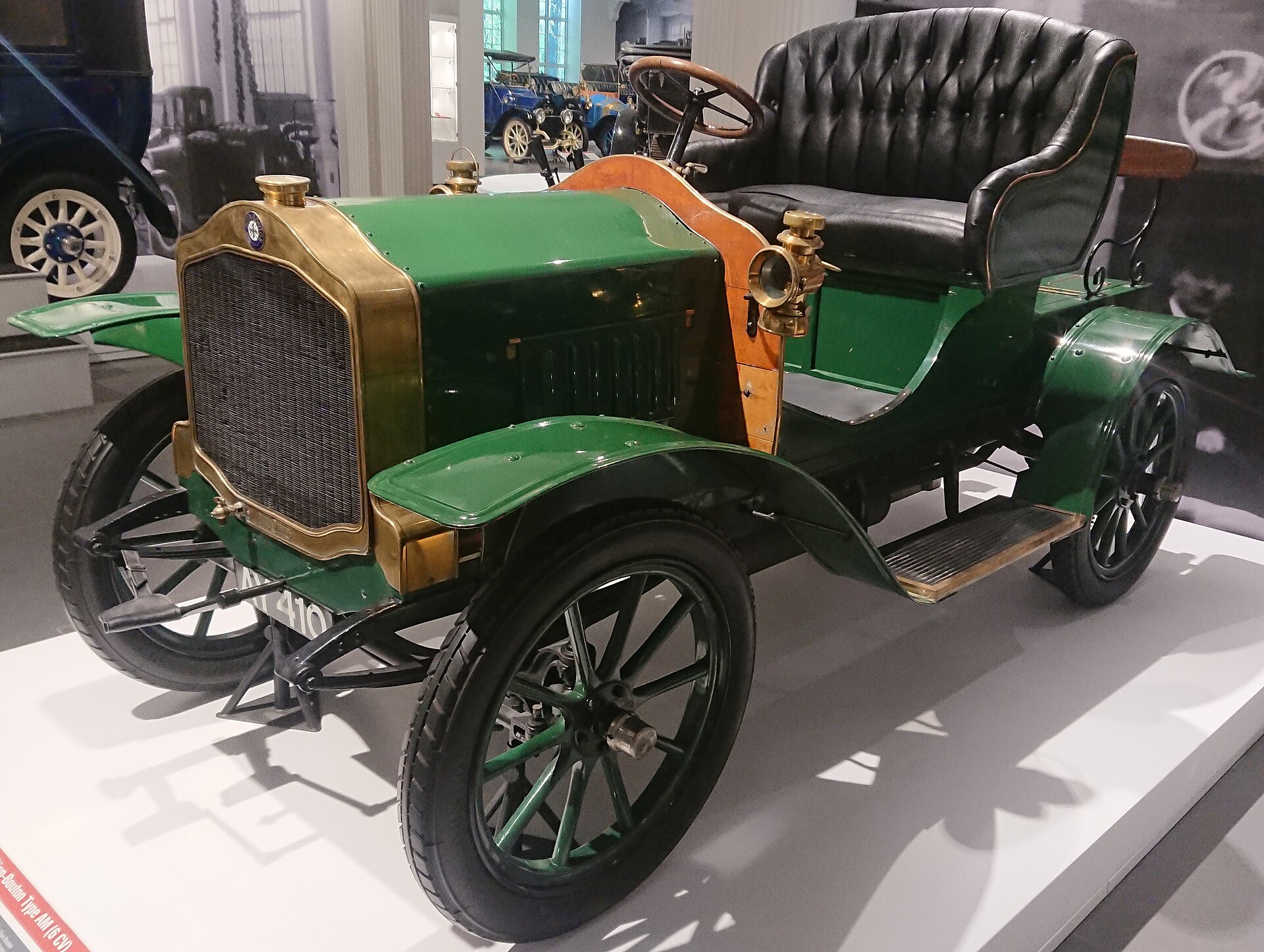
The last major innovation came in 1910. The 35 CV Type CJ had a 6,107 cc V8, described as the first successful mass-produced V8, and a 3,534 cc Type CN followed in 1912. The V8 stayed in production until 1923.
In the First World War the company made gun parts, armoured vehicles, aero engines, cars and lorries. From 1913 to 1918 it built an anti-aircraft system for France's army, a 75 mm field gun mounted on a V8 lorry.
After the war the company lost its place. The factory was closed for much of 1927. When it reopened it offered only the 2.0-litre four-cylinder LA and the 2.5-litre straight-eight LB, which sold poorly even after its engine grew to 3 litres in 1930. Rumours of a takeover by Peugeot or Mercedes came to nothing, and passenger car production ended in 1932.
Railcars, Land Rovers and the end
The company continued with other products. From 1923 it built railcars and trailers for metre-gauge lines, the first for the Chemin de Fer des Côtes-du-Nord. Commercial vehicles were made until 1950, and the last vehicles with a De Dion badge, in the early 1950s, were Land Rovers built under licence. The company's span is usually given as 1883 to 1953, although the name was sold to a motorcycle maker in 1955.
De Dion himself was a public figure. In 1898 he co-founded the Paris Motor Show, and in 1900 he helped found the sports daily L'Auto-Vélo, whose successor L'Auto created the Tour de France in 1903. In 1899, during the Dreyfus affair, he struck President Émile Loubet with a walking stick at the Auteuil racecourse and spent 15 days in prison. He died in Paris on 19 August 1946, aged 90; Georges Bouton had died in 1938.
The de Dion axle today
The axle design outlived the company by decades. Later users include every Aston Martin from 1967 to 1989 and the Alfa Romeo Alfetta and 75, as well as the Rover P6, the DAF 66, the Volvo 300 series, the Caterham Seven, Auto Union's Type D racing car and the Mercedes-Benz G 580 electric of 2024. Its fixed camber helps traction, at the cost of two joints for each driveshaft. Early De Dion-Boutons can be seen alongside other veteran cars in 1900s classics, the power converter turns old CV ratings into kW, and the surviving model is listed in the De Dion-Bouton catalogue.
De Dion-Bouton timeline
| Year | Event |
|---|---|
| 1881 | De Dion sees the toy locomotive |
| 1883 | Trépardoux et Cie formed in Paris |
| 1884 | La Marquise steam car |
| 1887 | Bouton wins the first motor race as sole entrant (28 April) |
| 1894 | Paris–Rouen (22 July); Trépardoux resigns |
| 1895 | High-speed single-cylinder engine |
| 1900 | Model D vis-à-vis; Brooklyn licence |
| 1904 | About 40,000 engines supplied; 2,000-plus cars a year |
| 1910 | Type CJ V8 |
| 1927 | Factory closed for most of the year |
| 1932 | Passenger car production ends |
| 1953 | Company ends |
Landmark De Dion-Bouton models
| Model | Years | Why it matters |
|---|---|---|
| La Marquise | 1884 | Four-seat steam car |
| Steam tractor | 1894 | First across the line in Paris–Rouen; de Dion axle |
| Single-cylinder engine | from 1895 | Licensed to more than 150 makers |
| Model D vis-à-vis | from 1900 | Popular voiturette with the engine under the seat |
| Type CJ | from 1910 | 6,107 cc V8 |
Photo gallery

FAQ
Who founded De Dion-Bouton?
Jules-Albert de Dion, Georges Bouton and Charles Trépardoux, in Paris in 1883.
What is a de Dion axle?
A rear axle in which a rigid tube holds the wheels parallel while the differential sits on the chassis. Trépardoux designed it around 1894.
Did De Dion-Bouton win the Paris–Rouen race?
De Dion's steam tractor finished first on 22 July 1894 but was ruled ineligible because it needed a stoker. It received the second prize.
When did De Dion-Bouton stop making cars?
Passenger car production ended in 1932. Commercial vehicles continued until 1950 and the company until 1953.
Sources
- Wikipedia — De Dion-Bouton (accessed 24 Oct 2026)
- Wikipedia — Jules-Albert de Dion (accessed 24 Oct 2026)
- Wikipedia — Georges Bouton (accessed 24 Oct 2026)
- Wikipedia — Paris–Rouen (motor race) (accessed 24 Oct 2026)
- Wikipedia — De Dion tube (accessed 24 Oct 2026)
Found a mistake? Report an error