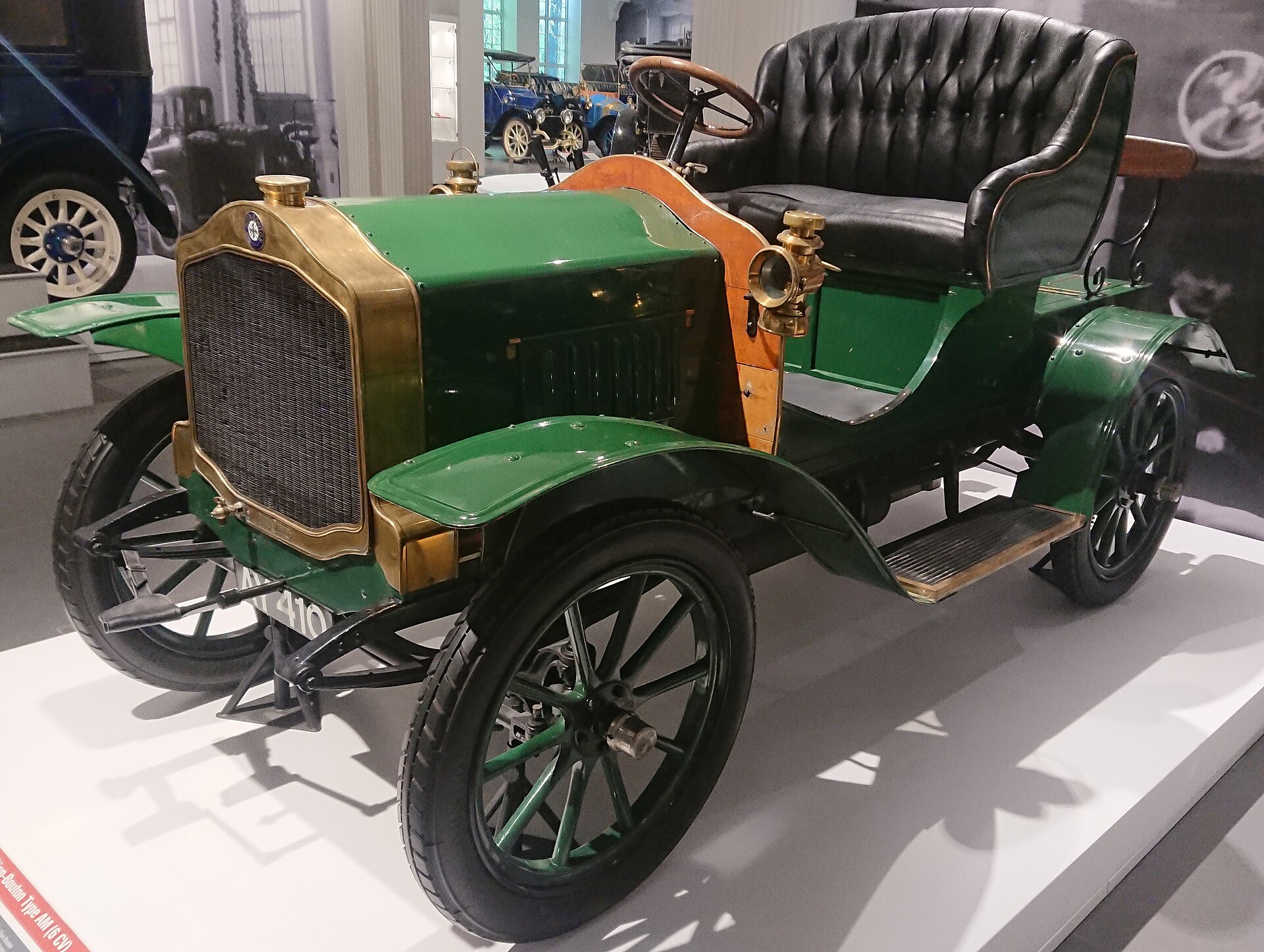
 De Dion-Bouton Vis-à-vis
Specs, engines and history
Published Sources (2) Report an error
By Oleksandr Hnatiuk, Automotive Editor & Used Car Specialist
- Built
- 1898–1902
- Top power
- 4 kW (5 PS)
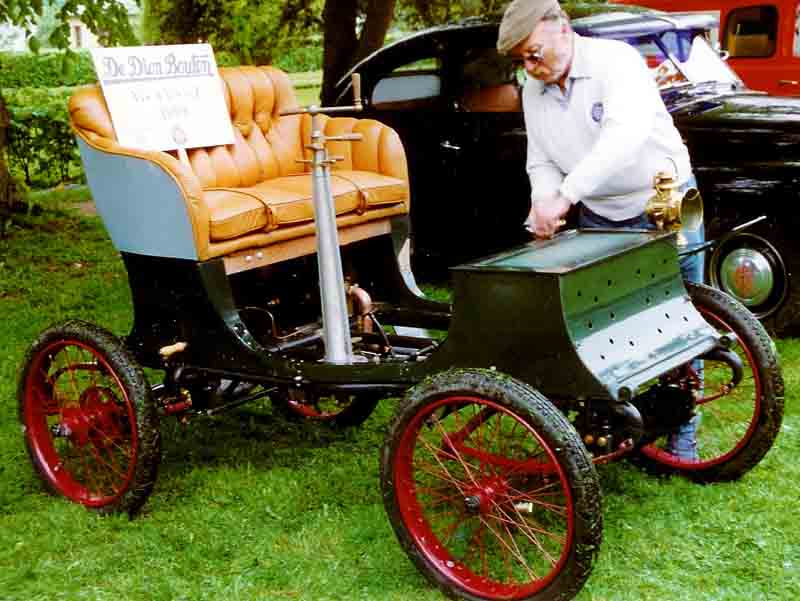
The De Dion-Bouton Vis-à-vis is the light car that De Dion-Bouton of Puteaux, near Paris, built from 1898 to 1902, in which the passengers sat facing the driver. The factory called it simply the petite voiture; "vis-à-vis" was the popular name. German Wikipedia calls it the first car built in large numbers, with between about 1,500 and 2,970 made in the Types D, E, G and L. It combined a high-revving single-cylinder engine, a two-speed gearbox and the De Dion rear axle, and many still run today.
In short
- Rear-mounted single-cylinder De Dion-Bouton engine: 402 cc and 2.6 kW (3.5 PS) in the Types D and E, up to 700 cc and 4.4 kW (6 PS) in the Type L.
- Two-speed gearbox with a separate clutch for each gear; drive through a shaft to a De Dion axle.
- About 300 kg in standard form and 35 km/h for the Type G.
- In 1900 De Dion-Bouton was the world's second-largest car maker after Locomobile, with 400 cars and 3,200 engines (English Wikipedia).
Vis-à-vis at a glance
| Parameter | Metric | Imperial |
|---|---|---|
| Maker | De Dion, Bouton et Cie, Puteaux | — |
| Production | 1898–1902 | — |
| Types | prototypes (1898–1899), D, E, G, L | — |
| Built | over 1,500 by April 1901, or 2,970 (sources quoted by German Wikipedia) | — |
| Body | two-seat vis-à-vis bench facing the driver; tonneau, coupé, taxi and van versions | — |
| Layout | rear engine, shaft drive, De Dion rear axle | — |
| Engine | single-cylinder four-stroke, water-cooled, 402 cc (D, E), 499 cc (G), 700 cc (L) | 24.5–42.7 cu in |
| Power | 2.6 kW (3.5 PS) to 4.4 kW (6 PS) | — |
| Gearbox | two speeds, reverse optional | — |
| Frame | welded round steel tube | — |
| Wheels | wire spokes, 700 × 80 mm | — |
| Weight | about 300 kg; about 500 kg for closed bodies | 660 / 1,100 lb |
| Top speed | 35 km/h (Type G) | 22 mph |
From steam to the petite voiture
The company began in Paris in 1883, when the Marquis Jules-Albert de Dion financed the toymakers Georges Bouton and Charles Trépardoux. Their first vehicles were steam-powered: the second steam car, La Marquise, followed in 1884, and in 1893 they built steam tractors with the De Dion tube axle, which separates the axle's locating and driving functions. At the Paris–Rouen trial on 22 July 1894, a De Dion steam vehicle averaged 18.7 km/h over 126 km but was disqualified because it needed a stoker as well as a driver.
Trépardoux left in 1894 over the move to internal combustion, and the firm became De Dion, Bouton et Compagnie. In 1895 Bouton created a 137 cc single-cylinder engine with trembler-coil ignition. Designed for 900 rpm, it suffered bearing failures and rough running until the engineers raised the revs; it ran up to 3,500 rpm in trials and usually at 2,000 rpm. Fitted to tricycles, the engine made the company's name. German Wikipedia counts about 15,000 motor tricycles before production ended in 1902. A four-wheeler followed in 1898.

The single-cylinder engine
The engine of the Vis-à-vis was a water-cooled development of the tricycle unit. Its valve gear was Bouton's inlet-over-exhaust variant: the inlet valve opened automatically, while a gear-driven camshaft worked the exhaust valve. Early series engines used a serpentine radiator and a centrifugal pump.
| Engine | Bore × stroke | Displacement | Power | Used in |
|---|---|---|---|---|
| prototype / pre-series | 74 × 76 mm | 327 cc | about 2 kW (2¾ PS) | 1898–1899 cars |
| D / E | — | 402 cc | 2.6 kW (3.5 PS) | 1899–1901 |
| G | 84 × 90 mm | 499 cc | 3.3 kW (4.5 PS) at 1,800 rpm | 1900–1902 |
| L | 90 × 110 mm | 700 cc | 4.4 kW (6 PS) | 1902 |
English Wikipedia rates the 402 cc Model D at 2.8 kW (3¾ CV) and calls the De Dion-Bouton engine the first high-speed lightweight internal-combustion engine. It was licensed to more than 150 manufacturers, and German Wikipedia lists more than 240 brands that used it. In 1898 Louis Renault modified a De Dion-Bouton with a fixed driveshaft and a ring-and-pinion gear, and his first car, the Renault Type A, used a De Dion engine; Renault's later story is told in our history of Renault.
Gearbox, axle and chassis
The gearbox was unusual. It had two speeds, with all gear pairs permanently in mesh and each gear engaged by its own clutch; reverse was an option. Early cars were shifted with a hand wheel on the steering column, later ones with a lever. Drive went through a shaft to the De Dion rear axle, which German Wikipedia counts among the car's main features alongside the steel tube frame and easy handling.
The frame was welded from round steel tube and widened behind the front seats. Three semi-elliptic leaf springs carried the front axle and quarter-elliptic springs the rear; the De Dion axle brought rear springing with the Type D. The first Type D had drum brakes on the gearbox and differential, with two brake pedals, while later cars had a drum brake on each rear wheel. With about 300 kg and 2.6 kW, a Type D or E had roughly 9 kW per tonne, a figure our power-to-weight calculator can compare with later cars.
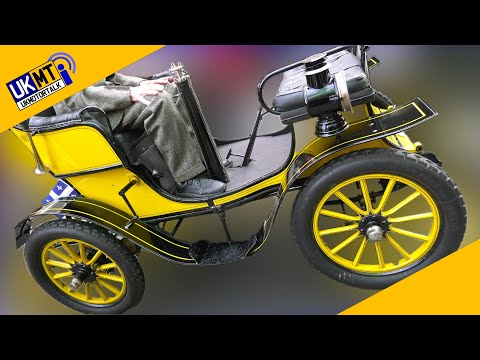
Types D, E, G and L
| Type | Years | Engine | Notes |
|---|---|---|---|
| Prototypes | late 1898 – early 1899 | 327 cc, about 2 kW | unsprung rear axle |
| D | late 1899 – 1900/1901 | 402 cc, 2.6 kW (3.5 PS) | first series type; rear suspension with the De Dion axle |
| E | 1900 | 402 cc, 2.6 kW (3.5 PS) | steering wheel, long gear lever, rear drum brakes |
| G | 1900–1902 | 499 cc, 3.3 kW (4.5 PS) | unofficially split into G1 and G2; 35 km/h |
| L | 1902 | 700 cc, 4.4 kW (6 PS) | last Vis-à-vis type |
English Wikipedia describes the development differently, as Models D, E, G, I and J, with outputs reaching 4.5 kW (6 CV) by 1902, and dates the Model D to 1900. In 1902 the company moved on to the rear-entry Model K and the Model O with three speeds, and in 1903 to the front-engined Populaire.

Bodies and daily use
Most bodies were wooden. In the classic layout the driver sat on a seat above the engine, which folded forward for access, and the passengers sat on a detachable front bench facing him; the bench could also be turned to face forward. Variants included a loading platform for light commercial use, a closed "Coupé Opéra" and a taxi derived from it, tonneau and box-van bodies, and conversions to a double phaeton. Early bodies came from Rothschild & Fils, and in Britain H. J. Mulliner & Co. built some; British owners nicknamed the car "Ding-Dong" after the bell fitted to early models. One British car of 1900 with a Mulliner body still carries the registration Y 65.
The company's growth shows how well the formula sold. In 1900 it produced 400 cars and 3,200 engines with 1,300 employees (German Wikipedia), and by 1904 about 40,000 De Dion-Bouton engines had been supplied across Europe.

The Vis-à-vis today and collecting one
German Wikipedia notes that a large number of these cars survive and that many still run. On the London to Brighton Veteran Car Run, held on the first weekend of November, De Dion-Boutons are well represented, and the Vis-à-vis is the second-largest group of the make after the Populaire. Museums with examples include the Cité de l'Automobile (Schlumpf collection) in Mulhouse, the National Motor Museum at Beaulieu and the Musée Henri Malartre at Rochetaillée-sur-Saône, which has a rare coupé.
German Wikipedia quotes one sale in euros: a 1901 Type G sold by Bonhams in 2008 for €66,278 including premium.
- For the first series: a Type D, with the 402 cc engine and the earliest form of the De Dion axle.
- For easier driving: a Type E or later, with a steering wheel instead of the first control layout and rear drum brakes.
- For more power: a Type G or L, with 3.3–4.4 kW.
- Check the body: many cars were rebodied or converted, so the original body type is worth confirming.
More veteran cars are in our classic cars section.
Photo gallery


De Dion-Bouton Vis-à-vis in our rankings
In production longer than 17% of ranked nameplates in the 1CARS catalog (No. 698 of 912).
FAQ
What does vis-à-vis mean on a De Dion-Bouton?
"Face to face": the passengers sat on a front bench facing the driver, who sat above the engine at the rear. The factory called the car the petite voiture.
How many De Dion-Bouton Vis-à-vis were built?
Sources differ: over 1,500 by April 1901 by one count, and 2,970 in total according to two other sources quoted by German Wikipedia.
What engine does the Vis-à-vis have?
A rear-mounted water-cooled single-cylinder engine: 402 cc and 2.6 kW (3.5 PS) in the Types D and E, 499 cc in the Type G and 700 cc with 4.4 kW (6 PS) in the Type L.
How fast is a De Dion-Bouton Vis-à-vis?
About 35 km/h for the Type G, according to German Wikipedia.
What is a De Dion axle?
A rear axle design that separates the locating tube from the drive shafts. De Dion-Bouton first used it on steam tractors in 1893 and then on the Vis-à-vis.
Data sources
Data checked by an editor against the sources below.
- Wikipedia — De Dion Bouton
- Wikipedia — De Dion Bouton Vis à Vis