 Fiat 4 HP
Specs, engines and history
Published Sources (1) Report an error
By Felix Hartmann, Automotive Technology & EV Contributor
- Built
- 1899–1900
- Top power
- 3 kW (4 PS)
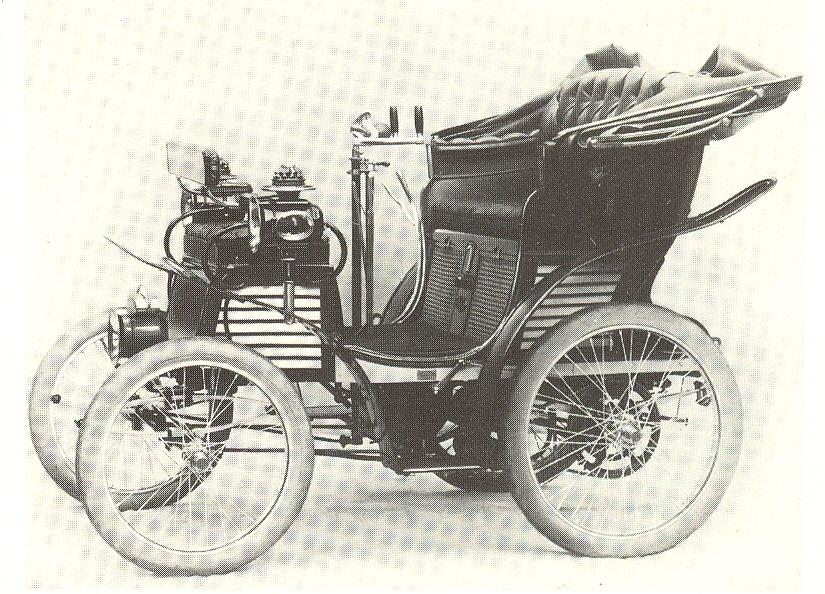
The Fiat 4 HP, also called the 3½ HP, is the first car built by Fabbrica Italiana Automobili Torino (FIAT), produced in Turin in 1899 and 1900. It was derived from the Welleyes, a design by Aristide Faccioli built by the Ceirano brothers, whose plant and patents Fiat took over when it was founded. Only 24 or 26 cars were made, depending on the source, and at least four survive. A water-cooled twin at the rear drove the rear wheels through a three-speed gearbox with no reverse.
In short
- Horizontal two-cylinder engine at the rear: 679 cc and 3.1 kW (4.2 hp) at 800 rpm (English Wikipedia), or 657 cc and about 4.5 HP (3.4 kW) (Italian Wikipedia).
- Top speed about 35 km/h; fuel consumption 8 litres per 100 km.
- Built at the Corso Dante plant in Turin: 8 cars in 1899 and, by Italian Wikipedia's count, 18 in 1900.
- Survivors are kept in Turin (two), at Beaulieu in England and at the Henry Ford Museum in Dearborn.
Fiat 4 HP at a glance
| Parameter | Metric | Imperial |
|---|---|---|
| Maker | F.I.A.T., Corso Dante plant, Turin | - |
| Also called | 3½ HP, 3½ CV | - |
| Production | 1899–1900 | - |
| Built | 24 (English Wikipedia) or 26 (Italian Wikipedia) | - |
| Designer | Aristide Faccioli | - |
| Body | four-seat vis-à-vis, by coachbuilder Marcello Alessio | - |
| Layout | rear engine, rear-wheel drive | - |
| Engine | horizontal water-cooled straight-two, side valves, 679 cc (657 cc in Italian Wikipedia) | 41.4 cu in |
| Power | 3.1 kW (4.2 hp) at 800 rpm | - |
| Gearbox | three-speed manual, no reverse, leather cone clutch | - |
| Wheelbase | 1,470 mm | 57.9 in |
| Length × width × height | 2,300 × 1,420 × 1,450 mm | 90.6 × 55.9 × 57.1 in |
| Kerb weight | 680 kg | 1,500 lb |
| Top speed | 35 km/h (some sources about 40 km/h) | 22 mph |
| Fuel consumption | 8 l/100 km | 35 mpg (UK), 29 mpg (US) |
| Successor | Fiat 6 HP | - |
Ceirano, Faccioli and the founding of Fiat
The car's roots lie with the Ceirano brothers, Giovanni, Ernesto and Matteo, who did much to start the Italian motor industry. Giovanni Ceirano co-founded Ceirano GB & C in 1898 and began building the Welleyes car in 1899, to a design by the engineer Aristide Faccioli. In July 1899 the Welleyes plant and patents were sold to Giovanni Agnelli. FIAT itself was founded in Turin on 11 July 1899 by a group of about ten Piedmontese aristocrats with an interest in motoring. Production of the 3½ HP began at the end of that year.
English Wikipedia's article on Ceirano GB & C dates the company to October 1888 in one place and October 1898 in another. It names Giovanni Battista Ceirano, Emanuele di Bricherasio, Attilio Calligaris, Pietro Fenoglio and Cesare Goria Gatti among the founders. It first made bicycles under the Welleyes brand. Faccioli was hired in 1899 to design a small two-seater. The Welleyes car was presented on 30 April 1899 with two horizontal cylinders and a two-speed leather-belt drive, while the Fiat that followed had three speeds and chain drive.
The Ceirano family went on to found several more Turin makers:
| Year | Company | Founder |
|---|---|---|
| about 1900 | Fratelli Ceirano & C., S.T.A.R. from 1903 | Giovanni Battista Ceirano |
| 1904 | Itala | Matteo Ceirano |
| 1906 | S.P.A. (Società Piemontese Automobili) | Matteo Ceirano |
| 1906 | SCAT (Società Ceirano Automobili Torino) | Giovanni Ceirano |
| 1919 | Ceirano Fabbrica Automobili | Giovanni Ceirano and his son Ernesto |
Giovanni Battista Ceirano became Fiat's agent for Italy but left within a year to set up the brothers' new firm. Italian Wikipedia also recalls that the first Italian car is usually credited to Enrico Bernardi of Verona, whose small petrol tricycle went into production with Miari & Giusti in 1894. The early decades of the company are told in our history of Fiat.

Engine and drive
The two-cylinder engine lay horizontally and lengthwise at the rear. It had side valves; the exhaust valves were worked by a camshaft and the inlet valves opened automatically by suction. Lubrication was total-loss: an oiler sent oil through copper pipes to the bearings, and it dropped into the sump without being recovered. The crank gear was exposed in an open, shell-shaped crankcase.
The two sources give different figures:
| Item | English Wikipedia | Italian Wikipedia |
|---|---|---|
| Displacement | 679 cc | 657 cc |
| Power | 3.1 kW (4.2 hp) at 800 rpm | about 4.5 HP effective; 3.5 HP was the tax rating |
| Built | 24, 8 in the first year | 26: 8 in 1899, 18 in 1900 |
| Top speed | 35 km/h | about 35 km/h, some sources about 40 km/h |
The "3½ HP" name therefore refers to the fiscal rating, while the "4 HP" name is used for the second batch, which Italian Wikipedia describes with a front-mounted radiator. A coil radiator cooled the engine: early cars had it under the seat, later ones ahead of the front axle.
Power went through a leather cone clutch to a three-speed gearbox with a freewheel but no reverse, then by chain and a bevel-gear differential to the rear wheels. With 3.1 kW for 680 kg, the car had about 4.6 kW per tonne, or more than 200 kg for every kW. The power-to-weight calculator shows how far modern cars have moved from that.
Chassis and body
The frame was made of wooden beams reinforced with steel. Both axles were rigid: the front on double semi-elliptic leaf springs, the rear on semi-elliptic springs. The front wheels were smaller than the rear ones, on low-pressure tyres of 580 × 55 mm in front and 670 × 55 mm at the rear. Ground clearance was 250 mm.
Braking was basic. Both systems acted on the rear wheels only: a pedal brake on the half-shafts and a hand brake on the wheels. The four-seat vis-à-vis body, with two passengers facing the driver, was built by the Turin coachbuilder Marcello Alessio. Italian Wikipedia credits the car with climbing gradients of 8–10%.

Fuel use and performance in context
The 4 HP used 8 litres per 100 km while carrying four people at no more than 35 km/h, or about 2 litres per 100 km for each seat. Our fuel economy converter turns the figure into about 35 mpg (UK) or 29 mpg (US). The top speed and gradient figures come from Italian Wikipedia and the period data it cites; no road test of the car is quoted in the sources.
Fiat 4 HP compared with other early cars
Set against the other pioneer cars on 1cars, the first Fiat came late but was already more powerful than the cars of the early 1890s. The table uses the figures from each car's Wikipedia articles:
| Car | Years | Engine | Power | Weight | Top speed |
|---|---|---|---|---|---|
| Daimler Stahlradwagen | 1889 | 565 cc V-twin | 0.97 kW (1.3 PS) | 300 kg | - |
| Peugeot Type 3 | 1891–1894 | 565 cc V-twin | 1.5 kW (2 hp) | - | about 18 km/h |
| Benz Velo | 1894–1902 | 1,045 cc single | 1.1–2.6 kW (1.5–3.5 PS) | 280–320 kg | about 19 km/h |
| De Dion-Bouton Vis-à-vis | 1898–1902 | 402–700 cc single | 2.6–4.4 kW (3.5–6 PS) | about 300 kg | 35 km/h (Type G) |
| Fiat 4 HP | 1899–1900 | 657–679 cc twin | 3.1 kW (4.2 hp) | 680 kg | about 35 km/h |
Compared with the Benz Velo, the Fiat had a smaller two-cylinder engine but more power, and it was almost twice as fast. It was also more than twice as heavy, with its wooden frame and four-seat body. The De Dion-Bouton Vis-à-vis reached the same 35 km/h with a single cylinder and less than half the weight. The light voiturette from Puteaux was also built in far larger numbers: 1,500 to 2,970 against Fiat's 24 or 26.
Surviving cars
At least four Fiat 4 HP cars survive, according to both Wikipedia articles:
| Location | Country |
|---|---|
| Centro Storico Fiat, Turin | Italy |
| Museo Nazionale dell'Automobile, Turin | Italy |
| National Motor Museum, Beaulieu | United Kingdom |
| Henry Ford Museum, Dearborn, Michigan | USA |
A film by the Heritage HUB channel shows a 3½ HP on the London to Brighton Veteran Car Run.
- To see one in Italy: the Centro Storico Fiat and the Turin automobile museum each hold a car.
- To see one abroad: Beaulieu in England and Dearborn in the USA.
- For context: the Ceirano Welleyes of 1899, the design it came from, is shown in the photo below.
Current and past Fiat models are listed in the Fiat catalogue, and more early cars are in our classic cars section.


Fiat 4 HP in our rankings
FAQ
What was the first Fiat car?
The 3½ HP, also called the 4 HP, built in Turin from 1899 to 1900. It was derived from the Ceirano Welleyes designed by Aristide Faccioli.
How many Fiat 4 HP were built?
24 according to English Wikipedia and 26 according to Italian Wikipedia (8 in 1899 and 18 in 1900).
What engine does the Fiat 4 HP have?
A water-cooled horizontal twin at the rear: 679 cc and 3.1 kW (4.2 hp) at 800 rpm in English Wikipedia, or 657 cc and about 4.5 HP in Italian Wikipedia.
How fast is the Fiat 4 HP?
About 35 km/h; some sources quoted by Italian Wikipedia give about 40 km/h.
Where can the first Fiat be seen?
At the Centro Storico Fiat and the automobile museum in Turin, at the National Motor Museum in Beaulieu and at the Henry Ford Museum in Dearborn.
Data sources
Data checked by an editor against the sources below.