
 Fiat 126
All generations, specs and history
Published Sources (2) Report an error
By Oleksandr Hnatiuk, Automotive Editor & Used Car Specialist
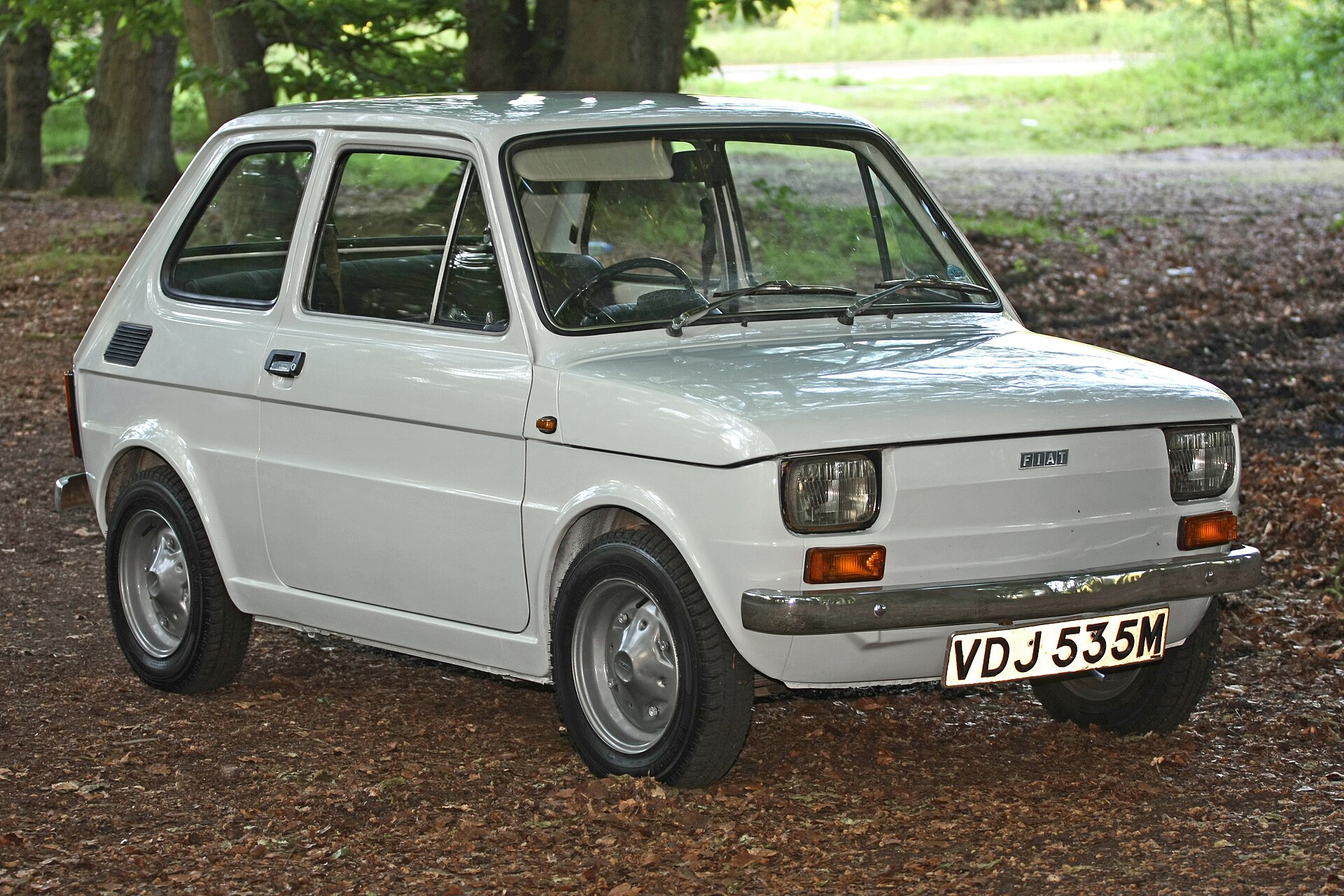
- Built
- 1972–2000
- Generations
- 2
- Top power
- 19 kW (26 PS)
Timeline
126 generations
Click a generation for its own page
/ 126p and Bis overlapped in 1987–2000, so Bis sits on a second lane
- 126 / 126p 1972–2000 · Sedan · 17 kW (23 PS)
- 126 Bis 1987–1991 · Hatchback · 19 kW (26 PS)
Newest first · 2 generations since 1972
-
1987
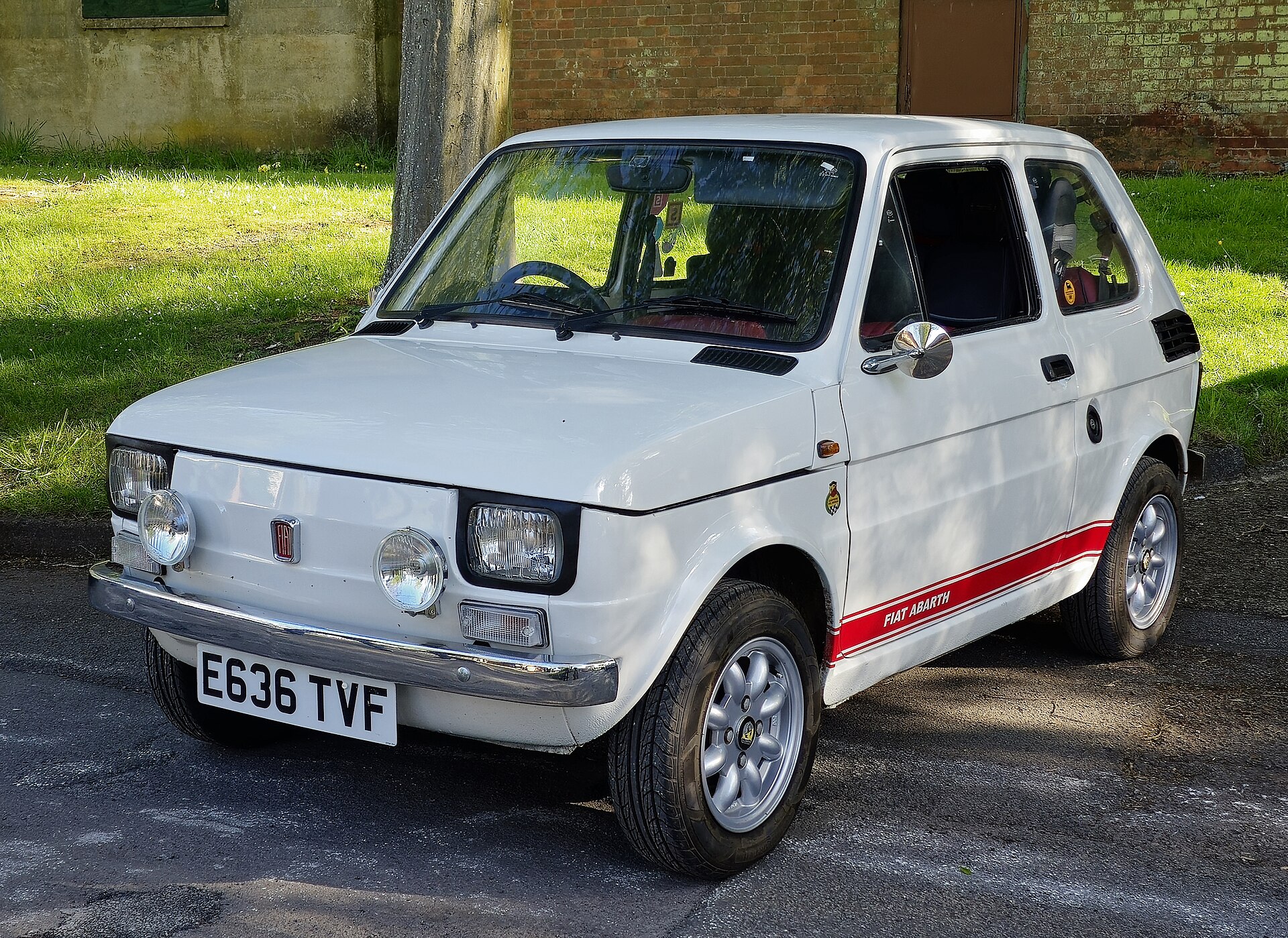
- 1972 / 126p 1972–2000 · Sedan · 17 kW (23 PS)

All generations by year: 126 Bis (1987–1991) · 126 / 126p (1972–2000)
Which one is mine?
Pick the year of first registration to see which generation it is.
- Bis 1987–1991
- 126 / 126p 1972–2000
The Fiat 126 is a rear-engined four-seat city car that Fiat presented at the Turin show in October 1972 as the successor to the Nuova 500. It kept the 500's 1,840 mm wheelbase and an air-cooled two-cylinder engine in the tail. Italian plants built it until about 1980 and Polish ones until 22 September 2000, for a total of 4,673,655 cars.
In short
- Two-door saloon styled by Sergio Sartorelli, plus the three-door 126 Bis hatchback of 1987-1991.
- Engines: 594 cc and 652 cc air-cooled twins of 17 kW (23 PS), then a 704 cc water-cooled flat twin of 19 kW (26 PS) in the Bis.
- Output: 1,352,912 cars in Italy, 3,318,674 in Poland and 2,069 by Steyr-Puch in Austria.
- The Polish 126p cost 69,000 zloty in 1973 and became the official "Maluch" in 1997.
Size at a glance
| Dimensions | Fiat 126 / 126p |
|---|---|
| Length | 3,054 mm120.2 in |
| Width | 1,378 mm54.3 in |
| Height | 1,302 mm51.3 in |
| Wheelbase | 1,840 mm72.4 in |
Specs by version
Engines
| Version | Engine | Power | Torque | Gearbox | Drive | Production years |
|---|---|---|---|---|---|---|
| 126 / 126p · 600 (594 cc) | 0.6 l · 2 cyl · Petrol 594 cc | 17 kW 23 PS23 hp | 39 Nm29 lb-ft | 4-sp Manual | Rear-wheel drive | 1972–1978 |
| 126 / 126p · 650 (652 cc) | 0.7 l · 2 cyl · Petrol 652 cc | 17 kW 23 PS23 hp | 43 Nm32 lb-ft | 4-sp Manual | Rear-wheel drive | 1977–2000 |
| 126 / 126p · Steyr-Puch 126 (643 cc boxer) | 0.6 l · 2 cyl · Petrol 643 cc | 18 kW 24 PS24 hp | - | - | Rear-wheel drive | 1974–1975 |
| Bis 704 cc | 0.7 l · 2 cyl · Petrol 704 cc | 19 kW 26 PS25 hp | - | - | Rear-wheel drive | 1987–1991 |
Performance
Show all 2 versions
| Version | Top speed |
|---|---|
| 126 / 126p · 600 (594 cc) | 105 km/h65 mph |
| 126 / 126p · Steyr-Puch 126 (643 cc boxer) | 117 km/h73 mph |
Dimensions and weight
Show all 1 versions
| Version | Length | Width | Height | Wheelbase |
|---|---|---|---|---|
| 126 / 126p · 600 (594 cc) | 3,054 mm120.2 in | 1,378 mm54.3 in | 1,302 mm51.3 in | 1,840 mm72.4 in |
Verified Manufacturer and type-approval data from our catalog · Sources and methodology
Fiat 126 at a glance
| Item | Fiat 126 |
|---|---|
| Years | 1972-2000 (Italy to about 1980, Poland 1973-2000) |
| Production | 4,673,655 in total |
| Plants | Cassino and Termini Imerese (Italy); FSM Bielsko-Biala and Tychy (Poland); Steyr-Puch (Austria) |
| Body styles | two-door saloon; three-door hatchback (Bis) |
| Designer | Sergio Sartorelli |
| Layout | rear engine, rear-wheel drive, four seats |
| Engines | 594 cc and 652 cc air-cooled twins; 704 cc water-cooled flat twin |
| Power | 17 kW (23 PS) to 19 kW (26 PS) |
| Kerb weight | 580-619 kg |
| Size | 3,054 mm long, 1,378 mm wide, 1,302 mm high |
| Top speed | about 105 km/h (Wikipedia DE) |
| Price new | 69,000 zloty in Poland, 1973 (about 20 average monthly wages) |
The car sits in the Fiat catalogue next to its predecessor, the Fiat Nuova 500.
Why Fiat replaced the Nuova 500
The Nuova 500 had been on sale since 1957, and the 126 was planned as its direct replacement. It reused the 500's wheelbase and most of its mechanical parts under a square, flat-sided body drawn by Sergio Sartorelli, and the engine stayed behind the rear axle.
The 126 was launched at the Turin Motor Show in October 1972. Wikipedia notes that rear-engined small cars were already seen as outdated in Western Europe, and the 126 became one of the last of them in Europe, along with the Volkswagen Beetle. That is one reason why the 126 lived longest in Poland. Fiat stopped marketing the 126 in 1993 in favour of the front-drive Cinquecento, yet the Polish line kept running for seven more years. In early 2020 Autocar ranked the 126 the 26th longest-lived single-generation car, with a 28-year production run.
From Turin small car to Polish Maluch
The Polish chapter started on 29 October 1971, when the government in Warsaw signed a licence and industrial cooperation agreement with Fiat. A new factory, FSM, went up in Bielsko-Biala in 1972. The first 126p, assembled from Italian parts, appeared on 6 June 1973, and the production line officially opened on 22 July 1973. Polish cars rode higher than Italian ones and carried a "p" suffix.
At 69,000 zloty the 126p cost about 20 average monthly wages, and buyers waited more than four years. From 1977 an "express" pre-payment scheme delivered a car within a month for 120,000 zloty, later 150,000. Poland repaid part of the licence with parts: Wikipedia DE records 800,000 rear-drive sets supplied to Fiat between 1974 and 1980.
| Year | Milestone |
|---|---|
| 1971 | Licence agreement signed on 29 October |
| 1973 | First 126p on 6 June; Bielsko-Biala line opens on 22 July |
| 1975 | Second Polish plant in Tychy starts building the car |
| 1981 | One millionth 126p |
| 1984 | FL facelift in December: plastic bumpers, new dashboard |
| 1987 | Water-cooled 126 Bis hatchback |
| 1993 | Three millionth Polish car in May; record 69,549 built at Bielsko-Biala |
| 1994 | EL version with Cinquecento parts in September |
| 1997 | ELX with catalytic converter in January |
| 2000 | Last car on 22 September after 3,318,674 Polish units |
Tychy built the 126p from 1975 to 1991 and averaged more than 135,000 cars a year, with a peak of 182,323 in 1980, according to Interia. Bielsko-Biala averaged about 43,000 a year over 27 years. In the 1980s the 126p was estimated to be the most common car in Poland. Exports went far: Australia sold it as the FSM Niki from 1989 to 1992 as the country's cheapest new car, China bought 10,000 for government use in the early 1980s, and about 10,000 were still registered in Cuba in 2016.
Engines: air-cooled twins and the water-cooled Bis
The original engine was a 594 cc air-cooled parallel twin with a 73.5 mm bore, giving 17 kW (23 PS) and 39 Nm. It drove the rear wheels through a four-speed gearbox with no synchromesh on first. At the end of 1977 the bore grew to 77 mm for 652 cc. Fiat kept the quoted output at 17 kW (23 PS) while torque rose to 43 Nm, and the same year brought larger 185 mm brakes.
The 126 Bis of 1987 was the biggest technical change. Its 704 cc twin was laid flat and water-cooled, which freed space for a second boot above the engine and a rear hatch. Output rose to 19 kW (26 PS). The Bis stayed in production until 1991, while the air-cooled saloon outlived it by nine years. A 1974 test quoted by Wikipedia DE averaged 6.1 l/100 km.
| Engine | Years | Displacement | Power | Torque | Cooling |
|---|---|---|---|---|---|
| 600 | 1972-1978 | 594 cc | 17 kW (23 PS) | 39 Nm | air |
| 650 | 1977-2000 | 652 cc | 17 kW (23 PS), up to 20 kW (27 PS) by version | 43 Nm | air |
| Bis | 1987-1991 | 704 cc | 19 kW (26 PS) | - | water |
| Steyr-Puch | 1974-1975 | 643 cc boxer | up to 18 kW (25 PS) | - | air |
Power figures for the 652 cc engine vary between sources, from 17 kW to 20 kW depending on market and trim.

Versions, special editions and conversions
In Italy the facelifted car was called the Personal 4. German buyers got the Bambino from 1977, which was deliberately rated one PS lower for insurance reasons, and the red and brown special editions of 1981-1983 with tinted glass. Austria's Steyr-Puch built 2,069 cars with its own 643 cc boxer twin, good for 117 km/h against about 105 km/h for the Fiat engine.
The Polish range moved on in steps. The FL of December 1984 brought plastic bumpers and a new dashboard, with electronic ignition and a rear fog lamp following in 1985. The EL of September 1994 borrowed parts from the Cinquecento, and the ELX of January 1997 added a catalytic converter. The last series, the "Happy End", was limited to 500 red and 500 yellow cars. In Germany, POP sold open-top conversions of the Bis as the POP 650 and POP 2000 in the early 1990s. FSM also tested prototypes that never went on sale, including a "Bombel" van and a front-engined, front-drive car.
Poland's other Fiat-derived car of the period was the larger FSO Polonez, built by a different factory in Warsaw.
Fiat 126 today: what to check when buying
Classics World's buying guide puts rust first, since it decides value and whether a car can return to the road at all. Check the sills where they meet the front and rear arches, the bottom corners of the rear arches, the floors and the front panel around the spare wheel well, whose drain hole must be kept clear. Reproduction floor panels exist; early metal bumpers and plain rear screens are scarce.
Mechanically the twin is simple, with no conventional oil filter (only a centrifugal unit to clean) and shim-adjusted fan belts. Ignition condensers are a known weak spot, and the water-cooled Bis is prone to head gasket failure. A car that jumps out of gear may only need a cheap gearbox mount, though internal wear is also possible. The drum brakes can fade badly, so many owners fit a front disc conversion that needs 13-inch wheels. Right-hand-drive steering racks and headlamps are now hard to find. In the UK, help comes from the Fiat Motor Club GB, the Fiat 126 Club UK and specialists such as Motobambino.
Values have climbed steadily. The Classic Cars For Sale price tracker put a condition-two car at about EUR 4,000 (GBP 3,500) in 2020, against GBP 900 in 2005. Hagerty UK reported a restored 1991 Bis advertised at about EUR 6,100 (GBP 5,295) in April 2022. Early, very original Italian-built cars sit at the top of the market. More small cars of the era are in the classic cars section.

Fiat 126: first vs latest generation
| Spec | 126 / 126p | 126 Bis | Change |
|---|---|---|---|
| Years | 1972–2000 | 1987–1991 | 15 years apart |
| Most powerful version | 17 kW (23 PS) | 19 kW (26 PS) | +2 kW (+12%) |
Oldest and newest generation in the 1cars catalog. Power is the strongest version of each; other rows are shown only when both generations have the figure.
Fiat 126 in our rankings
- No. 1 of 112 · Smallest sedans (3,054 mm)
- No. 1 of 552 · Smallest cars (3,054 mm)
- No. 92 of 1136 · Longest-running car nameplates (28 years · top 9%)
- No. 73 of 78 · Fastest sedans (117 km/h · top 94%)
- No. 33 of 34 · Fastest cars of the 1970s (117 km/h · top 98%)
- No. 394 of 405 · Fastest cars (117 km/h · top 98%)
Shorter than 99% of ranked sedans in the 1CARS catalog (No. 1 of 112).
FAQ
How many Fiat 126s were built?
In total 4,673,655 were built between 1972 and 2000. Italian plants made 1,352,912, Polish factories in Bielsko-Biala and Tychy made 3,318,674, and Steyr-Puch in Austria built 2,069 with its own boxer engine.
What is the difference between the Fiat 126 and the 126p?
The 126p is the Polish-built version made by FSM under licence from 1973. It used the same body and engines but rode higher, and in later years gained its own updates such as the FL, EL and ELX, which never reached Italian showrooms.
What engine does the Fiat 126 Bis have?
The Bis of 1987-1991 has a 704 cc water-cooled twin mounted flat under a raised rear floor. It gives 19 kW (26 PS), and the lower engine made room for a hatchback and a second luggage area above it.
When did Fiat 126 production end?
Polish production ended on 22 September 2000 at Bielsko-Biala with the "Happy End" series of 500 red and 500 yellow cars. Italian production had stopped around 1980, and the water-cooled Bis was dropped in 1991.
Data sources
Data checked by an editor against the sources below.
- Wikipedia - Fiat 126
- Co - Fiat 126 Buyers Guide


