
 Fiat 128
All generations, specs and history
Published Sources (1) Report an error
By Oleksandr Hnatiuk, Automotive Editor & Used Car Specialist
- Built
- 1969–1985
- Generations
- 2
- Top power
- 55 kW (75 PS)
Timeline
128 generations
Click a generation for its own page
saloon and estate and Sport Coupe and 3P overlapped in 1971–1985, so Sport Coupe and 3P sits on a second lane
- 128 saloon and estate 1969–1985 · Sedan, Station wagon · 40–49 kW (54–67 PS)
- 128 Sport Coupe and 3P 1971–1980 · Hatchback, Coupe · 47–55 kW (64–75 PS)
Newest first · 2 generations since 1969
- 1971 Sport Coupe and 3P 1971–1980 · Hatchback, Coupe · 47–55 kW (64–75 PS) saloon and estate and Sport Coupe and 3P overlapped in 1971–1985
- 1969 saloon and estate 1969–1985 · Sedan, Station wagon · 40–49 kW (54–67 PS)
All generations by year: 128 Sport Coupe and 3P (1971–1980) · 128 saloon and estate (1969–1985)
Which one is mine?
Pick the year of first registration to see which generation it is.
- 128 Sport Coupe and 3P 1971–1980
- 128 saloon and estate 1969–1985
The Fiat 128 is the compact front-wheel-drive family car that Fiat launched in spring 1969 and sold in Italy until 1985. Dante Giacosa's team placed a 1.1-litre overhead-cam engine across the nose with the gearbox beside it, a layout most European makers later adopted. It was European Car of the Year 1970, came as a saloon, estate, Rally, Sport Coupé and 3P, and lived on under licence for decades.
In short
- Italian production: about 3.1 million cars (2,776,000 saloons and estates plus 330,800 coupés and 3Ps), built at Rivalta near Turin.
- Engines: Aurelio Lampredi's belt-driven SOHC four of 1,116 and 1,290 cc, from 40 kW (55 PS) to 55 kW (75 PS).
- European Car of the Year 1970 with 235 points, well ahead of the Autobianchi A112 (96) and Renault 12 (79).
- Licence production ran until 2008 at Zastava in Kragujevac and until 2009 at Nasr in Egypt.
Size at a glance
| Dimensions | Fiat 128 saloon and estate |
|---|---|
| Length | 3,850 mm151.6 in |
| Width | 1,590 mm62.6 in |
| Height | 1,340 mm52.8 in |
| Wheelbase | 2,445 mm96.3 in |
Specs by version
Engines
| Version | Engine | Power | Torque | Gearbox | Drive | Production years |
|---|---|---|---|---|---|---|
| 128 saloon and estate · 1100 | 1.1 l · 4 cyl · Petrol 1,116 cc | 40 kW 54 PS54 hp | 81 Nm60 lb-ft | Manual | Front-wheel drive | 1969–1985 |
| 128 saloon and estate · 1300 Special | 1.3 l · 4 cyl · Petrol 1,290 cc | 44 kW 60 PS59 hp | - | Manual | Front-wheel drive | 1974–1978 |
| 128 saloon and estate · 1300 Rally | 1.3 l · 4 cyl · Petrol 1,290 cc | 49 kW 67 PS66 hp | - | Manual | Front-wheel drive | 1971–1974 |
| 128 Sport Coupe and 3P · Sport Coupe 1100 | 1.1 l · 4 cyl · Petrol 1,116 cc | 47 kW 64 PS63 hp | 86 Nm63 lb-ft | Manual | Front-wheel drive | 1971–1975 |
| 128 Sport Coupe and 3P · 3P 1300 | 1.3 l · 4 cyl · Petrol 1,290 cc | 54 kW 73 PS72 hp | - | Manual | Front-wheel drive | 1975–1980 |
| 128 Sport Coupe and 3P · Sport Coupe 1300 | 1.3 l · 4 cyl · Petrol 1,290 cc | 55 kW 75 PS74 hp | - | Manual | Front-wheel drive | 1971–1975 |
Performance
Show all 1 versions
| Version | Top speed |
|---|---|
| 128 saloon and estate · 1100 | 137 km/h85 mph |
Dimensions and weight
Show all 3 versions
| Version | Length | Width | Height | Wheelbase | Kerb weight |
|---|---|---|---|---|---|
| 128 saloon and estate · 1100 | 3,850 mm151.6 in | 1,590 mm62.6 in | 1,340 mm52.8 in | 2,445 mm96.3 in | 750 kg1,653 lb |
| 128 Sport Coupe and 3P · Sport Coupe 1100 | - | - | - | 2,223 mm87.5 in | - |
| 128 Sport Coupe and 3P · Sport Coupe 1300 | - | - | - | 2,223 mm87.5 in | - |
Verified Manufacturer and type-approval data from our catalog · Sources and methodology
Fiat 128 at a glance
| Item | Fiat 128 |
|---|---|
| Years | 1969-1985 in Italy (production at Rivalta to September 1983, sales to August 1985) |
| Production total | about 3,107,000 in Italy |
| Plant | Rivalta di Torino, Italy |
| Body styles | two- and four-door saloon, three-door Familiare/Panorama estate, two-door Sport Coupé, three-door 3P hatchback |
| Engineering | Dante Giacosa; engine by Aurelio Lampredi |
| Layout | transverse front engine, front-wheel drive, independent suspension all round |
| Engines | 1,116 cc and 1,290 cc SOHC four-cylinder |
| Power | 40-55 kW (55-75 PS) |
| Kerb weight | 750-770 kg (saloon) |
| Top speed | 137.4 km/h (1100 saloon, Motor test, 1970) |
| 0-97 km/h (60 mph) | 15.5 s (1100 saloon, Motor, April 1970) |
| Price new | from 875,000 lire in Italy (1969); GBP 876 in the UK (1970) |
The 128 is part of the Fiat catalogue, and the company background is in our history of Fiat.
Giacosa's layout, tested on the Primula
The 128 replaced the rear-wheel-drive Fiat 1100 R. Fiat had been cautious about front-wheel drive and tried the idea first under another badge: the Autobianchi Primula of 1963 used a transverse engine with the gearbox mounted beside it on the end of the block, and Fiat tested that arrangement for five years before putting it into a Fiat. The BMC Mini of 1959 and the 1100/1300 of 1962 already had transverse engines, but with the gearbox in the sump.
The result was a 3,850 mm saloon on a 2,445 mm wheelbase, about 20 cm shorter and more than 100 kg lighter than the Fiat 124. Fiat claimed that the mechanical parts took up only 20 per cent of the car's volume. The bonded windscreens raised the torsional rigidity of the body shell by as much as 92 per cent, according to Fiat. Suspension was independent on all four wheels.
Rivals noticed. Volkswagen reportedly took a 128 apart in 1970 while it developed the front-drive Volkswagen Golf.

Lampredi's belt-driven engine
Aurelio Lampredi, a former Ferrari engineer, drew the 128's four-cylinder. It had an iron block, an aluminium head, a five-bearing crankshaft and a single overhead camshaft driven by a toothed rubber belt. The 1,116 cc version measured 80 x 55.5 mm, an over-square design. Valve clearances were set with shims that could be changed without disturbing the timing.
| Version | Years | Displacement | Power | Torque |
|---|---|---|---|---|
| Saloon 1100 | 1969-1985 | 1,116 cc | 40 kW (55 PS) | 81 Nm |
| Rally | 1971-1974 | 1,290 cc | 49 kW (67 PS) | 88-92 Nm |
| Sport Coupé 1100 | 1971-1975 | 1,116 cc | 47 kW (64 PS) | 86 Nm |
| Sport Coupé 1300 | 1971-1975 | 1,290 cc | 55 kW (75 PS) | - |
| Special 1300 | from 1974 | 1,290 cc | 44 kW (60 PS) | - |
| 3P 1100 | 1975-1980 | 1,116 cc | 48 kW (65 PS) | - |
| 3P 1300 | 1975-1980 | 1,290 cc | 54 kW (73 PS) | - |
Torque values come from the German Wikipedia table; sources differ on the Rally (88 Nm in English sources, 92 Nm in German). US cars had 37 kW (50 PS) from the 1100. The same drivetrain went into the mid-engined Fiat X1/9 in 1972.
Rally, Sport Coupé and 3P
The Familiare, a three-door estate, joined the saloons in 1970. At the Geneva show in March 1971 Fiat added the 128 Rally: a two-door saloon with the 1,290 cc engine, a twin-choke Weber carburettor and a top speed of about 160 km/h (100 mph). It won the Canadian Winter Rally four times between 1971 and 1974.
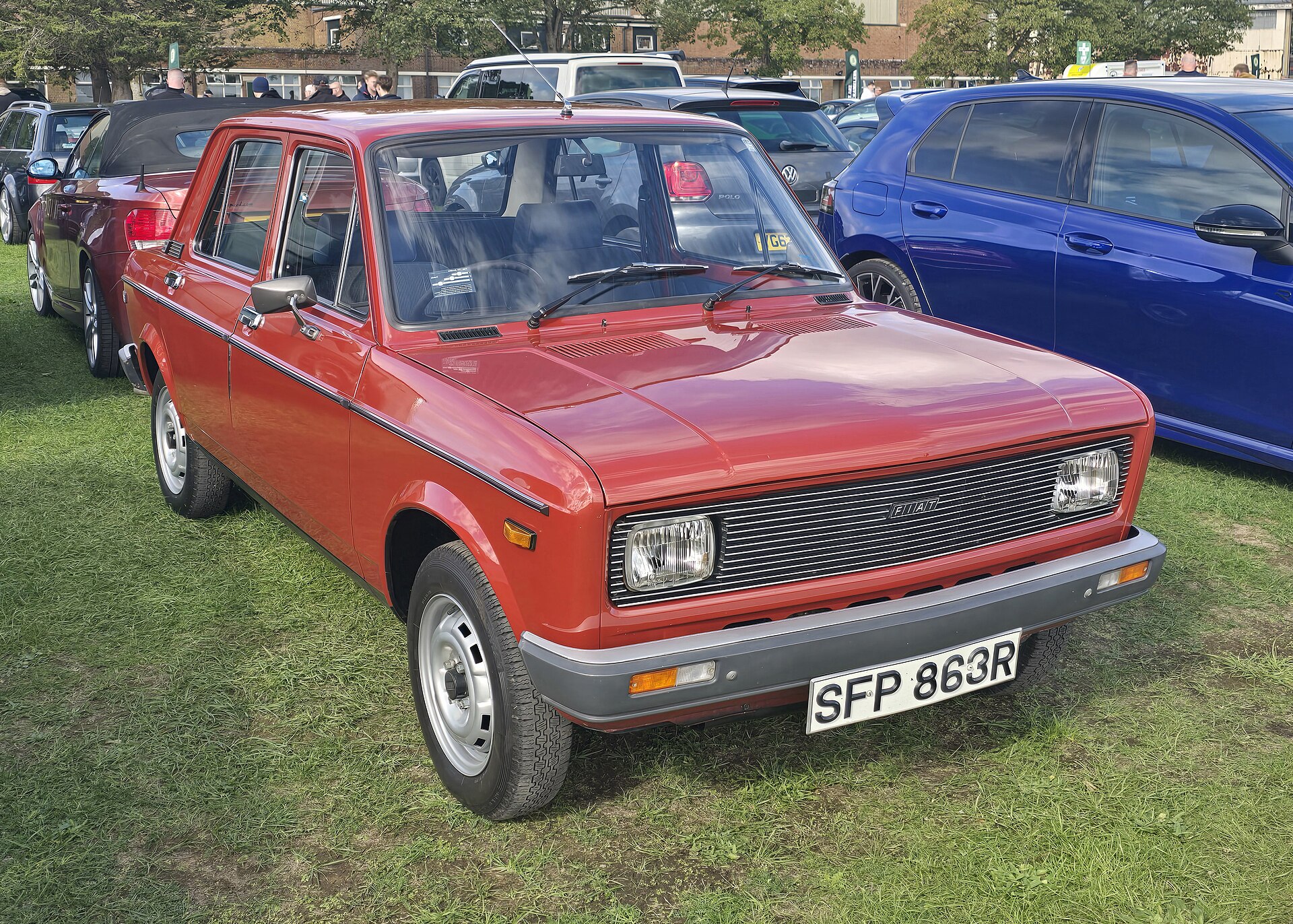
The Sport Coupé followed at the Turin show in November 1971 in S and SL trims. It used a shorter 2,223 mm wheelbase and offered 47 or 55 kW (64 or 75 PS). In 1975 Fiat replaced it with the 128 3P Berlinetta, a three-door coupé with a hatch that stayed in the range until 1980. Facelifts came in 1972 (new grille, bumpers, dashboard and brake servo) and 1976 (rectangular headlamps, with the estate renamed Panorama). The 1974 Special put the 1,290 cc engine, detuned to 44 kW (60 PS), into the four-door body.
Period tests praised the packaging. Motor measured 137.4 km/h, 0-60 mph in 15.5 seconds and 27.5 mpg (10.3 l/100 km) in April 1970. At GBP 876 the 128 cost a little more in Britain than the Morris 1300 (GBP 830) and the Ford Escort (GBP 838).
Licensed 128s from Kragujevac to Cairo
The 128 had an unusually long second life outside Italy. Zastava in Yugoslavia built a hatchback version, the Zastava 101: 1,031,671 were made between 1971 and 2001, and the renamed Skala 55 continued until October 2008. A 128-type saloon was added in the 1980s. Zastava's later small car, the Zastava Koral, sold abroad as the Yugo, came from the same Kragujevac plant. In Poland FSO assembled 58,541 Zastava 1100p cars between 1973 and 1982.
SEAT in Spain built 31,893 of its own 128 3P between 1976 and 1980, including a version with a 1,438 cc engine. Fiat Concord in Argentina produced the 128 from 1971 to 1990, including the five-door Rural estate and the Europa and Súper Europa saloons, with 255,110 cars in total. Colombia assembled the 128 from 1973 to 1980, and Nasr in Egypt kept building the 128 from kits until 2009.
In Italy the Ritmo arrived in April 1978. By the end of 1978 the 1300 engine had gone from the saloon, coupés ended around 1979-1980, and the Panorama made way for the 127 Panorama in autumn 1980. The 1100 saloon stayed on sale until August 1985, when it cost 9 million lire.
Fiat 128 today: what to check when buying
Corrosion is the reason survivors are rare. A British classic insurer's retrospective says the 128's reputation for "corroding virtually at will was no myth", so start with the structure: sills, floor pans, front and rear wheel arches, the bottoms of doors and tailgate, and the front subframe and suspension mounts. A car with fresh paint and no record of welding needs a careful look underneath.
The Lampredi engine is sturdy, but its cam belt needs changing at regular intervals, so ask for receipts. Mechanical parts are generally easy to source, helped by the shared drivetrain of the X1/9 and the licensed cars, while trim, badges and Rally or Sport Coupé body parts are much harder.
Values: Classic Trader's overview for 2021 to January 2026 puts realistic prices for most 128s at about EUR 5,000-16,000 in 2026, with good Sport Coupé and 3P cars at about EUR 8,000-18,000; a few modified or exceptional cars are advertised far higher. More Italian and European classics are in the classic cars section.
Photo gallery

Fiat 128: first vs latest generation
| Spec | 128 saloon and estate | 128 Sport Coupe and 3P | Change |
|---|---|---|---|
| Years | 1969–1985 | 1971–1980 | 2 years apart |
| Most powerful version | 49 kW (67 PS) | 55 kW (75 PS) | +6 kW (+12%) |
| Wheelbase | 2,445 mm | 2,223 mm | −222 mm |
Oldest and newest generation in the 1cars catalog. Power is the strongest version of each; other rows are shown only when both generations have the figure.
Fiat 128 in our rankings
- No. 3 of 79 · Lightest sedans (750 kg)
- No. 4 of 122 · Smallest sedans (3,850 mm)
- No. 8 of 424 · Lightest cars (750 kg)
- No. 40 of 565 · Smallest cars (3,850 mm · top 8%)
- No. 282 of 1147 · Longest-running car nameplates (16 years · top 26%)
- No. 63 of 78 · Power-to-weight: sedans (53 kW/t · top 81%)
Lighter than 97% of ranked cars in the 1CARS catalog (No. 8 of 424).
FAQ
When was the Fiat 128 made?
Fiat launched the 128 in spring 1969. Production at Rivalta ended in September 1983 and Italian sales in August 1985. Licensed versions lasted much longer: Zastava built them until 2008 and Nasr in Egypt until 2009.
How many Fiat 128s were built?
About 3.1 million in Italy: 2,776,000 saloons and estates and 330,800 coupés and 3Ps. Licence production adds over a million Zastava 101s, 255,110 cars in Argentina and smaller numbers from SEAT, FSO and others.
What was the most powerful Fiat 128?
The Sport Coupé 1300 of 1971-1975, with 1,290 cc and 55 kW (75 PS). The 3P 1300 that replaced it had 54 kW (73 PS), and the two-door Rally saloon had 49 kW (67 PS).
Why is the Fiat 128 important?
It popularised the transverse engine with the gearbox beside it, first tried on the Autobianchi Primula. That layout became standard for European front-wheel-drive family cars, and the 128 won European Car of the Year 1970.
Data sources
Data checked by an editor against the sources below.
- Wikipedia - Fiat 128


