 Volvo V40
Specs, engines and history
Published Sources (4) Report an error
By Felix Hartmann, Automotive Technology & EV Contributor
- Built
- 2012–2019
- Top power
- 187 kW (254 PS)
Which V40 to buy
Our verdict · Felix Hartmann
For most buyers a facelifted car from 2016 onwards with a Drive-E engine is the sensible choice: the T3 or the D3, both with 112 kW, are enough for everyday driving. The D2 suits high-mileage drivers who value economy over performance. Enthusiasts will look for the early T5 with the 2.5-litre five-cylinder or a Cross Country T5 with all-wheel drive.
Before buying a used example, look through the service history, that the airbag warning light goes out after start-up and, on Cross Country models with all-wheel drive, that the Haldex coupling has been serviced. Comparable used hatchbacks are the Audi A3, the BMW 1 Series and the Volkswagen Golf. The rest of the range is on the Volvo catalogue page.
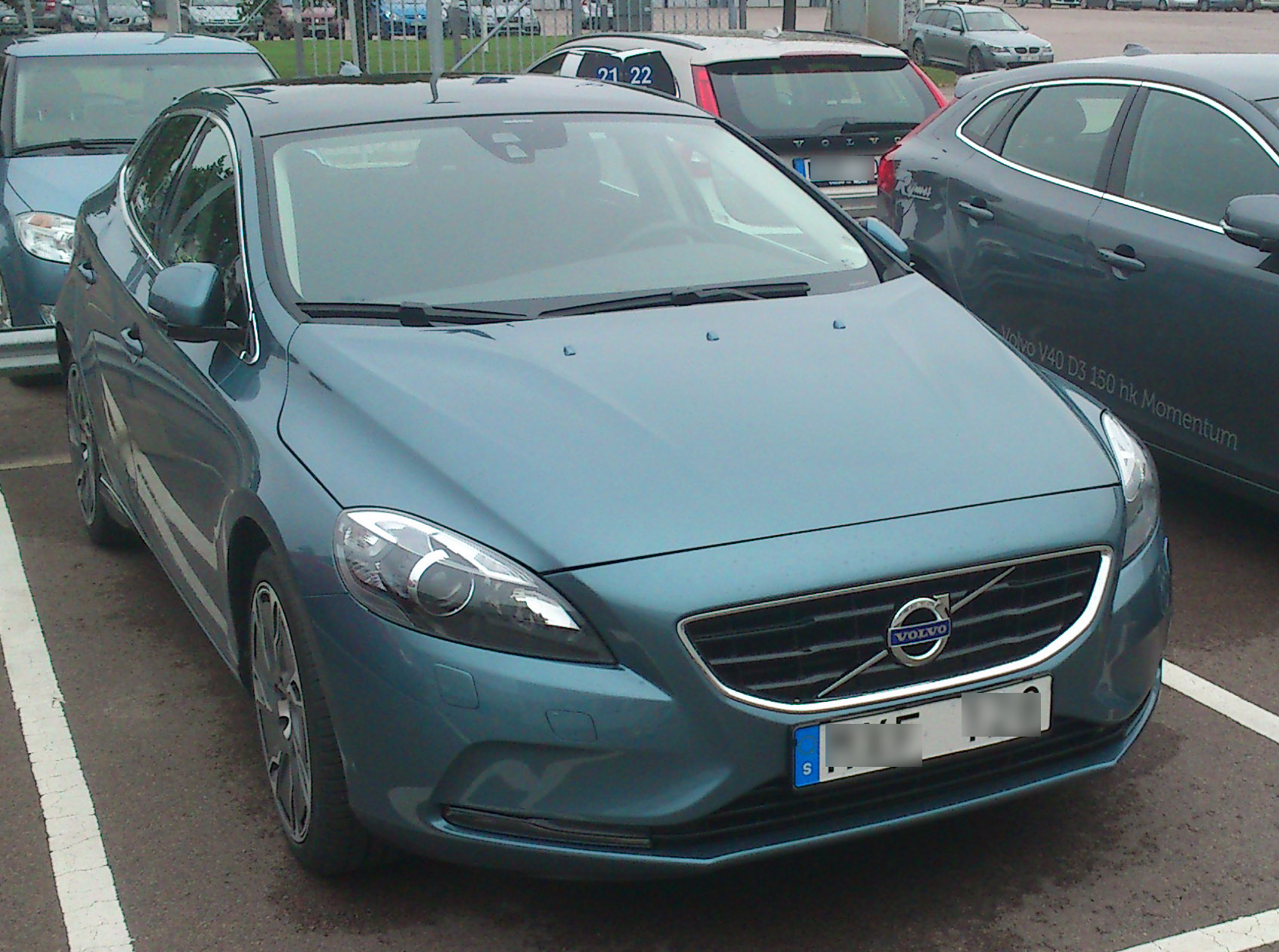
The Volvo V40 of 2012–2019 is a five-door premium compact hatchback that Volvo built in Ghent, Belgium. No car before it had an airbag for pedestrians, and it set record Euro NCAP scores in 2012. Engines ranged from an 85 kW diesel to a 187 kW five-cylinder petrol; production ended in July 2019 without a direct successor. The name had been used before, from 1995 to 2004, on a mid-size estate.
In short
- Revealed at the Geneva Motor Show in 2012, on sale from 15 September 2012.
- Euro NCAP 2012: 98 per cent for adult occupants and 88 per cent for pedestrians, both records at the time.
- Ford C1 platform; from 2015 Volvo's own Drive-E four-cylinder engines replaced the Ford and five-cylinder units.
- V40 Cross Country from early 2013, optional all-wheel drive with the T4 and standard with the T5.
Size at a glance
| Dimensions | Volvo V40 I |
|---|---|
| Length | 4,369 mm172.0 in |
| Width | 1,802 mm70.9 in |
| Height | 1,445 mm56.9 in |
| Wheelbase | 2,647 mm104.2 in |
Specs by version
Engines
| Version | Engine | Power | Torque | Production years |
|---|---|---|---|---|
| Diesel · 6 versions | ||||
| D2 1.6 | 1.6 l · 4 cyl · Diesel D4162T | 85 kW 116 PS114 hp | 270 Nm199 lb-ft | 2012–2015 |
| D2 2.0 Drive-E | 4 cyl · Diesel D4204T8 | 89 kW 121 PS119 hp | 280 Nm207 lb-ft | 2015–2019 |
| D3 2.0 five-cylinder | 2.0 l · 5 cyl · Diesel D5204T6 | 110 kW 150 PS148 hp | 350 Nm258 lb-ft | 2012–2015 |
| D3 2.0 Drive-E | 4 cyl · Diesel D4204T9 | 112 kW 152 PS150 hp | 320 Nm236 lb-ft | 2015–2019 |
| D4 2.0 five-cylinder | 5 cyl · Diesel D5204T4 | 130 kW 177 PS174 hp | 400 Nm295 lb-ft | 2012–2015 |
| D4 2.0 Drive-E | 4 cyl · Diesel D4204T14 | 141 kW 192 PS189 hp | 400 Nm295 lb-ft | 2015–2019 |
| Petrol · 13 versions | ||||
| T2 1.5 Drive-E | 4 cyl · Petrol B4154T5 | 90 kW 122 PS121 hp | 220 Nm162 lb-ft | 2016–2019 |
| T2 2.0 Drive-E | 4 cyl · Petrol B4204T38 | 90 kW 122 PS121 hp | 220 Nm162 lb-ft | 2015–2019 |
| T2 1.6 | 1.6 l · 4 cyl · Petrol B4164T3 | 90 kW 122 PS121 hp | 240 Nm177 lb-ft | 2012–2015 |
| T3 1.6 | 1.6 l · 4 cyl · Petrol B4164T3 | 110 kW 150 PS148 hp | 240 Nm177 lb-ft | 2012–2015 |
| T3 1.5 Drive-E | 4 cyl · Petrol B4154T6 | 112 kW 152 PS150 hp | 250 Nm184 lb-ft | 2015–2019 |
| T3 2.0 Drive-E | 4 cyl · Petrol B4204T37 | 112 kW 152 PS150 hp | 250 Nm184 lb-ft | 2015–2019 |
| T4 1.6 | 1.6 l · 4 cyl · Petrol B4164T | 132 kW 179 PS177 hp | 240 Nm177 lb-ft | 2012–2015 |
| T4 2.0 five-cylinder | 2.0 l · 5 cyl · Petrol B5204T8 | 132 kW 179 PS177 hp | 300 Nm221 lb-ft | 2012–2015 |
| T4 2.0 Drive-E | 4 cyl · Petrol B4204T19 | 140 kW 190 PS188 hp | 300 Nm221 lb-ft | 2015–2019 |
| T5 2.0 five-cylinder | 5 cyl · Petrol B5204T9 | 157 kW 213 PS211 hp | 300 Nm221 lb-ft | 2013–2015 |
| T5 2.0 Drive-E | 4 cyl · Petrol | 182 kW 247 PS244 hp | 350 Nm258 lb-ft | 2015–2019 |
| T5 2.5 five-cylinder | 2.5 l · 5 cyl · Petrol B5254T14 | 183 kW 249 PS245 hp | 360 Nm266 lb-ft | 2013–2015 |
| T5 2.5 five-cylinder AWD | 5 cyl · Petrol B5254T12 | 187 kW 254 PS251 hp | 360 Nm266 lb-ft | 2013–2015 |
Performance
Show all 2 versions
| Version | CO₂ |
|---|---|
| D2 2.0 Drive-E | 134 g/km |
| D3 2.0 Drive-E | 144 g/km |
Dimensions and weight
Show all 3 versions
| Version | Length | Width | Height | Wheelbase | Kerb weight |
|---|---|---|---|---|---|
| D2 1.6 | 4,369 mm172.0 in | 1,802 mm70.9 in | 1,445 mm56.9 in | 2,647 mm104.2 in | - |
| D2 2.0 Drive-E | - | - | - | - | 1,453 kg3,203 lb |
| D3 2.0 Drive-E | - | - | - | - | 1,486 kg3,276 lb |
Verified Manufacturer and type-approval data from our catalog · Sources and methodology
Volvo V40 at a glance
| Parameter | Volvo V40 (2012–2019) |
|---|---|
| Production | 2012 – July 2019, Ghent (Belgium); also assembled in Shah Alam (Malaysia) |
| Body | five-door hatchback; Cross Country with 15 mm more ride height |
| Platform | Ford C1 (Global C), the last new Volvo on a Ford platform |
| Length / wheelbase | 4,369 mm / 2,647 mm |
| Width / height | 1,802 mm / 1,445 mm |
| Kerb weight | 1,357–1,498 kg |
| Engines | 1.5–2.5 litres, three to five cylinders petrol; 1.6–2.0 litres diesel |
| Power | 85 kW (D2 1.6) to 187 kW (T5 2.5 AWD) |
| Gearboxes | six-speed manual, six-speed Powershift dual-clutch, six- and eight-speed Aisin automatics |
| Predecessors | C30, S40, V50 |
Development and platform
The V40 used Ford's C1 platform, shared with the Focus down to the bulkhead, with revised electric power steering and its own spring and damper settings. Wikipedia DE calls it Volvo's last new model on a Ford platform. Chris Benjamin designed the exterior and Pontus Fontaeus the interior; it was the last Volvo designed under Steve Mattin.
After its premiere at the 2012 Geneva show, the car went on sale on 15 September 2012. It replaced three models at once: the C30 coupé-hatchback, the S40 saloon and the V50 estate. Its larger stablemates were the Volvo S60 saloon and the V60 estate.

Safety: the first pedestrian airbag
The V40 introduced a world first: a pedestrian airbag. In a collision with a person the bonnet is raised and an airbag unfolds over the lower third of the windscreen and the A-pillars, covering hard areas that a pedestrian could hit.
Euro NCAP published its result in August 2012. According to GoAuto, the V40 scored 98 per cent for adult occupant protection, the best yet recorded, and a record 88 per cent for pedestrian protection. Safety assistance reached 100 per cent and child occupant protection 75 per cent. Euro NCAP's secretary general said the car set a new standard. The V40 collected several safety prizes afterwards, among them the Auto Express Safety Award 2013 and a Road Safety Award in 2014.
Engines: Ford and five-cylinder to Drive-E
The engine range changed completely during the car's life. Until 2015 the V40 used Ford's 1.6 EcoBoost petrol engines, Volvo's own five-cylinder petrol and diesel units and a 1.6 PSA diesel. From 2015 Volvo's modular Drive-E four-cylinders of 1.5 and 2.0 litres took over.
| Engine (years) | Type | Power | Torque |
|---|---|---|---|
| T2 (2012–2015) | 1.6 EcoBoost petrol | 90 kW (122 PS) | 240 Nm |
| T3 (2012–2015) | 1.6 EcoBoost petrol | 110 kW (150 PS) | 240 Nm |
| T4 (2012–2015) | 2.0 five-cylinder petrol | 132 kW (180 PS) | 300 Nm |
| T5 (2013–2015) | 2.5 five-cylinder petrol | 183 kW (249 PS); 187 kW (254 PS) AWD | 360 Nm |
| D2 (2012–2015) | 1.6 PSA diesel | 85 kW (115 PS) | 270 Nm |
| D3 (2012–2015) | 2.0 five-cylinder diesel | 110 kW (150 PS) | 350 Nm |
| D4 (2012–2015) | 2.0 five-cylinder diesel | 130 kW (177 PS) | 400 Nm |
| T2 / T3 (2015–2019) | 1.5 or 2.0 Drive-E petrol | 90 / 112 kW (122 / 152 PS) | 220 / 250 Nm |
| T4 (2015–2019) | 2.0 Drive-E petrol | 140 kW (190 PS) | 300 Nm |
| T5 (2015–2019) | 2.0 Drive-E petrol | 182 kW (248 PS) | 350 Nm |
| D2 (2015–2019) | 2.0 Drive-E diesel | 89 kW (121 PS) | 280 Nm |
| D3 (2015–2019) | 2.0 Drive-E diesel | 112 kW (152 PS) | 320 Nm |
| D4 (2015–2019) | 2.0 Drive-E diesel | 141 kW (192 PS) | 400 Nm |
Wikipedia also lists a T4 with the 1.6 EcoBoost (132 kW, 240 Nm) and a 157 kW (213 PS) version of the 2.0 five-cylinder. Converting the outputs to horsepower or back is easy with the power converter.
V40 Cross Country, R-Design and Polestar
The V40 Cross Country arrived in early 2013. It sits 15 mm higher and has protective body cladding, bigger wheels and hill descent control. A fifth-generation Haldex coupling sent drive to all four wheels: as an option on the T4, as standard on the T5. The Cross Country won the Tow Car Awards in 2013 and again in 2015.
The sporty R-Design trim also came in early 2013. Polestar offered a Polestar Performance software update that raised the output of several engines. Wikipedia DE gives the example of a D3 that matches the D4 after the update, since the two engines differ only in their software.

The 2016 facelift
The updated V40 was unveiled at the Geneva show of 2016 and reached showrooms in April. Its most visible change was the new front with "Thor's Hammer" LED daytime running lights. New upholstery options arrived, and the top trim was renamed from Summum to Inscription. In July 2019 production ended, and Volvo did not replace the car directly. The smallest Volvos today are compact SUVs: the Volvo XC40 and the even shorter electric EX30.
The first V40 (1995–2004)
The V40 name first appeared on an estate. Volvo launched the S40 saloon and V40 estate in 1995; the V40 premiered in Bologna in December 1995. Both were built at the NedCar factory in Born, the Netherlands, on a platform shared with the Mitsubishi Carisma, and they were the last Volvos made there. The original plan was to call them S4 and F4, but Audi had already reserved the S4 name.
Outputs ranged from 66 kW (90 PS) in the 1.9 diesel to 147 kW (200 PS) in the T4. A Phase II update in July 2000 brought revised engine management, direct-injection diesels, larger brakes and revised suspension. Volvo built 423,491 of these V40 estates between 1995 and 2004, after which the V50 took over.


Photo gallery


Volvo V40 in our rankings
- No. 10 of 70 · Biggest engines: hatchbacks (2,497 cc)
- No. 25 of 106 · Most powerful hatchbacks (187 kW · top 24%)
- No. 19 of 66 · Widest hatchbacks (1,802 mm · top 29%)
- No. 19 of 65 · Most torque: hatchbacks (400 Nm · top 30%)
- No. 21 of 67 · Longest hatchbacks (4,369 mm · top 32%)
- No. 143 of 420 · Smallest cars (4,369 mm · top 35%)
Bigger engine than 85% of ranked hatchbacks in the 1CARS catalog (No. 10 of 70).
FAQ
When was the Volvo V40 made?
The hatchback was built from 2012 to July 2019. An earlier V40 estate was made from 1995 to 2004.
Why is the Volvo V40 known for safety?
Because of the pedestrian airbag, a world first, and its 2012 Euro NCAP scores, which were the highest yet for adult occupant and pedestrian protection.
What is the most powerful Volvo V40?
The all-wheel-drive T5 of 2013–2015, whose 2.5-litre five-cylinder made 187 kW (254 PS) and 360 Nm.
What replaced the Volvo V40?
There was no direct successor. The smallest Volvos today are the XC40 and EX30 compact SUVs.
Where was the Volvo V40 built?
In Ghent, Belgium, with additional assembly in Shah Alam, Malaysia. The 1995–2004 V40 was built at NedCar in Born, the Netherlands.
Data sources
Data checked by an editor against the sources below.
- Wikipedia - Volvo V40 (2012–2019)
- Wikipedia - Volvo V40 (2012)
- Euro NCAP - 26c627b4 3d2e 4d22 Aa92 8fdaf56ec8ec
- EEA CO₂ monitoring (European Environment Agency, CC BY 4.0)