
 Volvo 480
Specs, engines and history
Published Sources (3) Report an error
By Sarah Whitmore, Senior Automotive Writer
- Built
- 1986–1995
- Top power
- 90 kW (122 PS)
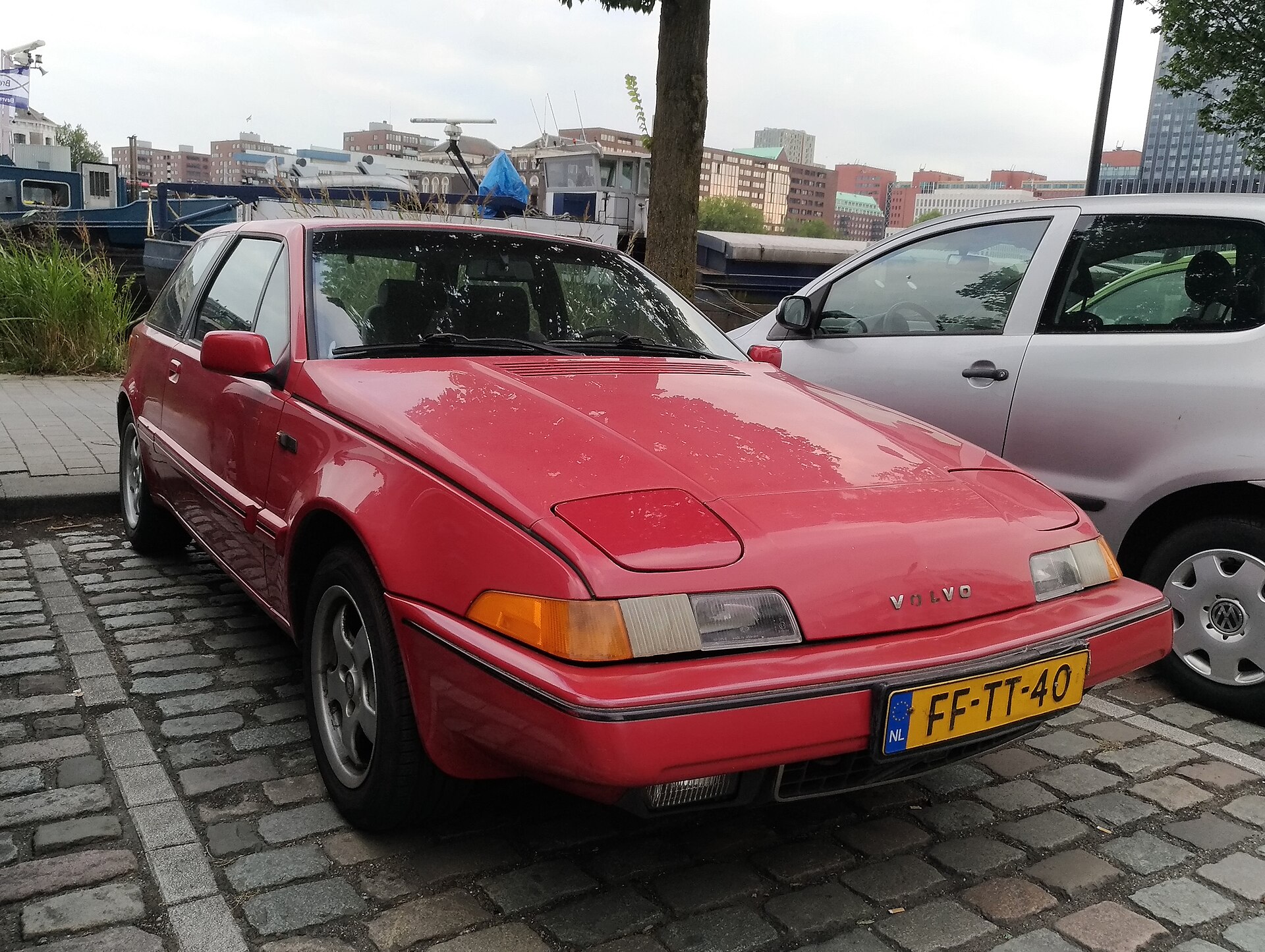
The Volvo 480 is a three-door, four-seat sports hatchback that Volvo Car B.V. built at Born in the Netherlands from 1986 to 7 September 1995. It was Volvo's first front-wheel-drive production car and the only Volvo with pop-up headlights. Renault-sourced 1.7 and 2.0-litre engines, one of them turbocharged, gave 76-90 kW, and 76,375 cars were made.
In short
- Press launch on 15 October 1985, public debut at the Geneva show in March 1986, production until 7 September 1995.
- 76,375 built, of which 22,421 were sold in the UK, the 480's largest market.
- 1.7-litre engines with 80 kW (109 hp) or, as the Turbo of 1988, 88-90 kW (120-122 hp); a 2.0 with 81 kW (110 hp) from 1993.
- Exterior by John de Vries, interior by Peter Horbury; rear suspension developed with Lotus.
Size at a glance
| Dimensions | Volvo 480 I |
|---|---|
| Length | 4,258 mm167.6 in |
| Width | 1,710 mm67.3 in |
| Height | 1,318 mm51.9 in |
| Wheelbase | 2,503 mm98.5 in |
Specs by version
Engines
| Version | Engine | Power | Torque | Gearbox | Drive | Production years |
|---|---|---|---|---|---|---|
| 1.7 ES (catalyst) | 1.7 l · 4 cyl · Petrol 1,721 cc | 76 kW 103 PS102 hp | - | - | Front-wheel drive | 1991 |
| 1.7 ES | 1.7 l · 4 cyl · Petrol 1,721 cc | 80 kW 109 PS107 hp | 140 Nm103 lb-ft | 5-sp Manual | Front-wheel drive | 1986 |
| 2.0 | 2.0 l · 4 cyl · Petrol B20F | 81 kW 110 PS109 hp | 165 Nm122 lb-ft | - | Front-wheel drive | 1993–1995 |
| 1.7 Turbo | 1.7 l · 4 cyl · Petrol B18FT | 88 kW 120 PS118 hp | 170 Nm125 lb-ft | 5-sp Manual | Front-wheel drive | 1988 |
Performance
Show all 3 versions
| Version | 0–100 km/h | Top speed |
|---|---|---|
| 1.7 ES | 9.5 s 0–62 mph | 190 km/h118 mph |
| 2.0 | 9.3 s 0–62 mph | 191 km/h119 mph |
| 1.7 Turbo | 8.9 s 0–62 mph | 200 km/h124 mph |
Dimensions and weight
Verified Manufacturer and type-approval data from our catalog · Sources and methodology
Volvo 480 at a glance
| Item | Volvo 480 |
|---|---|
| Years | 1986-1995 |
| Production | 76,375 |
| Plant | Born, Netherlands (Volvo Car B.V., the former DAF car plant) |
| Body style | 3-door, 4-seat hatchback with frameless glass tailgate |
| Designers | John de Vries (exterior), Peter Horbury (interior) |
| Layout | transverse front engine, front-wheel drive, platform shared with the 440/460 |
| Engines | 1,721 cc four (with or without turbo), 1,998 cc four |
| Power | 76 kW (102 bhp) to 90 kW (122 hp) |
| Weight | 1,016-1,079 kg |
| Top speed | 190 km/h (1.7 ES) to 200 km/h (Turbo) |
| 0-100 km/h | 9.5 s (1.7 ES), 8.9 s (Turbo), 9.3 s (2.0) |
| Price new | SEK 120,000 in 1986 for the 480 ES, including tax |
Volvo's other models, from the rear-drive saloons to today's range, are listed in our Volvo catalogue, and more cars of the 1980s are in our classic cars section.
A Dutch-built Volvo with pop-up lamps
The 480 came from Volvo's Dutch arm, which the Swedish company had built up after taking over DAF's car business in the 1970s. Volvo published the first picture on 15 October 1985 and showed the car at Geneva in March 1986. Sales in mainland Europe started in May 1986, and right-hand-drive cars reached the UK and Ireland on 11 June 1987.
The shape broke with every Volvo before it. John de Vries drew a low wedge nose with pop-up headlamps and a composite nose cone and bonnet that saved weight and were kinder to pedestrians. The glass tailgate and the cut-off rear were a nod to the 1800 ES of the early 1970s, as Volvo itself points out. Peter Horbury, who later became Volvo's head of design twice, was responsible for the interior. Volvo called it a coupé in Europe, although the body sits somewhere between a liftback and a small estate.
The 480 was also planned for the United States as a 2+2 sports wagon for autumn 1987, and Volvo expected to sell 25,000 cars overseas. A weak dollar killed the plan, and in February 1988 the US launch was postponed indefinitely.

Lotus chassis, Renault engines and a digital dashboard
The 480 was the first front-wheel-drive Volvo built in series. A transverse four-cylinder engine drove the front wheels through a five-speed Renault JC5 manual gearbox, or a ZF 4HP14Q four-speed automatic. The rear axle was developed by Lotus, whose engineers helped tune the suspension; the company's story is told in our history of Lotus Cars. Brakes were discs at the front and drums or discs at the rear, depending on version.
Electronics were a selling point. The 480 had daytime running lights, follow-me-home headlights with a 30-second delay, a rear wiper that switched on automatically in reverse, and an electronic Information Centre that showed range, instant consumption and average speed. Volvo's own heritage text admits that the number of electronically controlled functions contributed to reliability problems in the early years.
| Version | Engine | Power | Torque | 0-100 km/h | Top speed |
|---|---|---|---|---|---|
| 480 ES 1.7 (from 1986) | 1,721 cc B18, injection | 80 kW (109 hp) | 140 Nm | 9.5 s | 190 km/h |
| 480 Turbo (from 1988) | 1,721 cc, Garrett turbo | 88-90 kW (120-122 hp) | 170-175 Nm | 8.9 s | 200 km/h |
| 480 ES with catalyst (from 1991) | 1,721 cc | 76 kW (102 bhp) | - | - | - |
| 480 2.0 (from 1993) | 1,998 cc B20F | 81 kW (110 hp) | 165 Nm | 9.3 s | 191 km/h |
Figures from Wikipedia EN and Octane; Japanese-market Turbos were rated at 85 kW (115 hp).
Turbo, facelifts and special editions
The Turbo of 1988 used a light-pressure Garrett turbocharger with electronic control and pushed the top speed past 200 km/h. A minor facelift in 1991 brought catalytic converters to all models, which cut the 1.7's output to 76 kW (102 bhp) in Octane's figures. For 1993 the 2.0-litre B20F arrived, and it replaced the naturally aspirated 1.7. The last facelift, in 1994, is easy to spot by the clear front indicators and an airbag steering wheel.
Special editions kept the range alive in its final years. Volvo sold the Paris Blue in 1991 and the Two-Tone in 1992-1993. In the UK a 480 GT limited to 250 cars and the 2.0 engine went on sale on 1 June 1994 at GBP 16,245. The last numbered cars were the Celebration (called Collection in mainland Europe) of May 1995, which Car magazine listed at GBP 16,500. In Sweden the final Turbo cost SEK 214,600, and only about 3,800 480s were sold in Volvo's home country.
Two projects stopped short of customers. A convertible was announced in summer 1987, shown at Geneva in 1990 and planned for early 1991, but production did not follow. A 1986 electric prototype used a 15.6 kWh nickel-cadmium battery and 42 hp motor for a claimed range of 120 km.
The end of the 480 and its legacy
Production ended on 7 September 1995 without a direct successor. Its sporting rivals in Europe included front-drive coupés such as the second-generation Volkswagen Scirocco. Octane notes that many enthusiasts see the C30 of 2006, with its glass tailgate, as the car that picked up the 480's idea.

Volvo 480 today: what to check when buying
The Octane buying guide of March 2024 starts at the back. Water gets into the boot through the tailgate top and the rear light seals, so lift the boot carpet and check for damp. Rust appears on the rear wheelarches, the suspension mounting points and the sills, and in the boot floor of any car that has leaked.
The Renault 1.7 is simple, sturdy and cheap to repair. Early 2.0-litre engines could burn a lot of oil; ask whether the official Volvo dealer fix, known as modification 2371, has been carried out. The electrics are the weak point: test every switch, the pop-up headlamps and the Information Centre on the dashboard before you buy, because tracing faults can take time.
Prices remain low. Octane gave these guide figures in March 2024 (GBP converted at about 1.17):
- Naturally aspirated cars from about EUR 1,750 (GBP 1,500); tidier examples EUR 2,900-4,100 (GBP 2,500-3,500).
- Turbo runners from about EUR 2,350 (GBP 2,000); nicer cars EUR 4,100-5,850 (GBP 3,500-5,000).
- Special editions such as the GT or Celebration may command a slight premium.
The UK took 22,421 cars, nearly 30 percent of all 480s, which makes British classifieds a natural place to start looking for a right-hand-drive car.
Volvo 480 in our rankings
- No. 143 of 561 · Smallest cars (4,258 mm · top 26%)
- No. 31 of 100 · Biggest engines: hatchbacks (1,998 cc · top 31%)
- No. 34 of 77 · Fastest hatchbacks (200 km/h · top 45%)
- No. 45 of 99 · Longest hatchbacks (4,258 mm · top 46%)
- No. 505 of 1143 · Longest-running car nameplates (9 years · top 50%)
- No. 40 of 76 · Quickest hatchbacks, 0–100 (8.9 s · top 53%)
Shorter than 74% of ranked cars in the 1CARS catalog (No. 143 of 561).
FAQ
Where was the Volvo 480 built?
At Born in the Netherlands, in the former DAF car plant run by Volvo's Dutch subsidiary Volvo Car B.V. The same factory built the related 440 and 460, and later became NedCar. All 76,375 cars of the 480 were made there between 1986 and 1995.
Was the Volvo 480 the first front-wheel-drive Volvo?
Yes. The 480 was Volvo's first series-produced car with front-wheel drive, launched in 1986; the 440 hatchback and 460 saloon later shared its platform. It is also the only Volvo ever fitted with pop-up headlights.
How fast is the Volvo 480 Turbo?
The 480 Turbo reaches 200 km/h and accelerates from 0 to 100 km/h in 8.9 seconds. Its 1.7-litre engine with a Garrett turbo produced 88-90 kW (120-122 hp) and 170-175 Nm, depending on the source and market.
Was there a Volvo 480 convertible?
Only as a prototype. Volvo announced a convertible in 1987 and showed it at the 1990 Geneva show with a planned launch in early 1991, but it never went into production.
Data sources
Data checked by an editor against the sources below.
- Wikipedia - Volvo 480
- Volvocars
- Octane-magazine - Volvo 480 Buying Guide Historyand Review


