DAF: Hub van Doorne's Belt-Drive Cars, 1958 to 1975
DAF is the Dutch company from Eindhoven that began as a trailer works in 1928, became a lorry maker in 1949 and built small passenger cars from 1958 to 1975. Its cars were known for one invention, the Variomatic belt-drive continuously variable transmission developed by the founder, Hub van Doorne, which made the DAF 600 one of the first cars with a CVT. Volvo took over the car division in 1975, and the DAF 66 was renamed the Volvo 66. The lorry business continues as DAF Trucks, owned by PACCAR since 1996.
Key takeaways
- Hub van Doorne started his Eindhoven business in April 1928; with his brother Wim it became Van Doorne's Aanhangwagen Fabriek (DAF) in 1932.
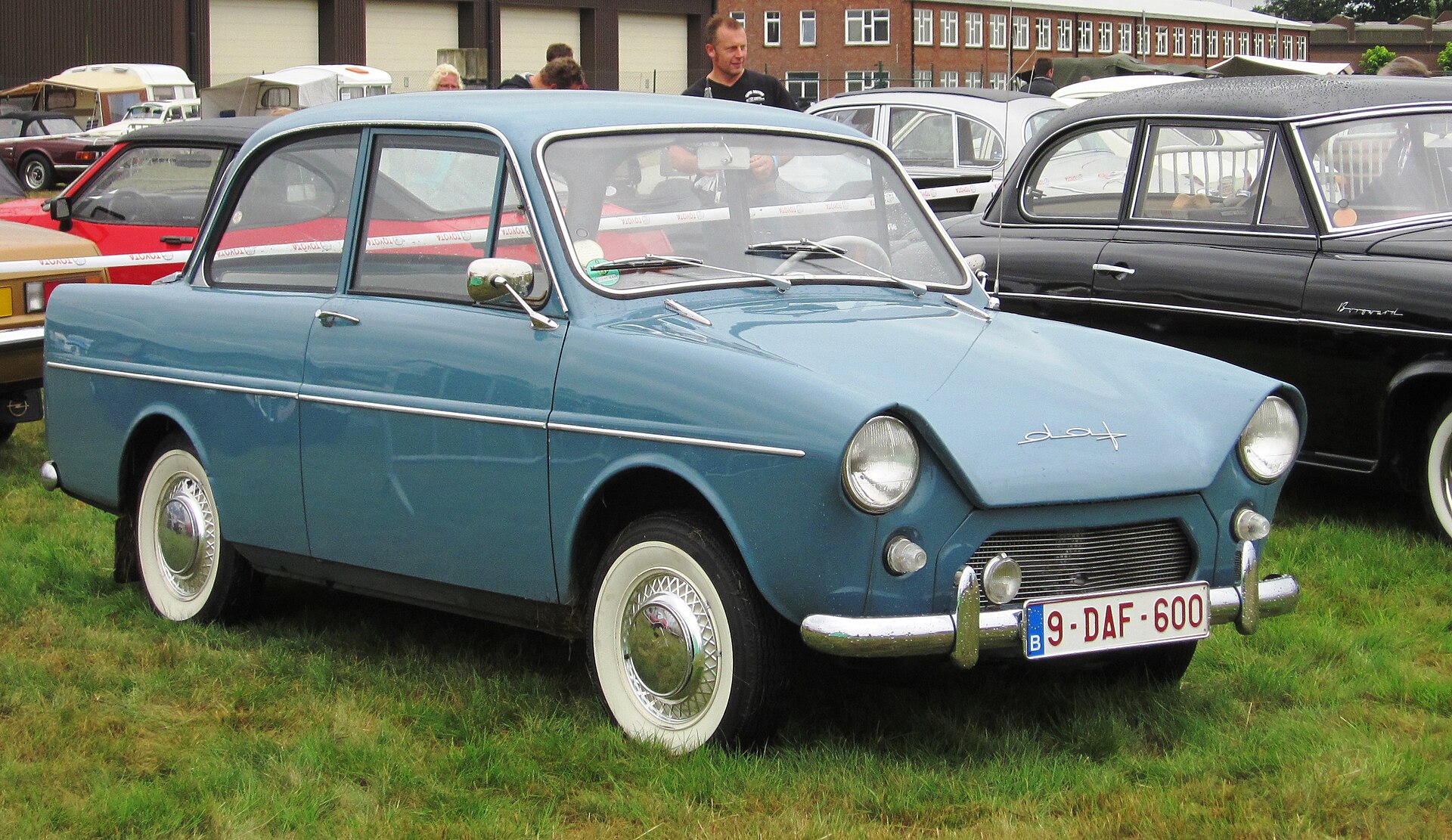
- The DAF 600 was shown at the Amsterdam show in February 1958 with a 590 cc flat-twin of 16.2 kW (22 hp) and the Variomatic; 30,591 were built up to 1963.
- DAF opened a car plant at Born in 1967; the DAF 66 of 1972 had Renault engines of up to 44 kW (60 PS), and 146,297 were built.
- Volvo bought a 33% stake in December 1972 and took over the car business with 75% on 1 January 1975.
DAF at a glance
| Fact | Value |
|---|---|
| Founded | April 1928, Eindhoven, Netherlands |
| Founders | Hub van Doorne (1900–1979), Wim van Doorne |
| Name | Van Doorne's Aanhangwagen Fabriek (1932); Van Doorne's Automobiel Fabriek (1949) |
| Cars | 1958–1975: 600, 750, Daffodil, 33, 44, 46, 55, 66 |
| Transmission | Variomatic belt-drive CVT |
| Car plant | Born, Limburg (opened 1967) |
| Car division | Sold to Volvo, 1975 |
| Today | DAF Trucks, owned by PACCAR since October 1996 |
Hub van Doorne and the trailer works
Hubert "Hub" van Doorne was born on 1 January 1900 in the village of America in Dutch Limburg, the son of a blacksmith. The family moved to Deurne in March 1912, and his father died soon after. Hub was thought too young to take over the forge, so he trained at the Mandiger machine factory in Eindhoven. After the First World War he worked as a chauffeur-mechanic and then at the De Valk brewery.
In April 1928 he set up a metal workshop on the brewery's grounds, backed by its managing director A. H. Huenges. It began with four people, including his brother Wim, and employed 30 within a year. Hub ran the technical side and Wim the finances. In 1932 the business was renamed Van Doorne's Aanhangwagen Fabriek, the trailer factory that gave DAF its name, and from 1936 the brothers owned it outright. Before the war DAF developed the Trado conversion, which turned two-axle Ford lorries into three-axle off-road vehicles.

Lorries from 1949
In 1949 DAF began building lorries, trailers and buses and became Van Doorne's Automobiel Fabriek. The first lorry was the A30. In the 1950s DAF supplied the Dutch army with soft-skin vehicles such as the YA-126 and the YA-328, the "Dikke Daf".

The Variomatic and the first car
In late 1954 Hub van Doorne proposed a belt-driven continuously variable transmission for road vehicles, and in 1955 DAF produced its first design. The Variomatic uses two pulleys, each made of two cones, linked by a V-belt. Moving the cones apart or together changes the diameter the belt runs on and so the gear ratio, without steps. On DAF cars, engine vacuum and centrifugal weights controlled the cones. Reverse used a separate mode, so a DAF could drive backwards as fast as forwards, and DAFs had their own class in the Dutch reversing championship.
The first car was shown at the Amsterdam Motor Show, the AutoRAI, in February 1958, and about 4,000 were ordered. The DAF 600 went into production in 1959. Its air-cooled 590 cc flat-twin had 16.2 kW (22 hp) at 4,000 rpm and gave a top speed of about 97 km/h.
The Variomatic was the Netherlands' first automatic gearbox and the first commercially successful CVT. One of the first two cars went to Truus Smulders-Beliën, the first woman to be a Dutch mayor. In the 600 to the 55 each rear wheel had its own pair of cones and belt, which gave limited-slip traction and helped DAF in rallies but wore tyres quickly. By 1963, 30,591 had been built. The model is covered in DAF 600 history and specifications.
Daffodil, 44 and 55
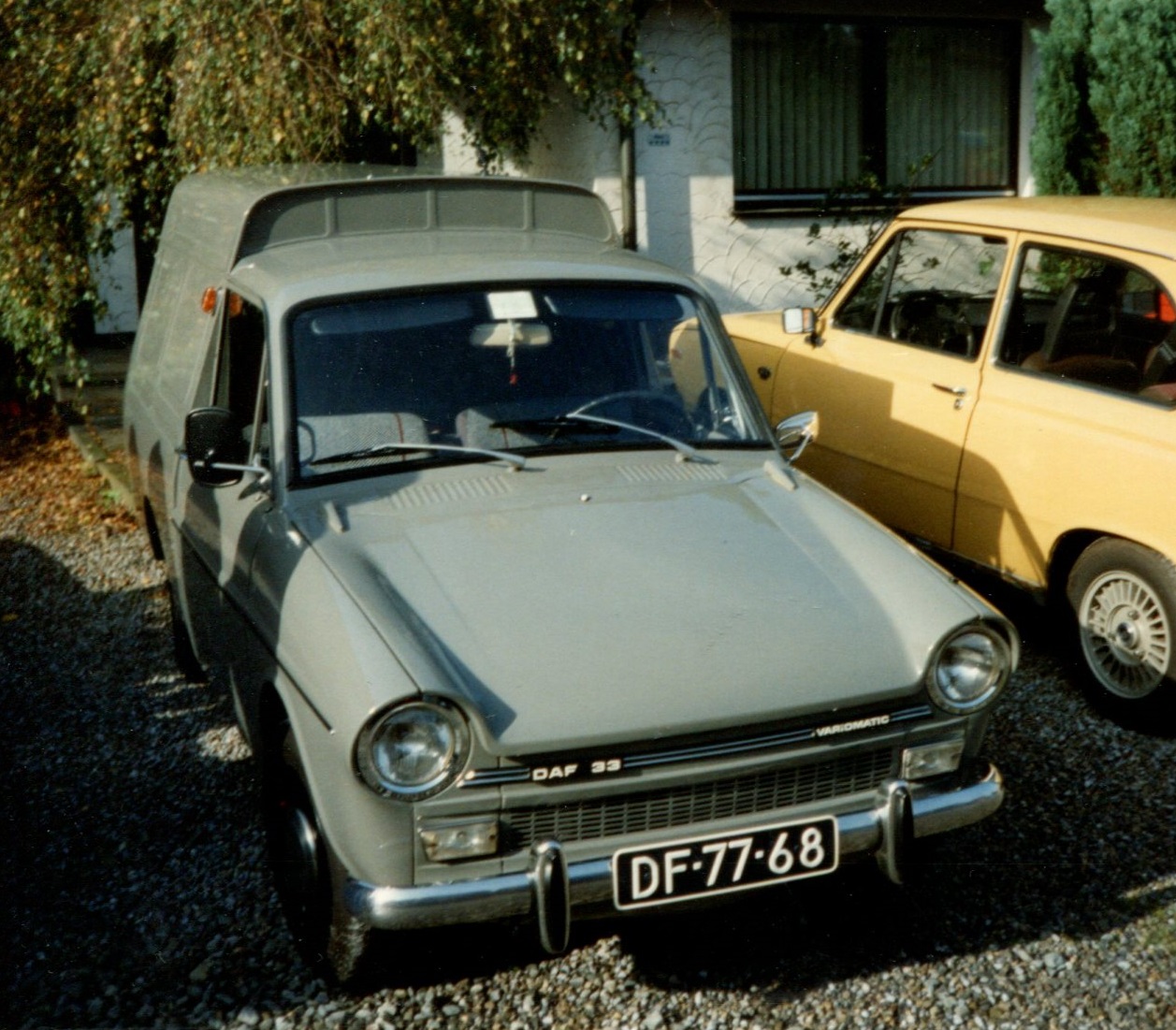
The 750 had a larger 749 cc twin, and the better-equipped Daffodil series followed as the DAF 30, 31 and 32. When the larger DAF 44 appeared in 1966, the 32 became the 33. The 44 was styled by Giovanni Michelotti and had an 850 cc twin and swing-axle rear suspension. In 1967 DAF opened a new car factory at Born, and the 44 was the first model built there.
The 55 of 1968 moved to four cylinders. Its 1,108 cc water-cooled engine came from the Renault 8. Italian coachbuilders also used DAF parts: Michelotti built the Shellette beach car, and OSI the City Car.

The 66 and the Volvo years
The DAF 66 of September 1972 replaced the 55. It had a squarer front, Renault engines of 1.1 and 1.3 litres and a De Dion rear axle with a stronger Variomatic and a differential. Standard cars had 39 kW (53 PS); the 1.1-litre Marathon had 44 kW (60 PS), and the 1300 Marathon of 1973 had 42 kW (57 PS). Compared with the 600, the most powerful 66 had 27.8 kW more. In all, 146,297 were built. The Dutch armed forces ordered a military version, the YA 66, in 1974, and 1,201 were made. The single-belt DAF 46 combined the 44 body with the 66's rear axle.
Outside money arrived in 1972. International Harvester bought a third of the company, and in December 1972 Volvo bought a 33% stake. On 1 January 1975 Volvo raised its holding to 75%, and the car division with the Born plant passed to Volvo Cars, leaving DAF with lorries. The DAF 66 was replaced by a reworked Volvo 66. The P900 project, planned as the DAF 77, was launched in 1976 as the Volvo 343 with a Variomatic, and the Volvo 340 and 360 sold more than 1.3 million cars until 1991. Volvo's own history is told in the story of Volvo.
After the cars
Volvo sold its share of the Born plant, by then called NedCar, to Mitsubishi in 2001; car production there ended in 2024. The Variomatic patents went to Van Doorne Transmissie in Tilburg, which Bosch bought in 1995. Its steel push-belt CVT, first used in the Ford Fiesta and Fiat Uno, spread to many later cars, and belt CVTs became standard on scooters from 1985. Williams built a CVT for its 1993 FW15C Formula One car, but it was banned before it raced.
The lorry company merged with Leyland Trucks in 1987, was listed in 1989, went into administration in February 1993 and was sold in a management buyout as DAF Trucks. PACCAR bought it in October 1996. Hub van Doorne died on 23 May 1979.
Who these cars suit
A DAF suits owners who want a simple, economical classic with an automatic gearbox and very easy driving. The early twins are the lightest and slowest; the 55 and 66 have four-cylinder Renault engines and up to 44 kW. The belt is the part to check, because a broken belt on the single-belt 46 stops the car. The power converter turns the PS and hp ratings into kW, the surviving model is listed in the DAF catalogue, and later cars from the Born plant are in the Volvo catalogue.
DAF timeline
| Year | Event |
|---|---|
| 1928 | Hub van Doorne's workshop in Eindhoven (April) |
| 1932 | Renamed Van Doorne's Aanhangwagen Fabriek (DAF) |
| 1949 | First DAF lorry, the A30 |
| 1958 | DAF 600 shown at the AutoRAI (February) |
| 1959 | DAF 600 production begins |
| 1966 | DAF 44 by Michelotti |
| 1967 | Born car plant opens |
| 1968 | DAF 55 with a Renault engine |
| 1972 | DAF 66; Volvo buys 33% (December) |
| 1975 | Volvo takes 75% and the car business (1 January) |
| 1996 | PACCAR buys DAF Trucks (October) |
Landmark DAF models
| Model | Years | Why it matters |
|---|---|---|
| 600 | 1959–1963 | First DAF car, with the Variomatic; 30,591 built |
| Daffodil | 1960s | Better-equipped twin-cylinder range |
| 44 | from 1966 | Michelotti design, first car from Born |
| 55 | from 1968 | First four-cylinder DAF |
| 66 | 1972–1975 | De Dion axle; 146,297 built; became the Volvo 66 |
FAQ
What does DAF stand for?
Van Doorne's Aanhangwagen Fabriek, the "van Doorne trailer factory", from 1932. From 1949 it stood for Van Doorne's Automobiel Fabriek.
What is the Variomatic?
DAF's belt-drive continuously variable transmission: a V-belt runs between two pairs of cones whose spacing changes the ratio without steps.
Why did DAF stop making cars?
Volvo bought into the company in 1972 and took over the car division and the Born plant in 1975. DAF itself kept the lorry business.
Does DAF still exist?
Yes, as DAF Trucks in Eindhoven, owned by PACCAR since 1996.
Sources
- Wikipedia - DAF Trucks (accessed 24 Oct 2026)
- Wikipedia - Hub van Doorne (accessed 24 Oct 2026)
- Wikipedia - DAF 600 (accessed 24 Oct 2026)
- Wikipedia - Variomatic (accessed 24 Oct 2026)
- Wikipedia - DAF 66 (accessed 24 Oct 2026)
Found a mistake? Report an error