 DAF 600
Specs, engines and history
Published Sources (1) Report an error
By Felix Hartmann, Automotive Technology & EV Contributor
- Built
- 1959–1963
- Top power
- 16 kW (22 PS)
DAF is best known today for trucks, but from 1958 to 1975 it also built passenger cars. Hub van Doorne founded the business in Eindhoven in 1928 as an engineering workshop, with brewery director A. H. Huenges as co-founder and investor. In 1932 it became Van Doorne's Aanhangwagen Fabriek, a trailer factory, abbreviated to DAF; in 1949, when it began making trucks, the name changed to Van Doorne's Automobiel Fabriek. Passenger cars followed from 1958 to 1975, after which Volvo took over the car business and the factory at Born. DAF Trucks has belonged to Paccar since 1996.
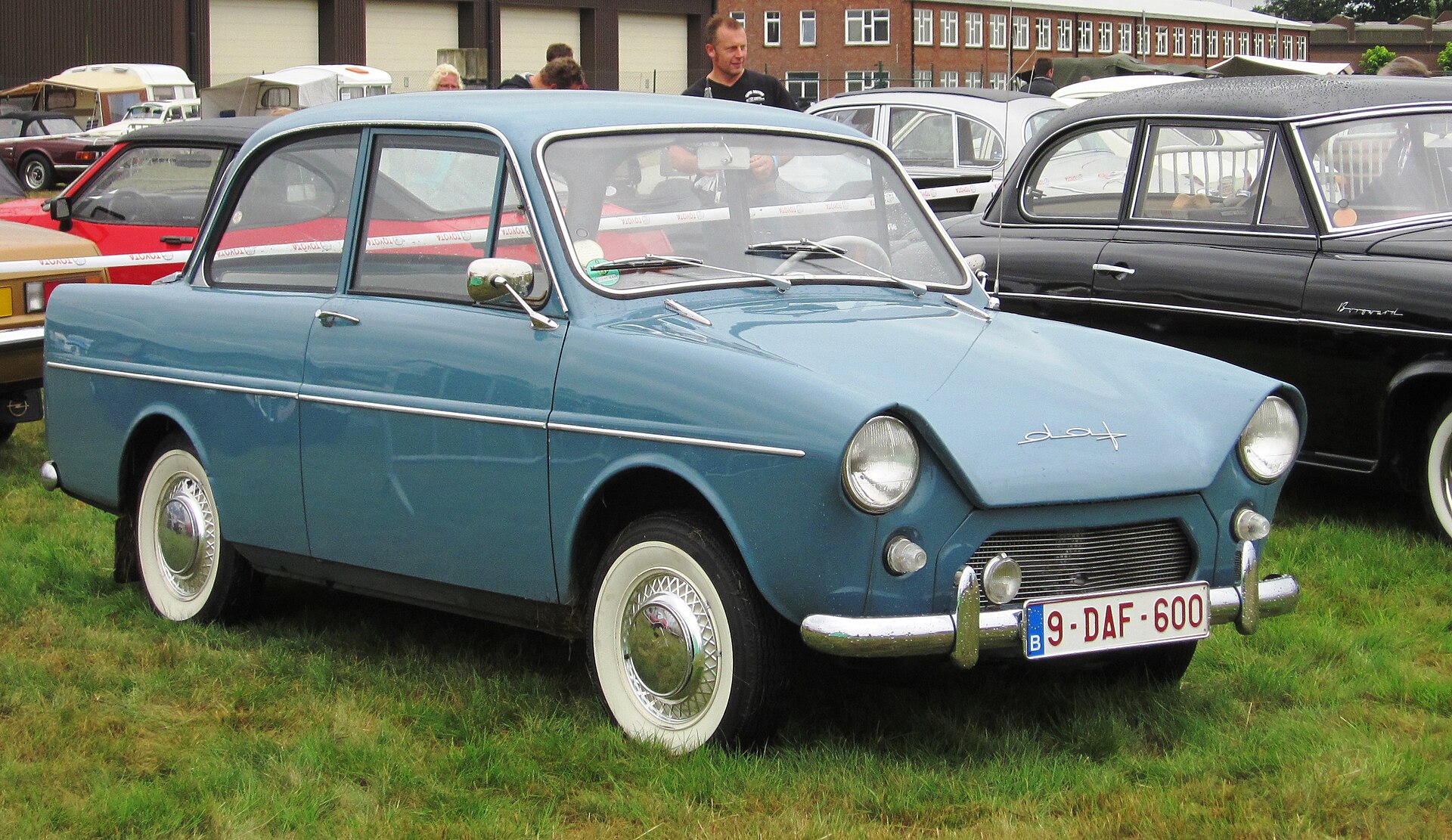
The 600 is the first production DAF car: a small two-door saloon with an air-cooled flat-twin engine and the Variomatic belt-drive automatic transmission. It was shown in February 1958, built in Eindhoven from 1959 to 1963, and 30,591 were made. It was the first production car since the Clyno of the 1920s to use a continuously variable transmission, and the Variomatic principle lives on in the CVTs of today.
Specs by version
Verified Manufacturer and type-approval data from our catalog · Sources and methodology
In short
- Presented at the Amsterdam Motor Show in February 1958; production 1959–1963 in Eindhoven; 30,591 built.
- 590 cc air-cooled four-stroke flat-twin, 16.2 kW (22 hp) at 4,000 rpm, driving the rear wheels.
- Variomatic: belts and pulleys controlled by centrifugal weights and inlet manifold vacuum, with no gears to change.
- Replaced in 1961 by the DAF 750 and Daffodil with a 746 cc engine.
DAF 600 at a glance
| Parameter | Metric | Imperial |
|---|---|---|
| Maker | DAF (Van Doorne's Automobiel Fabriek), Eindhoven | - |
| Production | 1959–1963 | - |
| Built | 30,591 | - |
| Designer | Johan van der Brugghen | - |
| Body | two-door saloon, small family car | - |
| Layout | front engine, rear-wheel drive | - |
| Engine | 590 cc air-cooled flat-twin, four-stroke | 36.0 cu in |
| Power | 16.2 kW (22 hp) at 4,000 rpm | - |
| Transmission | DAF Variomatic continuously variable | - |
| Wheelbase | 2,050 mm | 80.7 in |
| Length | 3,610 mm | 142.1 in |
| Height | 1,440 mm | 56.7 in |
| Successor | DAF 750 and Daffodil (1961) | - |
DAF from trailers to cars
The company grew from engineering work to trailers, then to trucks: the first DAF lorry was the A30 of 1949, and trailers and buses were built alongside. Hub van Doorne ran the business with his brother Wim from 1932. For its first car, DAF developed both the engine and the transmission itself.
| Year | Event |
|---|---|
| 1928 | Hub van Doorne's engineering workshop founded in Eindhoven |
| 1932 | renamed Van Doorne's Aanhangwagen Fabriek (DAF) |
| 1949 | first trucks; renamed Van Doorne's Automobiel Fabriek |
| end of 1957 | first details of the DAF 600 published |
| February 1958 | 600 shown at the Amsterdam Motor Show |
| 1959 | 600 in production |
| 1961 | DAF 750 and Daffodil replace the 600 |
| 1967 | Born car plant opens; the 44 is its first model |
| 1972 | Volvo buys a 33 % stake (December) |
| 1 January 1975 | Volvo raises its holding to 75 % and takes over the car business |
| 1996 | Paccar buys DAF Trucks |
Launch and the first owners
DAF published the first details at the end of 1957, and the car was presented to the public at the Amsterdam Motor Show in February 1958. By 1959 it was in production. The first two cars went to Truus Smulders-Beliën, the first female mayor in the Netherlands, and to the chairman of the Dutch automobile club. Smulders-Beliën did not know that her staff had ordered the car for her.
The design was the work of Johan van der Brugghen. The 600 was a compact two-door saloon, 3,610 mm long on a 2,050 mm wheelbase, with the engine at the front and drive to the rear wheels through the Variomatic.

The 590 cc flat-twin
DAF designed the engine in-house. It was a 590 cc air-cooled four-stroke flat-twin with a bore of 76 mm, rated at 16.2 kW (22 hp) at 4,000 rpm. The same engine family stayed in DAF cars, in larger sizes, until the DAF 46 was discontinued in 1976.
| Engine | Model | Bore | Power |
|---|---|---|---|
| 590 cc flat-twin | DAF 600 (1959–1963) | 76 mm | 16.2 kW (22 hp) |
| 746 cc flat-twin | DAF 750 and Daffodil (from 1961) | 85.5 mm, same stroke | 22 kW (30 bhp) |

How the Variomatic works
The Variomatic replaced the gearbox with two pairs of conical drums linked by a V-shaped belt. Moving the two halves of a drum together or apart changes the diameter at which the belt runs, and so the ratio between engine and wheels. The distance is set automatically by centrifugal weights inside the drums, which respond to engine speed, helped by the vacuum in the inlet manifold, and the system keeps the belt at a constant tension.
Two effects surprised drivers. On a level road at full throttle, easing off the accelerator raised the ratio, and with enough time the speed would climb from about 97 km/h (60 mph) to nearly 110 km/h (70 mph). For hills, a switch on the dashboard reversed the vacuum action to hold a lower ratio and give more engine braking.
Because the transmission works the same way in both directions, a DAF could drive backwards as fast as forwards. In the former Dutch annual championship for reverse driving, DAFs had to race in a class of their own, since no other car could keep up.
The idea had a long history: Milton Reeves patented a related design in the US in 1889 and Fouillaron another in France in 1898. English Wikipedia credits Christoffel Sellenraad with the original development that DAF turned into the Variomatic.

From the 600 to the modern CVT
The 600 put a continuously variable transmission into series production, and the principle spread far beyond DAF. Scooters have used Variomatic-type drives since 1985. Car makers including Audi, Honda, Mini, Subaru and Nissan, in the Primera, have offered CVTs, and Tata planned one for the Nano. In Formula One, Williams built a CVT version of the FW15C in 1993; it was banned before it raced, after heat problems in testing.
Measured against its own family, the 600 was the modest beginning. The 746 cc engine of 1961 gave about 36 % more power, 22 kW against 16.2 kW, and the Daffodil alone sold more than four times as many cars as the 600: 132,919 against 30,591.
Successors and the end of DAF cars
In 1961 DAF replaced the 600 with two cars launched together: the DAF 750, essentially the same car with fewer luxury fittings and less chrome, and the better-equipped Daffodil. Both used the 746 cc engine with 22 kW (30 bhp) and a claimed top speed of 105 km/h (65 mph).
| Model | Years | Built | Notes |
|---|---|---|---|
| DAF 600 | 1959–1963 | 30,591 | first DAF car |
| DAF 750 | 1961–1963 | 16,767 | simpler version |
| DAF Daffodil | 1961–1967 | 132,919 | sold as DAF 30, 31 and 32 in Germany |
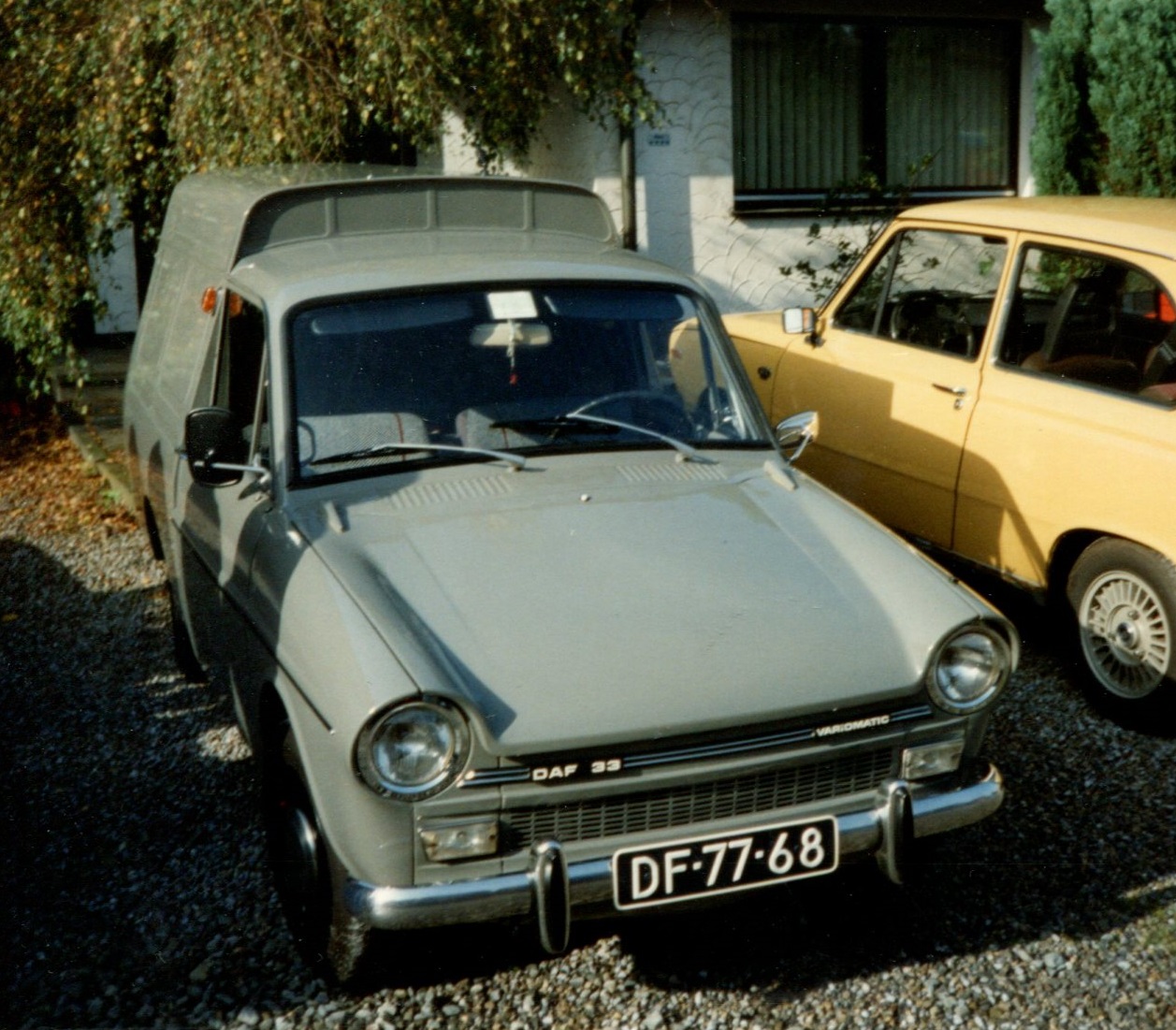
| DAF 33 | from 1967 | - | slightly more powerful successor of the Daffodil |
Larger DAFs followed: the 44 in 1966, the 55 in 1968, then the 66 and 46. Volvo took a 33 % stake in December 1972 and, on 1 January 1975, raised it to 75 %, took over the company's car business and the plant at Born, and dropped the 33 and 44. The Variomatic patents passed to Van Doorne Transmissie, which Bosch bought in 1995 and which introduced the steel push belt used in the Ford Fiesta and Fiat Uno.
The truck side of DAF went its own way. It merged with Leyland Trucks, then part of Rover Group, in 1987 and was floated on the Dutch and London stock exchanges in 1989. DAF NV went into administration in 1993, the Dutch operations continued after a management buyout as DAF Trucks, and Paccar bought DAF Trucks in October 1996 and Leyland Trucks in June 1998, reuniting the two. Eindhoven, where the 600 was built, remains DAF's headquarters and main plant.
Owning a DAF 600 today
The 600 is now a rare car: barely 30,000 were made, and later DAFs far outnumbered it. Things to check:
- Variomatic: the drive depends on the belts and the conical drums, so their condition matters more than on a car with a gearbox.
- Engine: the original 590 cc twin rather than a 746 cc unit from a 750 or Daffodil.
- Version: a car from 1959–1963, not a later Daffodil with the same basic body.
More small cars of the period are in the 1950s classics section, and the wider story of old cars on 1cars is collected under classic cars.
Photo gallery


DAF 600 in our rankings
- No. 705 of 912 · Longest-running car nameplates (4 years · top 83%)
- No. 148 of 149 · Most powerful sedans (16 kW)
- No. 131 of 131 · Biggest engines: sedans (590 cc)
- No. 855 of 859 · Most powerful cars (16 kW)
- No. 557 of 557 · Biggest engines: cars (590 cc)
In production longer than 17% of ranked nameplates in the 1CARS catalog (No. 705 of 912).
FAQ
How many DAF 600s were built?
30,591, between 1959 and 1963.
What engine does the DAF 600 have?
A 590 cc air-cooled four-stroke flat-twin with 16.2 kW (22 hp) at 4,000 rpm, designed by DAF.
What is the DAF Variomatic?
A continuously variable transmission with V-belts running between conical drums, controlled by centrifugal weights and inlet manifold vacuum.
Could a DAF 600 really drive as fast in reverse?
Yes. The Variomatic works the same in both directions, which is why DAFs had their own class in Dutch reverse-driving contests.
What replaced the DAF 600?
The DAF 750 and the Daffodil, launched together in 1961 with a 746 cc engine.
Data sources
Data checked by an editor against the sources below.