
UAZ-452
Specs, engines and history
Updated Published Sources (1) Report an error
By Felix Hartmann, Automotive Technology & EV Contributor

- Built
- 1965–present
- Top power
- 83 kW (113 PS)
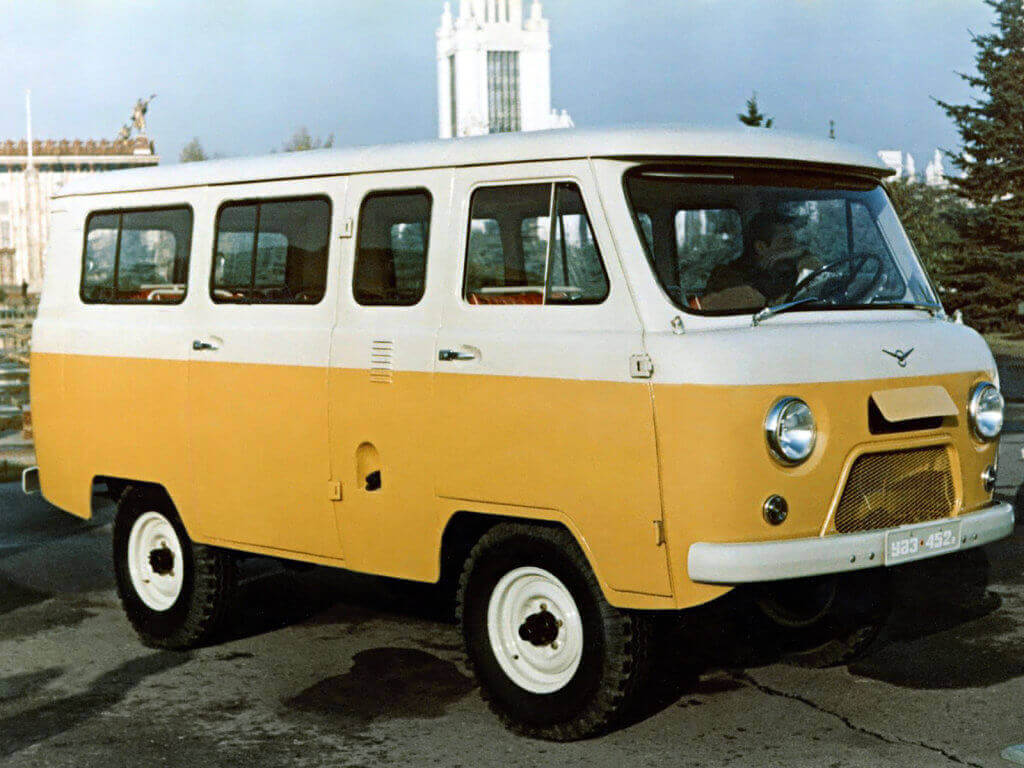
The UAZ-452 is a forward-control four-wheel-drive van built by UAZ since 1965, developed from the UAZ-450 of 1958. Nicknamed the Bukhanka ("loaf") for its rounded shape, it shares its basic body with the original and is described as the oldest vehicle design still in production. Current versions use a 2.7-litre petrol engine with 82.5 kW (112 PS).
In short
- Family history: UAZ-450 (1958), UAZ-452 (1965), new four-digit model numbers from 1985.
- Body styles: van (3741), minibus (2206), ambulance (3962), combi (3909), pickup (3303) and double-cab pickup (39094).
- Running gear: ladder frame, rigid axles on leaf springs, selectable four-wheel drive with a two-speed transfer case.
- Engine output grew from about 55 kW (75 PS) in 1965 to 73 kW (99 PS) in 1985 and 82.5 kW (112 PS) today.

UAZ-452 at a glance: maker, years and purpose
The UAZ-452 is a light off-road van with the cab over the front axle and the engine between the front seats. It was designed for the Soviet armed forces as a small all-terrain load carrier, and it later became a standard vehicle for rural ambulances, utilities and expedition travel. The maker, UAZ, was founded in 1941 and also builds the UAZ Patriot; its wider story is told in the history of UAZ.

Owners use three nicknames. The van is the Bukhanka, a loaf of bread; the ambulance is the Tabletka, a pill; and the 3303 pickup is the Golovastik, a tadpole. Since the 2010s UAZ itself has grouped all versions under the name SGR.
From the UAZ-450 to the Bukhanka: six decades of production
The project started in 1954, when the Soviet automotive ministry asked for a light off-road freight vehicle for the army. Vladimir Ariamov drew the first prototype, nicknamed Soroka ("magpie") for its black-and-white paint; Evgeny Starostin and Lev Shemarin revised it, and Shemarin completed the final design.

Series production of the UAZ-450 was prepared in 1958 with a planned 4,000 vehicles a year. It used the chassis and engine of the GAZ-69 4x4 and is described as the first Soviet forward-control vehicle of its kind. A rear-wheel-drive UAZ-451 followed in 1961.
The UAZ-452 replaced the 450 in 1965. It brought an overhead-valve engine derived from the GAZ-21 Volga, a four-speed gearbox and a tidier body without roof windows. Sources date the start of series production to 1965 or 1966.
| Year | Event |
|---|---|
| 1954 | Ministry order for a light off-road freight vehicle |
| 1958 | UAZ-450 enters production on GAZ-69 mechanicals |
| 1961 | Rear-wheel-drive UAZ-451 added |
| 1965 | UAZ-452 replaces the 450 with a GAZ-21-based engine and four-speed gearbox |
| 1979 | Facelift: amber indicators, larger rectangular rear lights |
| 1985 | New four-digit model numbers; engine raised to 73 kW (99 PS); new instrument panel and brakes |
| 1994 | UAZ-3909 combi (crew van) introduced |
| 1996–2000 | Long-wheelbase 33036, sleeper-cab 39095, double-cab 39094 and cargo-passenger 39625 |
| 2011 | ABS, power steering, seat belts and a Euro 4 engine on 39625, 3962 and 2206 |
| 2018 | Anniversary edition marking 60 years since the UAZ-450 |
The 1985 update is the dividing line in naming: the 452 van became the 3741, the 452V minibus became the 2206, the 452A ambulance became the 3962 and the 452D pickup became the 3303. Many owners and dealers still call every version a UAZ-452.
How the Bukhanka is built: frame, axles and cab
The UAZ-452 is built like a light truck rather than a car-derived van. A box-section ladder frame carries rigid front and rear axles on longitudinal leaf springs with lever-type dampers. The Bukhanka's steering is worm-and-sector, and power assistance only arrived in 2011. Brakes were hydraulic drums at all four wheels, with a vacuum booster and dual circuits on later vans.

The forward-control layout gives a short wheelbase of 2,300 mm (90.6 in) and a short front overhang, which helps on steep approaches. The penalty is space: the engine sits in a cover between the driver and passenger, which takes room from the cab but lets a mechanic reach it from inside. The all-steel body has four doors on the classic van: one for each front seat, a single side door on the right and twin rear doors.
The cab was always simple. Early vans had little sound insulation and only a basic heater, and the 1985 update added a new instrument panel and speedometer. Front head restraints and larger door mirrors arrived in the early 2000s.
Engines and four-wheel drive by period
Every UAZ-452 uses a front-mounted petrol four-cylinder driving the rear wheels, with the front axle engaged through a two-speed transfer case. A rear differential lock became available on later vans, and the 2018 anniversary model offered an electrically operated one.

- 1965–1985: 2,445 cc ZMZ-451 family, derived from the GAZ-21 Volga, rated at about 52–55 kW (70–75 PS) depending on the source and year. It could run on low-octane 72–76 RON petrol.
- 1985 onwards: an uprated UMZ engine with 73 kW (99 PS).
- 2011 onwards: Euro 4 engines; current vans use a 2,693 cc ZMZ-409 family engine with 82.5 kW (112 PS) at 4,250 rpm and 198 Nm (146 lb-ft) at 2,500 rpm. Some sources list 208 Nm.
The first 452s had a four-speed manual gearbox with synchromesh on third and fourth gears only. Current UAZ-452 versions have a five-speed manual gearbox.
UAZ-452 specifications
The table shows the current UAZ-3741 van and 2206 minibus with the 2.7-litre engine. Figures differ slightly between UAZ-452 model years and body versions.

| Parameter | Metric | Imperial |
|---|---|---|
| Engine | 2,693 cc petrol four-cylinder (ZMZ-409 family) | 164 cu in |
| Maximum power | 82.5 kW (112 PS) at 4,250 rpm | – |
| Maximum torque | 198 Nm at 2,500 rpm | 146 lb-ft |
| Gearbox | 5-speed manual, 2-speed transfer case | – |
| Drive | Selectable 4x4 | – |
| Wheelbase | 2,300 mm | 90.6 in |
| Length | 4,363–4,440 mm | 171.8–174.8 in |
| Width (body) | 1,940 mm | 76.4 in |
| Height | 2,064–2,101 mm | 81.3–82.7 in |
| Ground clearance | 205–220 mm | 8.1–8.7 in |
| Fording depth | 500 mm | 19.7 in |
| Kerb weight | 1,805–2,015 kg | 3,979–4,442 lb |
| Payload | 865–925 kg | 1,907–2,039 lb |
| Top speed | 127 km/h | 79 mph |
| Fuel use at 90 km/h | 13.5 L/100 km | 17.4 mpg US |
| Fuel tank | 77 L | 20.3 US gal |
| Tyres | 225/75 R16 | – |
The 3303 pickup and the 39094 double cab use a longer 2,550 mm (100.4 in) wheelbase and a 50 L (13.2 US gal) tank; the pickup is limited to 115 km/h (71 mph).
UAZ-452 variants: van, minibus, ambulance and pickups
UAZ built the family in two naming systems: letter suffixes until 1985 and four- or five-digit numbers afterwards.

| Variant | Years | Body / purpose | Engine | Notes |
|---|---|---|---|---|
| UAZ-450 / 450A / 450D | 1958–1965 | Van, ambulance, flatbed | 2.4 L, GAZ-69-based | Predecessor, 4x4 |
| UAZ-451 / 451M | 1961–1982 | Rear-drive van | 2.4 L | 451 pickups were exported to Finland |
| UAZ-452 / 3741 | 1965–present | All-steel van (Bukhanka) | 2.4 L, later 2.7 L | Base model |
| UAZ-452A / 3962 | 1965–present | Ambulance (Tabletka) | 2.4 L, later 2.7 L | Stretchers and medical seats |
| UAZ-452V / 2206 | 1965–present | Minibus, 8–11 seats | 2.4 L, later 2.7 L | Imported to Japan from 2005 |
| UAZ-452D / 3303 | 1965–present | Dropside pickup (Golovastik) | 2.4 L, later 2.7 L | Two-seat cab |
| UAZ-3909 | 1994–present | Combi: crew seats plus cargo area | 2.7 L | Crew van for work teams |
| UAZ-39094 | 1997–present | Double-cab pickup | 2.7 L | Long wheelbase |
| UAZ-39625 | 2000–present | Glazed cargo-passenger van | 2.7 L | ABS and Euro 4 from 2011 |
Versions with shielded electrical systems (452E, 452AE, 452DE) were also built, and cold-climate 452AS and 452VS prototypes were tested in 1976.
Strengths and weaknesses in daily use
The UAZ-452 earned its place through simplicity. The ladder frame, separate axles and carburettor-era engines could be repaired in the field with basic tools, and parts were shared with the Volga and later UAZ models. It remains in use with rural services, emergency gas crews and hunting and fishing clubs, and it appears among Soviet all-wheel-drive vehicles that outlived their era.

The Bukhanka's weaknesses come from the same age. Early vans had no seat belts, and the front occupants sit above the front axle with little structure ahead of them. Owners commonly report body corrosion and uneven build quality, and the cab is noisy and hot in summer. Fuel use of 13.5 L/100 km at a steady 90 km/h is high for the size.
Buying and preserving a UAZ-452 today
The Bukhanka is popular as a base for camper and expedition conversions, especially the 2206 minibus and 3909 combi. Pre-1979 vans with round tail lights are the most distinctive, and anniversary cars from 2018 have their own two-tone paint.
When inspecting one, check:
- Frame rails, floor and door bottoms for rust, which matters more than mileage.
- The engine cover seals and cab heater, since fumes and heat reach the cab.
- Transfer case engagement, front hubs and the rear differential lock where fitted.
- Brakes and steering play, especially on pre-2011 vans without power steering.
- Paperwork for any camper or off-road conversion.
Other Soviet-era designs like the UAZ-452 are listed under Soviet classic cars.
Rivals
Compare with…
Compare UAZ-452 with
- GAZ-Sobol quick spec comparison
- Volkswagen Transporter quick spec comparison
-
In production
- Years
- 1998–present
- Body
- Van, Minibus
- Fuel
- Petrol, Diesel
- Power
- 63–103 kW (86–140 PS)
-
EV version
In production
- Years
- 1950–present
- Body
- Van, Minibus
- Fuel
- Petrol, Diesel, Electric
- Power
- 18–173 kW (24–235 PS)
7 generations
- T2
- T3
- T4
- T5
- T6
- T7
- +1 earlier


UAZ-452 photos 18


UAZ-452 videos 2

UAZ-452 video 1

UAZ-452 video 2
FAQ
When was the UAZ-452 produced, and where?
UAZ has built the UAZ-452 since 1965 at its own plant, after the UAZ-450 of 1958. The Bukhanka is still in production, which makes it one of the longest-running vehicle designs in the world.
How many UAZ-452 were built?
UAZ has not published a verified lifetime total for the 450/452 family. The UAZ-450 was planned at 4,000 a year in 1958, and the van has stayed in continuous production for six decades.
What engine does the UAZ-452 have?
Early vans used a 2.4-litre four-cylinder derived from the GAZ-21 Volga, with about 55 kW (75 PS). Current models use a 2.7-litre petrol engine with 82.5 kW (112 PS) and a five-speed manual gearbox.
What variants of the UAZ-452 were made?
The main versions are the 3741 van, 2206 minibus, 3962 ambulance, 3909 combi, 3303 pickup, 39094 double cab and 39625 glazed van. Before 1985 they carried letter codes such as 452A, 452V and 452D.
Why is the UAZ-452 called the Bukhanka?
Bukhanka means "loaf", a nickname earned by the van's rounded, bread-like body. The ambulance version is called the Tabletka ("pill") and the 3303 pickup the Golovastik ("tadpole").
Is the UAZ-452 collectable, and what should buyers check?
It has a growing following, especially early round-tail-light vans and camper-friendly minibuses. Check the frame and body for rust first, then the transfer case, brakes and steering, and make sure any conversion is documented.
Data sources
Data checked by an editor against the sources below.
- Wikipedia - UAZ 452


