
 UAZ Hunter
Specs, engines and history
Updated Published Sources (2) Report an error
By Oleksandr Hnatiuk, Automotive Editor & Used Car Specialist Reviewed by Felix Hartmann

- Built
- 2003–present
- Top power
- 94 kW (128 PS)
Which UAZ Hunter to buy
Our verdict · Oleksandr Hnatiuk
For most owners the petrol ZMZ-409 version is the simplest choice, with widely available parts. Diesel versions use less fuel on long trips. Because the Hunter's design is old and simple, the condition of the frame, axles and body is more important than the year: check for corrosion, worn suspension bushes and leaks from the axles and transfer case.
The UAZ Hunter is a compact body-on-frame off-roader built by UAZ since 2003. It is a modernised civilian version of the long-running UAZ-469 family, keeping its separate ladder frame, live axles and part-time four-wheel drive with a two-speed transfer case, but adding more modern engines, a five-speed gearbox and improved comfort. Its 2.7-litre petrol engine produces 94 kW (128 PS).
In short
- Body: steel hardtop with five doors, five seats; separate ladder frame.
- Engines: 2.7 ZMZ-409 petrol with 94 kW (128 PS) and 210 Nm; ZMZ-5143 diesel also offered.
- Drivetrain: five-speed manual, two-speed transfer case, rear-wheel drive with selectable front axle.
- Off-road: 210 mm ground clearance, 500 mm wading depth (old 1cars text).
Size at a glance
Jeep Wrangler IV JL
The UAZ Hunter is 760 mm shorter, 92 mm narrower and 249 mm taller than the Jeep Wrangler IV JL.
| Dimensions | UAZ Hunter | Jeep Wrangler IV JL | Difference |
|---|---|---|---|
| Length | 4,025 mm158.5 in | 4,785 mm188.4 in | −760 mm−29.9 in |
| Width | 1,785 mm70.3 in | 1,877 mm73.9 in | −92 mm−3.6 in |
| Height | 2,050 mm80.7 in | 1,801 mm70.9 in | +249 mm+9.8 in |
| Wheelbase | 2,380 mm93.7 in | 3,007 mm118.4 in | −627 mm−24.7 in |
Chevrolet Niva
The UAZ Hunter is 23 mm shorter, 15 mm wider and 398 mm taller than the Chevrolet Niva.
| Dimensions | UAZ Hunter | Chevrolet Niva | Difference |
|---|---|---|---|
| Length | 4,025 mm158.5 in | 4,048 mm159.4 in | −23 mm−0.9 in |
| Width | 1,785 mm70.3 in | 1,770 mm69.7 in | +15 mm+0.6 in |
| Height | 2,050 mm80.7 in | 1,652 mm65.0 in | +398 mm+15.7 in |
| Wheelbase | 2,380 mm93.7 in | 2,450 mm96.5 in | −70 mm−2.8 in |
| Boot | - | 320 L11.3 cu ft | - |
Specs by version
Dimensions and weight
Verified Manufacturer and type-approval data from our catalog · Sources and methodology
UAZ Hunter at a glance
The Hunter was introduced in 2003 as an updated UAZ-31514, replacing the earlier basic versions of the family. Its design is deliberately simple and rugged. It was sold in Germany and some Asian markets under the name UAZ Tigr, later renamed, and a kit called Vallarta was offered for Mexico. The company's story is told in the history of UAZ, and its range is in the UAZ catalogue.

| Fact | Value |
|---|---|
| Maker | UAZ |
| Production | since 2003 |
| Family | UAZ-469 / 3151 |
| Body | 5-door steel hardtop on ladder frame |
| Seats | 5 |
| Engines | 2.7 L petrol; diesel |
| Gearbox | 5-speed manual + 2-speed transfer case |
| Drive | Part-time 4x4 |
Design
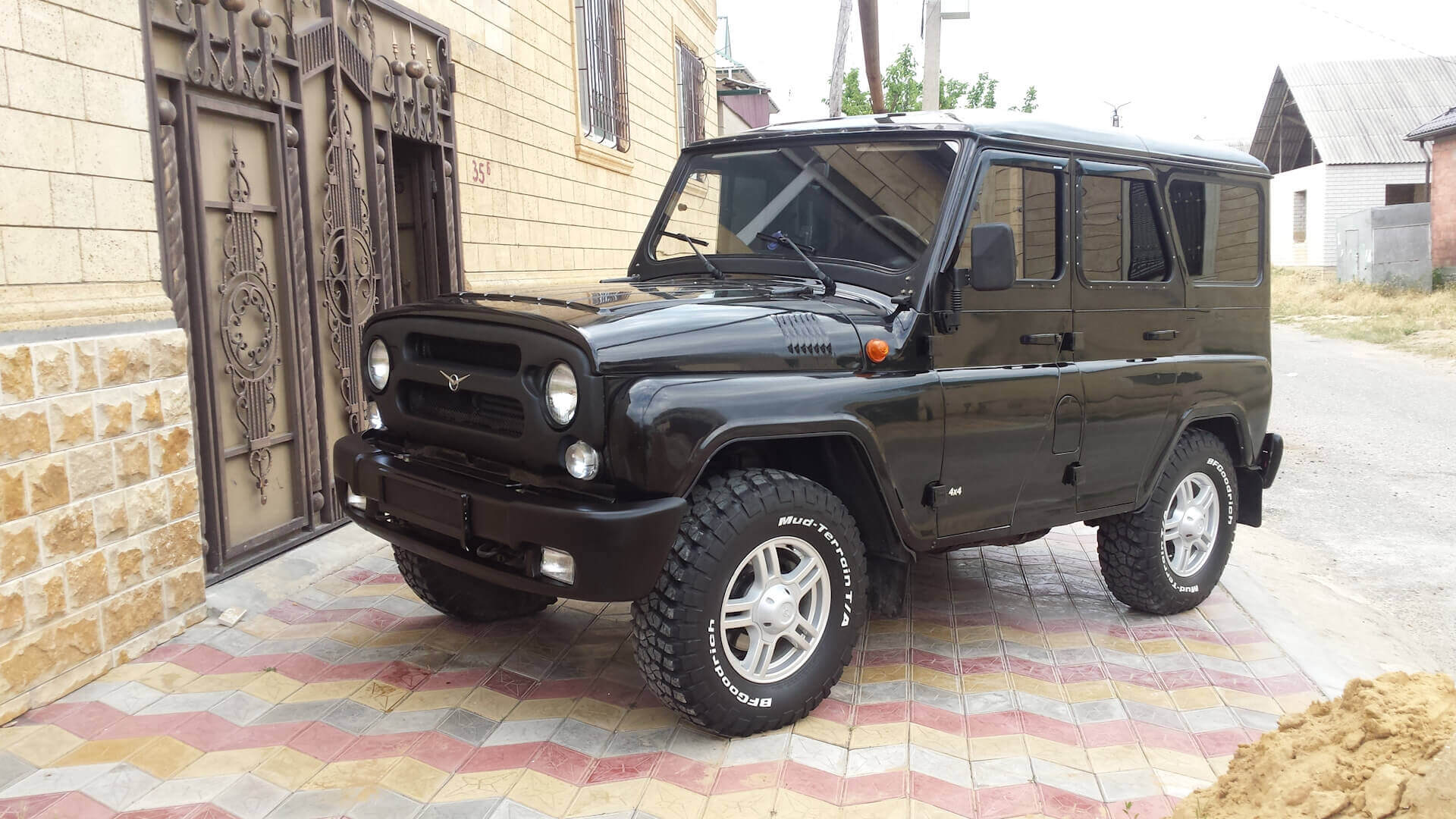
The Hunter's shape has changed very little from its predecessor. It has a boxy, upright body with round headlights flanking a simple two-bar grille, a pressed-steel front bumper with towing hooks and a vertical tailgate carrying the spare wheel. The old 1cars text notes that the narrow doors open through 90 degrees and that the large windows all round give a good view. A 2011 facelift brought back classic bumpers and removed the plastic mouldings fitted to earlier Hunters, returning to a look closer to the original UAZ-469.

Five-seat cabin
The cabin is basic but more comfortable than in older UAZ models. The front seats have adjustable backrest angle, fore-and-aft travel and lumbar support, and all seats have head restraints. The rear seats can be folded or removed to increase the load space. According to the old 1cars text, the floor is carpeted, power steering is fitted, but the steering column is not adjustable and the instruments are partly hidden behind the steering wheel. Heating performance was a common complaint.

Petrol and diesel engines, transfer case
| Engine | Type | Displacement | Power | Torque |
|---|---|---|---|---|
| ZMZ-409 | Petrol, 4-cylinder | 2,693 cc | 94 kW (128 PS) at 4,600 rpm | 210 Nm at 2,500 rpm |
| ZMZ-5143 | Diesel, 4-cylinder | – | – | – |
The 2.7-litre ZMZ-409 petrol engine runs on fuel of at least 92 octane. Wikipedia also lists a 2.7-litre version with 82 kW (112 PS) from 2010 to 2013. The petrol Hunter reaches 130 km/h and, according to the old 1cars text, uses about 13.2 litres per 100 km at 90 km/h, while the diesel uses about 10 litres at the same speed.

The gearbox is a five-speed manual of Korean origin, which the old 1cars text describes as easier to shift than the older four-speed. The two-speed transfer case drives the rear wheels permanently, with the front axle engaged rigidly when needed, so the Hunter has a part-time four-wheel-drive system rather than permanent all-wheel drive.
Chassis and off-road ability
The Hunter uses a separate ladder frame and live axles front and rear. The front axle is located by coil springs with telescopic dampers and an anti-roll bar, while the rear axle has semi-elliptic leaf springs. The brakes are discs at the front and drums at the rear, and the tyres are 225/75 R16 on 16-inch steel or alloy wheels. With 210 mm of ground clearance, a low-range transfer case and a 500 mm wading depth, the Hunter is very capable off-road, though less refined on the road.

Hunter size and weights
| Parameter | Metric | Imperial |
|---|---|---|
| Length | 4,100 mm | 161.4 in |
| Width (without mirrors) | 1,730 mm | 68.1 in |
| Height | 2,025 mm | 79.7 in |
| Wheelbase | 2,380 mm | 93.7 in |
| Track (front/rear) | 1,465 / 1,465 mm | 57.7 in |
| Ground clearance | 210 mm | 8.3 in |
| Wading depth | 500 mm | 19.7 in |
| Kerb weight | 1,845 kg | 4,068 lb |
| Gross weight | 2,520 kg | 5,556 lb |
| Payload | 675 kg | 1,488 lb |
| Fuel tank | 72 L | 19 US gal |
All dimensions are from the old 1cars text's specification table for the petrol version.

Special editions
The Hunter has been offered in many special editions:
| Year | Edition |
|---|---|
| 2010 | UAZ-469 nameplate edition |
| 2011 | Beach and Expedition |
| 2013 | Trophy |
| 2015 | Victory Series |
| 2016 | Jungle Edition |
| 2017 | 45th Anniversary |
| 2019 | Expedition |
| 2022 | 50th Anniversary (50 soft-top cars) |

UAZ announced in 2015 that the Hunter would be discontinued but resumed production the following year. Since 2021 the Czech company MW Motors has offered an electric conversion based on the same design, called the Spartan.
Crash safety
The Hunter has never been tested by Euro NCAP or any comparable programme. It has seat belts and head restraints for all seats. According to the old 1cars text, the maker chose not to invest in further crash-safety improvements to keep the price low, so buyers should see it as a utility off-roader rather than a family car.

Rivals: how the Hunter compares
The Hunter competes with other body-on-frame and rugged 4x4s such as the Jeep Wrangler, the Chevrolet Niva and its larger stablemate, the UAZ Patriot. Its strengths are excellent off-road ability, a robust frame and simple, repairable mechanicals. Its weaknesses are poor refinement, high fuel use, a basic cabin and weak crash protection.

Rivals
Compare with…
Compare UAZ Hunter with
- Jeep Wrangler quick spec comparison
- Great Wall Hover H5 quick spec comparison
- Chevrolet Niva quick spec comparison
-
In production
- Years
- 1987–present
- Body
- Convertible, SUV
- Fuel
- Petrol, Diesel, Plug-in hybrid
- Power
- 87–350 kW (118–476 PS)
4 generations
- YJ
- TJ
- JK
- JL
-
Ended 2020
- Years
- 2010–2020
- Body
- SUV
- Fuel
- Petrol, Diesel
- Power
- 100–105 kW (136–143 PS)


UAZ Hunter in our rankings
- No. 4 of 209 · Smallest SUVs and crossovers (4,025 mm)
- No. 68 of 588 · Smallest cars (4,025 mm · top 12%)
- No. 154 of 1172 · Longest-running car nameplates (23 years · top 14%)
- No. 103 of 396 · Oldest car models still on sale (23 years · top 27%)
- No. 65 of 162 · Biggest engines: SUVs and crossovers (2,693 cc · top 41%)
- No. 377 of 730 · Biggest engines: cars (2,693 cc · top 52%)
Shorter than 98% of ranked SUVs and crossovers in the 1CARS catalog (No. 4 of 209).
UAZ Hunter photos 20




UAZ Hunter videos 2

UAZ Hunter video 1

UAZ Hunter video 2
FAQ
What engine does the UAZ Hunter have?
The main engine is the 2.7-litre ZMZ-409 petrol four-cylinder with 94 kW (128 PS) and 210 Nm. A ZMZ-5143 diesel was also offered, and a 82 kW version of the 2.7 was used from 2010 to 2013.
Is the UAZ Hunter permanent four-wheel drive?
No. It drives the rear wheels, and the front axle is engaged rigidly through a two-speed transfer case when extra traction is needed. The low range makes it very capable off-road.
What is the ground clearance of the UAZ Hunter?
Ground clearance is 210 mm, and the old 1cars text gives a wading depth of 500 mm. Combined with low-range gearing and a separate frame, this makes it a capable off-roader.
Is the UAZ Hunter still made?
UAZ announced its end in 2015 but resumed production the next year, and special editions followed up to the 50th Anniversary run of 2022. An electric conversion is offered by MW Motors.
How is the Hunter related to the UAZ-469?
The Hunter is an updated civilian version of the UAZ-469 family, introduced in 2003 as an evolution of the UAZ-31514. It keeps the frame and axles but adds modern engines and a five-speed gearbox.
What gearbox does the UAZ Hunter have?
The Hunter uses a five-speed manual gearbox of Korean origin, which the old 1cars text describes as easier to shift than the older four-speed, combined with a two-speed transfer case for low-range off-road driving.
Data sources
Data checked by an editor against the sources below.
- The text of this article (1cars archive)
- Wikipedia - UAZ Hunter


