
 Volvo PV444
All generations, specs and history
Published Sources (3) Report an error
By Sarah Whitmore, Senior Automotive Writer
- Built
- 1947–1965
- Generations
- 2 · PV444 to PV544
- Top power
- 71 kW (97 PS)
Timeline
PV444 generations
Click a generation for its own page
Newest first · 2 generations since 1947
-
1958
-
1947


All generations by year: PV544 (1958–1965) · PV444 (1947–1958)
Which one is mine?
Pick the year of first registration to see which generation it is.
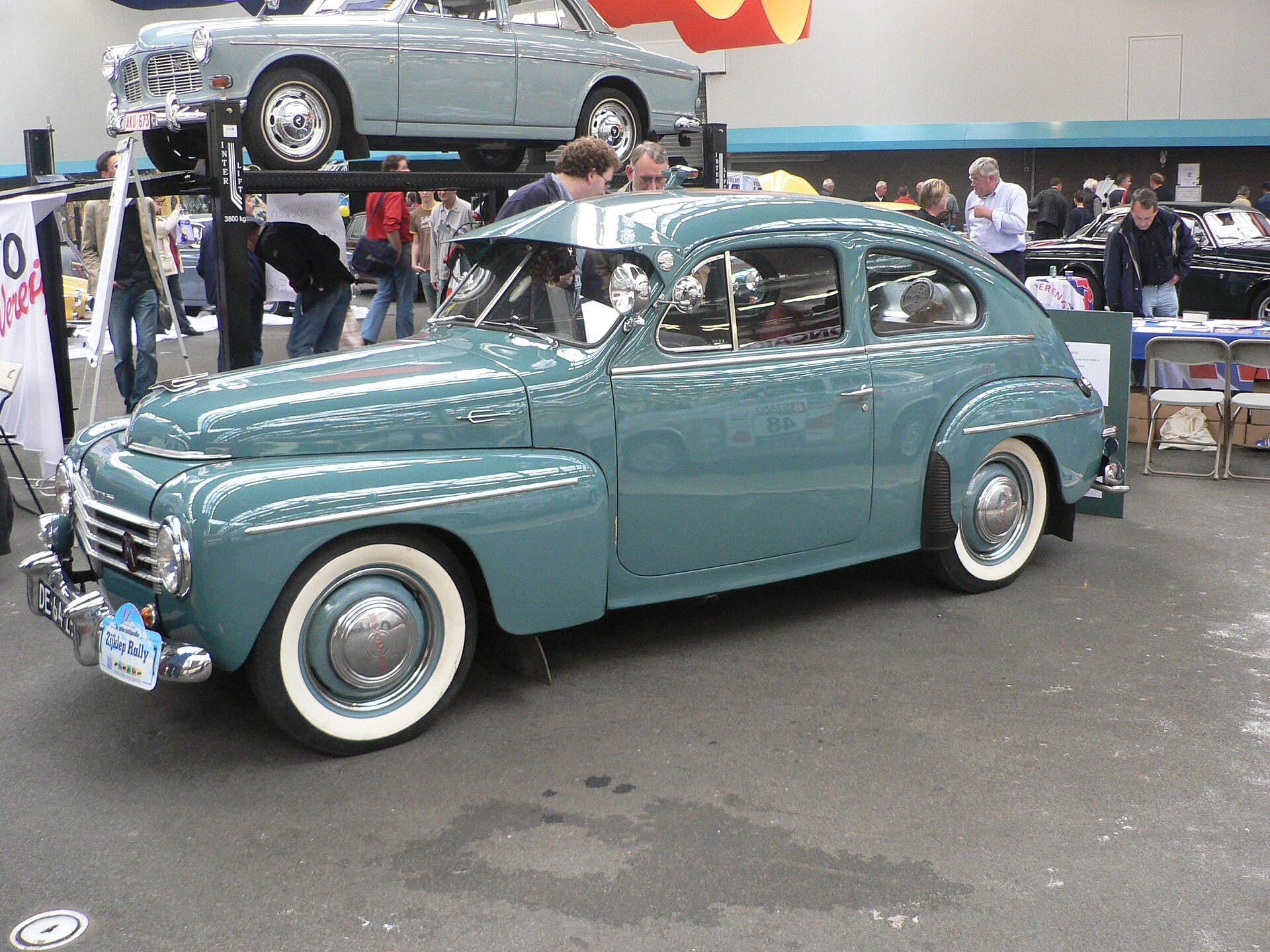
The Volvo PV444 and its successor the PV544 are the rounded two-door fastback saloons that turned Volvo into a volume car maker. Shown in Stockholm in September 1944 and built in Gothenburg from 1947 to 1965, they used four-cylinder engines from 1,414 cc and 29 kW (40 PS) to 1,778 cc and 71 kW (95 bhp). Volvo built 196,005 PV444s and 243,990 PV544s.
In short
- Unveiled in September 1944 at SEK 4,800, the price of Volvo's first car in 1927; deliveries began in 1947.
- PV444 1947-1958 with a three-speed gearbox; PV544 from August 1958 to October 1965 with a four-speed option and room for five.
- About 440,000 built in total, roughly 160,000 of them exported.
- Volvo's first car with a unitary body and a laminated windscreen; a second-hand PV544 won the 1965 Safari Rally.
Specs by version
Engines
| Version | Engine | Power | Gearbox | Drive | Production years |
|---|---|---|---|---|---|
| PV444 · 1947–1958 | |||||
| PV444 · 1.4 B4B 40 PS | 1.4 l · 4 cyl · Petrol B4B | 29 kW 39 PS39 hp | 3-sp Manual | Rear-wheel drive | 1947–1950 |
| PV444 · 1.6 B16B 85 hp | 1.6 l · 4 cyl · Petrol B16B | 63 kW 86 PS84 hp | 3-sp Manual | Rear-wheel drive | 1957–1958 |
| PV544 · 1958–1965 | |||||
| PV544 · 1.6 B16A 60 hp | 1.6 l · 4 cyl · Petrol B16A | 45 kW 61 PS60 hp | Manual | Rear-wheel drive | 1958–1961 |
| PV544 · 1.8 B18D 90 hp | 1.8 l · 4 cyl · Petrol B18D | 67 kW 91 PS90 hp | 4-sp Manual | Rear-wheel drive | 1962–1965 |
Dimensions and weight
Show all 4 versions
| Version | Wheelbase |
|---|---|
| PV444 · 1947–1958 | |
| PV444 · 1.4 B4B 40 PS | 2,600 mm102.4 in |
| PV444 · 1.6 B16B 85 hp | 2,600 mm102.4 in |
| PV544 · 1958–1965 | |
| PV544 · 1.6 B16A 60 hp | 2,600 mm102.4 in |
| PV544 · 1.8 B18D 90 hp | 2,600 mm102.4 in |
Verified Manufacturer and type-approval data from our catalog · Sources and methodology
Volvo PV444 at a glance
| Specification | Volvo PV444 and PV544 |
|---|---|
| Years | shown September 1944; built 1947 to October 1965 |
| Production | 196,005 PV444 and 243,990 PV544 (Volvo heritage data) |
| Plants | Lundby and Torslanda, Gothenburg, Sweden; Halifax, Nova Scotia, Canada (PV544 from 1963) |
| Body style | two-door fastback saloon; Duett estate and van as separate models |
| Design | project led by Helmer Petterson, engineering with Erik Jern |
| Layout | front engine, rear-wheel drive, unitary body, coil springs front and rear |
| Engines | B4B 1,414 cc; B14A 1,414 cc twin carburettor; B16 1,583 cc; B18 1,778 cc |
| Power | 29 kW (40 PS) to 71 kW (95 bhp) |
| Wheelbase | 2,600 mm (102.4 in) |
| Weight | about 953 kg (2,100 lb), 1965 PV544 (Hagerty) |
| 0-60 mph | about 14 s, 1965 PV544 B18 (Hagerty) |
| Price new | SEK 4,800 announced in 1944 |
A peace car planned in 1943
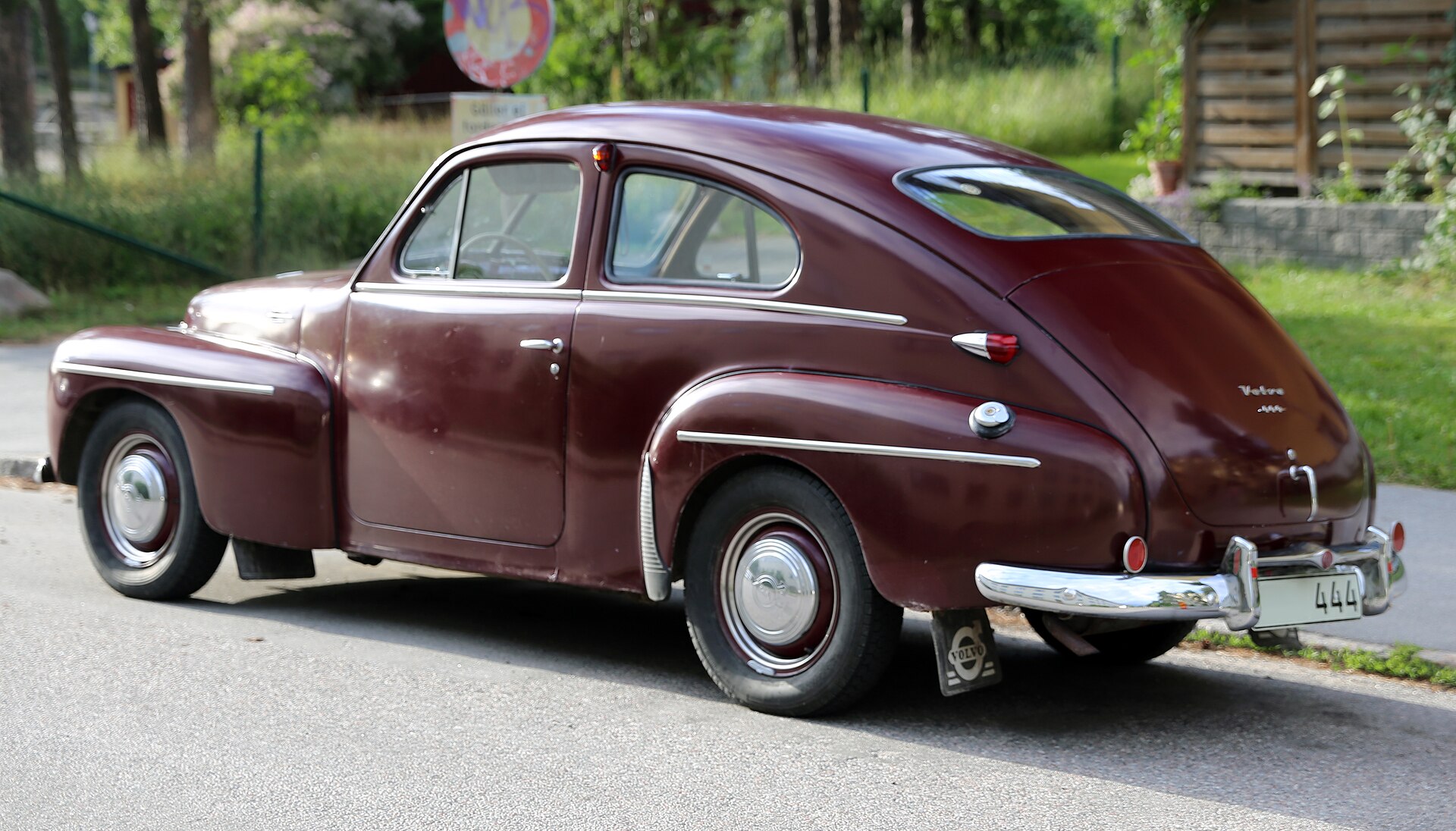
Before the PV444, Volvo had never built more than about 2,000 cars of one model series. In 1942 engineer Helmer Petterson proposed a smaller car during a trip with company founder Assar Gabrielsson, and in 1943 he became project leader. Management expected demand for small, cheaper cars once the war ended, and work began in May 1943 with Erik Jern as engineer. Volvo studied a 1939 Hanomag 1.3-litre, while the styling drew on American cars of the period.
The car was unveiled in September 1944 at the Royal Tennis Hall in Stockholm, under the patronage of Crown Prince Gustaf Adolf. The exhibition drew 148,357 visitors, a PV444 was raffled each day, and buyers signed contracts for 2,300 cars on the spot. The price of SEK 4,800 matched that of the 1927 ÖV4, Volvo's first car. Steel shortages after the war delayed production until 1947, and by then the price had risen: World of Volvo quotes SEK 8,000, while Zwischengas gives SEK 6,050 and says early orders were honoured at the original price.
First Volvo with a unitary body
The PV444 broke with Volvo's separate-chassis tradition: the body and floor formed one load-bearing steel structure. It had coil springs at both ends, hydraulic drum brakes on all four wheels and a laminated windscreen, which Volvo itself presents as an important safety innovation for the time. The three-speed gearbox was operated by a floor-mounted lever. From 1949 Volvo dipped the bodies in a phosphate bath, called Roto-Dip, to improve rust protection.
The company had planned to build 8,000 cars. Output reached 2,988 in 1948, more than Volvo had ever made in a year, and in 1949 passenger cars overtook trucks and buses in the company's annual production. In 1950 the PV444 topped the Swedish new-car registrations.

Volvo PV444 engines from B4B to B16
| Engine | Years | Displacement | Power | Notes |
|---|---|---|---|---|
| B4B | 1947-1950 | 1,414 cc | 29 kW (40 PS) | single downdraft carburettor |
| B4B | Oct 1950 | 1,414 cc | 32 kW (44 PS) | uprated |
| B4B | Oct 1955 | 1,414 cc | 38 kW (51 PS) | uprated |
| B14A | 1956-1957 | 1,414 cc | 52 kW (70 hp) | twin SU carburettors, US export |
| B16A | from 1957 | 1,583 cc | 45 kW (60 bhp) | single carburettor |
| B16B | from 1957 | 1,583 cc | 63 kW (85 bhp) | twin carburettors |
| B18 | 1961-1965 | 1,778 cc | 56-71 kW (75-95 bhp) | five main bearings, PV544 only |
The first engine was a 1,414 cc overhead-valve four with three main bearings, rated at 29 kW (40 PS). Outside North America the PV444 had only one engine choice at a time. Exports to the USA started in early 1956, mostly in Texas and southern California, with the twin-carburettor B14A of 52 kW (70 hp). For 1957 the engine grew to 1,583 cc, and the twin-carburettor B16B made 63 kW (85 bhp) with a fuel consumption of about 6.7 L/100 km, according to Zwischengas.

PV544 of 1958: five seats and four gears
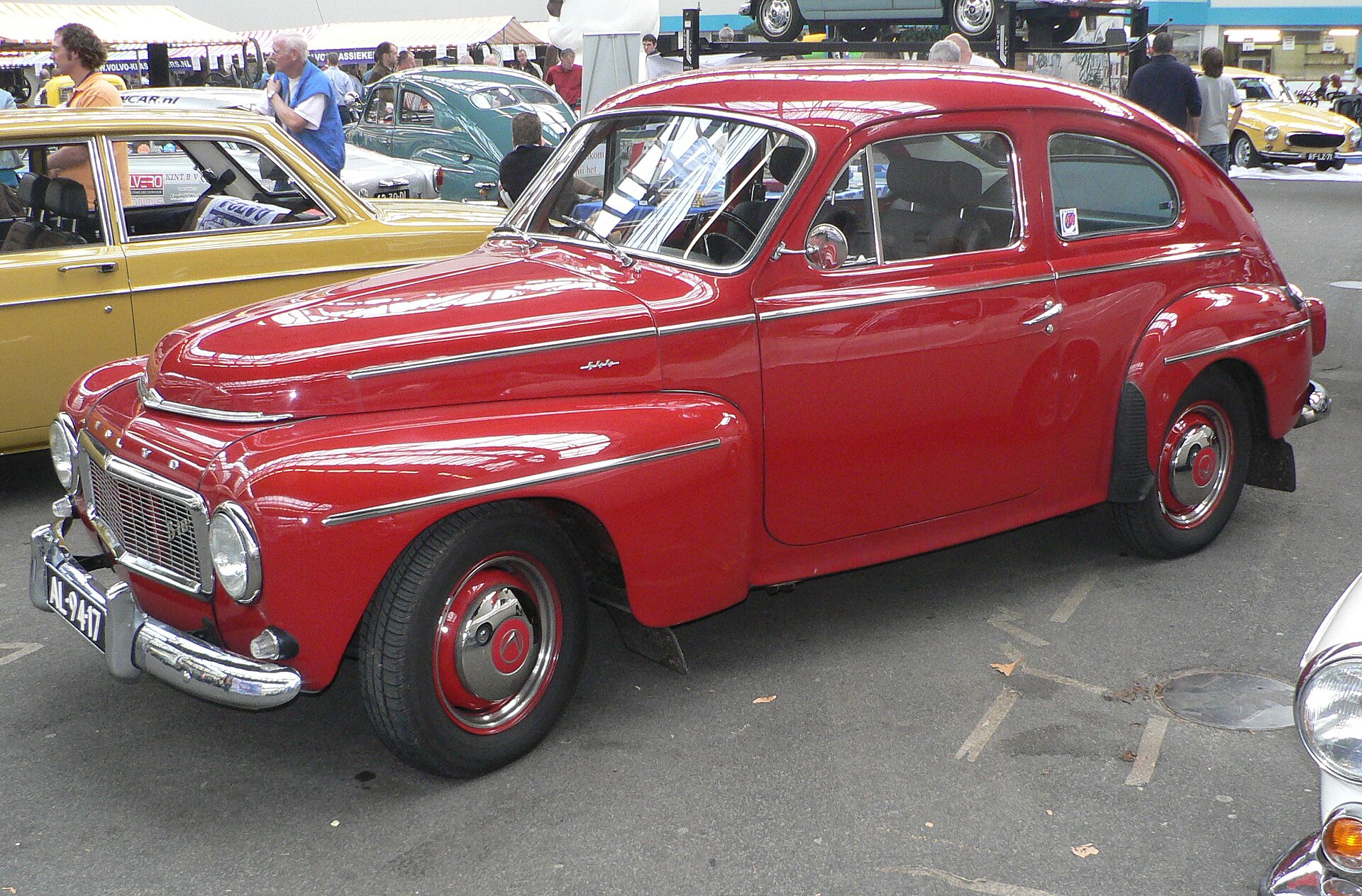
The PV544 arrived in August 1958 with the same shape and several visible changes. A one-piece curved windscreen and a larger rear window improved the view out, the dashboard got a padded top and a ribbon-type speedometer with a red strip, and a reshaped rear seat took three people, which explains the 5 in the name. A four-speed gearbox was offered for the first time, and three-point front seat belts became standard from the 1959 model year. Trim levels were Special I, Special II and Sport.
In 1961 the 1,778 cc B18 engine replaced the B16, with 56 kW (75 bhp) in single-carburettor form and 67 kW (90 bhp) with twin carburettors, later raised to 71 kW (95 bhp); Wikipedia dates the change to 1962. The same year the car moved from 6-volt to 12-volt electrics. Hagerty puts a 1965 PV544 at about 953 kg (2,100 lb), 0-60 mph in about 14 seconds and a top speed of a little over 145 km/h (90 mph).

Duett, P210 and the Halifax plant
The estate and van version, the Duett, appeared in 1953 as the PV445 and was later renamed P210. Zwischengas dates the P210 to 1960, and the Duett stayed in production until the 1969 model year, four years after the saloon. In 1963 the PV544 became the first Volvo built outside Sweden when assembly began at Halifax, Nova Scotia.
PV544 rally wins and the end of production in 1965
The PV raced with success in the American SCCA classes and won many rallies. Its best-known result came in 1965, when a second-hand PV544 won the East African Safari Rally. Production ended in October 1965, 21 years after the unveiling. Zwischengas writes that Volvo needed the factory space for the Amazon, and Volvo promised spare parts worldwide for another 12 years. The Volvo Amazon had been on sale since 1956 and took over as the company's mainstream car. Exports had earned Sweden more than SEK 1 billion. Among Swedish rivals of the era, the front-wheel-drive Saab 92 and its successors followed a different engineering route. The wider history of Volvo shows how the PV moved the company from trucks to cars.
Volvo PV444 today: what to check when buying
Start with the body, since the PV is a unitary car and the structure carries all the loads. Look at the sills, floors, wheel arches and the jacking points, and treat fresh underseal or filler with suspicion. Cars built before the Roto-Dip process of 1949 had less rust protection. Then check that the specification matches the year: a PV444 left the factory with a three-speed gearbox, the four-speed came only with the PV544, and 12-volt electrics and the five-bearing B18 belong to the later PV544. Upgraded engines and gearboxes are not a problem in themselves, but they change the value for buyers who want an original car.
Hagerty's valuation tool gave a typical price of about USD 12,300 (roughly EUR 11,800) for a 1965 PV544 in good condition in January 2025. Its three-year auction record for that year ran from USD 7,875 to USD 28,350. Volvo's 12-year parts guarantee ended in the late 1970s, so supply now depends on specialists and owners' clubs. The Volvo catalogue covers the PV's predecessors and every later Volvo car.
Photo gallery

Volvo PV444: first vs latest generation
| Spec | PV444 | PV544 | Change |
|---|---|---|---|
| Years | 1947–1958 | 1958–1965 | 11 years apart |
| Most powerful version | 63 kW (86 PS) | 71 kW (97 PS) | +8 kW (+13%) |
| Wheelbase | 2,600 mm | 2,600 mm | same |
Oldest and newest generation in the 1cars catalog. Power is the strongest version of each; other rows are shown only when both generations have the figure.
Volvo PV444 in our rankings
- No. 47 of 536 · Lightest cars (953 kg · top 9%)
- No. 16 of 91 · Lightest sedans (953 kg · top 18%)
- No. 233 of 1279 · Longest-running car nameplates (18 years · top 21%)
- No. 57 of 89 · Power-to-weight: sedans (70 kW/t · top 65%)
- No. 145 of 194 · Biggest engines: sedans (1,778 cc · top 75%)
- No. 615 of 798 · Biggest engines: cars (1,778 cc · top 78%)
Lighter than 91% of ranked cars in the 1CARS catalog (No. 47 of 536).
FAQ
How many Volvo PV444 and PV544 cars were built?
Volvo built 196,005 PV444s and 243,990 PV544s, about 440,000 in total between 1947 and 1965. Roughly 160,000 were exported, and the related Duett estate is counted separately.
What is the difference between the Volvo PV444 and PV544?
The PV544 of August 1958 has a one-piece windscreen, a larger rear window, a padded dashboard, a rear seat for three and an optional four-speed gearbox. The PV444 has a smaller divided windscreen and a three-speed gearbox.
What engine does the Volvo PV544 have?
The PV544 started with the 1,583 cc B16 in 45 kW (60 bhp) and 63 kW (85 bhp) forms. From 1961-1962 it used the 1,778 cc B18 with up to 71 kW (95 bhp).
When did Volvo stop making the PV544?
Production ended in October 1965. Some cars sold in 1966 were titled as 1966 models, but none was built that year. The Duett estate continued until the 1969 model year.
Data sources
Data checked by an editor against the sources below.
- Wikipedia
- Volvocars
- Hagerty - 1965 Volvo Pv544


