
 Volvo 740
Specs, engines and history
Published Sources (4) Report an error
By Sarah Whitmore, Senior Automotive Writer
- Built
- 1984–1992
- Top power
- 136 kW (185 PS)
Safety, space and the ADAC verdict
Our verdict · Sarah Whitmore
Volvo sold the 740 on safety and space. Electronic traction control arrived in the 700 series in 1985, and ABS was available, although it was standard on many 760s and not on the 740. In 1987 the German motoring club ADAC tested a 740 GL with a catalytic converter and 83 kW (113 PS): it reached 100 km/h in 12.0 seconds, used 8.9 l/100 km and carried 480 litres in the saloon's boot. Motor1 describes the estate as the benchmark of its class from 1985, and it competed for the same buyers as the W124 estate described in our Mercedes-Benz E-Class history.
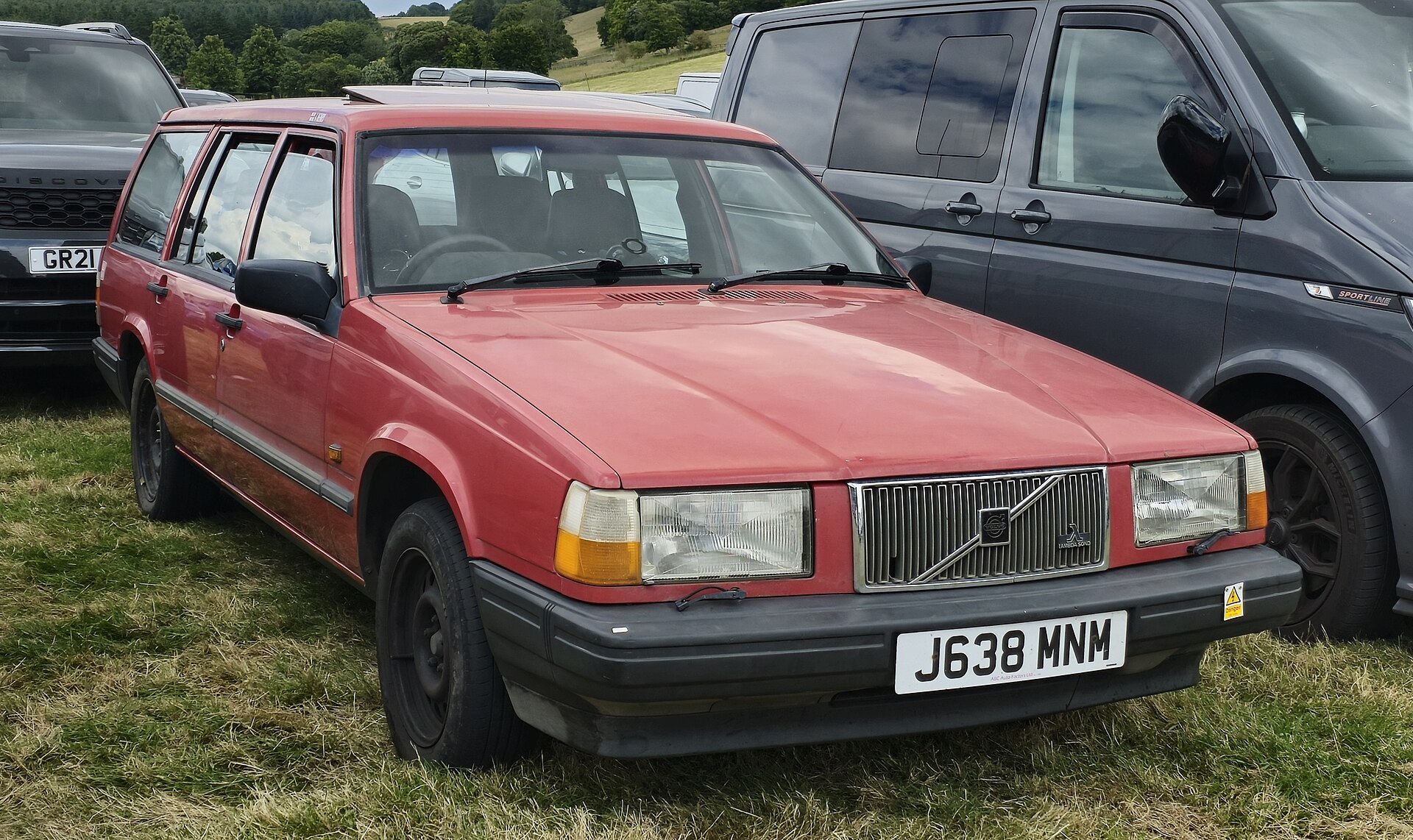
The Volvo 740 is the four-cylinder version of Volvo's 700 series, built from early 1984 to 2 October 1992 as a four-door saloon and, from 1985, a five-door estate. It used 2.0 and 2.3-litre petrol engines with or without a turbo plus Volkswagen six-cylinder diesels, and with 1,009,395 cars built it outsold the six-cylinder 760 it was derived from.
In short
- Built 1984-1992: 650,443 saloons and 358,952 estates, according to Volvo's own heritage figures.
- Petrol fours from 1,986 to 2,316 cc and a 2,383 cc six-cylinder diesel; outputs from 60 kW (82 PS) to 136 kW (182 bhp) for the UK-rated intercooled Turbo.
- Styled under Jan Wilsgaard as a cheaper sister of the 1982 Volvo 760.
- Overlapped with its successor, the 940, from August 1990 until the last 740 left the line in 1992.
Specs by version
Engines
| Version | Engine | Power | Drive | Production years |
|---|---|---|---|---|
| Diesel · 2 versions | ||||
| 2.4 D24 diesel | 2.4 l · 6 cyl · Diesel D24 | 60 kW 82 PS80 hp | Rear-wheel drive | - |
| 2.4 D24T turbodiesel | 2.4 l · 6 cyl · Diesel D24T | 80 kW 109 PS107 hp | Rear-wheel drive | - |
| Petrol · 5 versions | ||||
| 2.0 B200K (carburettor) | 2.0 l · 4 cyl · Petrol B200K | 61 kW 83 PS82 hp | Rear-wheel drive | - |
| 2.0 B200E | 2.0 l · 4 cyl · Petrol B200E | 85 kW 116 PS114 hp | Rear-wheel drive | - |
| 740 GLE 2.3 B23E | 2.3 l · 4 cyl · Petrol B23E | 98 kW 133 PS131 hp | Rear-wheel drive | 1984 |
| 740 GLT 2.3 16V B234F | 2.3 l · 4 cyl · Petrol B234F | 114 kW 155 PS153 hp | Rear-wheel drive | 1989–1990 |
| 740 Turbo 2.3 B230FT intercooler | 2.3 l · 4 cyl · Petrol B230FT | 136 kW 185 PS182 hp | Rear-wheel drive | 1985–1992 |
Performance
Show all 2 versions
| Version | Top speed |
|---|---|
| 2.0 B200K (carburettor) | 159 km/h99 mph |
| 740 Turbo 2.3 B230FT intercooler | 200 km/h124 mph |
Dimensions and weight
Verified Manufacturer and type-approval data from our catalog · Sources and methodology
Volvo 740 at a glance
| Item | Volvo 740 |
|---|---|
| Years | 1984-1992 (estate from 1985) |
| Production | 1,009,395 (650,443 saloons, 358,952 estates) |
| Plants (700 series) | Kalmar (Sweden) and Ghent (Belgium); kit assembly in Halifax (Canada) and Clayton (Australia) |
| Body styles | 4-door saloon (744), 5-door estate (745) |
| Designer | Volvo design team under Jan Wilsgaard |
| Layout | front longitudinal engine, rear-wheel drive, live rear axle |
| Engines | 2.0 and 2.3 petrol four, 8 or 16 valves, with or without turbo; 2.4 six-cylinder diesel and turbodiesel |
| Power | 60 kW (82 PS) to 136 kW (182 bhp) |
| Weight | 1,315-1,404 kg saloon, 1,371-1,458 kg estate |
| Top speed | about 200 km/h (124 mph) for the 740 Turbo |
| 0-100 km/h | 12.0 s for a 1987 740 GL with 83 kW (113 PS), ADAC test |
| Length / wheelbase | 4,785 mm / 2,770 mm (Volvo heritage data) |
The 740 sits in the long line of rear-drive Volvos described in our Volvo catalogue and in the company story on the history of Volvo.
Why Volvo built a four-cylinder 700
The 700 series began at the top. Volvo launched the 760 GLE on 2 February 1982 at nine European venues at once, with the PRV V6 and a Volkswagen turbodiesel. Jan Wilsgaard, head of Volvo's design and styling team, had proposed more than 50 designs for the car, and the result was a slab-sided, upright saloon with a large glass area.
The 760 was expensive, and the 240 it was meant to sit above stayed in production. Volvo filled the gap in 1984 with the 740 GLE: the same body and platform, a fuel-injected 2.3-litre B23E four-cylinder rated at 98 kW (131 bhp), and a price roughly midway between the 240 and the 760, as the Volvo Owners Club records. A cheaper GL with a carburettor engine followed. The 740 kept the 760's original live rear axle, which Volvo called Constant Track, while the 760 saloon moved to multi-link independent rear suspension in 1988.
Estate, Turbo and 16-valve: the 740 range by year
The estate arrived for 1985 and quickly became the core of the range. Over 40 percent of 740 sales in 1989 were estates, and in Germany the 745 was Volvo's best-selling model from 1985, according to Classic Trader's model history.
The fastest 740 was the Turbo. From 1985 the 2.3-litre B230FT gained an intercooler and was quoted at 136 kW (182 bhp) in the UK; catalysed versions sold elsewhere were rated at 118 kW (160 PS), rising to 119 kW (162 PS) for 1990-1992. Car & Classic lists 0-60 mph in 7.7 seconds and a top speed of 124 mph (200 km/h) for the intercooled car. For Italy Volvo built a 2.0 B200ET intercooled turbo with 118 kW (160 PS); Quattroruote timed it at 196.85 km/h.
Volvo's first multi-valve engine, the 2.3-litre B234F with two camshafts and two balance shafts, appeared in the 740 GLT at the 1988 Geneva show. Diesel buyers had the Volkswagen-built 2.4-litre six: 60 kW (82 PS) without a turbo and 80 kW (109 PS) with one.
| Engine | Displacement | Power | Notes |
|---|---|---|---|
| B200K, carburettor | 1,986 cc | 61 kW (82 bhp) | entry engine, top speed 99 mph (159 km/h) |
| B200E, injection | 1,986 cc | 85 kW (115 PS) | 2.0 with fuel injection |
| B23E, injection (GLE) | 2,316 cc | 98 kW (131 bhp) | 740 GLE launch engine, 1984 |
| B230F, injection, catalyst | 2,316 cc | 85 kW (114 hp) | catalyst versions |
| B234F, 16 valves (GLT) | 2,316 cc | 114 kW (153 hp) | 740 GLE/GLT, 1989-1990 |
| B230FT Turbo intercooler | 2,316 cc | 118 kW (160 PS) to 136 kW (182 bhp) | 740 Turbo, rating varies by market |
| D24, diesel | 2,383 cc | 60 kW (82 PS) | Volkswagen six-cylinder |
| D24T, turbodiesel | 2,383 cc | 80 kW (109 PS) | no intercooler in the 740 |
Gearboxes were a four-speed manual, a four-speed with electric overdrive, a five-speed manual and a four-speed automatic, and every 740 had disc brakes on all four wheels.

1989 facelift and the slow handover to the 940
Volvo gave the 740 a minor exterior facelift in autumn 1988 for the 1989 model year, with a new front end, and the Volvo Owners Club notes that the revised B230FT cut turbo lag by about 40 percent. For 1990 the car gained smaller composite headlamps and tail lights in the style of the 780 coupé, stronger 13 mm connecting rods on the B200 and B230, a Mitsubishi TD04 turbocharger and LH-Jetronic 2.4 injection. The 1991 cars received a new dashboard similar to the 760's, and the 1992 models swapped the mechanical cooling fan for an electric one.
The successor did not arrive in one step. The 940, in effect a 700 with a redesigned rear end, entered production in August 1990, and the two cars were built side by side for two years. The last 740 came off the line on 2 October 1992; the 760 had already ended on 27 June 1990. The six-cylinder line continued in the 960, which was renamed in 1996 and is covered in our history of the Volvo S90.


Volvo 740 today: what to check when buying
Rust is what ends most 740s. Car & Classic names the sills, wheel arches and underside as the areas to inspect first. The red-block engines are long-lived when serviced, so a folder of invoices with regular oil and timing belt changes is worth more than a low odometer reading, and a Turbo should be checked for smoke and turbo bearing noise.
Electrics are the second theme. Pre-facelift wiring harnesses are prone to cracking insulation, so test every light, window and gauge. Carburettor cars with the Pierburg 2B units (B230K and B230KH) are harder to keep running because carburettor parts are scarce, so fuel-injected cars are the safer buy. The Volvo Owners Club in the UK keeps model histories and production tables for the 700 series and is a good first contact for parts and advice.
Most cars still sell for modest money, while exceptional Turbos have reached a different level:
- Auction median about EUR 5,200 (USD 6,000) for 740s sold in the 12 months to May 2026, oldcarsdata.com, based on a small sample.
- A near-new 740 Turbo with 58,750 km was estimated at SEK 290,000-320,000 (about EUR 26,000-29,000) by Bilweb Auctions in September 2026; the same car had set a model record of SEK 280,000 in 2020.
Most 740s change hands well below that top figure, and condition and service history matter more than trim. More European saloons and estates of the 1980s are collected in our classic cars section.
Volvo 740 in our rankings
- No. 9 of 25 · Biggest engines: station wagons (2,383 cc)
- No. 9 of 24 · Longest station wagons (4,785 mm)
- No. 155 of 570 · Longest cars (4,785 mm · top 28%)
- No. 55 of 123 · Longest sedans (4,785 mm · top 45%)
- No. 41 of 91 · Fastest sedans (200 km/h · top 46%)
- No. 41 of 90 · Most powerful cars of the 1980s (136 kW · top 46%)
Longer than 72% of ranked cars in the 1CARS catalog (No. 155 of 570).
FAQ
How many Volvo 740s were built?
Volvo built 1,009,395 cars: 650,443 saloons and 358,952 estates between 1984 and 1992. Together with the 760 and 780 coupé, the 700 series passed 1.2 million cars, which made the 740 by far the most common member of the family.
What is the difference between the Volvo 740 and 760?
The 740 is the four-cylinder version introduced in 1984, while the 760 of 1982 used a V6, a turbocharged four or a turbodiesel, and had more equipment. From 1988 the 760 saloon also had multi-link independent rear suspension, while the 740 kept its live rear axle.
Which Volvo replaced the 740?
The Volvo 940 replaced it. Production of the 940 started in August 1990, and both cars were built side by side until the last 740 was made on 2 October 1992. The 960 took over from the six-cylinder 760.
How fast is a Volvo 740 Turbo?
The intercooled 740 Turbo reaches about 200 km/h (124 mph). Car & Classic quotes 0-60 mph in 7.7 seconds for the UK version rated at 136 kW (182 bhp); catalysed cars for other markets were rated at 118-119 kW (160-162 PS).
Data sources
Data checked by an editor against the sources below.
- Wikipedia - Volvo 700 Series
- Volvocars
- Carandclassic - Volvo 740 Models And Specs
- Org - Prof 700.shtml


