 Volvo 440/460
Specs, engines and history
Published Report an error
By Felix Hartmann, Automotive Technology & EV Contributor
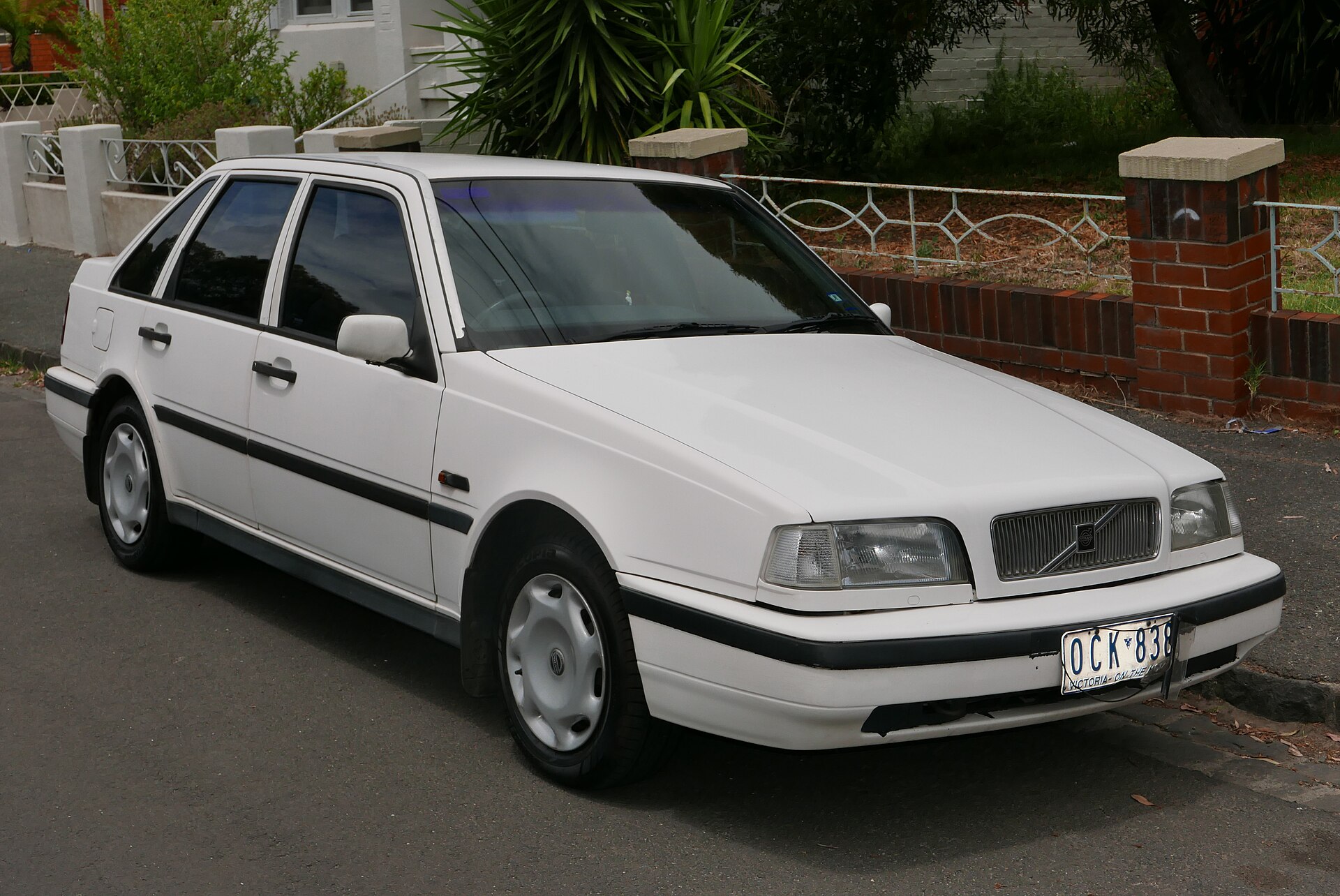
The Volvo 440 and 460 were Volvo's compact front-wheel-drive family cars from 1988 to 1996: the 440 a five-door hatchback, the 460 a four-door saloon that followed in 1989. Both were built at the NedCar plant in Born, the Netherlands, and replaced the 340/360. They shared their platform and Renault engines with the 480 coupé. The S40 and V40 took over in 1996.
In short
- Production June 1988 – September 1996 at Born (Netherlands); Wikipedia DE gives 460,822 cars.
- Renault-sourced petrol engines from 1.6 to 2.0 litres, 57–88 kW (78–120 PS), plus a 1.9 turbodiesel of 66 kW (90 PS).
- Front-wheel drive only; five-speed manual, four-speed automatic or a CVT in late cars.
- Facelift for the 1994 model year with an 850-style nose; Side Impact Protection System standard from 1993.
Volvo 440/460 at a glance: body styles and where it was built
| Item | Volvo 440 / 460 |
|---|---|
| Production | June 1988 – September 1996 |
| Plant | NedCar, Born, Netherlands |
| Body styles | 440: five-door hatchback; 460: four-door saloon (from 1989) |
| Layout | front engine, front-wheel drive |
| Engines | Renault 1.6, 1.7, 1.7 turbo, 1.8, 2.0 petrol; 1.9 turbodiesel |
| Power range | 57–88 kW (78–120 PS) |
| Gearboxes | five-speed manual; four-speed ZF automatic; CVT (HTA) in late cars |
| Sister model | Volvo 480 coupé |
| Predecessor / successor | Volvo 340/360 / Volvo S40 and V40 (1996) |
The 440 and 460 are listed in our Volvo catalogue. Their engines came from Renault, whose history is told in our history of Renault.
History: from the Galaxy project to the S40
Volvo began the "Galaxy Project" in 1978. Its G1 line produced the 480 coupé (G13), the 460 (G14) and the 440 (G15), while the G2 line became the Volvo 850. A G4 test mule designed by Jan Wilsgaard was finished in September 1980. In 1982 the project went to Volvo Car B.V., the successor of DAF's car business in the Netherlands, and part of the engineering was subcontracted to two English companies. Peter van Kuilenburg is credited with the exterior design and Peter Horbury with the interiors.
The 440 went into production in June 1988, and the 460 saloon followed in 1989. The 440, 460 and 480 shared the floorpan, suspension, Renault engines, transmissions and brakes. Volvo never offered an estate; ASC and Heuliez showed proposals, and Toncar sold a bolt-on conversion. For the 1994 model year, from autumn 1993, both cars got a new bonnet and nose, a new grille, new rear lamps and body-coloured bumpers that brought them closer to the 850. Production ended in September 1996, and the S40 and V40, which shared their platform with the Mitsubishi Carisma, took over in late summer 1996.

Engines, transmissions and performance
| Engine | Years | Power | Torque | Notes |
|---|---|---|---|---|
| 1.6 injection | 1993–1996 | 61 kW (83 PS) | 125 Nm | catalyst |
| 1.7 carburettor | 1988–1990 | 57–59 kW (78–80 PS) | 127–128 Nm | with / without catalyst |
| 1.7 carburettor | 1988–1990 | 64–66 kW (87–90 PS) | 130–131 Nm | with / without catalyst |
| 1.7 injection | 1988–1996 | 75–78 kW (102–106 PS) | 142–145 Nm | 185 km/h (Wikipedia EN) |
| 1.7 turbo | – | 88 kW (120 PS) | 175 Nm | 200 km/h (Wikipedia EN) |
| 1.8 injection | 1990–1996 | 66 kW (90 PS) | 140 Nm | best-selling version |
| 2.0 injection | 1993–1996 | 75–81 kW (102–110 PS) | 160–165 Nm | – |
| 1.9 turbodiesel | 1993–1996 | 66 kW (90 PS) | 180 Nm | Renault, swirl-chamber |
Power and torque come from Wikipedia DE; Wikipedia EN gives slightly different early figures for the carburettor 1.7. All engines drove the front wheels. The four-speed ZF automatic was the usual automatic; the late cars could have the Transmatic CVT with steel belts, sold as HTA ("High Tech Auto"), which Wikipedia EN describes as short-lived and slow-selling. The same Transmatic unit was later used in the Rover Metro.

Dimensions and body sizes
| Parameter | Metric | Imperial |
|---|---|---|
| Length 440 (1994–1996) | 4,345 mm | 171.1 in |
| Length 460 (to 1994) | 4,405 mm | 173.4 in |
| Length 460 (1994–1996) | 4,435 mm | 174.6 in |
| Top speed 1.7 injection | 185 km/h | 115 mph |
| Top speed 1.7 turbo | 200 km/h | 124 mph |
Our sources do not give width, height, kerb weight or boot volume, so these are left out. The 460 is the longer car because of its separate boot.

Trims and equipment
Early British cars came as L, GL, GLE, GLEi, GLT and Turbo; mainland Europe had GL, GLE, GLT and Turbo, later DL. With the 1994 facelift the range became base, S, Si, SE, GLT and CD, with Li added in 1994 and GS replacing Si and GLT later. From 1995 every engine was available with every trim, and an ES pack arrived in late 1995. For £100 in 1995, British buyers could swap the standard electric sunroof for air conditioning and 15-inch alloy wheels.

Safety features
The 440/460 carried over the crumple-zone design of the 300 Series. From early 1991 driver and passenger airbags and seatbelt pretensioners were optional. A high-level brake light, bulb-failure warning, door-open lights and a seatbelt reminder were standard across the range, and the Side Impact Protection System (SIPS) became standard in 1993. British cars had daytime running lights as standard. Volvo's advertising for the cars used crash-test dummies. Our sources give no independent crash-test rating for the 440/460.
Reliability and what to check
Our sources do not document typical faults of the 440/460, so no list of common problems is given here. Two points follow from the production history: the 1.8 was the best-selling version and is the easiest to find, while the CVT automatic (HTA) was short-lived and slow-selling, so it is the rarest gearbox. As with any car of this age, a full service history and a professional inspection matter more than the badge.
Rivals and which 440/460 to buy
Wikipedia EN names the Alfa Romeo 33 as a competitor. To set the Volvo against other compact family cars of the late 1980s and 1990s, use the car comparison tool or search the car finder.
Verdict: a post-1993 car brings SIPS as standard and the facelifted look; the 1.8 injection is the common, simple choice, the 2.0 the strongest naturally aspirated engine, and the 1.7 turbo the fastest version at 200 km/h. The 460 saloon suits those who want a separate boot, the 440 those who need the hatchback.
Photo gallery


FAQ
What is the difference between the Volvo 440 and 460?
The 440 is a five-door hatchback (from 1988), the 460 a four-door saloon (from 1989). They share engines, platform and interior.
Where was the Volvo 440 built?
At the NedCar plant in Born, the Netherlands, from June 1988 to September 1996.
What engines did the Volvo 440 have?
Renault petrol engines of 1.6, 1.7, 1.8 and 2.0 litres from 57 to 81 kW, a 1.7 turbo with 88 kW (120 PS) and a 1.9 turbodiesel with 66 kW (90 PS).
Is the Volvo 440 rear-wheel drive?
No. Every 440 and 460 has front-wheel drive; no four-wheel-drive version was offered.
What replaced the Volvo 440 and 460?
The Volvo S40 saloon and V40 estate, launched in 1996.