
 Volvo 140 Series
Specs, engines and history
Published Sources (5) Report an error
By Sarah Whitmore, Senior Automotive Writer
- Built
- 1966–1974
- Top power
- 91 kW (124 PS)
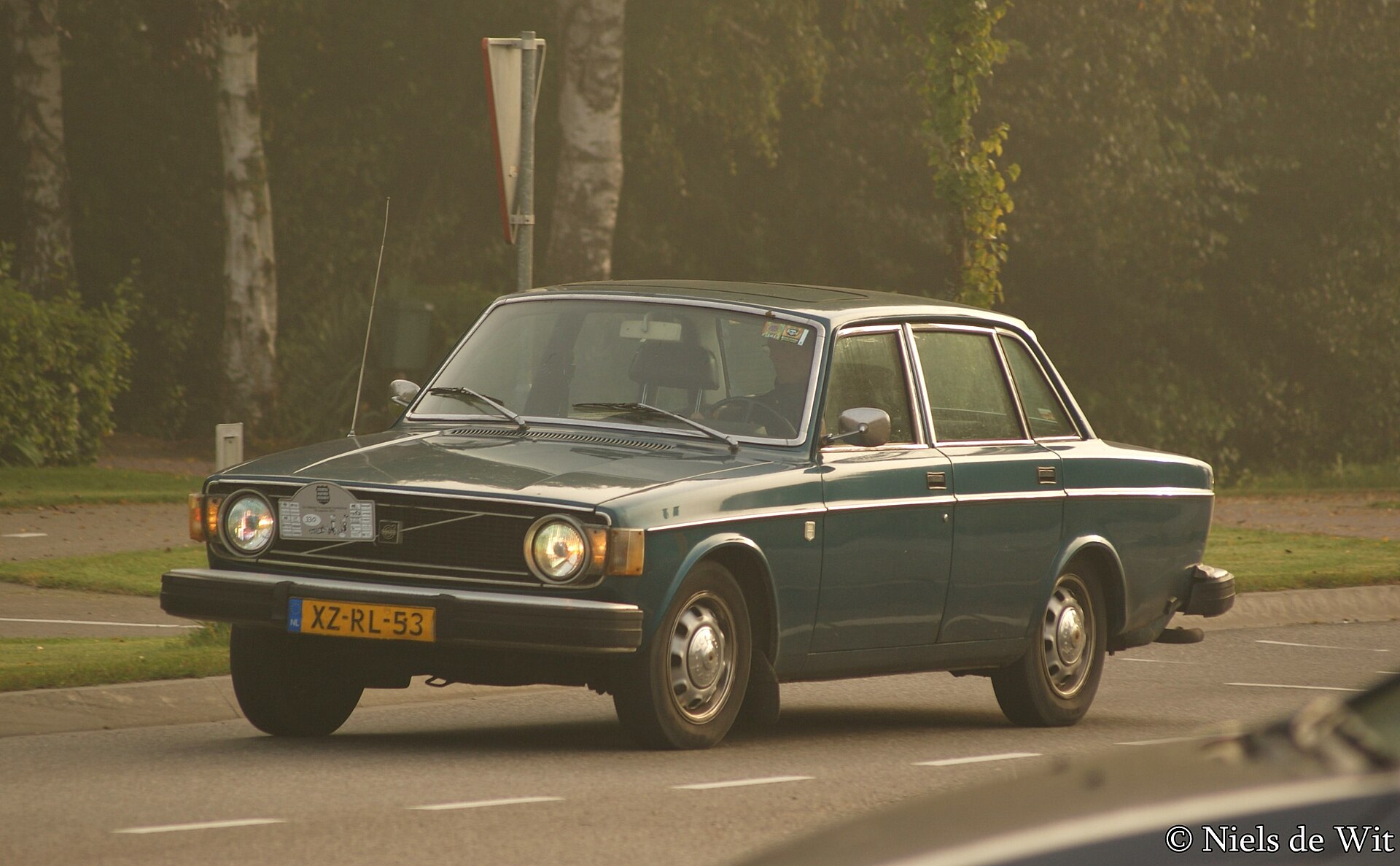
The Volvo 140 Series is the mid-size rear-wheel-drive family that Volvo built from 1966 to 1974: the 144 four-door saloon, the 142 two-door and the 145 estate. It used B18 and then B20 four-cylinder engines, had disc brakes on all four wheels from the first day, and became Volvo's first million-seller, with 1,205,111 cars built according to Volvo.
In short
- Presented to almost 400 journalists in Gothenburg on 17 August 1966; the 142 followed in early summer 1967 and the 145 estate in late November 1967.
- Volvo counts 523,808 of the 144, 412,986 of the 142 and 268,317 of the 145.
- Engines: 1.8-litre B18 and, from the 1969 model year, 2.0-litre B20, from 56 kW (75 bhp) to 91 kW (124 PS) with B20E fuel injection.
- Replaced by the 240 for the 1975 model year, which was developed from it and stayed in production until 1993.
Size at a glance
| Dimensions | Volvo 140 Series I |
|---|---|
| Length | 4,651 mm183.1 in |
| Width | 1,730 mm68.1 in |
| Height | 1,440 mm56.7 in |
| Wheelbase | 2,604 mm102.5 in |
Specs by version
Engines
| Version | Engine | Power | Gearbox | Drive | Production years |
|---|---|---|---|---|---|
| 144 1.8 B18A | 1.8 l · 4 cyl · Petrol B18A | 56 kW 76 PS75 hp | 4-sp Manual | Rear-wheel drive | 1966–1968 |
| 144 2.0 B20A | 2.0 l · 4 cyl · Petrol B20A | 60 kW 82 PS80 hp | 4-sp Manual | Rear-wheel drive | 1969–1974 |
| 145 2.0 B20A | 2.0 l · 4 cyl · Petrol B20A | 60 kW 82 PS80 hp | - | Rear-wheel drive | 1969–1974 |
| 144S 1.8 B18B | 1.8 l · 4 cyl · Petrol B18B | 72 kW 98 PS97 hp | - | Rear-wheel drive | 1966–1968 |
| 144S 2.0 B20B | 2.0 l · 4 cyl · Petrol B20B | 74 kW 101 PS99 hp | - | Rear-wheel drive | 1969–1974 |
| 144 GL 2.0 B20E | 2.0 l · 4 cyl · Petrol B20E | 91 kW 124 PS122 hp | - | Rear-wheel drive | 1971–1974 |
Performance
Show all 1 versions
| Version | Top speed |
|---|---|
| 144 2.0 B20A | 145 km/h90 mph |
Dimensions and weight
Show all 1 versions
| Version | Length | Width | Height | Wheelbase | Kerb weight |
|---|---|---|---|---|---|
| 144 2.0 B20A | 4,651 mm183.1 in | 1,730 mm68.1 in | 1,440 mm56.7 in | 2,604 mm102.5 in | 1,224 kg2,698 lb |
Verified Manufacturer and type-approval data from our catalog · Sources and methodology
Volvo 140 Series at a glance
| Item | Volvo 140 Series |
|---|---|
| Years | August 1966 to summer 1974 |
| Production | 1,205,111 (Volvo Cars); some sources give 1,251,371 |
| Plants | Torslanda (Sweden), Ghent (Belgium), Halifax (Canada); assembly also in Australia, Malaysia and South Africa |
| Body styles | 142 two-door saloon, 144 four-door saloon, 145 five-door estate, 145 Express high-roof |
| Designer | Jan Wilsgaard |
| Layout | front engine, rear-wheel drive, rigid rear axle |
| Engines | 1,778 cc B18 and 1,986 cc B20 four-cylinder, overhead valves |
| Power | 56-91 kW (75-124 PS) |
| Kerb weight | 1,170 kg (142 base) to 1,315 kg (145 de Luxe) |
| Top speed | 145 km/h (90 mph), 144 de Luxe, Autocar 1973 |
| 0-96 km/h (0-60 mph) | 13.9 s, same Autocar test |
| Price new (UK) | GBP 1,415 for a 144S in 1967; GBP 1,950 for a 144 de Luxe in 1973 |
The 140 sits in our Volvo catalogue between the Amazon it replaced and the 240 that followed it.
Project P660: why Volvo built the 144
Volvo's management signed off the basic brief in June 1960 under the project name P660. The new car had to be larger than the Volvo Amazon while staying in the same weight and price class, and several chassis versions were planned from the start. Jan Wilsgaard, who had drawn the Amazon, styled it with square lines and a six-window glasshouse.
The 144 was shown to the press in central Gothenburg on 17 August 1966, and series production began two days later. Swedish magazine Teknikens Värld named it its Car of the Year for 1966. The three-digit name followed a simple code: first digit for the series, second for the number of cylinders, third for the number of doors. The history of Volvo places the 140 at the point where the company moved from rounded post-war shapes to the square saloons it sold for the next three decades.
Safety engineering: discs all round and a three-wheel brake split
Safety carried the sales message from launch. Every 140 had hydraulic disc brakes on all four wheels, and the dual-circuit system was arranged so that each circuit served three wheels: both fronts and one rear. If one circuit failed, the driver still had braking on both front wheels. Volvo also fitted pressure-reducing valves to stop the rear wheels locking under hard braking.
The body had energy-absorbing zones front and rear and a twist-resistant body with a protective roof cage, the steering column was split to collapse in a crash, and the dashboard frame was designed for impact. Front seat belts were standard. Head restraints and inertia-reel belts followed later. For 1974 the fuel tank moved closer to the rear axle to protect it in a rear-end impact, and the bumpers grew larger.
Engines and gearboxes, 1966-1974
The launch engine was the 1.8-litre B18 from the Amazon, also used in the Volvo P1800. For the 1969 model year Volvo enlarged it to the 2.0-litre B20 and replaced the dynamo with an alternator. Bosch D-Jetronic fuel injection arrived for 1971 in the B20E, switched to K-Jetronic for 1974. The B20F, with lower 8.7:1 compression, served the US and other markets with emissions rules from 1972.
| Engine | Years | Displacement | Fuel system | Power |
|---|---|---|---|---|
| B18A | 1966-1968 | 1,778 cc | single carburettor | 56 kW (75 bhp) |
| B18B (144S) | 1966-1968 | 1,778 cc | twin carburettors | 72 kW (96 bhp) |
| B20A | 1969-1974 | 1,986 cc | single carburettor | 60 kW (82 PS) |
| B20B (S models) | 1969-1974 | 1,986 cc | twin carburettors | 74 kW (100 PS) |
| B20E (GL) | 1971-1974 | 1,986 cc | D-Jetronic, K-Jetronic for 1974 | 91 kW (124 PS) |
| B20F (US) | 1972-1974 | 1,986 cc | fuel injection, 8.7:1 compression | 81 kW (109 hp) |
Buyers could choose a four-speed manual, a four-speed manual with electric overdrive, or a three-speed Borg-Warner automatic. The Grand Luxe had overdrive as standard on manual cars from 1971, and the automatic selector moved to the floor for 1972.

142, 144, 145 and the 145 Express
The 144 saloon sold best, with 523,808 built. The two-door 142 reached 412,986. The 145 estate, at 268,317, had a near-vertical tailgate and a flat load floor of more than 2 cubic metres. In 1970 the 145 Express replaced the Duett as Volvo's load carrier: its roof rose by about 5 cm from the windscreen and by about 30 cm behind the B-pillar, and the rear hatch was made of glass-reinforced plastic. It came as a five-seat estate, a glazed two-seat van and a panel van.
The six-cylinder 164 of 1969 shared the 140's structure behind the windscreen, with a 100 mm longer wheelbase and a longer nose for the 3.0-litre B30 straight-six. Volvo kept refreshing the 140 every year:
- 1970: flow-through ventilation, electric rear-window heating, a single fixed rear side window on the 145.
- 1971: black grille with the diagonal Volvo bar, new wheels, B20E injection for the GL.
- 1972: flush door handles and a new dashboard.
- 1973: the main facelift, with a plastic grille, larger indicators, a new tail and the trims cut to L, de Luxe and Grand Luxe.
- 1974: K-Jetronic, bigger bumpers and no front quarter-lights.

Period road tests: Motor Sport and Autocar
Motor Sport tested a 144S in August 1967. At GBP 1,415 it cost exactly the same as the Rover 2000 TC, and its twin-carburettor 1,780 cc engine gave 75 kW (100 bhp), more than 161 km/h (100 mph) and a standing quarter-mile in 18.6 seconds. The tester liked the seats with adjustable lumbar support, the quiet gearbox and axle, and the fact that the engine used no oil. He criticised vague steering, a notchy gearchange, intake roar and fuel use of 13.0 l/100 km (21.8 mpg), and judged the Rover better in ride, handling and refinement while the Volvo had more room.
Autocar's 1973 test of a 144 de Luxe with the 60 kW (82 PS) B20 recorded a mean top speed of 145 km/h (90 mph), 0-60 mph in 13.9 seconds and 12.0 l/100 km (23.5 mpg) overall. The verdict was "mediocre performer, but relatively quiet and refined", with praise for the ride, rear legroom, boot and build quality, and a note that the brakes lacked bite when cold.
Volvo 140 today: what to check when buying
The Volvo Enthusiasts Club buyer's guide says the 140 was well rustproofed and undersealed, but it lists many places to inspect: front wings around the headlamps, the seam between front panel and wing, the radiator crossmember, inner wings at the bonnet hinges, the top corners of the bulkhead, both windscreen apertures behind the rubbers, door bottoms, the rear of the sills, rear arches, the shock absorber mounts inside the boot, both spare wheel wells and the bottom of the 145 tailgate.
The B18 and B20 can run past 320,000 km (200,000 miles), but camshafts, valve guides and fibre timing gears often need work around 160,000 km. A genuine Volvo oil filter with a non-return valve matters. Overdrive units share oil with the gearbox, so gear oil must never go in. Rear calipers seize on cars stored in damp garages, and ATE and Girling parts differ. Injection parts are expensive, and 142 doors and good 145 tailgates are scarce; later 240 tailgates fit.
Values stay modest. The Classic Valuer gives a median auction price of about EUR 8,300 (GBP 7,220) for the 144 based on sales from 2020 to 2026, and its highest recorded result was GBP 12,400 for a 1973 144 DL automatic in October 2024. The 142 and manual 145 estates are rarer, and twin-carburettor S models with overdrive are the most sought after. More Swedish and European classics are collected in our classic cars section.
Volvo 140 Series in our rankings
- No. 109 of 445 · Lightest cars (1,224 kg · top 25%)
- No. 30 of 84 · Lightest sedans (1,224 kg · top 36%)
- No. 252 of 587 · Longest cars (4,651 mm · top 43%)
- No. 56 of 126 · Smallest sedans (4,651 mm · top 45%)
- No. 13 of 26 · Smallest station wagons (4,651 mm · top 50%)
- No. 13 of 26 · Biggest engines: station wagons (1,986 cc · top 54%)
Lighter than 75% of ranked cars in the 1CARS catalog (No. 109 of 445).
FAQ
How many Volvo 140s were built?
Volvo Cars gives 1,205,111: 523,808 of the 144 saloon, 412,986 of the 142 two-door and 268,317 of the 145 estate. Some anniversary articles quote 1,251,371, so figures vary between sources. Either way, the 140 was Volvo's first car to pass one million.
What does 142, 144 and 145 mean?
The first digit stands for the series, the second for the number of cylinders and the third for the number of doors. A 144 is a four-cylinder car with four doors, the 142 has two doors, and the 145 estate counts its tailgate as the fifth door.
Which Volvo 140 engine is the most powerful?
The fuel-injected B20E of the 144 and 142 Grand Luxe, introduced for 1971. It produced 91 kW (124 PS DIN) from 1,986 cc, using Bosch D-Jetronic injection and, for the final 1974 model year, K-Jetronic.
What replaced the Volvo 140?
The 240 and 260 Series, presented in August 1974. They were developed from the 140, with a new front end with large bumpers, MacPherson-type front suspension and a new overhead-camshaft engine family, and stayed in production until May 1993.
Data sources
Data checked by an editor against the sources below.
- Wikipedia - Volvo 140 Series
- Volvocars
- Classicandsportscar
- 240 - Autocar 1973 June Autotest Volvo 144 de luxe
- Com - 50 Years Of The Volvo 140 Series


