 Volvo PV800 Series
Specs, engines and history
Published Sources (1) Report an error
By Felix Hartmann, Automotive Technology & EV Contributor
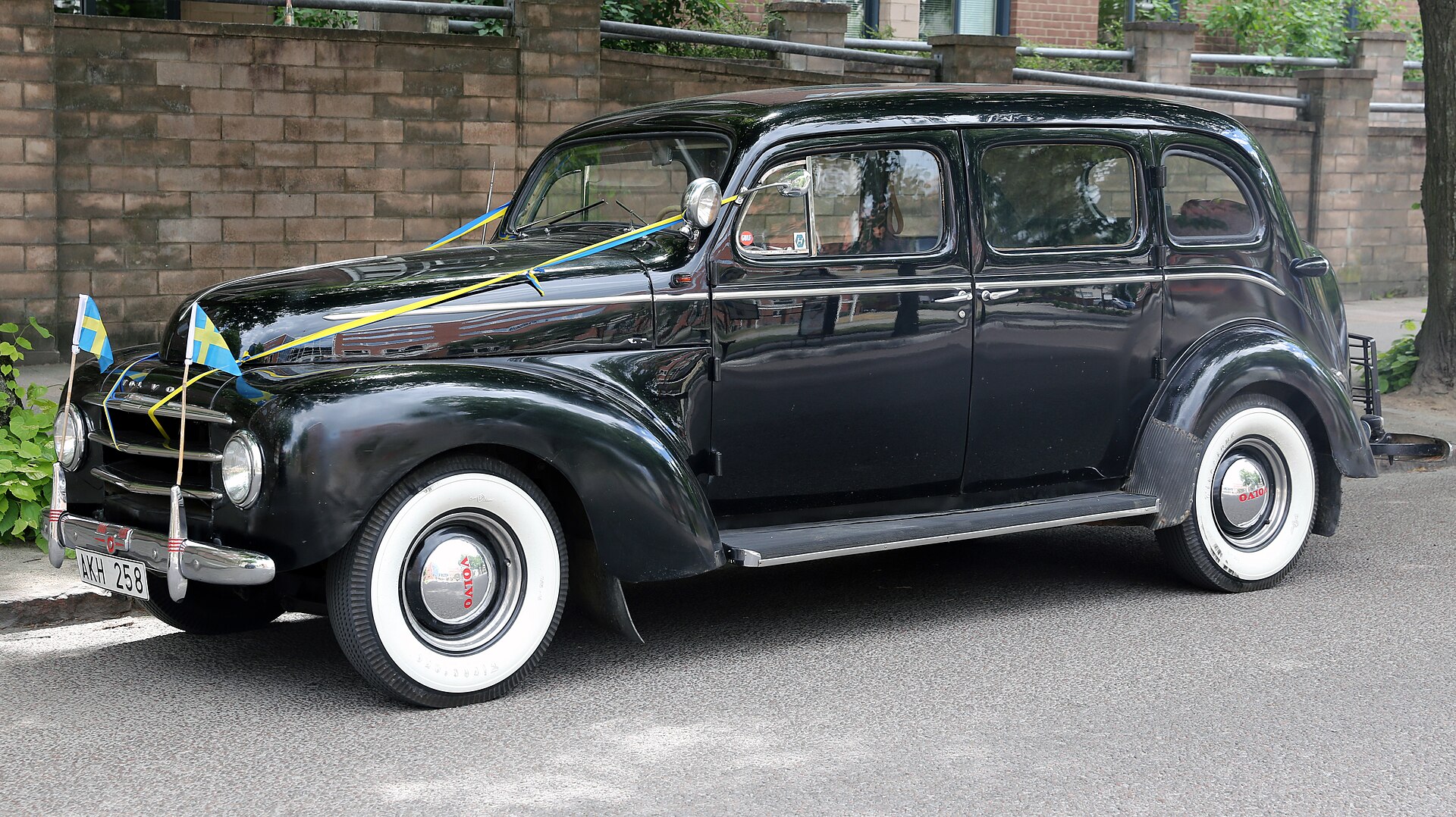
The Volvo PV800 Series is the large taxi Volvo built in Sweden from 1938 to 1958, known in Sweden by the nickname "Sugga", the sow. Designed as a purpose-built taxicab with room for eight people, it dominated the Swedish taxi market in the 1940s and 1950s. Volvo also sold it as a bare chassis for ambulances, estate cars and small vans, and built four-wheel-drive derivatives for the armed forces.
In short
- Built 1938–1958 in three main series: PV801–810 (1938–1947), PV821–824 (1947–1948) and PV831–834 (1950–1958).
- 8,864 civilian cars and chassis according to Volvo's figures, plus 930 military TPV and TP21 off-road vehicles.
- 3,670 cc side-valve straight-six with 63–67 kW (84–90 bhp), three-speed manual gearbox, hydraulic brakes on all wheels.
- Eight seats thanks to folding occasional seats; the PV801 had a glass division behind the driver.
Volvo PV800 Series at a glance
| Specification | Volvo PV800 Series |
|---|---|
| Maker | Volvo, Sweden |
| Production | 1938–1958 |
| Purpose | taxicab; chassis for ambulances, estate cars and vans; military off-road vehicles |
| Body | four-door saloon (taxi) or bare chassis |
| Layout | front engine, rear-wheel drive (TPV and TP21: four-wheel drive) |
| Engine | 3,670 cc side-valve inline six, EC and later ED |
| Gearbox | three-speed manual |
| Seats | up to eight, with folding seats |
| Wheelbase | 3,250 mm; 3,550 mm on the long PV810 and PV824 chassis |
| Predecessor / successor | Volvo TR670 Series / no direct successor (the Volvo 144 arrived about ten years later) |
The PV800 Series is listed in our Volvo catalogue. How it fits into the company's early years is told in the history of Volvo.
PV800 Series production timeline
| Year | Event |
|---|---|
| 1938 | taxis PV801 (with glass division) and PV802 (without) introduced, plus PV810 long chassis |
| 1940 | PV800 commercial chassis added |
| 1944–1946 | TPV four-wheel-drive military version for Sweden and Belgium, 210 built |
| 1947 | PV821–824 with the stronger ED engine and column gear lever |
| 1950 | PV831–834 with a lower front and headlamps set into the wings |
| 1953 | TP21 military off-road vehicle and Disponent executive car |
| 1958 | end of production |
Development and production history
Volvo replaced its TR670 taxi series in 1938 with a new design. Chassis and body were completely new, but the side-valve six-cylinder engine was carried over from older Volvo cars. The front end, with a bold V-shaped nose, was shared with the LV100 Series lorry, and the rounded contours followed American fashion of the time.
At launch there were two taxi versions, the PV801 with a glass division between the front and rear compartments and the PV802 without one. Both could carry eight people thanks to folding seats. The PV800 and the long-wheelbase PV810 were supplied as chassis for coachbuilders. Up to 1947 Volvo built 1,848 cars of this first series, among them 1,081 PV802s and 550 PV801s.
In 1947 the PV821 and PV822 taxis and the PV823 and PV824 chassis took over. They had the stronger ED engine and a column-mounted gear lever taken from the PV 60; 800 were built in 1947–1948. After a pause, the PV831 and PV832 followed in 1950 with a lower front profile and headlamps set back into the wings, similar to the PV444 and the L340 lorry. Together with the PV833 and PV834 chassis, 6,216 of the last series were made until 1958, the most of any PV800 generation. In 1953 Volvo added the Disponent, a civilian executive version.


Engine and drivetrain
All PV800s used a 3,670 cc inline six with side valves, bore 84.14 mm and stroke 110 mm. Volvo quotes 63, 64 or 67 kW (84, 86 or 90 bhp) depending on the version; the ED engine of the PV821–824 had 67 kW (90 bhp). Power went to the rear wheels through a three-speed manual gearbox, with a floor lever from 1938 to 1945 and a column lever later. Hydraulic brakes acted on all four wheels.
The military TP21 of 1953 used the same 3.67-litre six with 67 kW (90 hp) and a Volvo E9 gearbox, combined with four-wheel drive.
PV800 Series specifications
| Parameter | Metric | Imperial |
|---|---|---|
| Engine | 3,670 cc side-valve I6 | 224 cu in |
| Bore × stroke | 84.14 × 110 mm | 3.31 × 4.33 in |
| Power | 63–67 kW | 84–90 bhp |
| Gearbox | 3-speed manual | 3-speed manual |
| Wheelbase | 3,250 mm (long chassis 3,550 mm) | 128.0 in (139.8 in) |
| Seats | up to 8 | up to 8 |
| Brakes | hydraulic, all wheels | hydraulic, all wheels |
Variants and derivatives
| Variant | Years | Body / purpose | Built |
|---|---|---|---|
| PV801 | 1938–1947 | taxi with glass division | 550 |
| PV802 | 1938–1947 | taxi without division | 1,081 |
| PV800 / PV810 | 1940–1947 / 1938–1947 | chassis / long chassis | 37 / 180 |
| PV821 / PV822 | 1947–1948 | taxis | 200 / 300 |
| PV823 / PV824 | 1947–1948 | chassis / long chassis | 150 / 150 |
| PV831 / PV832 | 1950–1957 | taxis | 4,135 |
| PV833 / PV834 | 1950–1958 | chassis | 2,081 |
| TPV (m/43) | 1944–1946 | military four-wheel drive | 210 |
| TP21 (P2104) | 1953–1958 | military four-wheel drive | 720 |
The chassis versions were often the basis for proper ambulances, as well as estate cars and small vans. Even the PV802 taxi could act as a spare ambulance: with the right-hand seats folded, a stretcher could be loaded through the boot lid. The TP21 was nicknamed "Terräng-Sugga", the off-road sow, and enthusiasts now call it "Suggan".

In service and legacy
The PV800 Series was built for taxi work and gained a reputation for durability: Volvo itself describes the cars as virtually impossible to wear out, and a few were still in service in the 1980s. When production ended in 1958, Volvo had no direct replacement. A V8-engined successor, the P358 project, never went into production, and the Amazon was too small for taxi use. It took almost ten years before the Volvo 144 gave Swedish taxi operators a new Volvo saloon.
Preservation and collecting today
Because most PV800s spent their working lives as taxis, ambulances or commercial vehicles, a buyer should check which variant a car really is (the type number tells taxi, chassis or long chassis apart) and whether special coachwork is original. The military TP21 is a separate field for collectors of off-road vehicles. Other Swedish and European classics are gathered in our classic cars section.
Photo gallery


Volvo PV800 Series in our rankings
In production longer than 81% of ranked nameplates in the 1CARS catalog (No. 183 of 1082).
FAQ
When was the Volvo PV800 Series produced, and where?
From 1938 to 1958 by Volvo in Sweden.
How many Volvo PV800s were built?
Volvo's figures add up to 8,864 civilian cars and chassis: 1,848 PV801–810, 800 PV821–824 and 6,216 PV831–834. In addition, 210 TPV and 720 TP21 military vehicles were made.
What engine does the Volvo PV800 have?
A 3,670 cc side-valve straight-six with 63–67 kW (84–90 bhp), driving the rear wheels through a three-speed manual gearbox.
Why is the Volvo PV800 called "Sugga"?
"Sugga" is Swedish for sow, a nickname the large, rounded taxi earned in Sweden. The military TP21 became the "Terräng-Sugga".
What variants of the PV800 were made?
Taxis with and without a glass division, bare chassis for ambulances and vans, long-wheelbase chassis, the Disponent executive car and the four-wheel-drive TPV and TP21 for the armed forces.
Data sources
Data checked by an editor against the sources below.