 Volkswagen Scirocco
All generations, specs and history
Published Sources (2) Report an error
By Felix Hartmann, Automotive Technology & EV Contributor
- Built
- 1974–2017
- Generations
- 3 · 53 to 13
Timeline
Scirocco generations
Click a generation for its own page


- Scirocco 53 1974–1981 · Hatchback
- Scirocco 53B 1981–1992 · Hatchback
- Scirocco 13 2008–2017 · Hatchback
Newest first · 3 generations since 1974
All generations by year: Scirocco 13 (2008–2017) · Scirocco 53B (1981–1992) · Scirocco 53 (1974–1981)
Which one is mine?
Pick the year of first registration to see which generation it is.
Check by VINThe Volkswagen Scirocco is a three-door compact (C-segment) sports hatchback with 2+2 seating — the sportier alternative to the Volkswagen Golf, designed from the outset with younger buyers in mind. Three generations were built: the first appeared in 1974, the third returned in 2008 after a 16-year break, and a facelift followed for the 2015 model year.
In short
- Three generations: 1974–1981, 1981–1992 and 2008–2017, all based on Golf platforms.
- The second generation was replaced by the Volkswagen Corrado; the name returned in 2008.
- Third-generation engines range from a 1.4 TSI with 90 kW (122 PS) to a 2.0 TSI with 206 kW (280 PS) in the Scirocco R.
- A 312-litre boot, rising to 1,006 litres with the 50:50 rear seats folded.
Volkswagen Scirocco at a glance
Every Scirocco is a front-wheel-drive three-door with a transverse four-cylinder engine. More Volkswagen models are listed in our Volkswagen catalogue, and its everyday sibling is covered in our Volkswagen Golf article.
Volkswagen Scirocco generations
First generation (1974–1981)
The first Scirocco was built on the Golf's VW Group A1 platform as a three-door only. Large round headlights sat in a dark plastic grille, with rectangular fog lamps beneath the protruding bumper. Inside, a three-spoke steering wheel faced two large dials (speed and revs, the latter with fuel and temperature gauges), and two round instruments on the tunnel included a clock.
Engines were naturally aspirated four-cylinder petrol units of 1.1 to 1.6 litres with carburettors or injection, producing 37–74 kW (50–100 PS) and 80–137 Nm. Four- or five-speed manuals and a three-speed automatic drove the front wheels. Suspension used MacPherson struts at the front and coil springs with trailing arms at the rear; steering had no power assistance, and the brakes were front discs and rear drums.
Second generation (1981–1992)
The second Scirocco brought a new design with two rectangular headlights on each side. It was updated after 1984 and built until 1992, when it gave way to the Volkswagen Corrado (in production since 1987). It weighed 950–970 kg. The interior had a four-spoke wheel, a rectangular cluster with two large dials, vertical air vents and handy shelves beneath the dashboard.
Petrol four-cylinders of 1.3 to 1.8 litres, with eight or sixteen valves and carburettors or multi-point injection, produced 44–102 kW (60–139 PS) and 100–168 Nm. The car is remembered for attractive styling, a strong, reliable structure, good build quality, cheap parts, excellent handling and decent performance — but also a cramped cabin, poor sound insulation, low ground clearance and high fuel consumption.
Third generation (2008–2017)
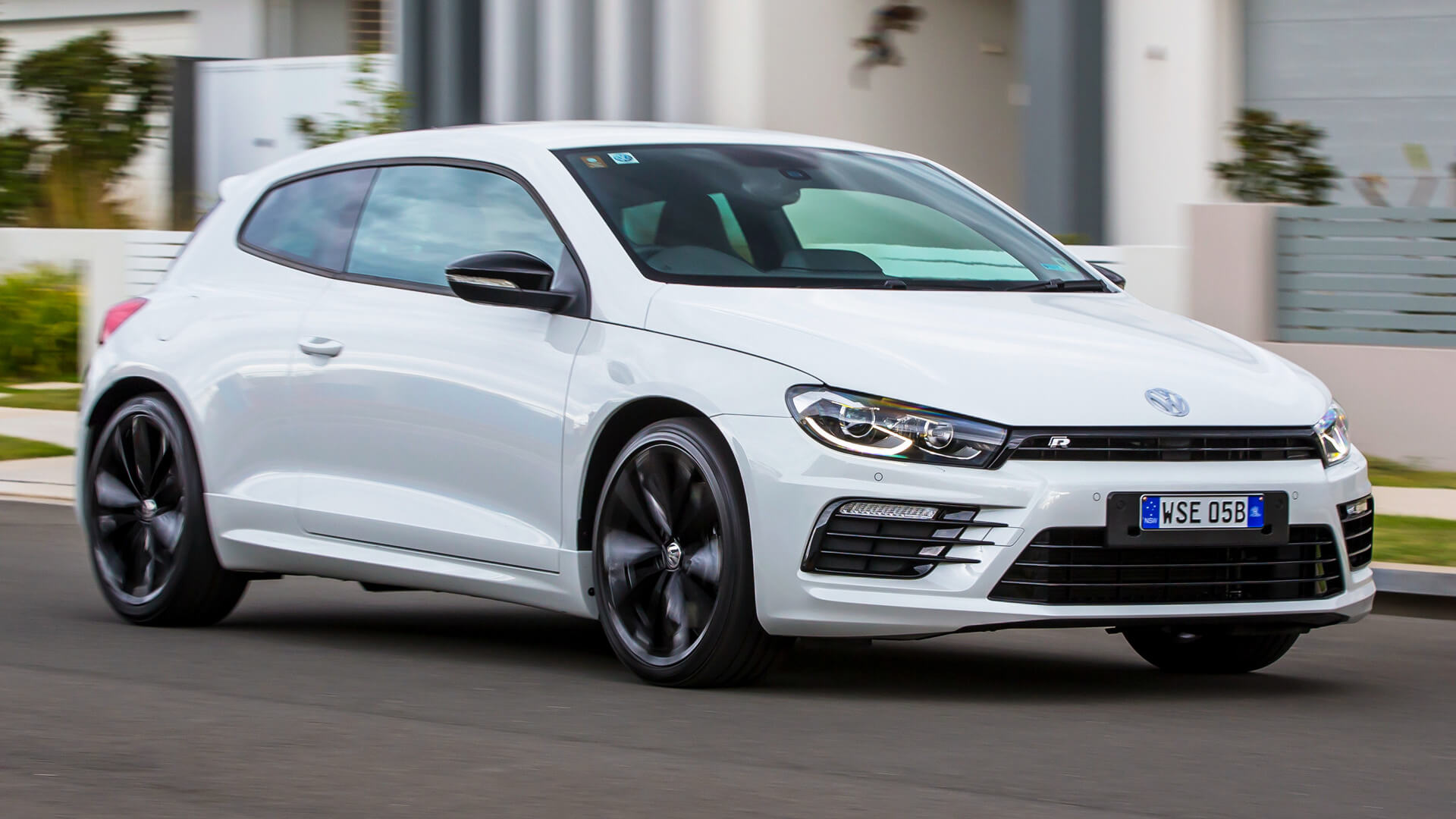
The image-building three-door coupé returned in 2008. Six years without significant updates hurt demand, so a facelifted 2015 model-year version was shown in 2014 with sportier styling, a modernised interior, new equipment and more powerful, more economical engines.
The facelift brought new headlights — bi-xenon with LED daytime running light contours on better-equipped cars, halogen on base versions — new bumpers with aerodynamic elements, a narrow grille and a lower trapezoidal intake covered in coarse mesh, and new alloy wheels of 17 to 19 inches (on the Scirocco R). Ground clearance is 129 mm, or 121 mm on the sports version. At the rear there are new LED tail lights, LED number-plate lighting, a reshaped tailgate and a bumper with a diffuser.
The cabin seats four. The driving position is excellent, with a new three-spoke multifunction wheel flattened at the bottom, two dials with a colour trip computer display and heated front seats with Easy Entry. Three extra gauges above the centre console show boost pressure, oil temperature and a stopwatch. Materials and build quality are high. The GTS adds a sports wheel with red stitching, stainless-steel pedals, red contrast details and a golf-ball gear knob. The boot holds 312 litres, or 1,006 litres with the split rear seats folded.
Engines and transmissions (third generation)
| Engine | Power (kW / PS) | Torque | 0–100 km/h | Top speed | Consumption |
|---|---|---|---|---|---|
| 1.4 TSI | 90 kW / 122 PS | 200 Nm | 9.7 s | 200 km/h | 6.3–6.4 l/100 km |
| 1.4 TSI | 118 kW / 160 PS | 240 Nm | 8.0 s | 218 km/h | 6.3–6.6 l/100 km |
| 2.0 TSI | 154 kW / 210 PS | 280 Nm | 6.9 s | — | 7.5 l/100 km |
After the 2014 update the smaller TSI rose to 92 kW (125 PS), and 2.0 TSI engines were offered with 132, 162 or 206 kW (180, 220 or 280 PS); European buyers could also choose modernised diesels with 110 and 135 kW (150 and 184 PS). The 1.4 engines come with a six-speed manual or seven-speed DSG; the most powerful engine is DSG-only.
The Scirocco III uses the PQ35 platform, with MacPherson struts at the front and a multi-link rear axle. The electromechanical steering has variable assistance and sport modes, and the brakes are discs all round (ventilated at the front). Even the base car has ABS, EBD, brake assist, traction control and ESP, plus front, side and curtain airbags, hill-start assist, 17-inch alloys and a touchscreen audio system with eight speakers.
Key specifications by generation
| Parameter | 1st | 2nd | 3rd |
|---|---|---|---|
| Years | 1974–1981 | 1981–1992 | 2008–2017 |
| Platform | VW A1 | VW A1 | PQ35 |
| Power (kW / PS) | 37–74 kW / 50–100 PS | 44–102 kW / 60–139 PS | 90–206 kW / 122–280 PS |
| Seating | 2+2 | 2+2 | 4 |
| Boot | — | — | 312 / 1,006 l |
Strengths and weaknesses
The third Scirocco stands out for its sporty, youthful looks, high build quality, powerful engines, good equipment and plenty of electronic driver aids; optional packages make it feel even more like a sports car. Space is limited, as expected of a 2+2 coupé. Rivals included the Volvo V40, Citroën DS4, Opel Astra GTC, BMW 1 Series, Alfa Romeo Giulietta and Audi A3.
Volkswagen Scirocco evolution in numbers
Did you know?
- The Volkswagen Scirocco ran for 43 years, from 1974 to 2017, over 3 generations in our catalog.
- The longest-running generation is the Scirocco 53B (1981–1992): 11 years.
Image credits · Photos from Wikimedia Commons under free licences
- Volkswagen Scirocco 53 · Photo: Stahlkocher / Wikimedia Commons, CC BY-SA 3.0
- Volkswagen Scirocco 53B · Photo: Helmut Gritschke (1958-2007), uploaded by: Moros / Wikimedia Commons, Public domain
- Volkswagen Scirocco 13 · Photo: © M 93 / Wikimedia Commons, CC BY-SA 3.0 de
Volkswagen Scirocco in our rankings
- No. 414 of 912 · Longest-running car nameplates (9 years · top 49%)
- No. 217 of 345 · Cars with the most generations (3 generations · top 68%)
In production longer than 51% of ranked nameplates in the 1CARS catalog (No. 414 of 912).
FAQ
How many generations of the Volkswagen Scirocco are there?
Three: 1974–1981, 1981–1992 and 2008–2017.
What replaced the Volkswagen Scirocco in 1992?
The Volkswagen Corrado, which had been in production since 1987.
What is the most powerful Volkswagen Scirocco?
The facelifted Scirocco R with a 2.0 TSI producing 206 kW (280 PS).
Is the Volkswagen Scirocco based on the Golf?
Yes. The first two generations used the Golf's A1 platform, and the third the PQ35 platform of the Golf of its time.
Data sources
Data checked by an editor against the sources below.
- Wikipedia — Volkswagen Scirocco
- Wikipedia — VW Scirocco