
 Volkswagen Corrado
Specs, engines and history
Published Report an error
By Felix Hartmann, Automotive Technology & EV Contributor
Which Corrado to buy - verdict
Our verdict · Felix Hartmann
- For the full experience: a VR6, ideally the 2.9-litre European car with 140 kW (190 PS) and a manual gearbox.
- For period character: a G60 with its supercharger, the top model before the VR6 arrived.
- For simpler ownership: a 2.0 16V or 1.8 16V, with naturally aspirated four-cylinder engines.
- For collectors: documented special editions such as the UK Storm (500 built).
Classic cars of all brands are collected in our classics section, and the comparison tool sets the Corrado against other 1990s coupés.
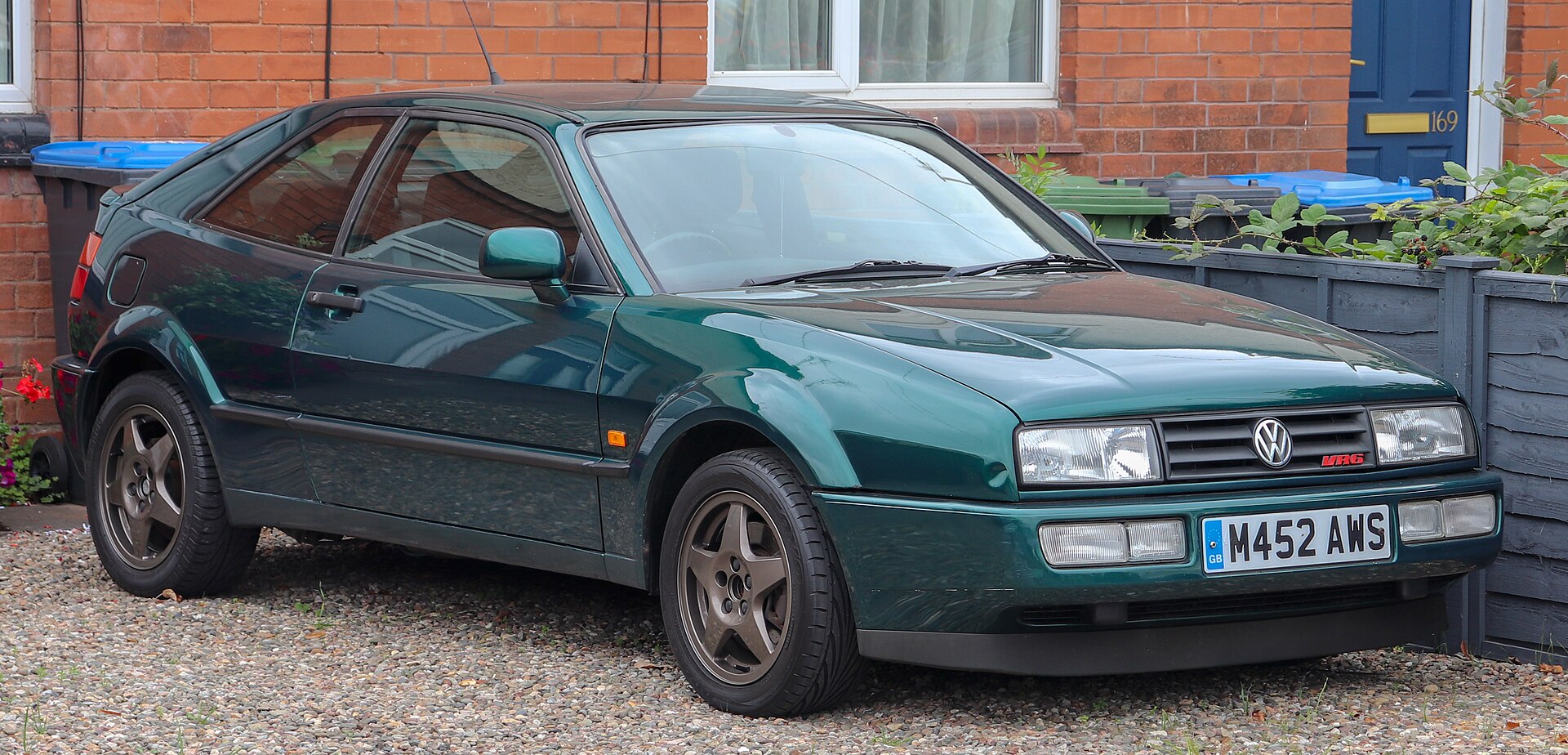
The Volkswagen Corrado is a front-wheel-drive 2+2 sports coupé that Volkswagen sold from 1988 to 1995. Karmann built it in Osnabrück on the floorpan of the second-generation Golf, and it overlapped with and eventually replaced the Scirocco. Best known for its active rear spoiler, the supercharged G60 and the narrow-angle VR6 engine, it was expensive in its day and sold only 97,521 cars, but it is now regarded as one of Volkswagen's best driver's cars.
In short
- Built by Karmann in Osnabrück from 1988 to 1995; 97,521 made, about 50,000 of them sold in the US.
- Designed by Herbert Schäfer; floorpan from the Golf Mk2 (A2), VR6 models with Golf Mk3 (A3) suspension parts.
- Engines from 79 kW (107 PS) to the 2.9 VR6 with 140 kW (190 PS); 0–100 km/h in as little as 6.9 seconds.
- Active rear spoiler that rises at 100 km/h in Europe (72 km/h in North America).
Volkswagen Corrado at a glance
| Specification | Volkswagen Corrado |
|---|---|
| Production | late 1988 – 1995 |
| Builder | Karmann, Osnabrück (Germany) |
| Number built | 97,521 (about 50,000 sold in the US) |
| Body | three-door 2+2 coupé (liftback) |
| Layout | front engine, front-wheel drive |
| Platform | Volkswagen A2 floorpan (Golf Mk2), A3 parts on VR6 models |
| Engines | 1.8 8V and 16V, 1.8 G60 supercharged, 2.0 8V and 16V, 2.8 and 2.9 VR6 |
| Power range | 79–140 kW (107–190 PS) |
| Kerb weight | 1,210–1,274 kg |
| Predecessor / successor | Scirocco Mk2 / Scirocco Mk3 (2008) |
The Corrado is listed in our Volkswagen catalogue. The coupé it overlapped with is covered in the Volkswagen Scirocco history, and the hatchback that supplied its floorpan in the Volkswagen Golf guide.
History: a more upmarket coupé from Karmann
In the 1980s Volkswagen sold the Scirocco as its sporty coupé, also built by Karmann. The Corrado was positioned above it as a more powerful and considerably more expensive coupé. Prototypes ran under the name Taifun; the production name comes from the Spanish verb correr, "to run". The car was launched at the end of 1988, three years before the Scirocco went out of production, and gradually took its place.
Herbert Schäfer's design had flush-mounted windows and a body shell that Karmann partly zinc-plated and galvanised. Its most famous detail is the active rear spoiler. It rises automatically above 100 km/h in Europe and above 72 km/h in North America, retracts below 25 km/h, and can also be raised by the driver.
Production figures show a short peak: 24,389 Corrados were built in 1989 and 21,893 in 1990, then output fell to 8,623 in 1993 and 2,424 in the final year, 1995. The yearly figures add up to 97,465, slightly fewer than the published total of 97,521.

Platform and chassis
The Corrado's floorpan is based on the A2 platform of the Golf Mk2 and Jetta. Four-cylinder cars use A2 subframes, suspension, steering and brakes. When the VR6 engine arrived in 1992, Volkswagen fitted the rear axle and some front axle parts of the Golf Mk3 (A3). VR6 models can be recognised by wider front wings, a different bonnet and a new front bumper to make room for the six-cylinder engine.
Engines and performance
| Engine | Years | Displacement | Power | Torque | 0–100 km/h | Top speed |
|---|---|---|---|---|---|---|
| 1.8 8V | - | 1,781 cc | 79–82 kW (107–112 PS) | 154–159 Nm | - | - |
| 1.8 16V | 1989–1992 | 1,781 cc | 100 kW (136 PS) | 162 Nm | 9.1 s | 210 km/h |
| 1.8 G60 (supercharged) | 1989–1993 | 1,781 cc | 118 kW (160 PS) | 225 Nm | 8.5 s (manual) | 225 km/h |
| 2.0 8V | 1993–1995 | 1,984 cc | 85 kW (115 PS) | 166 Nm | 10.6 s | 200 km/h |
| 2.0 16V | 1992–1995 | - | 100 kW (136 PS) | 180 Nm | 9.3 s | 210 km/h |
| 2.8 VR6 (Europe) | 1992–1995 | 2,792 cc | 130 kW (176 PS) | 240 Nm | 7.2 s | 230 km/h |
| 2.8 VR6 (North America, SLC) | 1992–1994 | 2,792 cc | 133 kW (180 PS) | 240 Nm | 6.8 s (manual) | 225 km/h |
| 2.9 VR6 | 1992–1995 | 2,861 cc | 140 kW (190 PS) | 245 Nm | 6.9 s (manual) | 233 km/h |
The G60 uses a scroll-type supercharger, the "G-Lader", named after the G-shaped spiral inside its housing. With 118 kW (160 PS) and 225 Nm it was the fastest Corrado until 1992. The VR6 has six cylinders in two banks only 15 degrees apart under a single cylinder head. The 2.9-litre version was the most powerful Corrado, with 140 kW (190 PS).


North America: the Corrado SLC
In the US and Canada the Corrado was launched as the G60. Sales started slowly because it cost much more than the Scirocco; Volkswagen of America later said it had "overequipped the Corrado". The VR6 was announced in October 1991 and arrived for 1992 as the Corrado SLC (Sport Luxury Coupe), with 133 kW (180 PS). About 3,500 VR6 cars were imported for 1992, and about 1,500 remaining G60s were sold alongside them. The 2.0 16V never reached North America, and 1994 was the last US model year. In Japan, Yanase dealers sold the car with the 1.8-litre engine only.

Special editions
- Storm (UK): 500 cars, 250 in Classic Green with cream leather and 250 in Mystic Blue with black leather, with BBS "Solitude" 15-inch wheels and heated leather seats as standard.
- G60 Jet (Germany): an economy version of the G60 in four colours with colour-coded interior.
- Campaign (UK, 1992): six VR6s in Dusty Mauve Pearl with red leather, given to Volkswagen UK's best six dealers; four were known to survive in 2022.
- Volkswagen Motorsport 16V G60: about two factory-built cars in Nugget Yellow, never put into series production.
Dimensions and weight
| Parameter | Metric | Imperial |
|---|---|---|
| Length | 4,049 mm | 159.4 in |
| Width (1989–1992 / 1993–1995) | 1,674 / 1,689 mm | 65.9 / 66.5 in |
| Height | 1,310 mm | 51.6 in |
| Wheelbase (1989–1992 / 1993–1995) | 2,471 / 2,469 mm | 97.3 / 97.2 in |
| Kerb weight | 1,210–1,274 kg | 2,668–2,809 lb |
Reputation and legacy
Contemporary testers liked the way the Corrado drove. Tiff Needell praised the G60's front-wheel-drive handling on Top Gear in 1988, and Car magazine later listed the VR6 among "25 Cars You Must Drive Before You Die". Auto Express calls it one of Volkswagen's best-ever driver's cars and the VR6 "by far the most desirable version". Richard Hammond summed up its commercial problem on Top Gear in 2003: it was a future classic, but it "was too expensive, and nobody bought it". After the Corrado, Volkswagen had no compact coupé until the third-generation Scirocco of 2008.
Photo gallery


FAQ
How many Volkswagen Corrados were built?
97,521 according to the published total, built by Karmann in Osnabrück from 1988 to 1995; about 50,000 were sold in the US.
What does G60 mean on the Corrado?
It refers to the G-Lader scroll supercharger with its G-shaped internal spiral; the G60 produced 118 kW (160 PS).
What is the fastest Corrado?
The 2.9 VR6 with 140 kW (190 PS), 245 Nm, 0–100 km/h in 6.9 seconds and a top speed of 233 km/h.
Why does the Corrado have a moving rear spoiler?
The active spoiler rises automatically at 100 km/h in Europe (72 km/h in North America) and retracts below 25 km/h.


