
 Volkswagen Lupo
Specs, engines and history
Published Sources (1) Report an error
By Felix Hartmann, Automotive Technology & EV Contributor
- Built
- 1998–2005
- Top power
- 92 kW (125 PS)
Which Lupo to buy: verdict
Our verdict · Felix Hartmann
- Best everyday choice: the 1.4 16V with 55 kW (75 PS), or the 1.4 TDI with 195 Nm for longer trips.
- For enthusiasts: the Lupo GTI, especially after March 2002 with the six-speed gearbox.
- For efficiency fans: the Lupo 3L, a piece of fuel-saving history, but complex to maintain.
- Cheapest to buy: the 1.0 with 37 kW (50 PS), adequate only for town use.
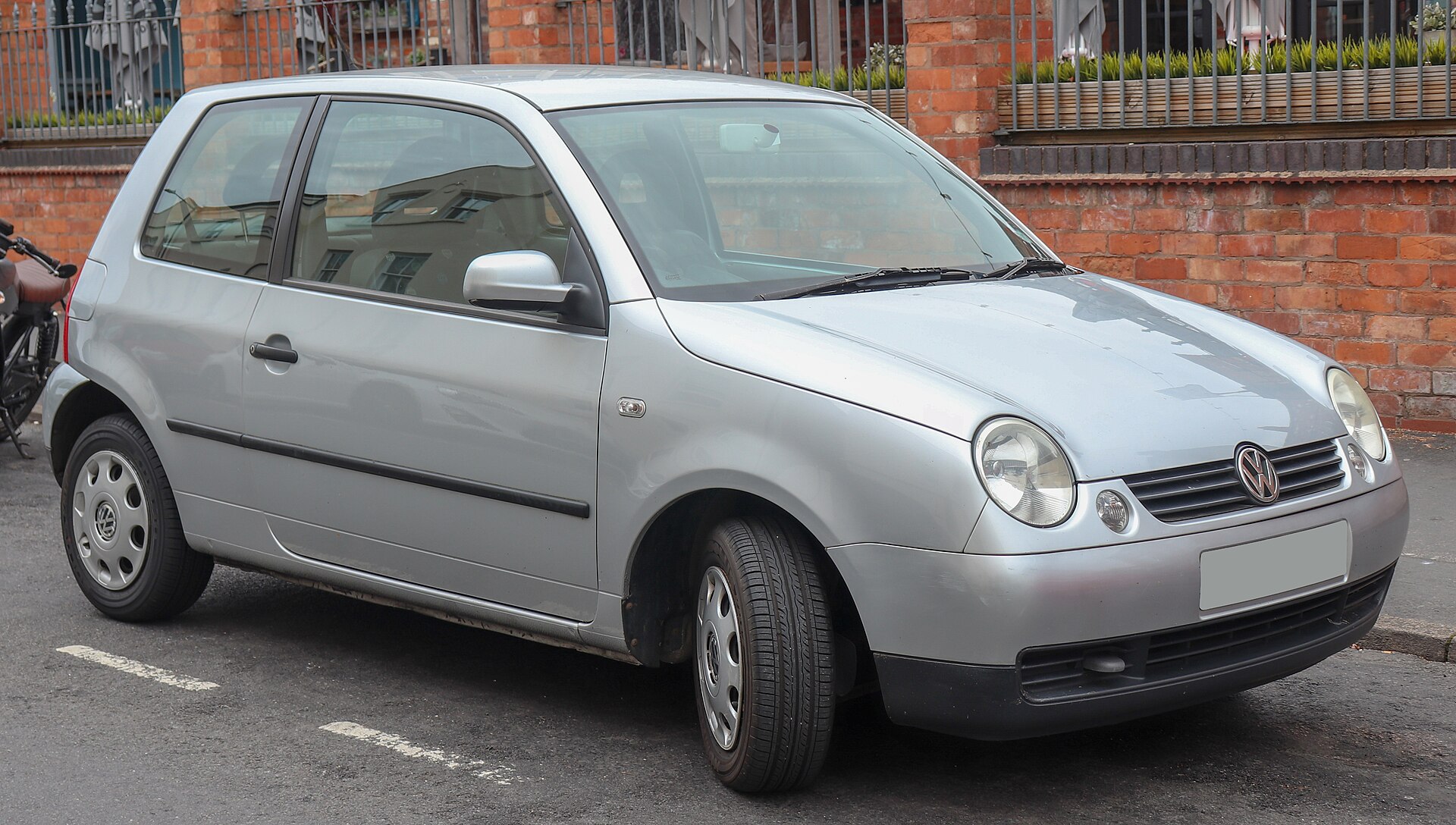
The Volkswagen Lupo is a three-door city car that Volkswagen built in Wolfsburg and Brussels from 1998 to June 2005. It shared its shortened Polo platform with the SEAT Arosa and covered an unusually wide range: from a 37 kW (50 PS) 1.0 to the 92 kW (125 PS) Lupo GTI, plus the Lupo 3L, one of the first production cars designed to use about 3 litres of diesel per 100 km. More than 480,000 were built before the Brazilian-made Fox replaced it.
In short
- A-segment city car, three-door hatchback only, front-wheel drive, built 1998-2005 in Wolfsburg (Germany) and Brussels (Belgium).
- One generation, Typ 6X (the 3L is Typ 6E), designed by Jozef Kabaň; twin of the SEAT Arosa.
- Petrol engines from 37 kW (50 PS) to 92 kW (125 PS); diesels from 44 kW (60 PS) to 55 kW (75 PS).
- Lupo FSI (2000-2003): Volkswagen's first production car with petrol direct injection.
Volkswagen Lupo at a glance
| Specification | Volkswagen Lupo (Typ 6X) |
|---|---|
| Segment | A-segment city car |
| Body | three-door hatchback |
| Production | 1998 - June 2005 |
| Plants | Wolfsburg, Germany; Brussels, Belgium |
| Platform | Volkswagen Group A00 (shortened Polo/Ibiza A0 platform) |
| Sister model | SEAT Arosa |
| Length / wheelbase | 3,524-3,530 mm / 2,318 mm |
| Kerb weight | 890-1,015 kg (Lupo 3L: 830 kg) |
| Power range | 37-92 kW (50-125 PS) |
| Successor | Volkswagen Fox (Europe); spiritual successor Volkswagen up! |
The name is Latin for "wolf", a reference to Volkswagen's home town of Wolfsburg. The Lupo sits below the Polo in our Volkswagen catalogue.
Generations and model history
The Lupo had one generation and no major facelift. Variants were added and dropped over its seven years.
| Generation | Code | Years | Body styles | Engines | Power (kW / hp) |
|---|---|---|---|---|---|
| Lupo | 6X | 1998-2005 | 3-door hatchback | 1.0, 1.4 8V/16V, 1.4 FSI, 1.6 GTI petrol; 1.4 TDI, 1.7 SDI diesel | 37-92 kW (50-125 PS) |
| Lupo 3L | 6E | 1999-2005 | 3-door hatchback | 1.2 TDI three-cylinder | 45 kW (61 PS) |
Production peaked in 2000 with 97,403 cars and then fell every year:
| Year | 1998 | 1999 | 2000 | 2001 | 2002 | 2003 | 2004 | 2005 |
|---|---|---|---|---|---|---|---|---|
| Built | 64,855 | 89,757 | 97,403 | 82,238 | 70,377 | 42,695 | 24,434 | 5,742 |
These annual figures add up to 477,501; Volkswagen's total is usually given as more than 480,000. In Ireland the Lupo was named Best Micromini in 1999.

Engines, transmissions and performance
| Engine | Displacement | Power | Torque | 0-100 km/h | Top speed | Years |
|---|---|---|---|---|---|---|
| 1.0 8V | 997/999 cc | 37 kW (50 PS) | 84-86 Nm | 17.7-18.0 s | 152 km/h | 1998-2005 |
| 1.4 8V | 1,390 cc | 44 kW (60 PS) | 116 Nm | 14.3 s | 160 km/h | 2000-2005 |
| 1.4 16V | 1,390 cc | 55 kW (75 PS) | 126 Nm | 12.0 s | 172 km/h | 1998-2005 |
| 1.4 16V Sport | 1,390 cc | 74 kW (100 PS) | 126 Nm | 10.0 s | 188 km/h | 1999-2005 |
| 1.4 16V FSI | 1,390 cc | 77 kW (105 PS) | 130 Nm | 10.0 s | 199 km/h | 2000-2003 |
| 1.6 16V GTI | 1,598 cc | 92 kW (125 PS) | 152 Nm | 7.8 s | 205 km/h | 2000-2005 |
| 1.2 TDI (3L) | 1,191 cc | 45 kW (61 PS) | 140 Nm | 14.5 s | 165 km/h | 1999-2005 |
| 1.4 TDI | 1,422 cc | 55 kW (75 PS) | 195 Nm | 12.3 s | 170 km/h | 1999-2005 |
| 1.7 SDI | 1,716 cc | 44 kW (60 PS) | 115 Nm | 16.8 s | 157 km/h | 1998-2005 |
Most Lupos have a five-speed manual gearbox. A four-speed automatic was offered with the 1.4 in some markets, a five-speed automated manual with the 3L, and the GTI received a six-speed manual in March 2002. The 1.2 TDI and 1.4 TDI are three-cylinder turbodiesels; the 1.7 SDI is the slowest of the three diesels, at 16.8 seconds to 100 km/h.
Lupo 3L: the 3-litre car
The Lupo 3L (Typ 6E) was Volkswagen's attempt to build the first series-production car that could use as little as 3 litres of fuel per 100 km. It combined the 1.2 TDI three-cylinder with aluminium and magnesium body and chassis parts, cutting the weight to 830 kg, and a drag coefficient of 0.29. The automated manual gearbox had a Tiptronic mode and an ECO mode that limited power and switched the engine off at stops, an early stop-start system. The same engine and gearbox went into the Audi A2 1.2 TDI 3L.
Independent drivers showed what it could do. In July 2001 Dr. Miyano averaged 2.36 l/100 km on a drive around Britain, and in November 2003 Gerhard Plattner averaged 2.78 l/100 km over 2,910 miles (about 4,680 km) through twenty countries.
Lupo GTI and Lupo FSI
The Lupo GTI arrived in 2000 and was presented as a spiritual heir to the original Golf GTI. Its 1.6 16V produces 92 kW (125 PS) and 152 Nm, enough for 0-100 km/h in 7.8 seconds and about 205 km/h. It is easy to spot: fully body-coloured bumpers, twin central exhausts and 15-inch alloy wheels. Bi-xenon headlights were standard, and from March 2002 the GTI had a six-speed manual.
The Lupo FSI (2000-2003) was the first Volkswagen production car with petrol direct injection. Its 1.4 16V FSI produces 77 kW (105 PS) and 130 Nm and averages 4.9 l/100 km, about 30% less fuel than a conventional engine of similar power. It was sold only in Germany, Austria and Switzerland and was the only Lupo version dropped before 2005.
Between the two sat the Lupo Sport, with the 74 kW (100 PS) 1.4 16V or the 55 kW (75 PS) 1.4 TDI, 14-inch alloys, front fog lights and larger front brake discs (256 mm instead of 239 mm).


Dimensions and boot
| Parameter | Metric | Imperial |
|---|---|---|
| Length | 3,524-3,530 mm | 138.7-139.0 in |
| Width (without / with mirrors) | 1,640 / 1,803 mm | 64.6 / 71.0 in |
| Height | 1,447-1,475 mm | 57.0-58.1 in |
| Wheelbase | 2,318 mm | 91.3 in |
| Kerb weight | 890-1,015 kg | 1,962-2,238 lb |
| Boot (seats up / folded) | 130 / 833 l | 4.6 / 29.4 cu ft |
At about 3.5 m the Lupo is short enough for tight city parking; our size comparison tool shows it next to modern city cars. With a 130-litre boot, the Lupo is best seen as a car for two people with occasional rear passengers.
Fuel economy and running costs
Volkswagen's headline figures were those of the special versions: about 3 l/100 km for the Lupo 3L and 4.9 l/100 km for the FSI. Our sources give no official figures for the other engines, so we do not quote them. To estimate costs on your own mileage, use the fuel cost calculator.
Safety
We found no sourced Euro NCAP result for the Lupo, so we do not quote a rating. Any score from that period would also not be comparable with today's tests. Standard equipment varied by market and year, so check what the individual car has.
Reliability and known issues
Our sources contain no data on typical Lupo faults, so we list none. With the youngest cars now about 20 years old, service history and the condition of each car count for more than the engine choice. The 3L and FSI use technology that was new at the time; check that a specialist can service them before buying.
Rivals
| Model | Engines | Power (hp) | Boot (l) | Price from (EUR) |
|---|---|---|---|---|
| Volkswagen Lupo (1998-2005) | 1.0-1.6 petrol, 1.2-1.7 diesel | 49-123 | 130 | not sourced |
| SEAT Arosa (twin) | shares Lupo engines | - | - | - |
| Volkswagen Fox (2005-2011, successor) | 1.2, 1.4 petrol, 1.4 TDI | 55-75 | - | - |
The Arosa differs mainly in styling and equipment. The Fox that replaced the Lupo in Europe had no GTI, FSI or 3L counterpart; its most powerful European engine produced 55 kW (75 hp).
Photo gallery

Volkswagen Lupo in our rankings
- No. 606 of 1082 · Longest-running car nameplates (7 years · top 61%)
- No. 88 of 141 · Most powerful hatchbacks (92 kW · top 63%)
- No. 876 of 1011 · Most powerful cars (92 kW · top 87%)
- No. 136 of 151 · Most powerful German cars (92 kW · top 91%)
In production longer than 39% of ranked nameplates in the 1CARS catalog (No. 606 of 1082).
FAQ
How many generations of the Volkswagen Lupo are there?
One. The Lupo (Typ 6X) was built from 1998 to 2005; the 3L version had its own type code, 6E.
What is the fastest Volkswagen Lupo?
The Lupo GTI: 92 kW (125 PS), 0-100 km/h in 7.8 seconds and about 205 km/h.
Did the Lupo 3L really use 3 litres per 100 km?
It was designed to use as little as 3 l/100 km, and independent drivers recorded averages of 2.36 and 2.78 l/100 km on long-distance runs.
What replaced the Volkswagen Lupo?
In Europe the Brazilian-built Volkswagen Fox replaced it in 2005; the up! of 2011 is seen as its spiritual successor.
Where was the Lupo built?
In Wolfsburg, Germany, and in Brussels, Belgium.
Data sources
Data checked by an editor against the sources below.


