 Toyota FJ Cruiser
Specs, engines and history
Published Sources (1) Report an error
By Sarah Whitmore, Senior Automotive Writer
- Built
- 2006–2022
- Top power
- 194 kW (264 PS)
Known issues and buying advice
Our verdict · Sarah Whitmore
- Inner wing panels: early cars (2007 to early 2008 according to Wikipedia, 2007–2009 according to CarGurus) can show bulging or cracked inner fender aprons; Toyota changed the design.
- 2007 model year: CarGurus lists rear-locker programming problems on all but the TRD Special Edition, and the most owner complaints of any year.
- Rust: check the body and frame.
- Windscreen: the upright glass is prone to stone chips.
- Modifications: many cars carry lifts, bumpers and racks; prefer reputable parts or unmodified cars.
- Safety: the IIHS named the FJ a Top Safety Pick with "good" ratings in its front and side tests; side curtain airbags were optional in 2007 and standard from 2008.
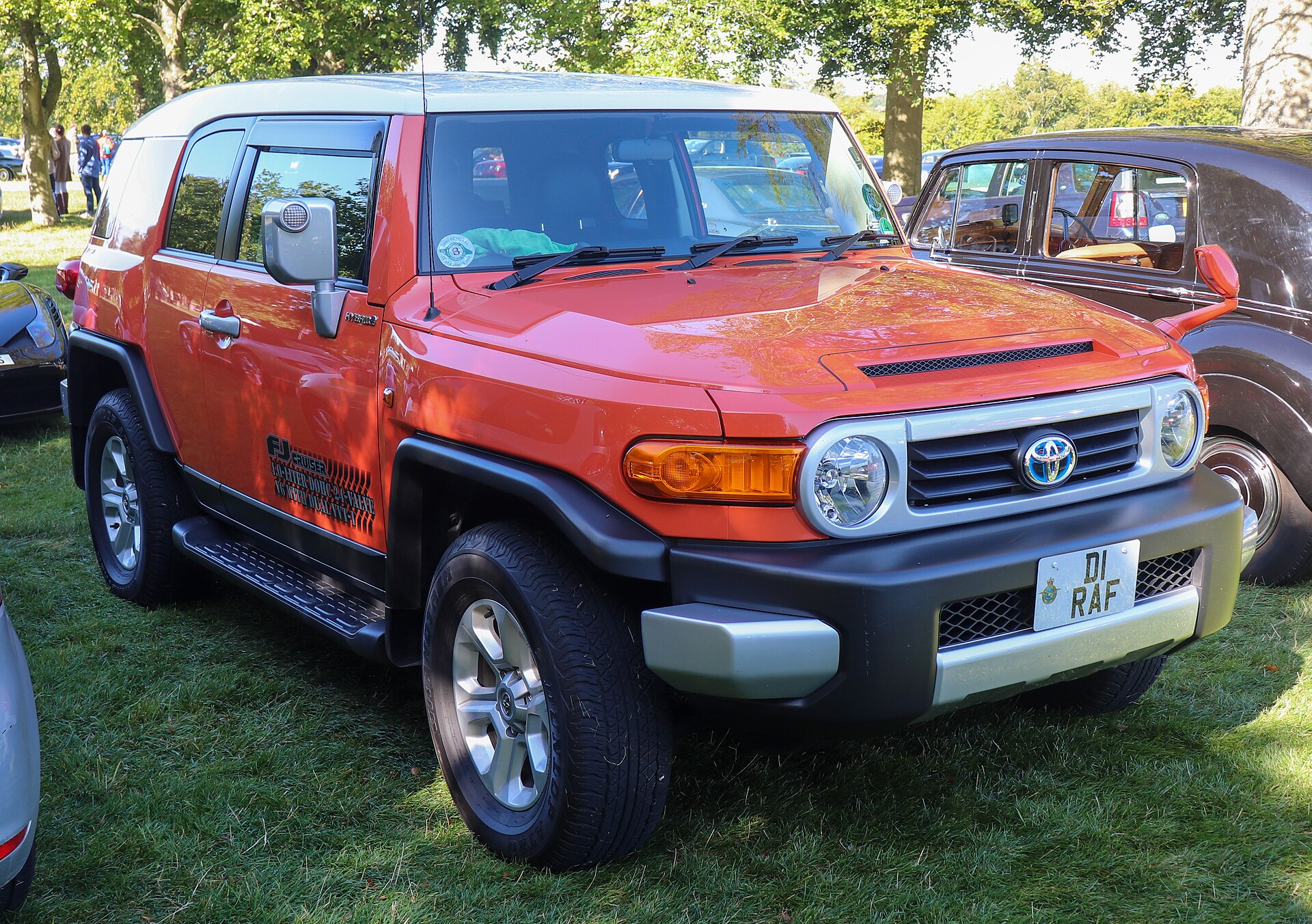
The Toyota FJ Cruiser is a body-on-frame off-road SUV with retro styling, built by Toyota's subsidiary Hino at Hamura near Tokyo from 2006 to 2022. It took its looks from the FJ40 Land Cruiser and its chassis from the Land Cruiser Prado, and it was sold mainly in North America (to the 2014 model year), Japan, Australia, the Middle East and Africa. Every car used the same 4.0-litre petrol V6.
In short
- One generation, code XJ10: production January 2006 – December 2022, all at Hino's Hamura plant.
- Engine: 1GR-FE 4.0 V6, 178 kW (239 hp) in 2007–2009, 194 kW (260 hp) from 2011; no diesel.
- Drive: six-speed manual with full-time 4WD, five-speed automatic with part-time 4WD, or rear-wheel drive in some markets.
- Rear-hinged rear doors, 70 cm wading depth, towing up to 2,268 kg (US rating).
Size at a glance
| Dimensions | Toyota FJ Cruiser XJ10 |
|---|---|
| Length | 4,670 mm183.9 in |
| Width | 1,895 mm74.6 in |
| Height | 1,830 mm72.0 in |
| Wheelbase | 2,690 mm105.9 in |
Specs by version
Engines
| Version | Engine | Power | Torque | Production years |
|---|---|---|---|---|
| 4.0 V6 | 4.0 l · 6 cyl · Petrol 1GR-FE | 178 kW 242 PS239 hp | 377 Nm278 lb-ft | 2007–2009 |
| 4.0 V6 (2010) | 4.0 l · 6 cyl · Petrol 1GR-FE | 193 kW 262 PS259 hp | 366 Nm270 lb-ft | 2010 |
| 4.0 V6 (2011–) | 4.0 l · 6 cyl · Petrol 1GR-FE | 194 kW 264 PS260 hp | 367 Nm271 lb-ft | 2011 |
Dimensions and weight
Verified Manufacturer and type-approval data from our catalog · Sources and methodology
Toyota FJ Cruiser at a glance
| Parameter | Value |
|---|---|
| Model code | XJ10 |
| Production | January 2006 – December 2022 |
| Plant | Hino Motors, Hamura (Tokyo), Japan |
| Platform | Toyota F2 body-on-frame, shared with the Land Cruiser Prado |
| Body | five-door SUV with rear-hinged access doors |
| Engine | 1GR-FE 4.0 l V6 petrol |
| Power | 178–194 kW (239–260 hp); 200 kW in South Africa |
| Torque | 366–377 Nm (US); 380 Nm (South Africa) |
| Gearboxes | six-speed manual; five-speed automatic |
| Kerb weight | 1,837–2,015 kg |
| Length × width × height | 4,670 × 1,895–1,905 × 1,830 mm (4WD) |
| Wheelbase | 2,690 mm |
| Predecessor / successors | Hilux Surf (Japan) / Land Cruiser Prado J250, Land Cruiser FJ |
From 2003 concept to production
Toyota showed the FJ Cruiser as a concept car at the Detroit motor show (NAIAS) in January 2003. Inside the company it was called "Rugged Youth Utility", a vehicle aimed at young male buyers. The exterior was drawn by Jin Won Kim, who was 24 when his design was chosen, and the interior by Bill Chergosky. The public response persuaded Toyota to build it, and the production version made its debut at Chicago in February 2005.
The concept's bright Voodoo Blue paint became the signature colour of the production car. Some features of the show car were dropped to save cost, such as a gear lever shaped like a shovel handle, torch-style interior lights and front seats that folded flat. The FJ shares its body-on-frame structure with the Land Cruiser Prado, although it is not identical to the two-door Prado.

Design and interior
The front borrowed the grille and headlamp arrangement of the FJ40, with the word "TOYOTA" spelled out across the grille instead of the usual badge. The windscreen stood almost upright and had three wipers. The side has no central pillar: two small rear-hinged doors open behind the front doors, and high-strength steel in the doors takes over the job of the pillar in a side impact.
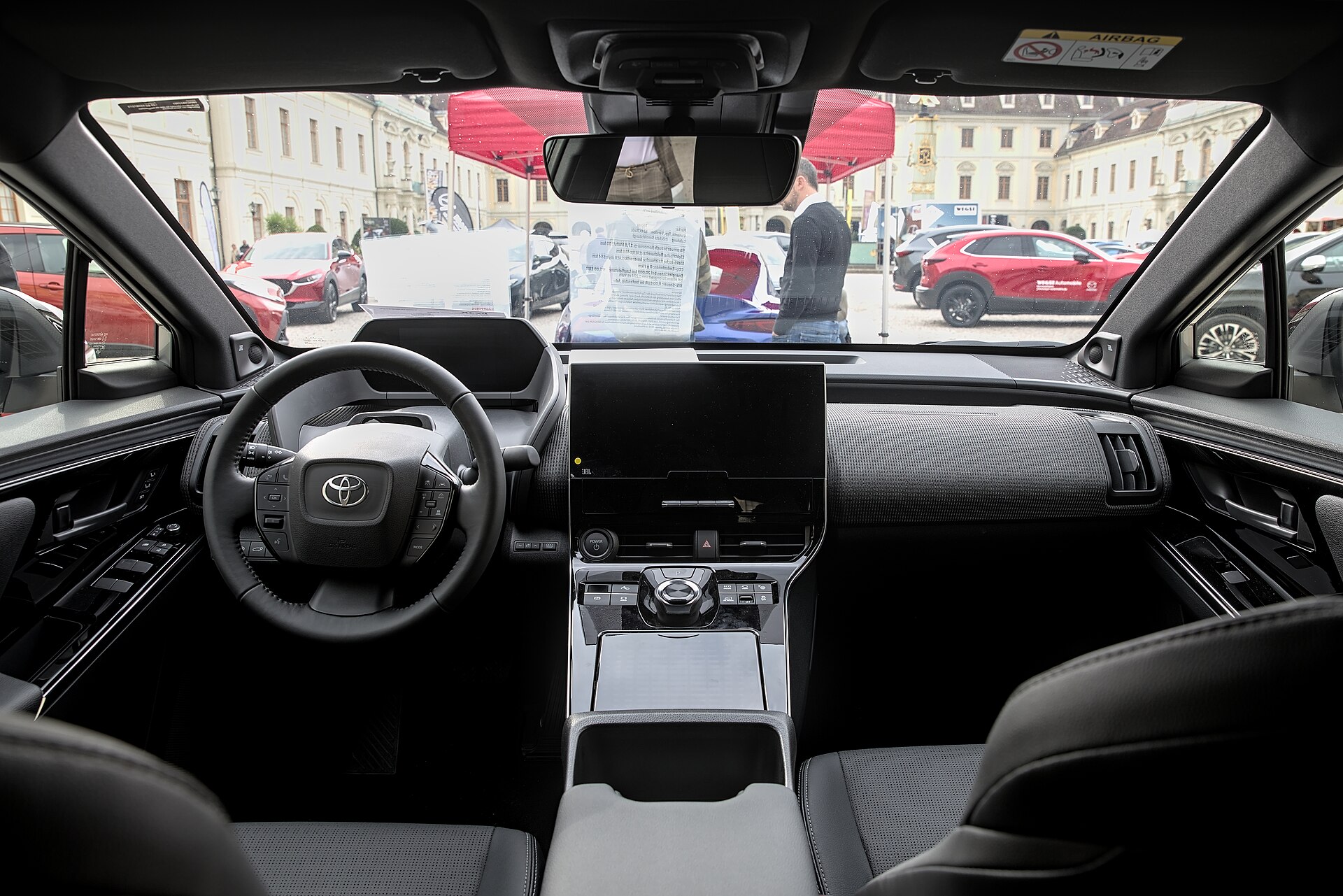
Inside, many surfaces were washable rubber, the controls were oversized so that they could be used with gloves, and an optional three-gauge cluster showed a compass, the outside temperature and an inclinometer. A 120 V socket in the load area was also available. A rear camera became available from the 2009 model year, and from 2011 new front-seat hinges made it easier to climb into the back.


Engine, gearboxes and four-wheel drive
| Years | Engine | Power | Torque | Fuel |
|---|---|---|---|---|
| 2007–2009 | 1GR-FE 4.0 V6, VVT-i | 178 kW (239 hp) at 5,200 rpm | 377 Nm at 3,700 rpm | 91 octane |
| 2010 | 1GR-FE, dual VVT-i | 193 kW (259 hp) at 5,600 rpm | 366 Nm | 87 octane |
| 2011–2014 (US) | 1GR-FE, dual VVT-i | 194 kW (260 hp) at 5,600 rpm | 367 Nm | 87 octane |
| 2011–2022 (South Africa) | 1GR-FE 4.0 V6 | 200 kW at 5,600 rpm | 380 Nm at 4,400 rpm | petrol |
The dual VVT-i update of 2010 added 15 kW and allowed regular 87-octane fuel, although Toyota still recommended premium for towing, off-road work and driving at altitude. The choice of gearbox decided the four-wheel-drive system. The six-speed RA61F manual came with full-time 4WD, a Torsen centre differential and a 40:60 front-to-rear split. The five-speed A750F automatic used a part-time system with high and low range, and some markets also had a rear-wheel-drive version with a limited-slip differential. A-TRAC traction control imitated a locking differential without its binding, and a rear locker was available.
Off-road ability and dimensions
| Figure | Value |
|---|---|
| Ground clearance | 24 cm |
| Approach / departure / breakover angle | 34° / 30° / 27.4° |
| Suspension travel | 20 cm front, 23 cm rear |
| Wading depth | 70 cm |
| Towing capacity | 2,268 kg (US); 1,500 kg braked (South Africa) |
| Load space, rear seats folded | about 1,890 l (66.8 cu ft) |
On the road the FJ was less convincing. Wikipedia records 0–60 mph in 7.8 seconds and 0.69 g of lateral grip on the standard Bridgestone Dueler tyres, and testers criticised the body roll, the large blind spots and the small rear seat. The front suspension used high-mounted double wishbones, the rear a four-link axle with coil springs. Size and practicality against other off-roaders can be checked in our comparison tool.
Fuel consumption
| Version (EPA, US) | Combined | l/100 km |
|---|---|---|
| Rear-wheel drive, automatic | 18 mpg | 13.1 |
| 4WD, automatic | 17 mpg | 13.8 |
| 4WD, six-speed manual | 16 mpg | 14.7 |
| South Africa, 4WD automatic (claimed) | - | 11.4–11.9 |
cars.co.za notes that real consumption was considerably higher than the South African claim. From August 2013 South African cars added an 87-litre supplementary tank to the 72-litre main tank, 159 litres in total. Our fuel cost calculator turns these figures into running costs.
Special editions
| Edition | Years | Units | Contents |
|---|---|---|---|
| TRD Special Edition | 2007 | 3,200 | black paint with black roof, Bilstein dampers, TRD exhaust, rock rails |
| Trail Teams Special Edition | 2008, 2010–2014 | 1,500–3,200 a year | one colour per year, from Iceberg (2008) to Heritage Blue (2014) |
| Ultimate Edition | 2014 | 2,500 | aluminium TRD skid plate, remote-reservoir rear dampers |
| FJ Crawler | from 2008 | - | ARB bull bar, Old Man Emu 3-inch lift, 33- or 35-inch tyres |
| Final Edition (Japan) | 2017 | - | on sale from 16 October 2017 |
| Final Edition (Middle East) | 2022 | 1,000 | launched 2 October 2022 |
At the SEMA Show in 2012 Toyota showed the FJ-S concept with a TRD supercharger and 257 kW (345 hp), about 30 percent more than standard; it never went into production.

Markets, sales and the end of production
US sales peaked at 56,225 in the first calendar year, 2006, and settled at 12,000–15,000 a year from 2009. Critics blamed competition from the Jeep Wrangler, fuel consumption and environmental concerns.
| Year | USA | Canada |
|---|---|---|
| 2006 | 56,225 | 4,919 |
| 2007 | 55,170 | 4,901 |
| 2008 | 28,688 | 2,630 |
| 2009 | 11,941 | 899 |
| 2010 | 14,959 | 797 |
| 2011 | 13,541 | 639 |
| 2012 | 13,656 | 726 |
| 2013 | 13,131 | 656 |
| 2014 | 14,718 | 618 |
The end of the North American FJ was announced on 5 November 2013, with 2014 as the last model year; CarGurus gives a 2014 starting price of around US$28,000 (about €21,000). Japan received the car only from 4 December 2010; 27,982 were sold there before sales ended on 31 January 2018. Australia took right-hand-drive cars with the automatic and 4WD from 2011 until exports stopped in August 2016. In South Africa the FJ was sold from August 2011, and its last list price in 2023 was R813,000 (about €40,700). Production for the Middle East and other markets continued until December 2022.
Which FJ Cruiser to choose
- For the strongest US car: a 2010–2014 model with dual VVT-i and 193–194 kW on regular fuel.
- For off-road use: the six-speed manual with full-time 4WD, or a Trail Teams edition.
- For the newest right-hand-drive car: a South African car from 2022 with the touchscreen update and Apple CarPlay.
- For a larger, more refined Toyota: the Land Cruiser 200; for a Toyota pickup, the Hilux.
All Toyota models are listed in the Toyota catalogue.
Photo gallery


Toyota FJ Cruiser in our rankings
- No. 28 of 125 · Biggest engines: SUVs and crossovers (4,000 cc · top 23%)
- No. 232 of 912 · Longest-running car nameplates (16 years · top 27%)
- No. 190 of 557 · Biggest engines: cars (4,000 cc · top 35%)
- No. 144 of 403 · Widest cars (1,895 mm · top 36%)
- No. 61 of 144 · Widest SUVs and crossovers (1,895 mm · top 43%)
- No. 178 of 420 · Longest cars (4,670 mm · top 43%)
Bigger engine than 77% of ranked SUVs and crossovers in the 1CARS catalog (No. 28 of 125).
FAQ
When was the Toyota FJ Cruiser made?
From January 2006 to December 2022. North American sales ended with the 2014 model year and Japanese sales in January 2018.
What engine does the FJ Cruiser have?
A 4.0-litre 1GR-FE V6: 178 kW (239 hp) in 2007–2009 and 193–194 kW (259–260 hp) from 2010 in the US; South African cars were rated at 200 kW.
Is the FJ Cruiser a Land Cruiser?
It is built on a body-on-frame platform shared with the Land Cruiser Prado and styled after the FJ40 Land Cruiser, but it was sold as a separate model.
Where was the FJ Cruiser built?
All FJ Cruisers were built by Hino Motors at its Hamura plant in Tokyo.
How much fuel does the FJ Cruiser use?
The EPA rated the 4WD automatic at 17 mpg combined, about 13.8 l/100 km.
Data sources
Data checked by an editor against the sources below.