 Toyota 2000 GT
Specs, engines and history
Published Sources (1) Report an error
By Sarah Whitmore, Senior Automotive Writer
- Built
- 1967–1970
- Top power
- 110 kW (150 PS)
Which Toyota 2000GT to choose
Our verdict · Sarah Whitmore
- For originality: a first-series MF10 of 1967–1969 with the original 3M engine.
- For everyday comfort: a second-series car from August 1969 with air conditioning.
- For the rarest: one of the nine MF12L cars, none of which was sold new.
- To compare: set the 2000GT against its rivals in our comparison tool; later Toyotas are listed in the Toyota catalogue.
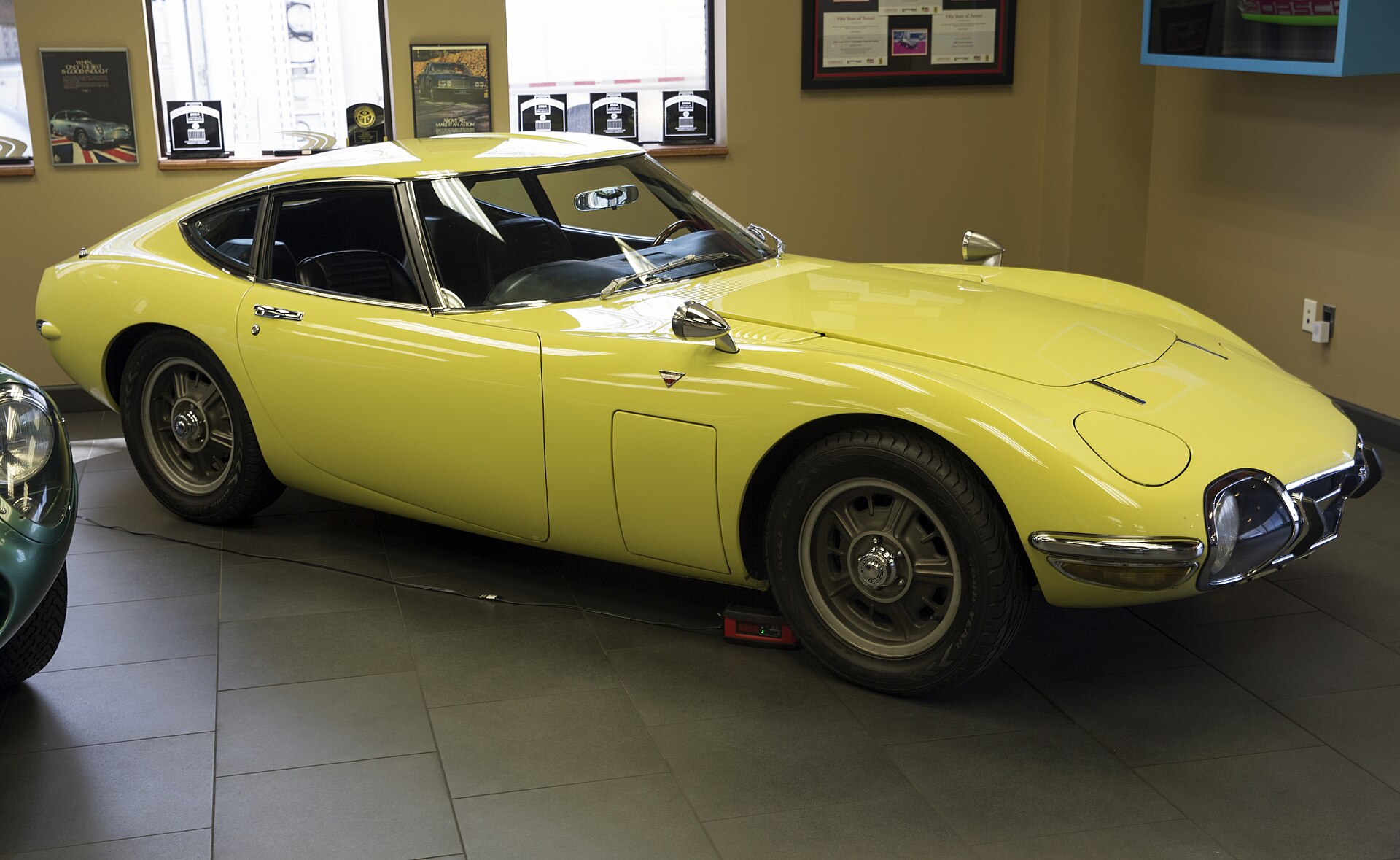
The Toyota 2000GT is a two-seat coupé that Yamaha built for Toyota from May 1967 to August 1970. It combined a twin-cam straight-six and a backbone chassis with disc brakes on all four wheels, a first for a Japanese car, and before going on sale it set 13 international speed records. Only 351 were made, and auction prices have reached US$2.5 million (2022).
In short
- Production: May 1967 – August 1970 by Yamaha in Iwata, Shizuoka; 351 built (337 regular production cars).
- Engine: 3M 1,988 cc DOHC six with three Mikuni-Solex carburettors, 110 kW (150 PS) at 6,600 rpm, 175 Nm.
- Price in Japan in 1967: ¥2,380,000, as much as two Toyota Crowns.
- October 1966: 13 FIA records in 72 hours at Yatabe, averaging 206 km/h over the full distance.
Size at a glance
| Dimensions | Toyota 2000 GT MF10 |
|---|---|
| Length | 4,175 mm164.4 in |
| Width | 1,600 mm63.0 in |
| Height | 1,160 mm45.7 in |
| Wheelbase | 2,330 mm91.7 in |
Specs by version
Engines
| Version | Engine | Power | Torque | Gearbox | Drive | Production years |
|---|---|---|---|---|---|---|
| 2000GT 2.3 (2M-B) | 2.3 l · 6 cyl · Petrol 2M-B | 103 kW 140 PS138 hp | 201 Nm148 lb-ft | — | Rear-wheel drive | 1967–1970 |
| 2000GT 2.0 (3M) | 2.0 l · 6 cyl · Petrol 3M | 110 kW 150 PS148 hp | 175 Nm129 lb-ft | 5-sp Manual | Rear-wheel drive | 1967–1970 |
Performance
Show all 1 versions
| Version | Top speed |
|---|---|
| 2000GT 2.0 (3M) | 217 km/h135 mph |
Dimensions and weight
Show all 2 versions
| Version | Length | Width | Height | Wheelbase | Kerb weight |
|---|---|---|---|---|---|
| 2000GT 2.3 (2M-B) | 4,175 mm164.4 in | 1,600 mm63.0 in | — | 2,330 mm91.7 in | 1,120 kg2,469 lb |
| 2000GT 2.0 (3M) | 4,175 mm164.4 in | 1,600 mm63.0 in | 1,160 mm45.7 in | 2,330 mm91.7 in | 1,120 kg2,469 lb |
Verified Manufacturer and type-approval data from our catalog · Sources and methodology
Toyota 2000GT at a glance
| Parameter | Value |
|---|---|
| Model codes | MF10 (right-hand drive), MF10L (left-hand drive), MF12L (2.3 l) |
| Production | May 1967 – August 1970 |
| Built by | Yamaha, Iwata (Shizuoka) |
| Built | 351 in total; 337 regular production cars |
| Body | two-door fastback coupé, two seats |
| Engine | 3M, 1,988 cc DOHC straight-six |
| Power | 110 kW (150 PS) at 6,600 rpm |
| Torque | 175 Nm at 5,000 rpm |
| Gearbox | five-speed manual; three-speed automatic on late cars |
| Kerb weight | 1,120 kg |
| Length × width × height | 4,175 × 1,600 × 1,160 mm |
| Wheelbase | 2,330 mm |
| Top speed | 217 km/h (claimed, with the 4.375 axle) |
Toyota 2000GT timeline
| Date | Event |
|---|---|
| 1964 | Toyota starts project 280A; Yamaha's sports-car work for Nissan (A550X) is halted in mid-1964 |
| 28 December 1964 | Toyota and Yamaha sign their partnership |
| August 1965 | first prototype completed, 11 months after the project began |
| Autumn 1965 | public debut at the 12th Tokyo Motor Show |
| 1966 | third place at the 1966 Japanese Grand Prix at Fuji |
| 1–4 October 1966 | 13 international records at the Yatabe test track |
| May 1967 | sales begin in Japan |
| 1967 | two open cars built for the James Bond film You Only Live Twice |
| August 1969 | minor change: new lamps, new dashboard, air conditioning, automatic option |
| August 1970 | production ends |
How Toyota and Yamaha created the 2000GT
Yamaha had worked on sports-car projects for Nissan after giving up its own plans for a car in 1962, among them a coupé prototype called A550X. When Nissan halted that work in mid-1964, Yamaha's president turned to Toyota, and the two companies signed their agreement on 28 December 1964. According to Wikipedia JA, Toyota had already started its own project, code 280A, earlier that year and had finished the basic chassis design. The A550X and the 2000GT share only the idea of a fastback coupé with retractable headlamps; their engines and structures differ.
The body was drawn by Toyota's industrial designer Satoru Nozaki, whose design was inspired by the Jaguar E-type, and the project was led by Jiro Kono (evo spells the name Jiro Kawano). The often repeated claim that Albrecht Goertz designed the car was denied by Goertz himself in a 1996 interview. Yamaha completed the first prototype in August 1965, and Toyota showed the aluminium-bodied car at the Tokyo Motor Show that autumn. How the 2000GT fits into the company's history is covered in our Toyota history.
Speed records at Yatabe in 1966
To prove the car before sales began, a modified prototype ran for 72 hours on the banked Yatabe high-speed track in Ibaraki from 1 to 4 October 1966. Five drivers shared the car, the event was approved by the FIA and the Japan Automobile Federation, and it set 13 records.
| Record | Average speed |
|---|---|
| 6 hours | 210.42 km/h |
| 24 hours | 206.23 km/h |
| 72 hours | 206.02 km/h |
| 1,000 miles | 209.65 km/h |
| 10,000 miles | 206.18 km/h |
| 10,000 km | 203.97 km/h |
| 15,000 km | 206.04 km/h |
Porsche beat these times at Monza in October 1967. The record car itself was later destroyed in an accident while serving as a pace car and was scrapped.
Design, chassis and cabin
The 2000GT sat on an X-shaped steel backbone frame with double wishbones and coil springs at all four wheels. Toyota UK and Wikipedia list several firsts: it was the first Japanese car with power-assisted disc brakes on all four wheels, and the first Toyota with rack-and-pinion steering. A limited-slip differential and 15-inch magnesium alloy wheels were standard. The roof was only 1,160 mm above the road.
Inside, the dashboard was finished in rosewood, and the radio could search for stations automatically. The steering column was adjustable for reach. The cabin was laid out for Japanese drivers of the 1960s; evo notes that people over about 1.83 m find it tight. Road & Track, testing a pre-production car in 1967, called it "one of the most exciting and enjoyable cars we've driven".


Engines: 3M and the rare 2.3-litre MF12L
The 3M engine was based on the six-cylinder unit of the Toyota Crown, with a Yamaha-designed aluminium head carrying two camshafts. Three twin-choke Mikuni-Solex 40 PHH carburettors fed it, and it produced 110 kW (150 PS) at 6,600 rpm and 175 Nm at 5,000 rpm. With 1,120 kg to carry, each kW had to move about 10 kg; our power-to-weight calculator compares that with other cars.
| Version | Engine | Power | Torque | Built |
|---|---|---|---|---|
| MF10 / MF10L | 3M 1,988 cc DOHC six | 110 kW (150 PS) at 6,600 rpm | 175 Nm at 5,000 rpm | 342 |
| MF12L | 2M-B 2,253 cc SOHC six | 103 kW (140 PS) at 5,800 rpm | 201 Nm at 3,800 rpm | 9 |
Toyota UK quotes 0–62 mph (100 km/h) in 8.6 seconds, and Toyota claimed a top speed of 217 km/h with the 4.375 final drive. The MF12L was planned as a cheaper model for North America, with a single-cam 2.3-litre engine also fitted with three Solex carburettors. Nine left-hand-drive cars were built, numbered 100001 to 100009, but the version never went on sale.

Production, prices and the 1969 facelift
Yamaha assembled the cars in small batches at Iwata. In 1967 the 2000GT cost ¥2,380,000 in Japan, as much as two Crowns or six Corollas, at a time when a university graduate started on about ¥26,000 a month. Toyota is reported to have lost money on every car. In the United States a 1968 car listed for about US$7,150.
| Market or use | Cars |
|---|---|
| Japan | 218 (110 first series, 108 second series) |
| Export | 102 |
| Special purposes | 14 |
| Prototypes and test cars | 2 |
| Unknown | 1 |
| Total regular production | 337 |
The 337 regular cars exclude the nine MF12L and a handful of other cars, which is why most English sources quote 351. A minor change of August 1969, designed by Heiji Kobayashi of GK Industrial Design, brought smaller integrated fog lamps, new front indicators, a redesigned dashboard, headrests, air conditioning and an optional three-speed automatic. Cars built up to July 1969 are called the first series, later ones the second series.
Racing and the James Bond cars
Before production began, the 2000GT raced to show what it could do. It finished third at the 1966 Japanese Grand Prix at Fuji, won the first Suzuka 1000 Kilometres that year, and in 1967 won both the 24 Hours of Fuji and the Fuji 1000 Kilometres. In the United States Carroll Shelby entered 2000GTs in the SCCA C-Production class in 1968.
For the James Bond film You Only Live Twice (1967), Toyota built two open cars with tonneau covers. Both were one-offs made for the film, and no open version was offered to customers.
Values today
| Date | Sale | Approx. EUR |
|---|---|---|
| 2013 | up to US$1,200,000 at auction | about €900,000 |
| December 2018 | US$511,000 | about €433,000 |
| 2022 | US$2,500,000 for a Toyota-Shelby 2000GT | about €2,370,000 |
In October 2020 evo put the value of a good car at more than £400,000 (about €450,000). Other coupés of the same decade are collected in our 1960s classics section.
Toyota 2000 GT in our rankings
- No. 8 of 79 · Lightest coupes (1,120 kg)
- No. 9 of 89 · Smallest coupes (4,175 mm)
- No. 9 of 33 · Fastest Japanese cars (217 km/h)
- No. 40 of 304 · Lightest cars (1,120 kg · top 14%)
- No. 76 of 420 · Smallest cars (4,175 mm · top 19%)
- No. 140 of 281 · Fastest cars (217 km/h · top 50%)
Lighter than 89% of ranked coupes in the 1CARS catalog (No. 8 of 79).
FAQ
How many Toyota 2000GTs were made?
351 in total from 1967 to 1970, of which 337 were regular production cars; the rest include nine MF12L with a 2.3-litre engine.
Who built the Toyota 2000GT?
Yamaha built the car for Toyota at Iwata in Shizuoka prefecture, and Toyota's designer Satoru Nozaki drew the body.
How much did the 2000GT cost new?
¥2,380,000 in Japan in 1967, the price of two Toyota Crowns, and about US$7,150 in the United States in 1968.
How fast is the Toyota 2000GT?
Toyota claimed 217 km/h, and Toyota UK gives 0–100 km/h in 8.6 seconds. In 1966 a prototype averaged 206 km/h for 72 hours.
Was there a convertible 2000GT?
Only two open cars were built, for the 1967 James Bond film You Only Live Twice; Toyota never sold an open version.
Data sources
Data checked by an editor against the sources below.