
 Toyota C-HR+ Electric
Specs, engines and history
Published Sources (3) Report an error
By Sarah Whitmore, Senior Automotive Writer
- Built
- 2025–present
- Top power
- 252 kW (343 PS)
- Euro NCAP
- 5 stars · 2025
Which C-HR+ to choose
Our verdict · Sarah Whitmore
- For town use and lower prices: the 57.7 kWh Active, with up to 456 km WLTP.
- For long trips: the 77 kWh front-wheel-drive Teamplayer, with the longest WLTP range of up to 609 km.
- For towing or winter roads: the AWD Lounge with 1,500 kg towing capacity and 252 kW.
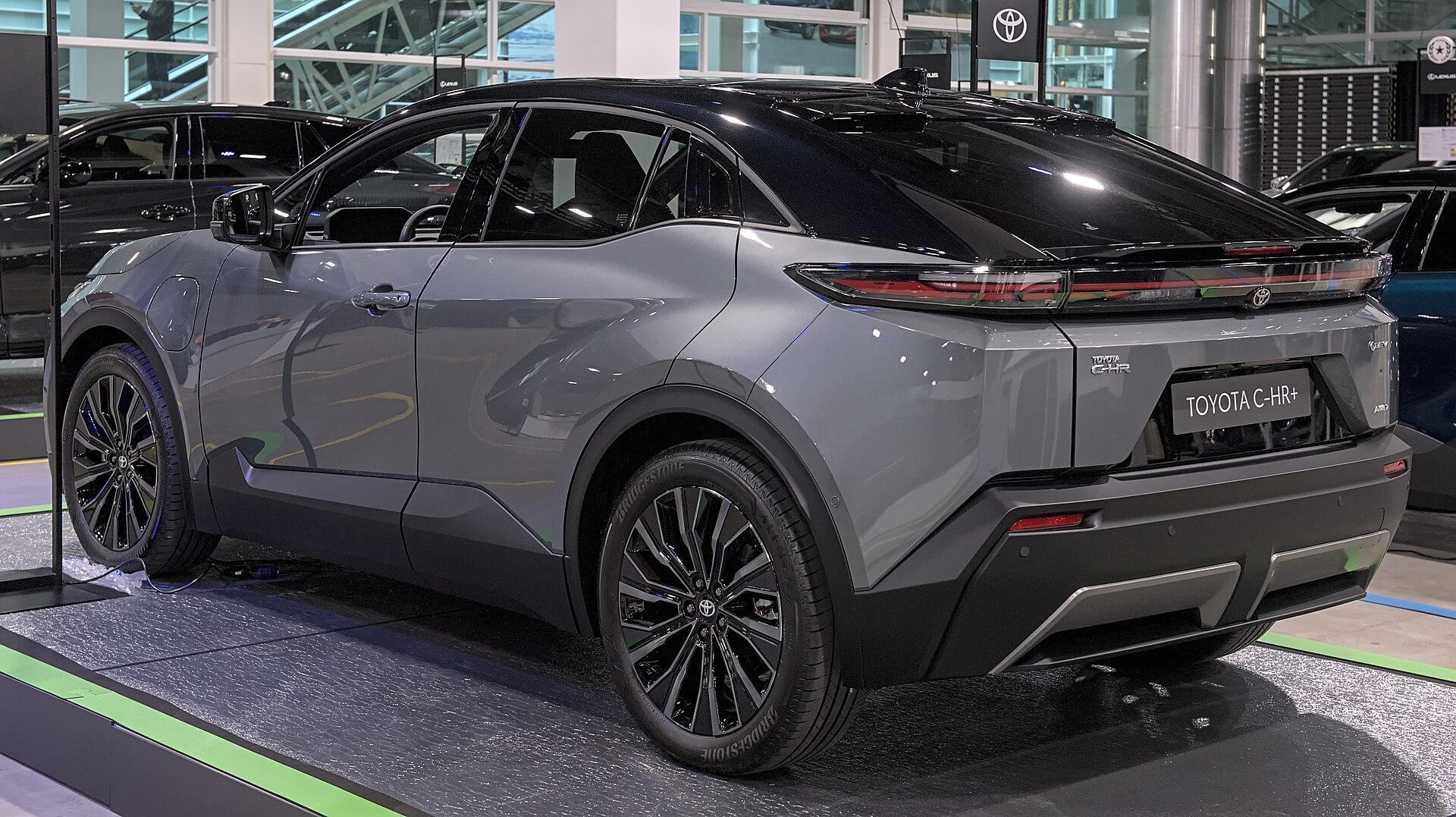
The Toyota C-HR+ is a battery-electric compact SUV revealed in March 2025 and built since September 2025 at the Takaoka plant in Toyota City, Japan. Despite the name, it is built on the e-TNGA platform of the bZ4X, while the hybrid C-HR is a different car. European buyers choose 57.7 or 77 kWh batteries, front- or all-wheel drive, and up to 609 km of WLTP range.
In short
- Three versions in Europe: 123 kW (167 PS), 165 kW (224 PS) and a 252 kW (343 PS) all-wheel-drive model with 0-100 km/h in 5.2 seconds.
- 150 kW DC charging; 10 to 80 percent takes 28 minutes, with battery preconditioning as standard.
- 4,530 mm long, 168 mm more than the hybrid C-HR, with a 416-litre VDA boot.
- Five Euro NCAP stars in 2025; German prices from EUR 41,990 (EUR 38,990 introductory offer until March 2026).
Size at a glance
| Dimensions | Toyota C-HR+ |
|---|---|
| Length | 4,530 mm178.3 in |
| Width | 1,870 mm73.6 in |
| Height | 1,595 mm62.8 in |
| Wheelbase | 2,750 mm108.3 in |
| Boot | 416 L14.7 cu ft |
Specs by version
Engines
| Version | Engine | Power | Torque | Gearbox | Drive | Production years |
|---|---|---|---|---|---|---|
| 57.7 kWh 123 kW | Electric | 123 kW 167 PS165 hp | 269 Nm198 lb-ft | 1-sp Single-speed | Front-wheel drive | 2025 |
| 77 kWh 165 kW | Electric | 165 kW 224 PS221 hp | 269 Nm198 lb-ft | 1-sp Single-speed | Front-wheel drive | 2025 |
| 77 kWh 252 kW AWD | Electric | 252 kW 343 PS338 hp | - | 1-sp Single-speed | All-wheel drive | 2025 |
Performance
Show all 3 versions
| Version | 0–100 km/h | Fuel consumption | Range |
|---|---|---|---|
| 57.7 kWh 123 kW | - | 13.4 kWh/100 km21.6 kWh/100 mi | 456 km283 mi |
| 77 kWh 165 kW | - | 13.4 kWh/100 km21.6 kWh/100 mi | 609 km378 mi |
| 77 kWh 252 kW AWD | 5.2 s 0–62 mph | - | 505 km314 mi |
Dimensions and weight
Show all 3 versions
| Version | Length | Width | Height | Wheelbase | Boot | Battery |
|---|---|---|---|---|---|---|
| 57.7 kWh 123 kW | 4,530 mm178.3 in | 1,870 mm73.6 in | 1,595 mm62.8 in | 2,750 mm108.3 in | 416 l14.7 cu ft | 58 kWh |
| 77 kWh 165 kW | 4,530 mm178.3 in | 1,870 mm73.6 in | 1,595 mm62.8 in | 2,750 mm108.3 in | 416 l14.7 cu ft | 77 kWh |
| 77 kWh 252 kW AWD | 4,530 mm178.3 in | 1,870 mm73.6 in | 1,595 mm62.8 in | 2,750 mm108.3 in | 416 l14.7 cu ft | 77 kWh |
Verified Manufacturer and type-approval data from our catalog · Sources and methodology
Safety
-
Euro NCAP 2025
Full Euro NCAP result
Stars from different years and organisations are not directly comparable: test protocols change every few years.
C-HR+ at a glance
| Specification | Toyota C-HR+ |
|---|---|
| Segment / body | compact electric SUV, five doors |
| Production | since September 2025, Takaoka plant (Japan) |
| Platform | e-TNGA, shared with bZ4X, Lexus RZ and Subaru Uncharted |
| Drive | front-wheel drive or dual-motor all-wheel drive |
| Power | 123 kW (167 PS), 165 kW (224 PS), 252 kW (343 PS) |
| Battery | 57.7 kWh or 77 kWh |
| WLTP range | up to 456 km (57.7 kWh), 609 km (77 kWh FWD), 505 km (AWD) |
| Charging | DC 150 kW; AC 11 kW, 22 kW on top grades |
| Length / wheelbase | 4,530 mm (178.3 in) / 2,750 mm |
| Boot | 416 l VDA including underfloor |
| Euro NCAP | five stars (2025) |
| Price from | EUR 41,990 (Germany, 2026); GBP 34,495 (UK, March 2026) |
Why a C-HR+ next to the C-HR
Toyota already sells the C-HR hybrid and plug-in hybrid, now in their second generation, as described in the Toyota C-HR guide. The C-HR+ borrows the coupé-style roof line and the name, but it is a separate, larger car with no combustion engine. Toyota dropped the "bZ" prefix outside China for this model, and the plus sign marks the bigger body and battery-only drive.
In North America the same car is simply called the C-HR and comes only with all-wheel drive and a 74.7 kWh usable battery; it debuted there on 14 May 2025, with an EPA estimate of 290 miles (467 km). Subaru sells a twin with a fastback rear as the Uncharted, on sale in the USA and Australia.
e-TNGA platform and technology
The C-HR+ sits on the battery-electric e-TNGA architecture first used by the Toyota bZ4X. Toyota says the underfloor battery makes the body 30 percent stiffer in torsion and lowers the centre of gravity by 65 mm compared with the C-HR hybrid and plug-in hybrid. Each axle uses an e-Axle that combines inverter, motor and transaxle, with silicon-carbide semiconductors in the inverter.
A heat pump warms the cabin and also helps cool the battery. Preconditioning can be started by hand, on a timer or automatically when the navigation system is set to a fast charger. The all-wheel-drive version has no system to disconnect the rear motor.

Versions, batteries and range
| Version | Battery | Power | WLTP range | 0-100 km/h |
|---|---|---|---|---|
| FWD 57.7 kWh | 57.7 kWh | 123 kW (167 PS) | up to 456 km | 0-62 mph 8.4 s |
| FWD 77 kWh | 77 kWh | 165 kW (224 PS) | up to 609 km | 0-62 mph 7.3 s |
| AWD 77 kWh | 77 kWh | 252 kW (343 PS) | up to 505 km | 5.2 s |
Front-wheel-drive versions have 268.6 Nm, according to Toyota UK. Range depends on wheel size and grade: Toyota UK lists 377 miles (607 km) for the 77 kWh Design on smaller wheels and 347 miles (558 km) for the Excel on 20-inch wheels. The AWD range of 505 km also applies to 20-inch wheels; the German importer quotes 501 km for the Lounge grade. WLTP consumption is about 13.4 kWh/100 km on 18-inch wheels.
Charging and real-world use
Every version accepts up to 150 kW of DC power, and Toyota quotes 28 minutes for 10 to 80 percent at 20 °C (68 °F). With preconditioning, Toyota targets under 30 minutes at -10 °C (14 °F), about 20 minutes faster than without it. On AC, the 11 kW on-board charger needs 4 hours 48 minutes from 10 to 80 percent, and the 22 kW unit on the UK Excel grade cuts that to 2 hours 12 minutes.
The boot holds 416 litres to VDA rules, including the space under the floor. Kerb weights run from 1,810 kg (3,990 lb) for the small battery to 1,950 kg (4,299 lb) for the heaviest 77 kWh car. Towing is rated at 750 kg for front-wheel drive and 1,500 kg (3,307 lb) for the all-wheel-drive Lounge in Germany.
Safety rating
Euro NCAP gave the C-HR+ five stars in 2025, testing the 77 kWh Long Range version. It scored 88 percent for adult occupants, 85 percent for child occupants, 80 percent for vulnerable road users and 79 percent for safety assist. ANCAP published a matching five-star result for the Subaru Uncharted. Toyota Safety Sense is standard on all grades.
Prices and grades in Germany and the UK
| Market | Grade | Drive and battery | Price |
|---|---|---|---|
| Germany | Active | FWD, 57.7 kWh | EUR 41,990 (EUR 38,990 offer to March 2026) |
| Germany | Teamplayer | FWD, 77 kWh | EUR 45,990 |
| Germany | Lounge | AWD, 77 kWh | EUR 53,990 |
| UK | Icon / Design / Excel | FWD | GBP 34,495 / 36,995 / 40,995 |
German orders opened on 12 December 2025, according to electrive. The Active grade has 18-inch wheels, a 14-inch central screen and a 7-inch instrument display; the Lounge adds 20-inch wheels, a 360-degree camera and a heated windscreen. UK prices date from March 2026, and the UK specification sheet lists front-wheel drive only.
C-HR+ against the Kia EV3
The Kia EV3 is the most direct Korean alternative. ADAC lists the EV3 Air with the 81.4 kWh battery and 150 kW at EUR 41,590 from November 2024, which buys more battery and less power than the C-HR+ Active at EUR 41,990. The EV3 Earth AWD has 195 kW for EUR 47,080 (ADAC, from April 2026), while the C-HR+ Lounge offers 252 kW for EUR 53,990. All Toyota electric and hybrid models are listed in the Toyota catalogue.
Photo gallery


Toyota C-HR+ Electric in our rankings
- No. 8 of 51 · Quickest Japanese cars, 0–100 (5.2 s)
- No. 19 of 96 · Longest-range electric cars (609 km · top 20%)
- No. 27 of 132 · Most powerful Japanese cars (252 kW · top 22%)
- No. 34 of 134 · Quickest SUVs and crossovers, 0–100 (5.2 s · top 26%)
- No. 55 of 175 · Quickest cars of the 2020s, 0–100 (5.2 s · top 32%)
- No. 123 of 382 · Quickest cars, 0–100 (5.2 s · top 33%)
Quicker from 0 to 100 km/h than 84% of ranked Japanese cars in the 1CARS catalog (No. 8 of 51).
FAQ
What is the range of the Toyota C-HR+?
Toyota quotes up to 456 km WLTP for the 57.7 kWh version, up to 609 km for the 77 kWh front-wheel-drive car and up to 505 km for the all-wheel-drive version on 20-inch wheels.
Is the C-HR+ the same car as the C-HR?
No. The C-HR is sold as a hybrid and plug-in hybrid, while the C-HR+ is battery-electric on the e-TNGA platform. It is 168 mm longer and has a 110 mm longer wheelbase, with no combustion engine at all.
How fast does the C-HR+ charge?
It accepts up to 150 kW DC and charges from 10 to 80 percent in 28 minutes at 20 °C. The standard 11 kW AC charger needs 4 hours 48 minutes for the same window, and the 22 kW option 2 hours 12 minutes.
Where is the C-HR+ built?
Toyota builds the C-HR+ at its Takaoka plant in Toyota City, Japan, where production started in September 2025. The North American C-HR and the Subaru Uncharted come from the same e-TNGA family.
Can the C-HR+ tow a trailer?
Yes. Front-wheel-drive versions are rated at 750 kg, and the all-wheel-drive Lounge in Germany at 1,500 kg, according to the German price announcement of December 2025.
Data sources
Data checked by an editor against the sources below.
- Wikipedia - Toyota C HR
- Co - 260316 C HR Tech Specs
- Electrive - Toyota C Hr Ab 38 990 Euro Bestellbar


