 Toyota Auris
All generations, specs and history
Published Sources (3) Report an error
By Felix Hartmann, Automotive Technology & EV Contributor
- Built
- 2006–2019
- Generations
- 2 · E150 to E180
- Top power
- 130 kW (177 PS)
Timeline
Auris generations
Click a generation for its own page

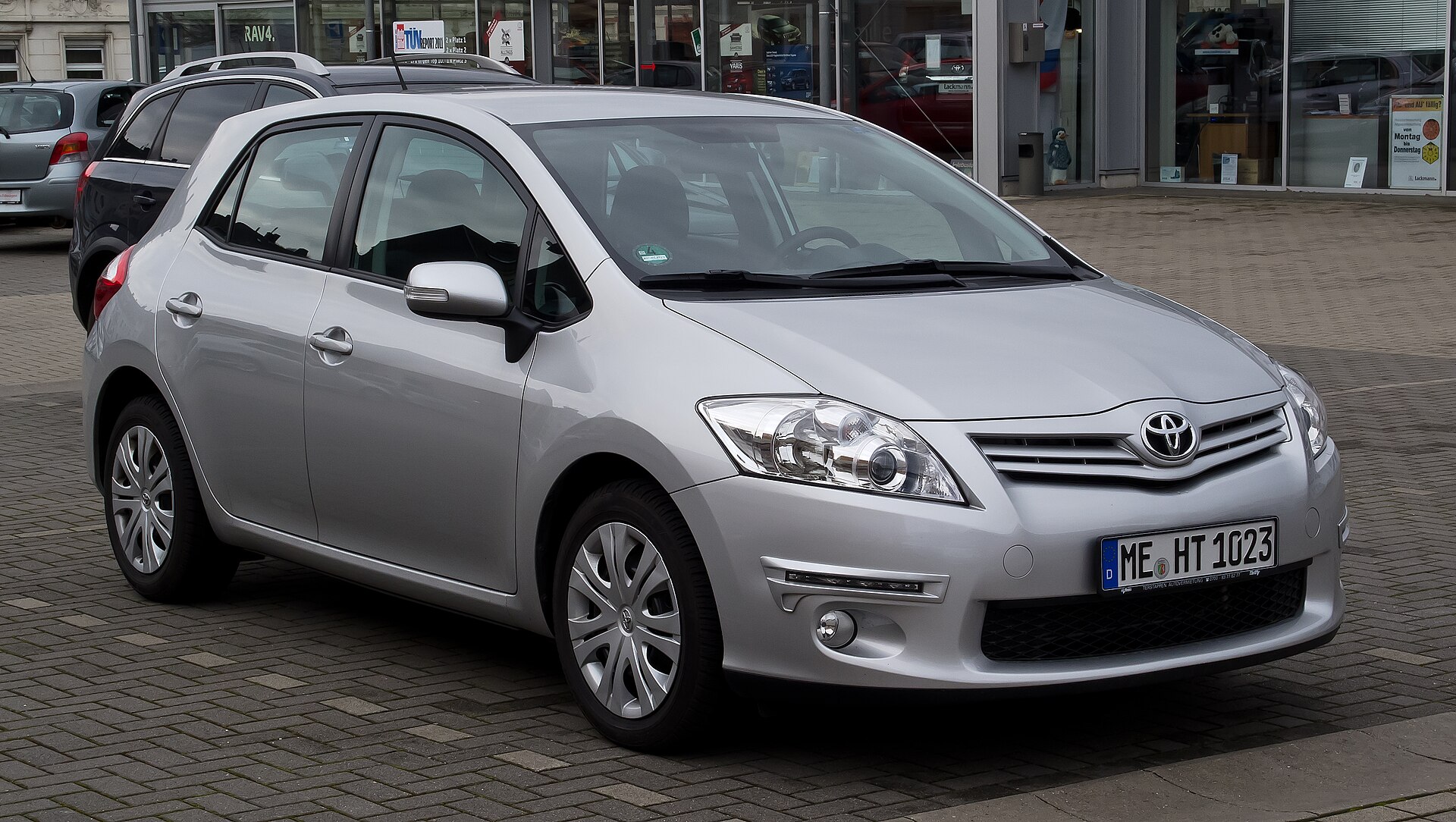
- Auris I E150 2006–2012 · Hatchback · 66–130 kW (90–177 PS)
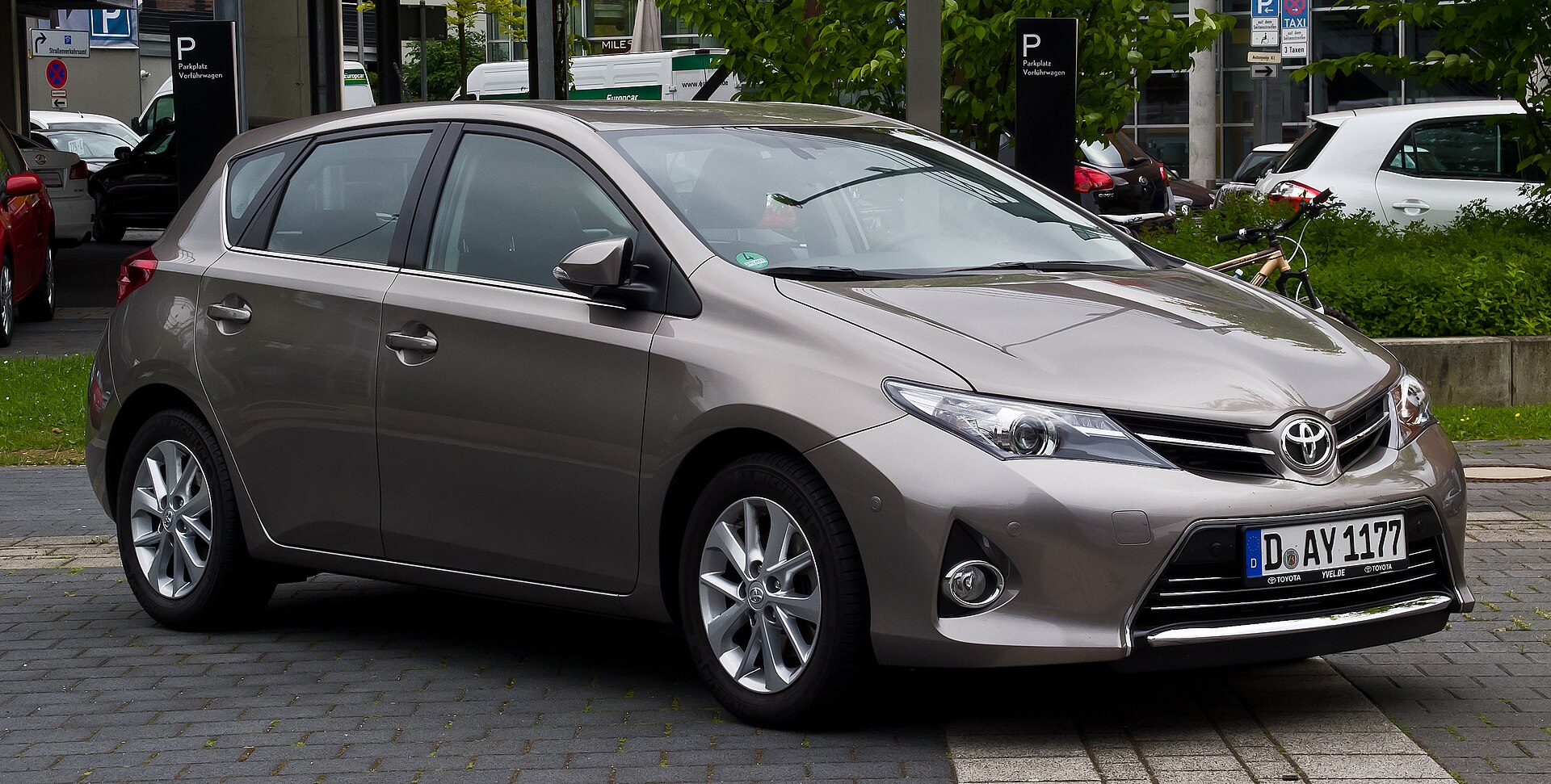
- Auris II E180 2012–2019 · Hatchback, Station wagon · 66–100 kW (90–136 PS)
Newest first · 2 generations since 2006
-
2012
-
2006
All generations by year: Auris II E180 (2012–2019) · Auris I E150 (2006–2012)
Which one is mine?
Pick the year of first registration to see which generation it is.
Check by VINWhich Auris to buy
Our verdict · Felix Hartmann
- For low running costs: an E180 1.8 Hybrid, rated at 3.5 l/100 km (NEDC), ideally as a Touring Sports if you need space.
- For a cheap first car: an E150 1.33 or 1.6 petrol with a manual gearbox.
- For more torque without a diesel: the facelifted E180 with the 1.2 T and 185 Nm.
- For high mileage: the E150 2.0 D-4D or the E180 1.6 D-4D.
The Toyota Auris is the compact hatchback that took over from the Corolla hatchback in Europe and was sold from 2007 to 2019 in two generations, E150 and E180. It was built in Japan, Turkey and at Toyota's Burnaston plant in the UK, which built the Auris Hybrid from 2010. In 2019 Toyota brought back the Corolla name for its successor, so the Auris is now a used-car buy.
In short
- Two European generations: E150 (2006-2012, three- and five-door) and E180 (2012-2018/19, five-door and Touring Sports estate).
- Engines from 66 kW (90 PS) to 130 kW (177 PS); the 1.8 Hybrid has a system output of 100 kW (136 PS).
- Five Euro NCAP stars for the E150 (2006) and for the E180 (2013).
- The E180 Hybrid was rated at 3.5 l/100 km and 79 g/km CO2 on the NEDC cycle.
Size at a glance
| Dimensions | Toyota Auris II E180 |
|---|---|
| Length | 4,330 mm170.5 in |
| Width | 1,760 mm69.3 in |
| Height | 1,475 mm58.1 in |
| Wheelbase | 2,600 mm102.4 in |
| Boot | 360 L12.7 cu ft |
Running cost
Fuel · Auris E180 1.8 Hybrid
about 900 EUR fuel a year at 15,000 km
3.5 l/100 km · petrol at 1.75 EUR/l · change mileage, fuel price or version
Specs by version
Engines
| Version | Engine | Power | Torque | Gearbox | Drive | Production years |
|---|---|---|---|---|---|---|
| Hybrid · 1 version | ||||||
| E180 · 1.8 Hybrid | 1.8 l · 4 cyl · Hybrid 1,798 cc | 100 kW 136 PS134 hp | - | CVT | Front-wheel drive | 2015–2019 |
| Petrol · 2 versions | ||||||
| E180 · 1.33 Dual VVT-i | Petrol | 73 kW 99 PS98 hp | - | - | Front-wheel drive | 2013–2018 |
| E180 · 1.2 T | 1.2 l · 4 cyl · Petrol 1,196 cc | 85 kW 116 PS114 hp | 185 Nm136 lb-ft | - | Front-wheel drive | 2015–2019 |
Performance
Show all 1 versions
| Version | 0–100 km/h | Top speed | Fuel consumption | CO₂ |
|---|---|---|---|---|
| E180 · 2012–2019 | ||||
| E180 · 1.8 Hybrid | 10.9 s 0–62 mph | 180 km/h112 mph | 3.5 l/100 km67.2 mpg US · 80.7 mpg UK | 79 g/km |
Dimensions and weight
Show all 1 versions
| Version | Length | Width | Height | Wheelbase | Kerb weight | Boot | Fuel tank |
|---|---|---|---|---|---|---|---|
| E180 · 2012–2019 | |||||||
| E180 · 1.8 Hybrid | 4,330 mm170.5 in | 1,760 mm69.3 in | 1,475 mm58.1 in | 2,600 mm102.4 in | 1,385 kg3,053 lb | 360 l12.7 cu ft | 45 l11.9 gal US |
Verified Manufacturer and type-approval data from our catalog · Sources and methodology
Toyota Auris at a glance
| Item | Toyota Auris |
|---|---|
| Segment | C-segment compact car |
| Body | 3- and 5-door hatchback (E150); 5-door hatchback and Touring Sports estate (E180) |
| Layout | front engine, front-wheel drive in Europe (4WD in Japan) |
| Built | Japan (Takaoka; Kanto Auto Works to 2011), Adapazari (Turkey), Burnaston (UK) |
| Other names | Corolla hatchback (Australasia), Scion iM and Corolla iM (North America, 2015-2018) |
| Predecessor / successor | Corolla E120 hatchback / Corolla E210 |
More Toyota models are in our Toyota catalogue.
Generations
| Generation | Code | Years | Body styles | Engines | Power (kW / PS) |
|---|---|---|---|---|---|
| Auris I | E150 | 2006-2012 | 3-door, 5-door hatchback | 1.33, 1.4, 1.6, 1.8 Hybrid, 1.4 D-4D, 2.0 D-4D, 2.2 D-CAT | 66-130 kW (90-177 PS) |
| Auris II | E180 | 2012-2018 | 5-door hatchback, Touring Sports estate | 1.2 T, 1.33, 1.6, 1.8 Hybrid, 1.4 D-4D, 1.6 D-4D, 2.0 D-4D | 66-100 kW (90-136 PS) |
E150 (2006-2012)
The first Auris went on sale in Japan on 23 October 2006 and in Europe in early 2007; UK sales began on 1 February 2007. It shared its platform with the E150 Corolla saloon, and Japan also had a sister model, the Toyota Blade, with 2.4-litre and 3.5-litre V6 engines. A facelift reached Germany in March 2010.
The Auris Hybrid followed in 2010. Production started at Burnaston in May 2010, the car went on sale in the UK on 1 July 2010 and in Germany in September 2010. It used the powertrain and batteries of the Prius. Europe took 15,237 Auris Hybrids in 2010 and 32,725 in 2011.
E180 (2012-2018)
The second Auris was revealed on 20 August 2012 and reached Europe in early 2013 as a five-door only. A new Touring Sports estate, 285 mm longer than the hatchback, was the first estate in its segment offered with a full hybrid. The E180 was built at Takaoka in Japan and at Burnaston. A facelift arrived in 2015, bringing a 1.2-litre turbo petrol engine; the hatchback grew from 4,275 to 4,330 mm in length. ADAC lists the last German versions until March 2019.
In North America the E180 hatchback was sold as the Scion iM from 2015 and as the Toyota Corolla iM for 2017 and 2018. In Taiwan, the Auris name lived on with the next generation from 2018 until 15 July 2020, when it became the Corolla Sport.


Engines, transmissions and performance
German engine line-ups, according to ADAC:
| Engine | Generation | Fuel | Power |
|---|---|---|---|
| 1.4 VVT-i | E150 (2007-2009) | petrol | 71 kW (97 PS) |
| 1.33 Dual VVT-i | E150 (2009-2012), E180 | petrol | 73-74 kW (99-101 PS) |
| 1.6 Dual VVT-i | E150 (2007-2009) | petrol | 91 kW (124 PS) |
| 1.6 Valvematic | E150 (2009-2012), E180 (2013-2015) | petrol | 97 kW (132 PS) |
| 1.2 T | E180 (2015-2019) | petrol | 85 kW (116 PS) |
| 1.8 Hybrid | E150 (2010-2012), E180 | petrol hybrid | 100 kW (136 PS) |
| 1.4 D-4D | E150, E180 (to 2017) | diesel | 66 kW (90 PS) |
| 1.6 D-4D | E180 (2015-2018) | diesel | 82 kW (112 PS) |
| 2.0 D-4D | E150 / E180 (2013-2015) | diesel | 93 kW (126 PS) / 91 kW (124 PS) |
| 2.2 D-CAT | E150 | diesel | 130 kW (177 PS) |
The 1.6 of the E150 had 157 Nm, a five-speed manual and reached 100 km/h in 10.4 seconds, with a top speed of 190 km/h. The 1.2 T of the facelifted E180 delivers 185 Nm and could be ordered with a manual gearbox or the Multidrive S CVT. Some petrol and diesel versions of the E150 were also sold with the MMT automated manual.
In the E180 Hybrid, a 73 kW (99 PS) 1.8-litre petrol engine with 142 Nm works with a 60 kW (82 PS) electric motor with 207 Nm. The system output is 100 kW (136 PS), the gearbox is a CVT and the nickel-metal hydride battery holds 1.3 kWh. Toyota quotes 10.9 seconds to 100 km/h, 180 km/h and up to 45 km/h on electric power alone. Use our power converter for kW, PS and hp.
Dimensions, space and boot
| Parameter | E150 1.6 (2007) | E180 Hybrid (2015) |
|---|---|---|
| Length | 4,220 mm (166.1 in) | 4,330 mm (170.5 in) |
| Width without mirrors | 1,760 mm (69.3 in) | 1,760 mm (69.3 in) |
| Height | 1,515 mm (59.6 in) | 1,475 mm (58.1 in) |
| Wheelbase | 2,600 mm (102.4 in) | 2,600 mm (102.4 in) |
| Kerb weight (EU) | 1,305 kg (2,877 lb) | 1,385 kg (3,053 lb) |
| Boot, seats up / folded | 354 / 1,335 l | 360 / 1,200 l |
| Fuel tank | 55 l | 45 l |
The second generation is lower and longer on the same 2,600 mm wheelbase. The Touring Sports estate measured 4,560 mm before and 4,595 mm after the 2015 facelift.
Fuel economy and running costs
The E180 1.8 Hybrid was rated at 3.5 l/100 km and 79 g/km CO2 on the NEDC cycle. The E150 1.6 petrol was rated at 7.1 l/100 km and 166 g/km. All are NEDC figures, so real-world consumption is higher. Our fuel cost calculator puts them into euros per year.
Trims and prices
European E150 trims included Luna, Sol, Life and Executive, and German E180 versions used names such as Cool, Design Edition and Executive. ADAC list prices for the cheapest versions:
| Version | Period | List price in Germany (EUR) |
|---|---|---|
| E150 1.4 | 2007-2009 | 15,700 (2007) |
| E150 1.8 Hybrid Life | 2010-2013 | 23,300 (2010) |
| E180 1.33 | 2013-2015 | 15,990 (2013) |
| E180 1.33 (facelift) | 2015-2018 | 16,490 (2015) |
| E180 1.8 Hybrid Cool (facelift) | 2015-2019 | 23,790 (2015) |
Safety
Euro NCAP tested the first Auris in December 2006: it scored five stars for adult occupants with 35 points and four stars for child protection. The E180 was tested in February 2013 and received five stars. Our safety section explains how these older tests compare with today's protocol.
Reliability and known issues
We have not found model-specific fault statistics for the Auris in the sources used for this article, so we do not list typical faults here. For a used Hybrid, ask for the service history and a health check of the hybrid battery.
Rivals
| Model | Engines | Power (kW / PS) | Boot (l) | Price from (EUR) |
|---|---|---|---|---|
| Toyota Auris (E180, facelift) | 1.2 T, 1.33, 1.8 Hybrid, 1.4 and 1.6 D-4D | 66-100 kW (90-136 PS) | 360 | 16,490 (Germany, 2015) |
| Volkswagen Golf VII | 1.0-1.4 TSI, 1.6-2.0 TDI | 63-110 kW (85-150 PS) | 380 | 17,175 (Germany, 2012) |
| Ford Focus III (facelift) | 1.0-1.6 petrol, 1.5-2.0 TDCi | 63-134 kW (85-182 PS) | 363 | 16,450 (Germany, 2014) |
Of the three, only the Auris offered a full hybrid among the engines listed here. The comparison tool sets them side by side.
Photo gallery


Toyota Auris: first vs latest generation
| Spec | Auris I E150 | Auris II E180 | Change |
|---|---|---|---|
| Years | 2006–2012 | 2012–2019 | 6 years apart |
| Most powerful version | 130 kW (177 PS) | 100 kW (136 PS) | −30 kW (−23%) |
Oldest and newest generation in the 1cars catalog. Power is the strongest version of each; other rows are shown only when both generations have the figure.
Toyota Auris in our rankings
- No. 5 of 54 · Most economical hatchbacks (3.5 l/100 km)
- No. 6 of 297 · Most economical cars (3.5 l/100 km)
- No. 323 of 1082 · Longest-running car nameplates (13 years · top 31%)
- No. 164 of 531 · Smallest cars (4,330 mm · top 31%)
- No. 34 of 93 · Longest hatchbacks (4,330 mm · top 37%)
- No. 56 of 141 · Most powerful hatchbacks (130 kW · top 40%)
More economical than 97% of ranked cars in the 1CARS catalog (No. 6 of 297).
FAQ
How many generations of the Toyota Auris are there?
Two in Europe: E150 (2006-2012) and E180 (2012-2018). The next generation was sold as the Corolla in Europe from 2019 and as the Auris only in Taiwan until 2020.
Where was the Toyota Auris built?
In Japan, in Adapazari in Turkey and at Burnaston in the UK. The Auris Hybrid for Europe was built at Burnaston from May 2010.
What replaced the Toyota Auris?
The Corolla E210 hatchback and Touring Sports, launched in Europe in January 2019 under the Corolla name.
Is the Auris Hybrid the same as a Prius?
It used the same powertrain and batteries as the Prius of its time, with a system output of 100 kW (136 PS).
How big is the Auris boot?
354 litres in the E150 1.6 and 360 litres in the E180 Hybrid hatchback, rising to 1,200-1,335 litres with the rear seats folded.
Data sources
Data checked by an editor against the sources below.
- Wikipedia - Toyota Auris
- ADAC - E18 Facelift
- ADAC