Toyota Land Cruiser 300: the J300 Generation
The Toyota Land Cruiser 300 (J300) is the latest generation of Toyota's full-size, body-on-frame four-wheel-drive flagship, a line that began production in 1951 and passed 10 million sales in August 2019. The new model premiered on 9 June 2021. It keeps a ladder frame but is far more modern than its predecessor, the Land Cruiser 200, and it replaced the famous V8 engines with new twin-turbo V6 units.
Key takeaways
- World premiere on 9 June 2021; first sales in the Middle East from 20 June 2021 and in Japan from 2 August 2021.
- Built on the new GA-F ladder-frame platform, about 200 kg lighter than its predecessor.
- Main engines: a 3.4 twin-turbo V6 petrol with 305 kW (415 PS) and 650 Nm and a 3.3 twin-turbo V6 diesel with 227 kW (308 PS) and 700 Nm, both with a ten-speed automatic.
- Approach and departure angles are 32° and up to 26.5°, and ground clearance is 230 mm.
Land Cruiser 300 at a glance
The Land Cruiser 300 belongs to Toyota's family of full-size four-wheel-drive, body-on-frame off-roaders that head the brand's SUV range. Because the Land Cruiser has a loyal following around the world, Toyota took great care not to alienate its fans. It was revealed online in June 2021 and went on sale in the Gulf states, Japan, South Africa and Australia in the following months. A sporty-looking GR Sport version was available for the first time, and a petrol hybrid joined the range later. More models are in our Toyota catalogue.
Exterior
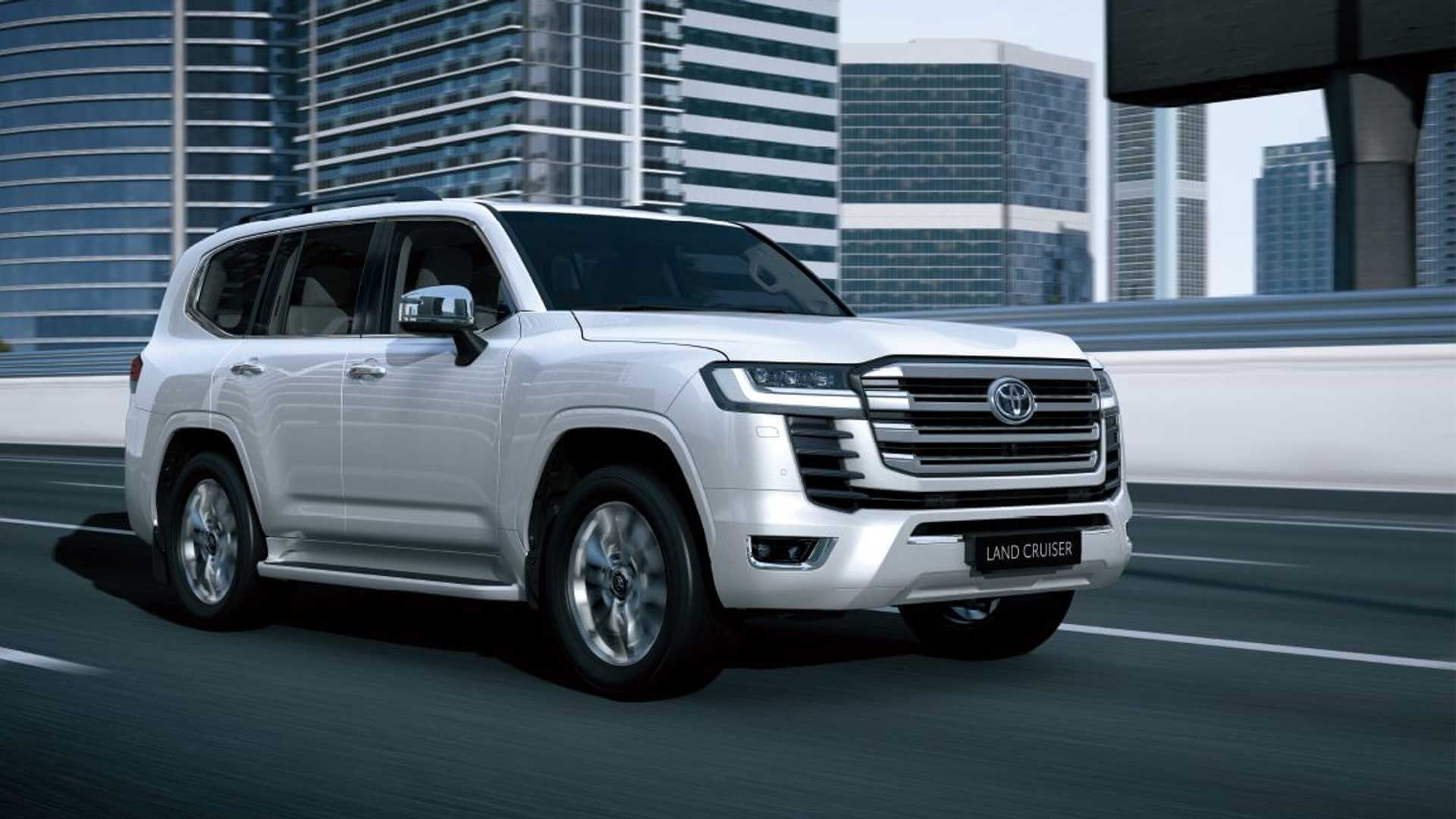
Before the official premiere, many spy photos of camouflaged test cars appeared, but the launch finally revealed the details. The overall shape and proportions were kept, so the new car looks very similar to the Land Cruiser 200, especially from the front and side, although many details were reworked. At the front it looks like a formidable road conqueror. Instead of chrome, Toyota used silver-painted plastic elements as well as black trim, with a new grille and new headlights.
Every version has LED headlights. Basic cars use reflector units - unusual, since even the previous model had projectors as standard - while higher trims get adaptive matrix LED headlights. L-shaped LED daytime running lights double as indicators. The intakes below the headlights differ by version and engine. The bonnet has a central recess and sharp lines running back to the windscreen pillars, with the Toyota badge in the centre of the grille.
The side view is recognisable, but several details were revised. The mirrors moved from the corner of the windscreen pillar onto the door panel; they have LED indicators, power folding, electric adjustment and memory. The wheel arches are larger, with crisply cut trims. The running boards are fixed rather than retractable, and two-tone paint is not offered. Minimum ground clearance remains 230 mm, limited by the rear differential. Wheels are 17, 18 or 20 inches, and the hubs now have six studs instead of five, so wheels from the previous model do not fit.
At the rear, the split tailgate was replaced by a single, power-operated tailgate. The tail lights are brighter and more expressive, though similar in shape, and a small spoiler carries an LED third brake light. The bumper has two horizontal LED fog lights, chrome trim and a removable cover for the tow hitch, and the reversing camera now has a washer. The roof can be solid or have an electric sunroof or panoramic roof, and roof rails and a shark-fin antenna are standard.
The GR Sport stands out with black trim on the grille, bumpers and wheel arches. Beyond its looks, it is 5 mm shorter, uses additional structural adhesive for extra rigidity and offers front and rear differential locks in addition to the centre lock.
Interior and practicality
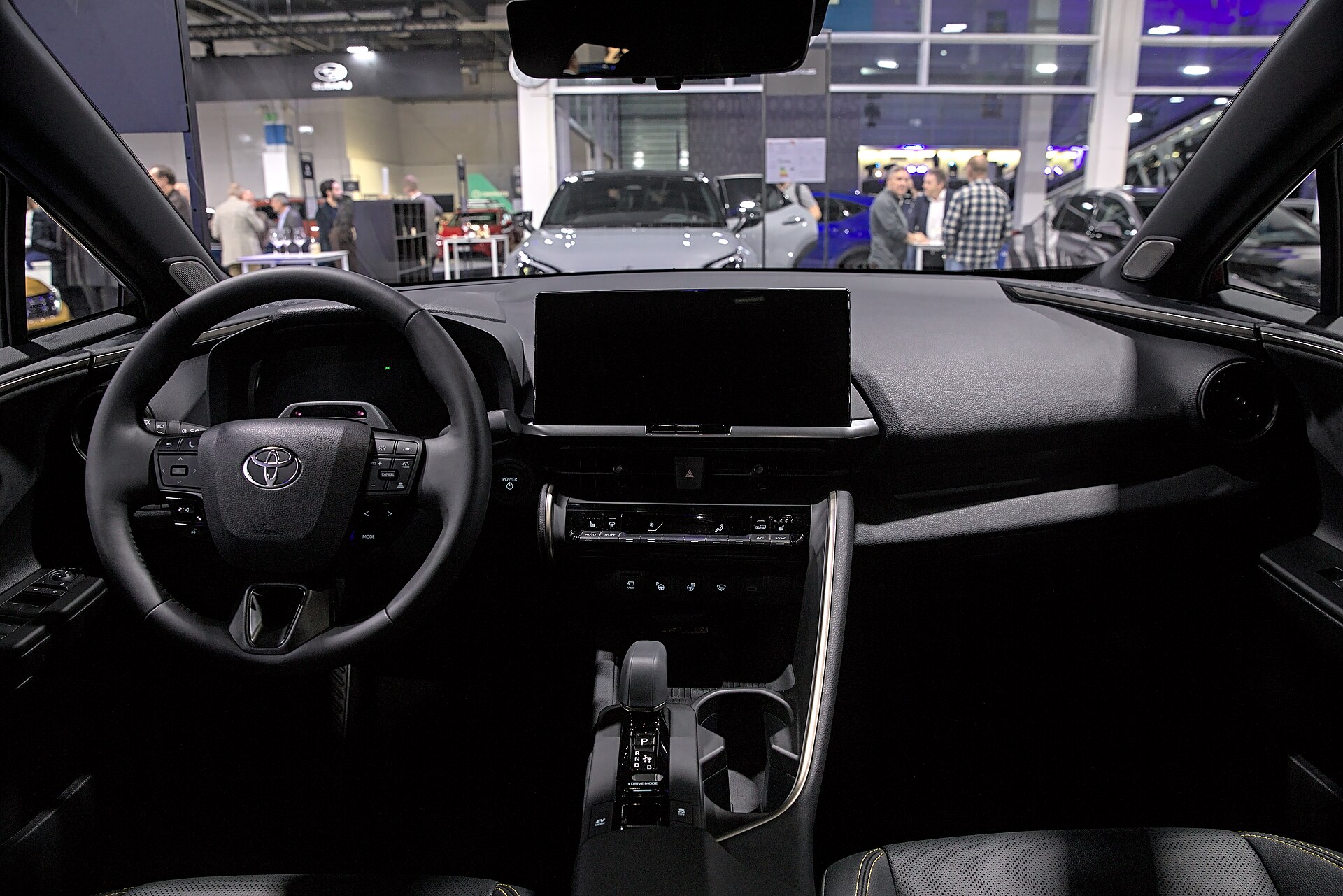
The cabin changed much more. The new dashboard is topped by a freestanding 7- or 10-inch infotainment screen, or a 12.3-inch screen on higher trims, with plenty of physical buttons and switches for quick access to key functions. All screens support wired Apple CarPlay and Android Auto, and there are at least four USB ports for the first two rows. The instruments are not fully digital: higher trims have two analogue dials with a 7-inch colour display between them, while base versions have a smaller screen. A head-up display with sharp graphics is available, as is a 14-speaker JBL audio system.
The start button sits to the left of the infotainment screen and can include a fingerprint scanner. The car stores four driver profiles for the steering wheel, seats and mirrors, and the steering column adjusts over a wide range. Because the dimensions are similar to the predecessor's, interior space is not much greater, and the large centre tunnel takes a little space from the front passenger. A rotary controller selects the off-road modes, including a new Auto mode for low range, with a separate Crawl Control button, a drive-mode switch and an electronic parking brake with hold function. Leather, real wood and polished aluminium are used throughout.
The Land Cruiser 300 is available with five or seven seats. In seven-seat cars the third-row seats fold into the floor instead of hanging on the boot sides. Rear passengers can have two entertainment screens, reclining and ventilated seats and their own climate controls, though the tunnel limits comfort for a third adult in the middle. The boot is slightly narrower but keeps its length and loading height, and the power tailgate can be opened with a foot movement.
Engines and transmission
| Engine | Power (kW / PS) | Torque | Gearbox | 0–100 km/h |
|---|---|---|---|---|
| 3.4 V35A-FTS twin-turbo V6 petrol | 305 kW / 415 PS | 650 Nm | 10-speed automatic | 6.7 s |
| 3.3 F33A-FTV twin-turbo V6 diesel | 227 kW / 308 PS | 700 Nm | 10-speed automatic | about 7 s |
| 4.0 1GR-FE V6 petrol (some markets) | 201 kW / 273 PS | - | 6-speed automatic | - |
| 3.4 V6 petrol hybrid (from mid-2020s) | 341 kW / 464 PS | - | 10-speed automatic | - |
The petrol V6, also used in the Lexus LS 500, has an aluminium block and head and a timing chain. With the ten-speed automatic it reaches 100 km/h in 6.7 seconds, compared with at least 8.6 seconds for the old naturally aspirated V8 with a six-speed automatic. Multi-Terrain Select offers the familiar Sand, Mud and Rock modes plus a new Deep Snow mode, and Multi-Terrain Monitor helps the driver see obstacles around the car.
Chassis
The Land Cruiser 300 uses the GA-F platform from the TNGA family, with a ladder frame whose cross-members are larger and joined using modern welding. Laser-welded tailor blanks make the frame lighter and stronger, increasing torsional stiffness by 20%. The body structure uses mainly high-strength steel, while the outer panels such as the bonnet, roof and doors are aluminium. Together with the frame changes, this cut about 200 kg, although extra insulation and equipment mean the total weight did not fall as much. Corrosion protection was also improved.
Depending on the version, there are up to three locking differentials, and a new generation of the Electronic Kinetic Dynamic Suspension System (E-KDSS) uses electronically controlled hydraulic cylinders instead of conventional anti-roll-bar links. The suspension, with double wishbones at the front and a rigid rear axle, is softer than before, with revised rear damper angles; adaptive variable suspension is available on more expensive versions. Steering combines hydraulic assistance with an additional electric motor. Brakes have 340 mm discs at the front and 345 mm at the rear with a new electro-hydraulic booster.
Safety and equipment
Even base versions have numerous airbags, including curtain airbags and a centre airbag, and the list of systems includes a surround-view camera with washers, adaptive and optional matrix headlights, collision avoidance, adaptive cruise control, wireless charging, automatic parking, driver-fatigue monitoring, a head-up display, Wi-Fi and the Toyota Safety Sense package. Depending on the market, standard equipment includes climate control, a touchscreen infotainment system, leather, electrically adjustable, ventilated front seats with memory, a reversing camera, parking sensors, heated seats, steering wheel and mirrors, keyless entry and start, alloy wheels, ten airbags, stability control, hill-start and descent assistance, fog lights, cruise control and four-wheel drive with low range and a centre differential lock.
Strengths and weaknesses
The Land Cruiser 300 keeps the ladder frame, outstanding off-road ability and permanent four-wheel drive that buyers expect, while the new turbo V6 engines are more powerful and quicker than the old V8s. Equipment, safety and cabin quality are much improved, and ground clearance remains high. On the downside, interior space barely grew, the tunnel limits room in the middle, and some will miss the V8. Rivals include the Range Rover, Nissan Patrol, Infiniti QX80, Cadillac Escalade, Volkswagen Touareg and Mercedes-Benz GLE.
FAQ
When did the Toyota Land Cruiser 300 come out?
It premiered on 9 June 2021, with first sales later that month.
What engines does the Land Cruiser 300 have?
Mainly a 3.4 twin-turbo V6 petrol with 305 kW (415 PS) and a 3.3 twin-turbo V6 diesel with 227 kW (308 PS), both with a ten-speed automatic; a 4.0 V6 and a hybrid are offered in some markets.
Does the Land Cruiser 300 still have a ladder frame?
Yes. It uses the new GA-F ladder-frame platform, which is lighter and 20% stiffer than before.
How many seats does the Land Cruiser 300 have?
Five or seven; the third-row seats fold into the floor.
What is the GR Sport version?
A sportier version with black trim, extra body adhesive for rigidity and front and rear locking differentials.